Oklahoma Trailheads With Trailer Parking
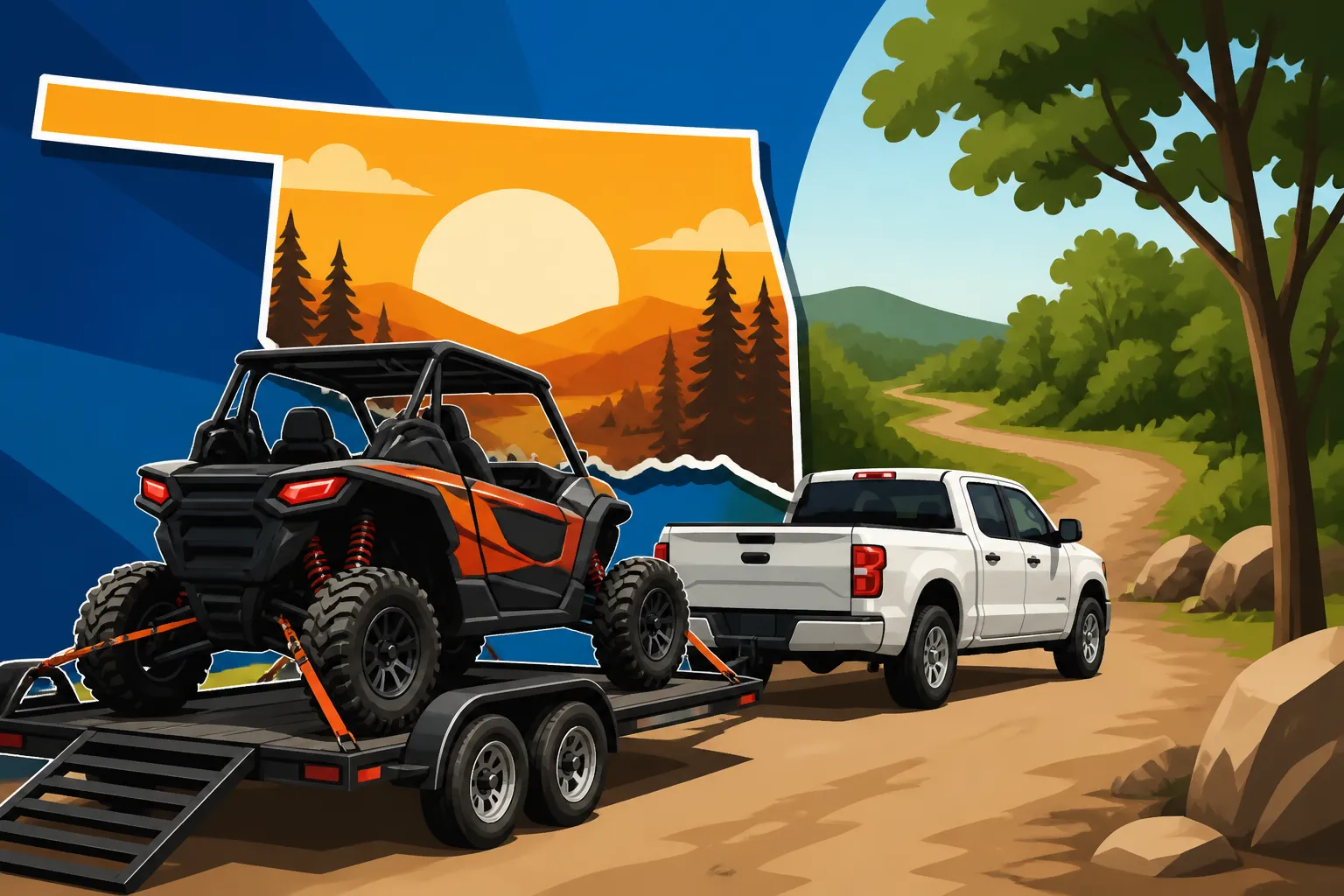
Finding an Oklahoma trailhead that can handle a truck, trailer, and off-road machine is harder than finding a trail on a map. A small pull-off may work for a pickup but leave nowhere to unload safely. This guide explains how to assess trailer parking, which riding areas to investigate, and what to confirm before towing.
How to find Oklahoma trailheads with trailer parking
A trailhead pin on a map does not guarantee space to park a tow vehicle and trailer. The location may be a narrow roadside entrance, an informal staging area, or a gate with room for only a few vehicles. Before you set out, check whether the destination has designated parking, whether trailers are allowed, and whether the access road is suitable for your rig.
Start with the riding area, not just the map pin
Search for the riding area’s official visitor information first, then look for details about parking, camping, vehicle access, and check-in. A general map app can help you find the entrance, but it may not tell you whether the lot has a turnaround, whether it fills early, or whether a long trailer can maneuver through it.
For example, a pin near Little Sahara State Park may get you to the right general area, but you still need to distinguish the riding entrance from a campground, office, or other facility. The same issue comes up at larger destinations: a mapped access point might be a trail entrance rather than a trailer staging area. When using a navigation app or onX Offroad to review an approach, treat the route as a planning aid—not proof that the final parking area can fit your trailer.
Look for clear wording such as “OHV parking,” “trailer parking,” “staging area,” or “camping with vehicle parking.” If the listing only says “parking available,” ask what kind. Regular car spaces may not be long enough for a truck and trailer, and a shared lot may not have room for unloading.
Confirm the practical details before you tow
When you contact a park office or land manager, ask questions that match your setup rather than simply asking whether parking is available. Share the approximate length of your truck and trailer, whether you need room to turn around, and how many machines you plan to unload. A short utility trailer and a long enclosed trailer can have very different space needs.
It also helps to ask whether parking is inside the riding area, near the trail entrance, or at a separate campground. Find out whether there are designated unloading zones, whether you can leave the trailer parked for the day, and whether overnight parking is permitted. Those details matter if you are arriving early, camping nearby, or meeting riders in separate vehicles.
If the area uses a check-in process, ask where to stop first. You do not want to discover that you need to register at one building and then tow to another lot through a crowded entrance. For a broader look at places to ride, see Oklahoma ATV Trails: Where to Ride and Oklahoma Trailheads With Trailer Parking.
Riding areas to investigate for trailer access
Oklahoma has several established off-road destinations, but parking arrangements can differ by location and can change with events, weather, maintenance, or seasonal access. Think of the places below as good starting points for checking trailer logistics—not as a promise that every lot will suit every rig.
| Riding area | General location | Trailer-planning considerations |
|---|---|---|
| Little Sahara State Park | Near Waynoka in northwestern Oklahoma | Confirm where to park and unload, and whether your intended campground or entrance is appropriate for a trailer |
| Cross Bar Ranch | Near Davis in south-central Oklahoma | Ask about current staging, check-in, overnight parking, and any event-day arrangements |
| Robbers Cave State Park OHV area | Near Wilburton in southeastern Oklahoma | Verify the correct riding-area entrance and where tow vehicles and trailers should be left |
| Ouachita National Forest access points | Southeastern Oklahoma | Check the motor vehicle use map and confirm that the specific access point is legal and suitable for your vehicle |
Little Sahara State Park near Waynoka
Little Sahara is a well-known destination for sand riding, and its established park facilities make it a natural place to begin researching trailer access. Still, do not assume that every parking area is intended for unloading machines or that a campground space and a day-use parking spot serve the same purpose. Check the park’s current instructions for the place you plan to use, and ask whether trailers can stay in the parking area while you ride.
Sand riding adds a few practical considerations. Your group may need a place to unload safely, secure loose gear, and organize machines before entering the riding area. If you are taking a larger rig, ask about traffic flow and turning room instead of relying on a satellite view alone. For planning the riding environment itself, Little Sahara State Park in Oklahoma and Oklahoma Dune Riding Explained provide related background.
Before leaving, make sure everyone understands where the trailer will remain and how you will get back to it. A parking spot that seems convenient on arrival can become difficult to find after a long riding day, especially if your group spreads out or several vehicles look similar.
Cross Bar Ranch and Robbers Cave
Cross Bar Ranch near Davis and the OHV area at Robbers Cave near Wilburton are both destinations worth checking when you want a designated riding area rather than an improvised roadside launch. Their access procedures and parking arrangements are not interchangeable, though. Check directly with the destination for the right entrance, where trailers should be staged, and whether a busy weekend or organized event changes the normal routine.
At either location, ask whether unloading is allowed in the parking area or whether there is a separate staging space. If your trailer is long, ask about turning space and whether the access road has tight corners or a steep approach. For a group ride, it is useful to confirm whether the entire group can park together or whether vehicles may need to use separate areas.
Robbers Cave has specific operating conditions for its riding area, so plan your arrival and riding schedule around the park’s posted information. The article Robbers Cave OHV Area in Oklahoma can help you prepare for the destination, while Cross Bar Ranch in Oklahoma is a useful companion when comparing a private riding area with a state park setting.
Ouachita National Forest access points
The Ouachita National Forest is not one single trailhead with a single parking arrangement. Access depends on the specific road, trail, and land-management rules for the area you intend to visit. A forest road entrance that appears to be a convenient launch point may not be a designated place to park a truck and trailer, and a route open to one type of vehicle may not be open to another.
Use the applicable motor vehicle use map to understand which roads are open to motorized travel, then confirm where parking is permitted. A mapping app such as onX Offroad can help you compare potential approaches and identify nearby roads, but it cannot replace land-manager guidance about legal parking or current closures. Check Oklahoma Ouachita National Forest Access and [Reading the Ouachita Motor Vehicle Use Map] before choosing a forest access point.
Do not block a gate, road, turnout, or access needed by other visitors or emergency vehicles. If there is no clearly suitable place to leave your truck and trailer, choose another access point rather than creating a parking spot on the shoulder.
How to judge whether a trailhead can handle your rig
Even when a destination allows trailers, the actual setup can make the difference between an easy arrival and a stressful one. The useful question is not simply “Is there parking?” It is “Can my vehicle and trailer get in, unload, wait, and leave without creating a hazard or blocking anyone?”
Check space, turning room, and road approach
Estimate the combined length of your tow vehicle and trailer, then consider how much space you need to turn. A straight parking stall may be long enough on paper but difficult to enter if vehicles are parked tightly on both sides. A loop or broad gravel lot may be easier to maneuver in, but only if it is designated for visitors and trailers.
Review the approach road for narrow shoulders, sharp turns, low branches, steep grades, and soft surfaces. A route that works for a car may be uncomfortable with a loaded trailer. Recent rain can also change conditions: packed dirt may become slick, while loose sand can make a slow uphill pull more demanding. Check Oklahoma Trail Conditions Before You Tow and Oklahoma Trail Closures After Rain when weather could affect your route.
If you are unsure, call with a specific question: “Can a truck and a trailer about this long enter, turn around, and park without backing into the road?” That is more useful than asking whether the location has a parking lot. If the answer is uncertain, ask whether there is a safer nearby staging option approved by the land manager.
Plan unloading and group staging
Arriving with several machines creates a small traffic problem of its own. Riders may be unloading ramps, tightening straps, checking tire pressure, putting on helmets, and sorting gear at the same time. If the parking area is narrow, that activity can block other visitors or leave machines exposed to passing traffic.
Before the trip, agree on a simple unloading order. One person can guide the tow vehicle while another watches the trailer’s clearance. Keep ramps and tie-downs organized, and move machines out of the travel lane as soon as they are unloaded. Do not unload on a public road or in a space that appears intended for emergency access.
For a larger group, set a meeting point that does not require every vehicle to cluster around the trailer. Your group can gather after the machines are unloaded, leaving space for arriving visitors. For more planning help, see [Staging a Ten-Machine Group Before a Dune Day] and Oklahoma Group Ride Planning.
Distinguish day parking from camping and overnight parking
A destination may have camping, day-use parking, or both, but those options may be managed differently. A campsite may be the right choice if you want to keep your trailer close overnight. A day-use lot may not permit overnight parking, and a trailhead area may need to be cleared after riding hours.
Ask whether the trailer can stay attached to the tow vehicle, whether it can be left unattended, and whether you need a separate camping reservation or check-in. If your plan includes arriving the night before, do not assume that a day-use area is open for overnight staging. Confirm quiet hours and any rules for generators, campfires, and pets if you are staying at a campground.
Keep your setup tidy even when the area allows overnight parking. Secure loose equipment, avoid spreading gear into neighboring spaces, and follow posted rules for waste and camp use. The goal is to leave room for other riders and avoid a last-minute scramble when it is time to depart.
A practical pre-trip checklist for trailer parking
A little preparation can prevent the most common problems: arriving at the wrong entrance, finding only car-sized spaces, or discovering that trailers cannot stay where you planned to unload. Build parking into the trip plan just as carefully as you plan fuel, machines, and riding time.
Call or check the destination’s official information
Before departure, confirm the exact entrance and parking instructions with the park, land manager, or riding area. Ask whether the intended area accepts trailers, whether parking is first-come, and whether reservations or permits affect where you can stage. If your visit falls on a holiday or event weekend, ask whether parking is likely to be redirected or restricted.
Keep a note of the person or office you spoke with and the instructions they gave you. This is especially helpful when a group has multiple tow vehicles and not everyone is arriving together. Send the group the correct entrance and parking directions in advance, rather than asking each driver to follow a generic map pin.
Prepare the trailer and machines for unloading
Check that the trailer lights, tires, hitch, safety chains, and tie-downs are ready before you reach the access road. Bring the equipment you need to unload safely, and make sure the ramp fits the trailer and machine. At a sandy or uneven lot, a small block or other suitable support can help keep a ramp stable, but only use equipment appropriate for your setup.
Take a quick photo of the parked truck and trailer, including nearby landmarks, if you are entering a large or busy area. This is a simple way to help your group find the correct vehicle later. Save the destination’s phone number and offline route details as well; cell service can be unreliable in some rural and forest areas.
Leave room for other visitors and emergency access
Park only where the destination permits. Do not use a gate opening, fire lane, road shoulder, or private driveway as overflow parking unless the land manager explicitly directs you there. If the designated area is full, contact staff or follow their instructions instead of improvising a space that could block access.
After unloading, check that the trailer is secure and that nothing is sticking into the driving lane. Keep ramps and gear out of shared paths, and be ready to move if staff need to reorganize the area. For route-specific preparation, Oklahoma Trail Etiquette Locals Expect and [Oklahoma Trailhead Parking and Trailer Access] can help round out your plan.
A reliable trailer-friendly outing starts with one simple habit: confirm the parking arrangement for the exact entrance you plan to use. Treat map pins and app routes as helpful tools, verify the details with the destination, and choose an access point that gives your truck, trailer, and riding group enough room to arrive and leave safely.
Disclaimer
This article is for general informational purposes only and does not constitute professional advice. Laws, prices and regulations vary by location and change over time. Consult a qualified professional for guidance on your specific situation.