Oklahoma Trail Etiquette Locals Expect
Oklahoma riding areas can change from loose sand at Little Sahara to rocky, wooded trails in the Ouachita foothills, and the etiquette that keeps a ride enjoyable travels with you. If you’re new to a trail system—or just don’t want to be the rider everyone remembers for the wrong reasons—this guide covers how to share trails, protect land, manage noise and dust, and prepare before unloading your ATV or UTV.
Learn the rules before you unload
Check access, vehicle limits, and local requirements
A trail that appears on a map isn’t automatically open to every kind of machine. Some routes are intended for motorcycles, while others may allow ATVs or side-by-sides. Public-land access can also depend on the managing agency, season, permit requirements, and designated routes. At private riding areas, the owner or operator sets additional rules, which may include age limits, speed limits, waivers, or restrictions on passengers.
Confirm the rules for the specific place you plan to ride before hitching up. For example, Little Sahara State Park is known for open dune riding, while a wooded route near Robbers Cave may have a very different layout and operating hours. Cross Bar Ranch has its own park rules, too. Don’t assume that rules from one property apply at another, or that a route shown in an app is open today. Check the official park or land manager information, then review [Oklahoma Trail Conditions Before You Tow] before making the drive.
This is also where a navigation app such as onX Offroad can help you plan a route and understand the surrounding land. Treat any map as a planning aid, not permission to ride: confirm access with the land manager, posted signs, or the park office. An enticing line on a screen doesn’t outweigh a closed gate or a marked boundary.
Respect signs, gates, and property lines
Stay on designated trails and roads. Cutting around a muddy patch, riding through grass to pass a group, or following a faint track beyond a boundary can damage land and create conflicts with owners and managers. In Oklahoma, a route may cross or border private property, timber land, wildlife areas, or other managed ground. When you aren’t certain where you may ride, stop and check rather than guessing.
Never treat an open gate as an invitation to enter. A gate may be open for ranch work, maintenance, or other authorized traffic. If a route requires passing through a gate and the instructions say to close it, leave it as you found it. That small act matters when livestock are nearby. For a broader look at access and permission, read [Oklahoma Landowner Permission Rules] and [Oklahoma Timber Land Access Rules].
| Situation | Better trail etiquette |
|---|---|
| You reach a closed or posted gate | Stop and turn around unless the land manager clearly says otherwise |
| A trail is muddy or blocked | Use the marked route or wait; don’t create a new bypass |
| You’re unsure whether a track is open | Check with the park or land manager before riding it |
| You pass through an authorized gate | Follow posted instructions and secure it as directed |
| A route crosses private land | Stay on the approved route and respect property boundaries |
Share the trail without creating a hazard
Slow down, give space, and pass carefully
Speed that feels comfortable on an open stretch can be unsafe around a blind corner, a trailhead, a campsite, or a group of riders. Slow down where visibility is limited and where people, animals, parked vehicles, or narrow trail features may be ahead. Dust can make it harder to judge distance, especially on dry roads and open terrain. If you can’t see clearly through the dust, ease off and leave more space instead of riding into it.
When you come up behind another machine, don’t tailgate or pressure the rider to move over. Give them time to find a safe place to let you pass. Use a clear, calm signal if you need to communicate, and pass only when there’s enough room and visibility to do so safely. Don’t squeeze between a machine and the edge of a trail or try to pass on a blind rise. If you’re riding in a group, keep a sensible gap so each rider can react to an unexpected stop.
On a narrow trail, riders should communicate early and avoid sudden maneuvers. If you meet someone coming the other way, slow down and work out who has the safer place to yield. Don’t assume the other person can back up easily—particularly if they’re on a steep, loose, or rocky section.
Keep noise and dust under control
A loud exhaust can turn a peaceful riding area into a source of complaints. Keep your machine properly maintained, avoid unnecessary revving, and ride considerately near homes, campgrounds, trailheads, and other visitors. A quick burst of throttle may seem harmless from the driver’s seat, but it carries farther than you might expect, especially in quiet wooded areas or early in the morning.
Dust is part of riding in dry conditions, but you can reduce the impact on others. Leave more distance from the machine ahead, slow down near campsites and staging areas, and avoid spinning the tires when a steady pace will do. If people are walking or setting up camp nearby, give them room and let the dust settle before continuing. For more context on how trail conditions affect a day out, see [Why Oklahoma Red Clay Turns Slick After Rain] and [Oklahoma Trail Riding After Heavy Rain].
A map app can be useful for finding a suitable route that avoids unnecessary backtracking through a busy area. onX Offroad may help you review route options before the group sets out, but keep the screen secondary to your surroundings. Etiquette means staying alert to other people, not focusing on a device while moving.
Protect the land and the people who use it
Leave the route as you found it
Riding off-trail can widen tracks, damage vegetation, disturb wildlife, and make erosion worse. It can also encourage other riders to follow the same shortcut until a small mistake becomes a lasting scar. If you encounter a rut, a wet spot, or an obstacle, don’t automatically create a new path around it. Follow local directions, wait for a safe opportunity, or turn back if the trail isn’t suitable for your machine or experience.
Pack out everything you bring in, including food wrappers, drink containers, broken straps, and parts that fall off a machine. Don’t leave trash at a trailhead or beside a campground because bins appear full; take it with you and dispose of it properly. Avoid disturbing plants, wildlife, livestock, fences, and signs. A considerate rider leaves the area looking much as it did before the group arrived.
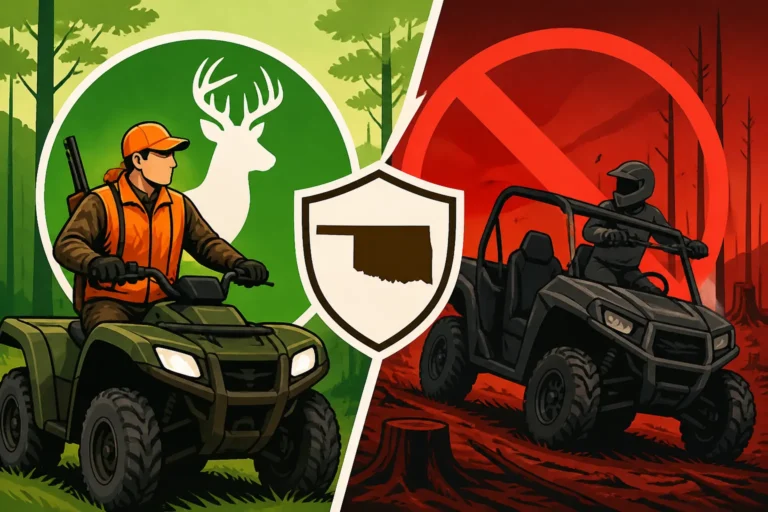
These habits matter on managed timber land and wildlife areas as well as at private parks. Access can be conditional, seasonal, or limited to designated roads. Check location-specific rules before riding, especially if your trip involves land with hunting access or other seasonal uses. The guides to [Oklahoma WMA Riding Only in Deer Season] and [Oklahoma Timber Land Riding Rules for Riders] explain why timing and route restrictions deserve attention.
Be thoughtful around pedestrians, families, and campgrounds
A busy trailhead is a shared space, not a place to test acceleration. Move slowly through parking and camping areas, watch for children who may dart between vehicles, and keep enough room around trailers and parked machines. If you’re helping a young rider, stay close and make sure they understand basic signals, stopping distances, and when to yield before joining a crowded route. Families looking for more age-specific guidance can review [Oklahoma Trails for Kids].
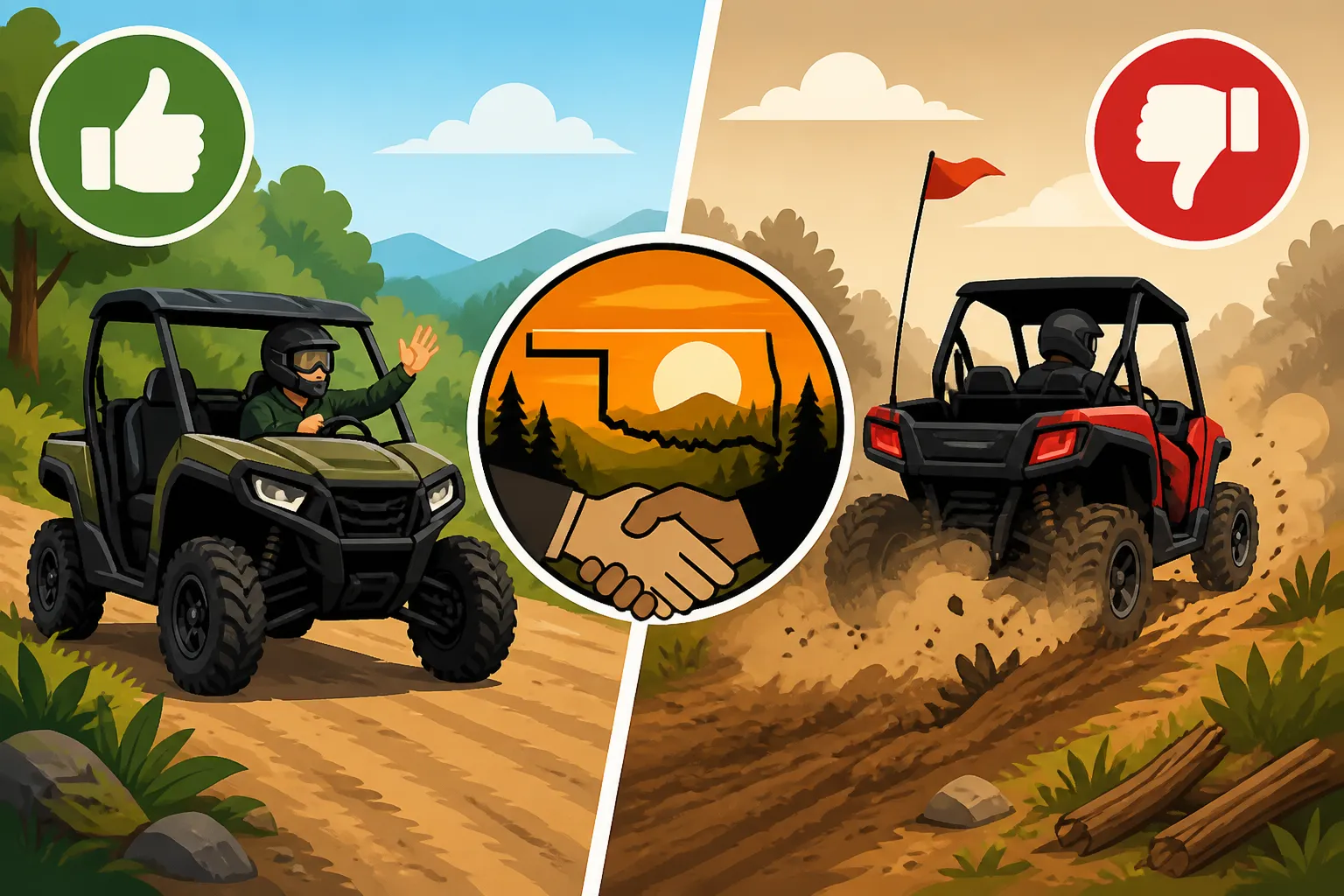
At a campground, respect quiet hours and keep machines on approved roads. Don’t use a campsite as a shortcut or ride close to someone’s tent simply because the route seems convenient. If a dog, child, or pedestrian is near the trail, stop or slow down enough to give them a wide, predictable path. A friendly wave is welcome; a sudden burst of throttle is not.
If you’re riding near other groups, avoid crowding their staging area or assuming their planned route is yours to join. A quick conversation can prevent confusion: ask where they’re headed, whether a trail is open to your machine, and whether they’re waiting for someone. Courtesy is especially helpful at narrow trail junctions where several groups may be trying to sort out directions at once.
Make courtesy part of your ride plan
Set expectations before the group starts
A group ride is easier when everyone knows the plan. Before leaving the staging area, agree on the route, regrouping points, hand signals, and what to do if someone falls behind or has a mechanical problem. Make sure each rider understands which trails are suitable for their machine and skill level. A confident rider on a sport quad may be comfortable with a route that feels intimidating to a newer rider or a family in a side-by-side.
Keep the group manageable and avoid blocking a junction while everyone discusses directions. Pull into a safe, designated spot to regroup, then move on once the trail is clear. If the group includes riders with different experience levels, let the least experienced person set the pace on difficult sections. It’s better to arrive together than to rush someone into a mistake.
Before the trip, you can use onX Offroad or another reliable mapping tool to review the general route and identify possible turns or access points. Download or carry useful information before losing cell service, and bring a backup plan. A phone map can help with orientation, but it won’t replace posted directions, local rules, or good judgment when conditions change.
Know when to turn around
Turning around is not poor riding; it’s good decision-making. A trail may be too muddy, too steep, too crowded, or simply beyond what your machine and group can handle that day. Rain can change the feel of Oklahoma clay quickly, while loose sand can tire out a rider who hasn’t ridden dunes before. If your tires are losing traction, visibility is poor, or a route is creating more risk than enjoyment, stop and reassess.
Make sure your machine is appropriate for the riding area, and don’t pressure another rider to attempt an obstacle they’re uncomfortable with. Keep an eye on fuel, water, weather, daylight, and the group’s physical condition. In hot weather, fatigue can build quietly; in remote areas, a minor breakdown may become a bigger problem if the group is unprepared. A little caution at the start can prevent a long, stressful walk back.
A good etiquette check is simple: are you leaving room for others, staying where you’re allowed, and helping keep the area enjoyable for the next person? If the answer is yes, you’re doing your part. For help choosing an area that fits your group, machine, and riding style, start with [Oklahoma ATV Trails: Where to Ride] and confirm the rules for your destination before you go.
Disclaimer
This article is for general informational purposes only and does not constitute professional advice. Laws, prices and regulations vary by location and change over time. Consult a qualified professional for guidance on your specific situation.