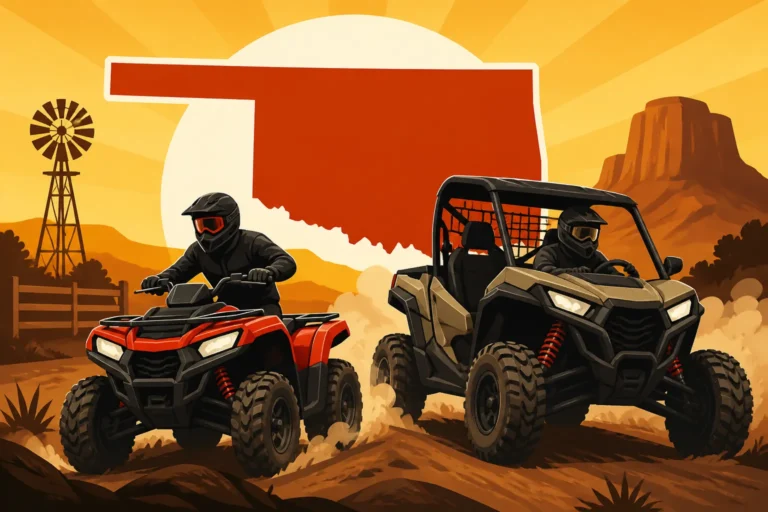
Riding Only From October to January
Timber-company riding areas in southeastern Oklahoma can look open on a map, then turn out to be closed when you arrive outside their seasonal access window. This guide explains when riding is generally allowed, which permits and hunting credentials may be needed, where machines can travel, and how to check access before towing to Honobia Creek or Three Rivers.
What the October-to-January riding window means
Seasonal access applies to specific timber lands
The October-to-January window is associated with certain privately owned timber lands in southeastern Oklahoma that are open to public access under specific conditions. It is not a statewide riding season, and it does not mean every Oklahoma trail closes in February or opens in October. State parks, private off-road parks, and other public riding areas may follow entirely different schedules.
Honobia Creek and Three Rivers are well-known examples of areas connected with timber-land access. The opportunity to ride there depends on the land-access rules, the dates in effect, and the conditions attached to the access program. Start with the specific location you plan to visit, then confirm its current rules before making the drive. For broader context, read [Oklahoma Timber Land Access Rules] and [Oklahoma Hunting Season and Trail Access].
A seasonal opening also should not be treated as a guarantee that every road is passable or open. A gate may be closed, a route may be temporarily restricted, or access may be affected by weather, logging, fire conditions, or hunting activity. A map showing a road or track does not necessarily establish that you have permission to ride it.
The window is commonly described as October through mid-January
The riding period is often described as running from October into January, with access ending around January 15. That mid-January cutoff matters: “January” does not necessarily mean you can ride until the last day of the month. The exact dates and restrictions can depend on the land-access program and the property’s posted rules.
Plan around the stated closing date rather than trying to squeeze in one more ride at the end of the season. If you are traveling from Tulsa, Oklahoma City, or farther away, check the access details close to your departure. A long drive, an overnight stay, and a loaded trailer make it especially frustrating to discover that the season has ended or a route has closed.
For a useful overview of the seasonal timing, see [October to January: The Timber Land Riding Window]. For the reason the cutoff matters, [Why Machines Come Off Timber Land After January 15] explains why riding access should not be assumed to continue after the published window.
| Access question | What to plan for |
|---|---|
| When can riding be allowed? | Generally during the October-to-January seasonal window for qualifying timber lands |
| Does January mean the whole month? | No. The season may end around January 15 |
| Does the window apply everywhere in Oklahoma? | No. It applies to particular timber-land access areas, not every trail or park |
| Is a visible road automatically open? | No. Confirm permission, seasonal status, and any posted restrictions |
| What should you check before leaving? | The area’s current access rules, permits, hunting requirements, closures, and route conditions |
Seasonal riding is not the same as ordinary trail access
It is easy to assume that a riding area works like a conventional off-road park: pay at the gate, unload, and follow the marked routes. Timber-land access can be more conditional. The permitted season, hunting requirements, speed limits, designated routes, and land-access permit rules may all apply at once.
That distinction affects how you prepare. A route that appears on a recreational mapping app may cross property where access is limited, or it may be unsuitable for your machine. Use maps to help plan, not as proof that a road is open. If you use onX Offroad, check its layers and route information as one planning tool, then compare what you see with the access program’s rules and signs on the ground.
Permits, hunting credentials, and other requirements
Check whether you need a land-access permit
Depending on the area and your eligibility, you may need an Oklahoma land-access permit to use timber-company land. Requirements can vary by residency and age, so do not assume that a permit you bought for another type of riding area covers this access. Review [Oklahoma Permits for Honobia Creek] or [Oklahoma Permits for Three Rivers] for location-specific context, and confirm the rules for the exact area you plan to enter.
A permit is only one piece of the puzzle. It does not automatically override seasonal closures, posted restrictions, or hunting-related requirements. Think of it as permission under the access program, not a blanket invitation to ride any road, trail, or parcel in the region.
Before your trip, make sure you know how the permit must be carried or shown. If digital proof is accepted, save it somewhere you can open without a strong cell signal. [Showing a Land Access Permit on Your Phone] covers practical preparation for keeping proof available in the field.
A deer-hunting credential may also be required
Timber-land riding access can be tied to deer hunting. In some access programs, riders must hold the required hunting license or otherwise meet the program’s hunter eligibility rules, even if their main reason for visiting is riding. Do not assume that having an ATV, a land-access permit, or a valid driver’s license meets this requirement.
This is a detail worth checking before you pack. A rider who arrives with a machine and the right land-access permit but lacks a required hunting credential may still be ineligible to ride. The requirements can also vary by person, season, and property, so verify them for each rider in your group—not only the person towing the trailer.
For a focused explanation, see [Riding Timber Land Requires a Deer License Too]. If hunting-season access is part of your plans, read [Oklahoma Hunting Season and Trail Access] as well. When in doubt, contact the program or managing office before you leave rather than trying to resolve eligibility at a remote entrance.
Verify rules for every person and machine in your group
A group ride can get complicated quickly if one person assumes everyone is covered by the same permit or hunting status. Make a simple checklist for each rider: permit eligibility, any required license, age-related rules, proof of ownership, and any other credentials the access program requires. If a friend is joining at the last minute, check their situation separately.
Also confirm rules for your particular machine. A side-by-side and a quad may be treated similarly for some access requirements but differ in practical ways, such as which roads they can safely use or whether a narrow route is suitable. Check the machine’s dimensions and turning space against your planned route, especially if the group includes wide UTVs or trailers.
Where you can ride and how to prepare
Stay on authorized routes
Seasonal access does not mean unrestricted cross-country riding. Timber-land rules may limit machines to designated roads or specific routes. Follow signs and barriers, and do not create a new trail because a path looks convenient. A road that appears unused may still be active for timber operations, hunting access, or property management.
This is particularly important on land shared with other users. Trucks, work vehicles, hunters, and other riders may be using the same network. Stay alert at blind corners, avoid blocking gates, and give larger vehicles room. [Designated Roads Only on Timber Land] and [25 mph on Timber Company Roads] are useful reminders that route and speed restrictions are part of the access conditions, not optional trail etiquette.
If you are planning with onX Offroad, use it to review the general route and identify possible access points, but do not rely on an app alone to decide where you can ride. Confirm the boundaries and restrictions with the land-access rules, then obey the signs posted at the location. If the digital map and a gate or sign disagree, treat the on-the-ground restriction seriously and seek clarification before proceeding.
Understand off-road limits and hunting-related restrictions
Some timber-land rules allow limited off-road travel for a specific hunting purpose, such as retrieving a downed animal, while prohibiting general off-road riding. That is not the same as permission to roam away from a designated road for recreation. If you are not carrying out an activity expressly allowed by the rules, keep your machine on authorized routes.
The distinction can be confusing when a rider sees tire tracks leading into the woods. Those tracks do not prove that the route is open or that the previous rider was complying with the rules. Do not follow them simply because they seem established. For details about the narrow hunting-related allowance, review [Half a Mile Off Road for a Deer] and confirm how it applies to your situation.
Before the ride, make sure everyone in the group understands the difference between a designated road, a permitted access route, and an unauthorized trail. A quick conversation at the truck can prevent a costly or unsafe misunderstanding once the group is spread out.
Plan for terrain, weather, and limited connectivity
Southeastern Oklahoma’s timber country can be rough on a machine and on a travel plan. Rain can change a route from manageable to slick, while ruts, loose soil, and debris can make a narrow road difficult for a larger side-by-side. A route that looked easy on a dry afternoon may be a different ride after overnight rain.
Check conditions before towing and use a map that helps you understand the area, but bring a backup plan. Download or save useful information before leaving reliable service, carry a charged phone and a power bank, and let someone know where you intend to ride. onX Offroad can help with offline planning when you prepare in advance, but it cannot replace posted access rules or local closure information.
Pack for a self-sufficient ride: water, basic tools, recovery gear suited to your machine, a first-aid kit, and warm or rain-ready layers. Give yourself enough daylight to return without rushing. If conditions have worsened, turning back is often the sensible call—even if you have already made the trip.
A practical checklist before you tow
Confirm the dates and access status
Start by checking the specific area rather than searching only for “Oklahoma ATV season.” Confirm that the timber-land access window is open for your intended ride date and find the actual closing date. If the season ends around January 15, do not plan a late-January visit without clear confirmation that access continues.
Next, check for temporary restrictions, closures, or local instructions. A seasonal opening is not a promise that every entrance or route will be available. Review [Oklahoma Trail Conditions Before You Tow] as part of your trip planning, and use the managing office or official access information to resolve uncertainty.
Check every rider’s credentials and carry proof
Before departure, confirm that every rider has the permit and any hunting credential required for that area. Keep proof accessible, and do not assume that a permit held by one person covers the whole group. If you are uncertain about an age or residency exemption, check the specific rule rather than relying on what happened during a previous trip.
Then check the basic machine paperwork and equipment. Make sure the machine is in sound condition, the trailer is secure, and riders have appropriate protective gear. These steps do not replace access requirements, but they help avoid a second preventable problem after you reach the riding area.
Use this final decision check
Before unloading, ask these questions:
- Is this specific property open for riding on today’s date?
- Do all riders meet the permit and hunting-related requirements?
- Are we entering through an authorized access point?
- Do we know which roads or routes are allowed?
- Have we checked signs, gates, and temporary restrictions?
- Do we have a plan for weather, limited service, and getting back before dark?
If any answer is unclear, pause and verify it. That may mean changing the route, choosing another riding area, or postponing the trip. It is far less aggravating than driving a trailer across the state only to find out that the access window has closed or one key requirement was missed.
Disclaimer
This article is for general informational purposes only and does not constitute professional advice. Laws, prices and regulations vary by location and change over time. Consult a qualified professional for guidance on your specific situation.