Oklahoma Insurance Proof at a Gate
An insurance question at an Oklahoma riding-area gate can be confusing: a land-access permit, a registration decal, and an insurance card are different things. Whether you need to show proof of coverage depends on where you’re riding and that property’s entry rules. Here’s how to check before you tow, what documents to bring, and what to do if the gate asks for proof.
Insurance proof is not the same as a riding permit
There is no single insurance document that works as a general pass to every Oklahoma trail, park, or private riding area. Insurance, registration, permits, and admission rules serve different purposes. A gate may ask for one, several, or none of them, depending on the land and the way it is managed.
A land-access permit, when required, gives eligible riders access under the applicable land rules. It is not proof that you have liability insurance. Likewise, an ATV registration decal identifies a registered machine; it does not demonstrate that an insurance policy is active. Start by checking which permits apply to your destination. Oklahoma Land Access Permits Explained covers that separate requirement.
Insurance proof usually means evidence of an active policy, such as an insurer-issued card or an official digital document. A waiver, registration receipt, or permit confirmation is not a substitute. If staff ask to see insurance, show the policy evidence they request and make sure it identifies the machine or coverage in a way they can understand.
| Document | What it generally shows | What it does not prove by itself |
|---|---|---|
| Insurance card or insurer document | That an insurance policy is in force, subject to its terms | That the machine has the permits required for a particular area |
| Registration decal or receipt | That the machine has been registered under the applicable process | That it is insured or allowed on every road or trail |
| Land-access permit | That the rider has obtained a required access permit, where applicable | That the machine has insurance |
| Park admission receipt or wristband | That the rider has paid or checked in as required | That the rider has met every equipment, permit, or insurance rule |
| Signed waiver | That the participant has accepted the document’s stated terms | That the machine is insured |
The practical takeaway is to treat each requirement as its own checklist item. If a gate asks for insurance proof, having the right permit or registration paperwork does not automatically answer that request.
Rules depend on the place you are entering
The first useful question is not simply, “Does Oklahoma require ATV insurance?” It is, “What does this particular riding area require for entry, and what rules apply to the riding I plan to do there?” Public land, state-managed riding areas, and private parks can set different conditions.
Public land and permit-managed areas
On public or permit-managed land, access rules may focus on a land-access permit, allowed riding areas, seasonal restrictions, and machine-use rules. Those requirements are separate from insurance. Do not assume that carrying an insurance card replaces a permit, or that a permit means insurance will never be requested.
For a trip involving a Wildlife Management Area or timber land, check the applicable access rules before departure. Requirements can differ by property and may include limits on where and when you can ride. Oklahoma WMA Access for a Quad and Oklahoma Timber Land Access Rules are useful starting points for understanding that access conditions can be specific to the land.
State parks and managed riding areas
A managed riding area may have its own entry process, safety rules, and posted conditions. Staff may ask riders to check in, show a permit, sign a waiver, or follow machine-specific requirements. Whether they require insurance proof is a separate question to confirm with the park or office.
Read the facility’s current instructions before loading up. If the website or posted information is unclear, contact the office and ask directly whether every rider or only the machine owner must show proof, and whether an electronic insurance document is accepted. Do not rely on another rider’s experience at a different park as confirmation.
Private parks, ranches, and organized events
Private property owners can set conditions for using their land. A private park, ranch, or event organizer may require an insurance document as part of admission, a waiver process, or event participation. The requirement may apply to the person operating the machine, the machine itself, or both. Confirm the wording before you arrive rather than guessing from the word “insurance.”
Ask whether coverage must be in the rider’s name, whether a policy covering a family or household is acceptable, and whether the document must identify the specific ATV or UTV. If you are attending an organized ride, check the event’s instructions as well as the property’s normal rules. [Oklahoma Private Ranch Waivers] explains why waiver and admission policies should be treated as property-specific.
A gate’s insurance request is also not the same as a general rule about road use. An off-road riding area can have entry conditions that differ from the requirements for using a machine on public streets. If your UTV is registered for street use, keep its road-related documents separate from the information needed for trail access. Oklahoma Insurance at Street Registration addresses that different situation.
What to carry and how to show it
A little preparation can keep a gate check from turning into a search through the truck, trailer, and phone. Before leaving, make a small document set for each machine and confirm that it matches the destination’s requirements.
- Check with the riding area. Ask whether insurance proof is required, what form it must take, and whether the rule applies to every machine or rider. Also ask about permits, check-in steps, and any event-specific conditions.
- Confirm the policy is active. Check the effective dates and verify that the document belongs to the policy you intend to use. If you recently changed coverage, renewals or changes may not appear on an old card.
- Match the document to the machine. If the park asks for proof tied to a particular ATV or UTV, check that the vehicle details are legible and correspond to the machine you are bringing. Contact the insurer if the document seems incomplete or the machine has recently changed owners.
- Bring a usable copy. Carry a paper version if you can, and save an official digital copy on your phone. A phone screenshot may be convenient, but it can be hard to read or may not show the full document. Ask the gate in advance what formats it accepts.
- Keep other paperwork separate. Store insurance evidence apart from registration, access permits, receipts, and waivers so you can present the right item when asked. For a broader pre-trip check, see Oklahoma Proof of Ownership on the Trail.
- Protect the documents. A simple waterproof sleeve or document holder can help keep paper readable around dust, rain, and fuel. If you need one, compare basic options at a retailer such as Amazon, but the holder does not change what the park accepts.
When showing digital proof, open the document before reaching the gate if reception may be unreliable. Save it for offline access where possible, keep your phone charged, and make sure brightness is high enough for staff to read the screen. If the machine is insured under another household member’s policy, bring the policy evidence and be ready to explain the relationship; confirm beforehand that the facility accepts that arrangement.
An insurance card typically provides a quick summary, not every term in a policy. It may not answer questions about exclusions, riders, passengers, racing, or use on a particular kind of property. If a gate asks whether the policy covers a specific activity, do not guess based on the card alone. Ask the insurer to explain the coverage and, if needed, provide written confirmation.
If you arrive and the gate asks for proof
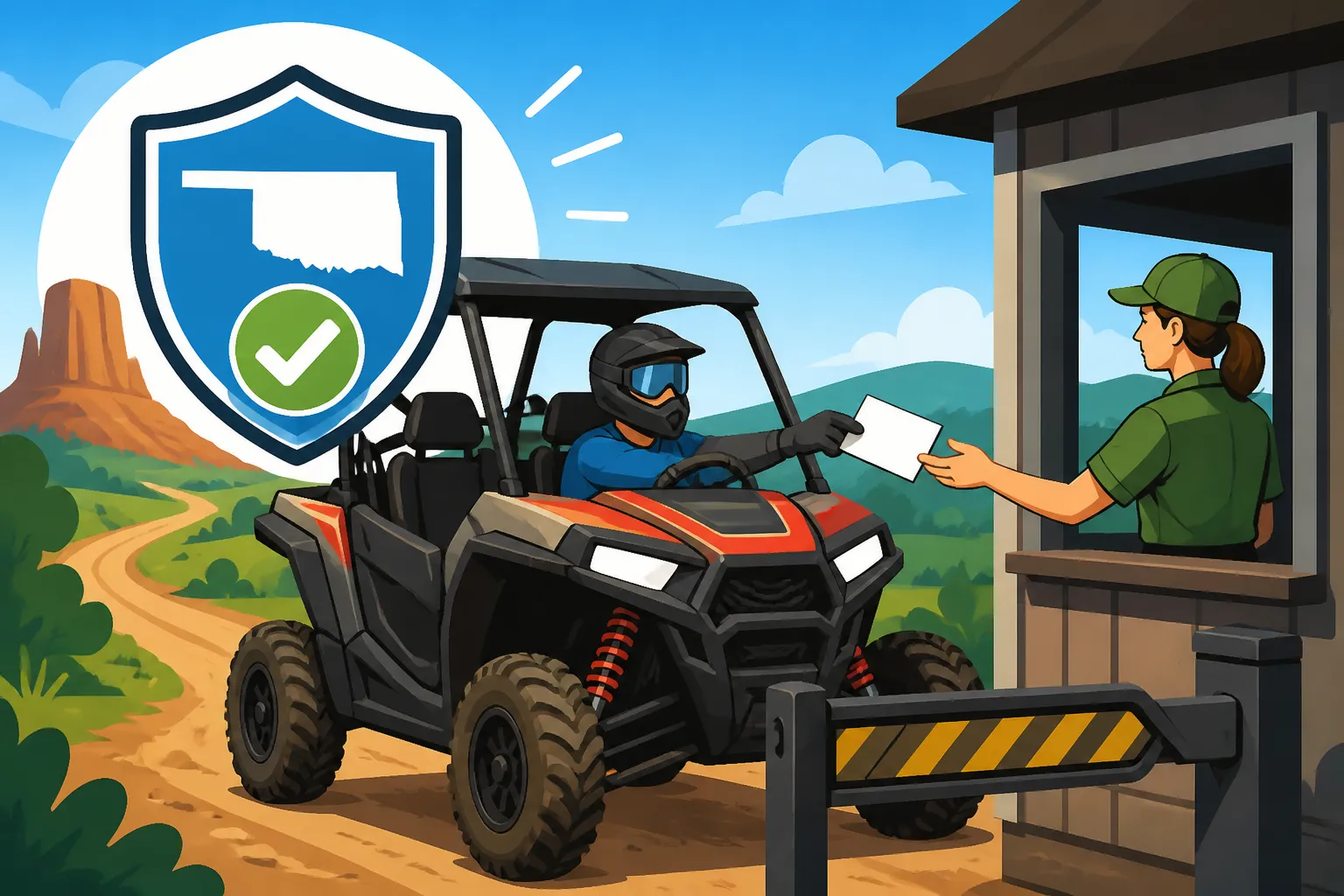
If the gate asks for insurance proof and you do not have it ready, stay calm and clarify exactly what staff need. Ask whether they will accept a digital insurer document, whether the requirement applies to your machine or to each rider, and whether you can retrieve the information without holding up the line. Do not assume that a registration receipt or permit will satisfy an insurance requirement.
If you cannot provide an accepted document, the facility may refuse entry under its rules. A waiver or promise to buy coverage later is not necessarily an alternative. The sensible choice is to follow the gate’s decision, contact the office if there is a genuine misunderstanding, and avoid riding until you know what is required.
If you believe you have coverage but cannot find the paperwork, contact your insurer or agent using a number you trust and request an official document. Avoid relying on a third-party message or an unfamiliar link for policy information. Once you get the proof, check that it is current and readable before presenting it.
If you are unsure whether a machine needs insurance at all, separate the questions. First, check the legal requirements for the way you intend to use it. Then check the destination’s admission rules. A machine used only off-road may face different requirements from one used on public roads, and a private property owner may set conditions beyond the baseline rules. Does Oklahoma Ask for Insurance at Registration? can help with the registration question; it does not replace checking the gate’s current policy.
Before the next trip, save the riding area’s contact information and keep a short checklist with the machine: insurance evidence if required, access permit if required, registration paperwork where applicable, and any admission confirmation. For visitors bringing a machine from another state, check both the destination’s access rules and the rules for out-of-state machines. Oklahoma Rules for an Out-of-State Machine can help identify that separate issue.
Disclaimer
This article is for general informational purposes only and does not constitute professional advice. Laws, prices and regulations vary by location and change over time. Consult a qualified professional for guidance on your specific situation.