Oklahoma WMA Access for a Quad
An Oklahoma Wildlife Management Area can look like an open place to ride, but public access does not automatically mean quad access. Rules can vary by area, road, season, and purpose. The key is to confirm that riding is allowed where and when you plan to go, then check whether you need a permit or hunting-related credentials before unloading.
WMA Access Does Not Automatically Include Quad Riding
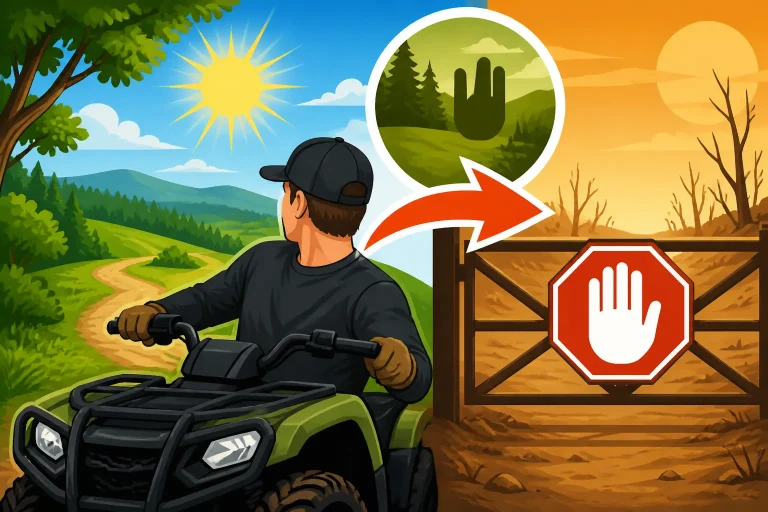
A Wildlife Management Area is managed for wildlife and public use, not necessarily as an off-highway vehicle park. An area may allow hunting, fishing, wildlife viewing, or travel on certain roads while restricting recreational ATV riding. A gate being open, or another vehicle being present, is not reliable proof that your quad can use the route.
Treat every WMA as a location with its own access rules. Before you go, confirm the current rules for the specific area and the exact type of travel you plan to do. In particular, find out whether:
- ATVs or UTVs are allowed at all
- Riding is limited to designated roads or trails
- The route is open to public vehicles or reserved for administrative use
- Access is allowed only during certain seasons or for certain activities
- A permit, hunting license, check-in, or other condition applies
- Temporary closures or special restrictions are in effect
The distinction between accessing an area and riding recreationally is important. A person might be allowed to enter a WMA on foot but not drive a quad through it. A hunter may have permission to use a machine for a limited purpose without having general permission to ride trails. Likewise, permission to travel on one road does not necessarily allow cross-country riding or travel on connecting routes.
Some riding opportunities are seasonal. Certain public-land or timber-land arrangements may limit vehicle access to a particular hunting period, rather than allowing year-round riding. Do not apply a season rule from one area to every WMA in Oklahoma, and do not assume that a route is open because it was open during a previous visit. Check the current area-specific rules before you tow.
| Question | What to verify before riding |
|---|---|
| Is the WMA open to quads? | Confirm that motorized ATV use is allowed on that particular area. |
| Where can you ride? | Check whether use is confined to designated or established roads and trails. |
| When can you go? | Verify seasonal limits, closures, and any activity-specific access window. |
| Is a permit required? | Ask whether the area has a land-access permit or other entry condition. |
| Are hunting credentials required? | Confirm whether a license or hunting-related rule applies to your intended use. |
| Can you ride off-road? | Do not assume cross-country travel is allowed; confirm the rule for the area. |
For broader background on the difference between a land-access permit and other riding requirements, see Oklahoma Land Access Permits Explained. If you are still sorting out the machine’s state paperwork, How to Register an ATV in Oklahoma covers registration separately from permission to ride on public land.
Check Permits, Hunting Rules, and Area-Specific Conditions
A registration document or decal is not a substitute for permission to use a WMA. Registration concerns the machine and its paperwork; access rules concern the land. A quad can be properly registered and still be prohibited from a particular road, closed area, or season.
Check whether a land-access permit applies
Oklahoma’s land-access requirements are not identical at every public riding location. Some areas have special access arrangements, so confirm the rule for the named WMA rather than relying on a general answer about “Oklahoma public land.” Honobia Creek and Three Rivers, for example, have specific land-access considerations. If either is your destination, check its permit and access conditions directly before setting out. The rules for those areas are not a safe shortcut for deciding what applies elsewhere.
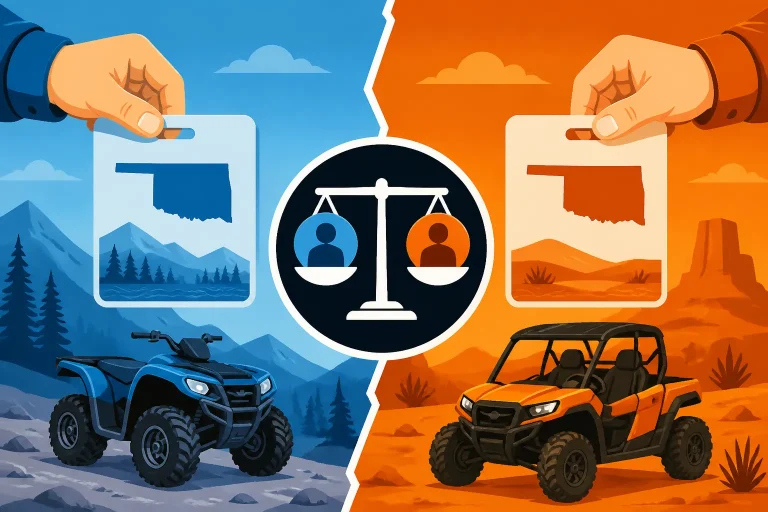
Start with Oklahoma’s Resident Land Access Permit or Oklahoma’s Nonresident Land Access Permit if you need to understand which permit category might apply. If you are visiting from another state, review Oklahoma Resident vs Nonresident Permits and confirm whether your intended WMA has a separate check-in procedure. A permit that grants access to one area does not necessarily authorize riding at another.
Do not assume that a permit automatically allows recreational riding. It may address entry or access while the WMA’s vehicle rules still limit where and why you can use a machine. Check both questions: May I access this land? and May I ride my quad on this route for this purpose?
Do not assume a hunting license is always enough
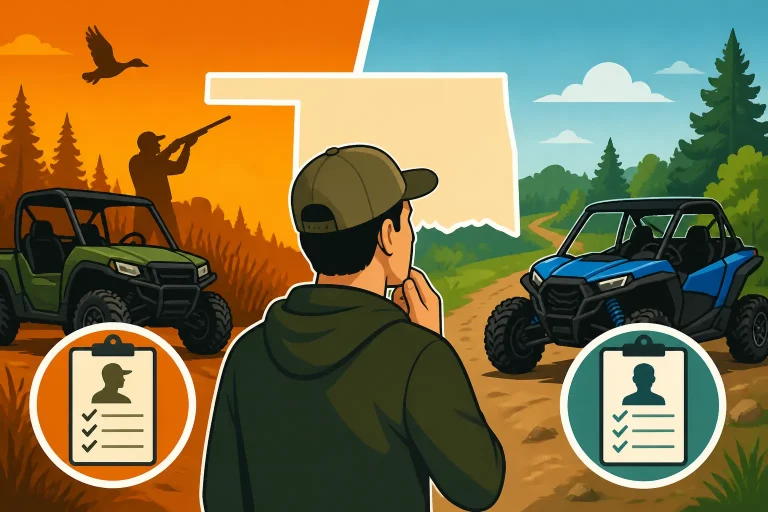
Hunting access and general ATV recreation are different activities. A WMA may have rules tied to hunting seasons, hunting licenses, or the purpose for which a vehicle is being used. If your plan is to ride for recreation rather than hunt, make that clear when checking the rules. If you are hunting, ask whether the machine may be used to reach a location, retrieve game, or travel on a designated road, and what restrictions apply.
Some public-land settings also have area-specific check-in requirements for nonresidents. Verify those requirements before arrival; do not assume that an out-of-state hunting license or an Oklahoma permit replaces a local check-in. Oklahoma WMA Nonresident Check-In explains why it is worth checking the procedure for your destination rather than treating every WMA alike.
For the connection between hunting credentials and access, see [Oklahoma Hunting License and Land Access]. The practical point is simple: a hunting license, land-access permit, and permission to ride a quad are separate questions. Depending on the area and what you plan to do, you may need to meet more than one requirement.
Follow Road, Season, and Machine-Use Restrictions
Once you have confirmed that quad access is allowed, pay close attention to where and how you may ride. Many public areas are not designed for unrestricted vehicle use. A rule permitting travel on an open road does not automatically permit riding through grassland, timber, wetlands, food plots, or other areas away from that route.
Stay on routes that are actually open
Look for current maps, posted signs, gates, and written area regulations. A road that appears on an older map may be closed, while a route that looks like a trail may be reserved for another use. Follow signs at entrances and intersections, and do not go around a closed gate simply because the ground beyond it looks passable.
The safest approach is to treat a route as closed unless you can confirm it is open to your type of machine. If an area allows travel only on designated roads, stay on those roads, avoid creating new tracks, and turn around if you cannot tell whether a route is authorized. The route rules are not just technicalities: they help protect habitat, reduce erosion, and keep riders from entering land or areas that are not open to public vehicle use.
Check Oklahoma WMA Road Rules for Riders and Oklahoma WMA Speed Limits for the kinds of limits that may apply. Do not assume the speed limit posted on a public road automatically governs a WMA road, or that a road with no visible sign has no speed restriction. Confirm the applicable rule and ride slowly enough to respond to people, wildlife, gates, and changing ground conditions.
Keep hunting-related vehicle use distinct from recreational riding
Some rules allow a machine for a specific hunting-related need, such as reaching an authorized area or retrieving legally taken game. That limited allowance should not be read as general permission to ride for fun. The conditions may specify where the machine can travel, when it can be used, or how far it may go from an approved route.
If you are relying on a game-retrieval exception, check its exact limits before using it. Oklahoma WMA Deer Retrieval Rules is a useful starting point, but the rule for the WMA you are visiting still controls. Do not use a retrieval allowance as a reason to ride elsewhere, carry passengers beyond what the machine is designed for, or take a shortcut off an authorized route.
Plan for a seasonal closure
Seasonal restrictions can affect whether you can reach a WMA by quad even when the property remains open for other uses. Some areas have periods when vehicle access is limited or unavailable. The dates and conditions may depend on the area’s management plan or a specific access arrangement.
Check the opening and closing dates close to your trip, especially if you are planning around a hunting season or a weekend that falls near a seasonal transition. A past visit, an old social media post, or a route shown on a general map cannot confirm that the area is currently open. Oklahoma WMA Riding Only in Deer Season covers why season limits matter, while Oklahoma Timber Land Access Rules is relevant when your destination involves timber-company land or a special public-access arrangement.
Before You Tow, Confirm the Details
A quick check before leaving can prevent a wasted trip, a citation, or damage caused by riding in a closed area. Use the name of the specific WMA when you ask questions; “Can I ride an ATV on public land?” is too broad to get a dependable answer.
- Identify the exact area and entrance. Some places have similar names or multiple access points. Confirm the WMA name and the route you plan to use.
- Ask whether your machine is allowed. Specify whether you have an ATV or UTV, and whether you want to ride recreationally, hunt, or retrieve game.
- Confirm where vehicles may travel. Ask whether access is limited to designated roads, and whether any trails or sections are closed.
- Check the season and current closures. Verify dates and temporary restrictions close to your trip.
- Ask about permits and check-in. Confirm which requirements apply to residents and nonresidents, and whether you must complete a check-in before entering.
- Read the signs at the area. Follow posted restrictions even if they differ from an old map or advice from someone who visited earlier.
- Carry proof of what you need. Keep applicable registration and permit information available, along with any documents required for your activity.
If the rules are unclear, contact the agency or office responsible for that WMA before hauling the machine there. Ask a narrow, practical question: “Is a quad allowed on this named road for recreational riding on my planned date, and what permit or check-in do I need?” That helps separate general land access from road permission and hunting-related exceptions.
A WMA is not a substitute for a designated OHV area. If the destination’s rules do not clearly allow your kind of riding, choose a place that does. Checking first is especially important if you are traveling with a group, bringing a UTV, or making a long tow; one rider’s assumption can affect everyone in the party.
The reliable rule is to verify access at the area level. Confirm the land requirement, the vehicle rule, the route, and the season independently. Once those pieces line up, you can plan your ride without treating a permit, hunting license, or open gate as blanket permission.
Disclaimer
This article is for general informational purposes only and does not constitute professional advice. Laws, prices and regulations vary by location and change over time. Consult a qualified professional for guidance on your specific situation.