Spark Arrestor Checks at a Riding Area Gate
A spark arrestor can be the small part that decides whether your ATV or UTV gets through a riding-area gate. The tricky part is that inspection practices and equipment rules can differ by property, and a permit does not automatically satisfy them. Here’s how to check your machine before you tow, what staff may look for, and what to do if your setup is questioned.
What a Spark Arrestor Check Is—and What It Is Not
A spark arrestor is a device in the exhaust system intended to reduce the chance that hot particles leave the tailpipe and start a fire. It is not the same thing as a muffler. A muffler reduces exhaust noise; a spark arrestor addresses escaping sparks. Some exhaust systems combine both functions, but one should not be assumed to perform the other.
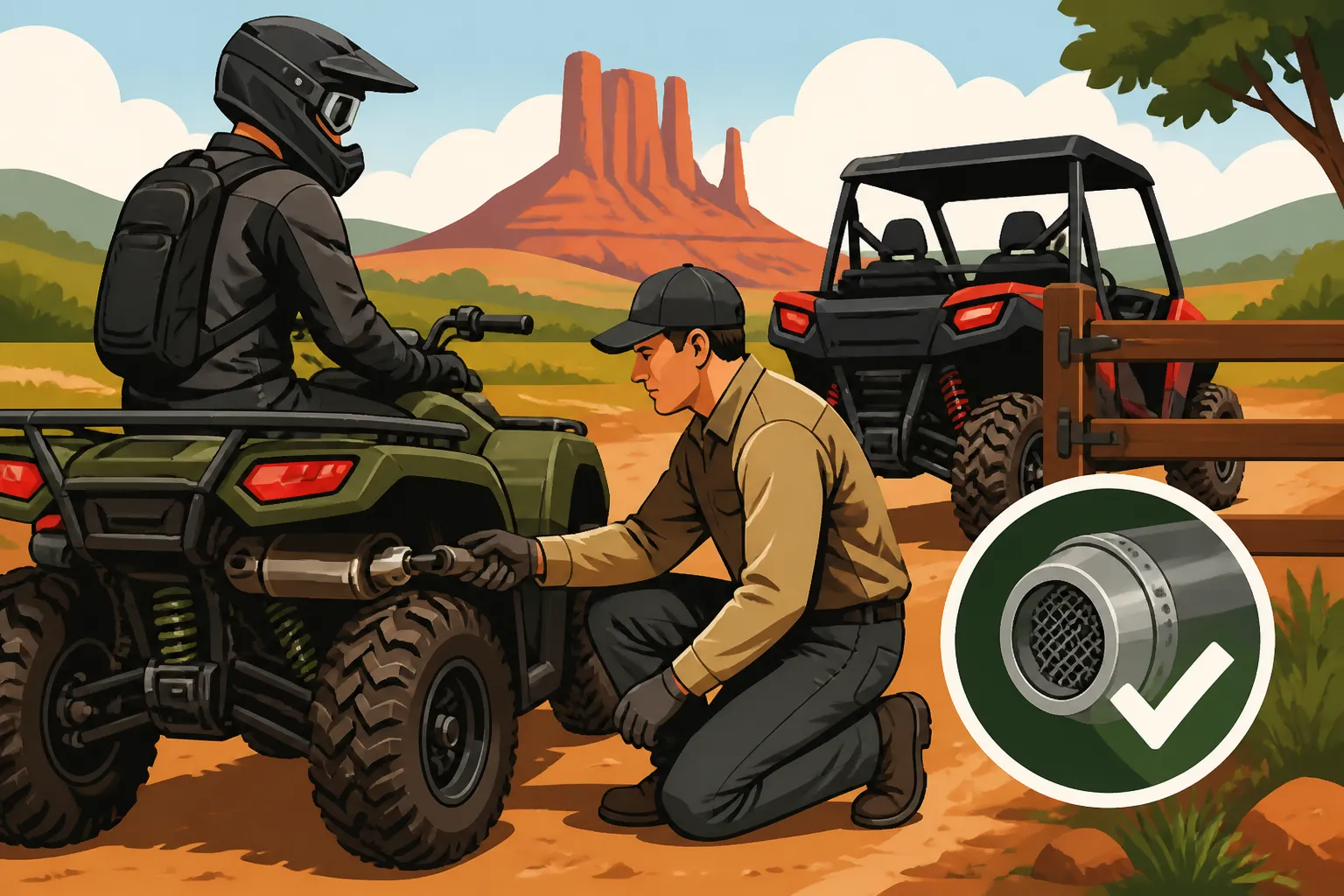
At a riding-area entrance, a check may be a quick visual look at the exhaust outlet or a question about the equipment installed. The staff member may want to confirm that the machine has an appropriate arrestor, that the exhaust has not been altered in a way that defeats it, or that the machine meets the property’s posted rules. The exact procedure depends on the operator and site.
Do not assume every Oklahoma riding area performs the same inspection, or that a check at one property tells you what another will accept. Public land managers, state recreation areas and private parks can set different conditions for access. A requirement may also be emphasized during dry conditions or when fire restrictions are in effect. For related planning, see Oklahoma Fire Restrictions in Dry Months.
A spark arrestor check is also separate from registration, a land-access permit, a waiver or a riding fee. Each may address a different requirement. For example, Oklahoma Land Access Permits Explained covers access permits, but having the right permit does not prove that an exhaust system meets a riding area’s equipment policy. Likewise, passing an equipment check does not replace permission to ride on that land.
If staff ask about your exhaust, treat the question as an equipment and access issue—not an invitation to argue about whether your machine is technically quiet enough. Noise rules and spark-arrestor requirements are separate matters. Oklahoma Sound Limits on Public Land can help you understand why a compliant arrestor does not necessarily make an excessively loud exhaust acceptable.
| Before the trip | What to verify |
|---|---|
| The riding area’s rules | Whether an arrestor is required and what kind of device or proof is accepted |
| Your machine’s exhaust | Whether the arrestor is present, correctly fitted and in serviceable condition |
| Any recent modifications | Whether a new muffler, exhaust insert or tune changed the setup |
| Entry requirements | Whether staff may inspect equipment and what happens if a machine does not pass |
| Fire conditions | Whether temporary restrictions or closures affect riding or equipment checks |
How to Check Your ATV or UTV Before You Leave
Start with the rules for the specific property you plan to visit. Look for its current equipment requirements, fire notices and entry instructions, or contact the office directly. A general statement that a park allows ATVs or UTVs does not settle whether it requires a spark arrestor, and an online discussion about another riding area may be out of date or refer to a different type of land.
When you contact the operator, describe the machine and exhaust setup accurately. “Stock exhaust” may be useful information, but it is not proof that a particular device meets the property’s standard. If you have an aftermarket exhaust, give the maker and model if known. Ask what the staff will accept as evidence, such as a visible marking, product documentation or an inspection at the entrance. Do not assume staff can identify an unmarked part by appearance alone.
Then inspect the machine while it is cool and turned off:
- Find the exhaust outlet and arrestor location. Check the owner’s manual or ask a qualified service professional if you are not sure where the device is installed. The arrestor may be integrated into the muffler or fitted as a separate component.
- Look for signs that the required part is missing or altered. A removed insert, an open exhaust outlet, loose hardware or an obvious gap deserves attention before the trip. Do not rely on a part that is sitting in the trailer or glove box as if it were installed.
- Check for damage and loose fittings. A cracked housing, damaged screen, missing fastener or poorly seated insert can undermine the setup and may draw questions at the gate.
- Use the manufacturer’s maintenance instructions. Some arrestors require cleaning or inspection. Follow the service procedure for your machine and exhaust; do not poke, drill or modify a component to clear it.
- Bring useful documentation. Keep the owner’s manual or product information available if the device is difficult to see or identify. Documentation may help explain the setup, but the property decides what it accepts.
If you have recently changed the muffler or exhaust, do not assume the new part includes a spark arrestor just because it is marketed as an off-road component. Check the product specifications and installation instructions. If ordering a replacement online, including through Amazon, verify exact fitment for the make, model and year and confirm that the part meets the riding area’s stated requirement. A product listing that says “spark arrestor” may not answer every question a land manager has about approval or compliance.
A machine that is used mostly on a farm or ranch still needs to meet the rules of the place where it is being ridden. Likewise, equipment that worked at a private park may not meet a public land manager’s requirements. If the property’s instructions are unclear, ask before loading up. Questions to Ask the Park Office Before You Go offers a useful framework for confirming entry details.
What May Happen at the Gate
Gate checks are not necessarily elaborate mechanical inspections. A staff member may look at the outlet, ask whether the machine has an arrestor, or refer to a posted rule. Some locations may check only selected machines or apply checks differently depending on conditions. That does not mean a rider should plan around the chance of not being checked. The property can still refuse access if a machine fails its requirements.
Be ready to answer plainly. If the arrestor is part of the original exhaust, say so, but avoid claiming that it is approved unless you have a reliable basis for that claim. If it is aftermarket, explain what was installed and offer the documentation you brought. If you do not know whether your device qualifies, ask staff to clarify rather than improvising an answer.
Possible outcomes depend on the operator’s policy. Staff may allow entry, ask you to correct a problem, request additional information, or deny access. A private park may have its own waiver and equipment conditions, while public land may follow the managing agency’s rules. Review Oklahoma Private Park Waivers and Rules for the broader point: private properties set entry conditions riders need to understand before arriving.
If your machine is turned away, do not remove an insert, alter the exhaust or attempt a makeshift repair in the parking area to get around the requirement. Ask whether there is a permitted way to resolve the issue, whether you can return with compliant equipment, and whether the entry fee or reservation can be changed. Policies differ, so do not count on a refund or on being allowed to park outside the gate and ride anyway.
It also helps to keep the rest of the machine in order. An arrestor check does not guarantee that the property will overlook other equipment issues, posted fire restrictions or operating rules. A machine that passes one check may still be subject to noise limits, trail restrictions or other conditions. The rules for particular riding areas can vary substantially, so verify the venue rather than relying on a generic Oklahoma checklist. For examples of the differences between trail systems, see Oklahoma Trails That Allow Side-by-Sides and Oklahoma Trails That Allow Dirt Bikes.
Avoiding a Failed Check and a Wasted Trip
The most reliable approach is to settle equipment questions before departure, not at the entrance. Check the property’s current rules close to your ride date, especially if dry weather, fire notices or seasonal closures may affect access. If the rule uses terms such as “approved” or “qualified,” ask which marking, documentation or device standard the operator expects. A vague assurance from a seller or a forum post may not be enough.
Make a short pre-trip check part of your loading routine:
- Confirm the arrestor is installed and has not been removed since the last ride.
- Look for damage, loose fasteners or a modified exhaust outlet.
- Check maintenance instructions if the device needs cleaning or periodic inspection.
- Pack product details or the manual if the component is hard to identify.
- Confirm the riding area’s specific equipment and fire rules.
- Leave time to address a problem before your reserved riding time or group meetup.
If you are buying a used machine, ask the seller whether the exhaust is original and whether any inserts or internal parts have been removed. Inspect the exhaust yourself rather than treating “it passed inspection before” as a guarantee. The part may have been changed since the previous owner rode it, and a different property may apply a different standard.
For group rides, check more than the lead machine. Each ATV or UTV may have a different exhaust, particularly when riders have installed aftermarket parts. Tell the group what the destination requires and encourage each owner to verify their own setup. A single machine turned away can complicate transportation and plans for everyone.
Finally, separate the questions you need answered. Ask the land manager about the arrestor and entry inspection; ask the relevant agency or property about permits; and check current fire restrictions before you ride. That approach avoids a common mix-up: assuming one document or one successful gate visit covers every condition. The safest plan is a properly maintained machine, clear confirmation from the destination and no last-minute exhaust modifications.
Disclaimer
This article is for general informational purposes only and does not constitute professional advice. Laws, prices and regulations vary by location and change over time. Consult a qualified professional for guidance on your specific situation.