Does Oklahoma Ask for Insurance at Registration?
The thought of getting your new (or new-to-you) off-road machine titled and registered can bring on a whole lot of questions, and one of the biggest head-scratchers for many riders is whether they'll need proof of insurance. It’s a completely fair question, especially since we're so used to needing insurance for every other vehicle we own. This guide will cut through the confusion and clarify exactly when and if Oklahoma requires insurance for your ATV or UTV at the time of registration.
The Simple Truth for Off-Road ATVs and UTVs in Oklahoma
Let’s get straight to it: for a standard, off-road ATV or UTV that isn't intended for regular street use, Oklahoma generally does not require you to show proof of insurance when you go to register it at the tag agency. This often comes as a surprise to folks who are accustomed to vehicle registration meaning automatic insurance checks.
What the Tag Agency Asks For
When you head to your local Oklahoma tag agency to get your off-road quad or side-by-side squared away, their primary focus will be on establishing ownership, ensuring the machine meets titling requirements, and collecting the initial registration fee. They'll be looking for things like your Manufacturer's Statement of Origin (MSO) if it's new, or a bill of sale and previous title if it's a used machine. They'll also want to verify the VIN.
For most off-road machines, the state treats registration as a one-time affair. You pay a small fee – often just $11 – and you receive a decal that goes on the front of your machine. This decal confirms your machine is registered and titled in Oklahoma. At no point during this process will the clerk typically ask to see an insurance card or policy. The application forms themselves won't have a section to fill out your insurance provider details or policy number, because it's simply not part of the standard requirement for these types of vehicles.
It's a huge relief for many riders to know they don't have to scramble to find an insurance policy just to get their machine registered. You can focus on getting your title paperwork in order and paying the necessary fees. For more details on what you'll owe, check out [Oklahoma ATV Registration Cost]. If you’re curious about the full process, we've got a detailed breakdown in [How to Register an ATV in Oklahoma].
Why the Rules Differ from Cars
This difference in requirements compared to cars, trucks, and even motorcycles often leaves riders scratching their heads. The reason is rooted in how the state categorizes and regulates these different types of vehicles. Cars, for example, are designed and intended for use on public roads and highways, where the risk of accidents involving other motorists is inherent. Because of this, Oklahoma, like most states, mandates liability insurance to ensure that if you cause an accident, there's a financial mechanism in place to cover damages and injuries to others.
Off-road ATVs and UTVs, however, are primarily designed for use on private land, designated trails, or specific off-highway vehicle (OHV) parks. In these environments, the likelihood of a collision with another road-going vehicle is significantly reduced. While accidents can certainly happen off-road, the state's legislative framework has historically treated these machines differently because their intended use keeps them off the main thoroughfares where mandatory insurance becomes critical for public safety.
Think of it this way: your lawnmower or a tractor used solely on private property doesn't require state-mandated liability insurance to be registered, because it's not operating in the public road system. While an ATV or UTV is more powerful and carries different risks, the principle is similar for machines confined to off-road environments. They still need to be titled, which helps establish ownership and deter theft, and they are subject to excise tax at the time of titling, which you can learn more about in [Oklahoma Excise Tax at Titling]. But the immediate need for insurance to get that initial decal simply isn't there.
When Insurance Becomes a Must-Have: Street-Legal UTVs
While the general rule is "no insurance required for registration" for typical off-road machines, there's a crucial exception that every UTV owner needs to be aware of: street-legal UTVs. Oklahoma has a specific pathway for certain UTVs to be made street-legal, allowing them to operate on many public roads. Once a UTV goes down this path, the rules change entirely, aligning much more closely with those for traditional on-road vehicles.
The Street-Legal UTV Distinction
In 2021, Oklahoma passed legislation that created a class of "street-legal utility vehicles." This was a game-changer for many UTV enthusiasts who wanted the flexibility to drive their side-by-sides on county roads, across town, or to access trails directly from their homes. However, making a UTV street-legal isn't just a matter of saying it is; it involves specific equipment upgrades and an entirely different registration process.
To qualify as street-legal, your UTV must be equipped with things like turn signals, headlights, taillights, brake lights, a horn, a windshield, and rearview mirrors. Essentially, it needs to meet a host of safety and equipment standards designed for vehicles sharing the road with cars and trucks. You can find a comprehensive list of these requirements in [Oklahoma Street Legal UTV Requirements].
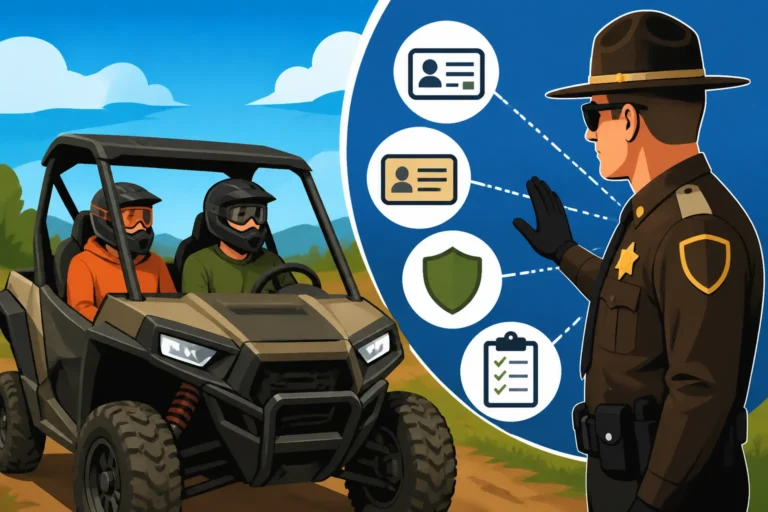
Crucially, once your UTV meets these standards and you apply for a street-legal plate, it is then considered an on-road vehicle for registration purposes. This reclassification immediately triggers the requirement for mandatory liability insurance. This isn't just a suggestion; it's a non-negotiable part of the process.
The Registration Process for Road-Legal Machines
When you visit the tag agency to obtain an annual road plate for your street-legal UTV, the clerks will ask for proof of current liability insurance. This is exactly like registering a car or truck. You'll need to provide an insurance card or policy declaration proving that you have at least the state's minimum required liability coverage. Without this, they simply won't issue you a street-legal plate and annual decal.
This street-legal registration is also different from the one-time off-road registration in that it needs to be renewed annually. Each year, when it's time to renew your street-legal UTV's registration, you'll again need to show proof of active insurance. For more on what to expect with yearly renewals, check out [Oklahoma Street UTV Annual Renewal].
The implications of driving a street-legal UTV on public roads without insurance are serious. You could face fines, penalties, and even have your UTV impounded if you're stopped by law enforcement. It's not just about the registration; it's about operating legally and responsibly on shared public roadways. Make sure you understand [Oklahoma Insurance at Street Registration] if you plan to get a road plate for your UTV.
| Feature | Standard Off-Road ATV/UTV | Street-Legal UTV (Road Plate) |
|---|---|---|
| State Registration | Yes (one-time) | Yes (annual) |
| Proof of Insurance Req. | No | Yes |
| Decal Type | Front decal (for life of ownership) | Annual plate & decal (like a car) |
| Driving on Public Roads | Restricted (crossings, specific areas) | Generally allowed (with restrictions) |
| Title Required | Yes | Yes |
| Excise Tax | Yes | Yes |
Beyond the Mandate: Why Insurance Is Still a Smart Move
Even though Oklahoma doesn't mandate insurance for off-road ATVs and UTVs at the point of registration, dismissing it entirely might be a decision you come to regret. Riders face real risks out on the trails and even on their own property, and insurance can offer a critical safety net.
Protecting Your Investment and Yourself
Let's be realistic: ATVs and UTVs are not cheap. They represent a significant investment, often costing thousands of dollars. Accidents happen, machines get stolen, and things break. Without insurance, you're on the hook for every penny of repair, replacement, or medical bill.
Consider these scenarios:
- A rollover on a tricky trail: You misjudge a turn, and your UTV flips, causing extensive damage. Repairs could quickly run into the thousands.
- Theft from your garage or deer camp: You come back to find your quad gone. Without coverage, that machine is simply lost, and you're out the entire value.
- An unexpected fire: Imagine a barn fire that damages your ATV or UTV stored inside.
- A collision with another rider: Even on private land or a public trail, you could collide with another machine, damaging both vehicles and potentially injuring someone.
In these situations, comprehensive and collision coverage can save you from a massive financial hit. Liability coverage, even if not required by the state, is equally important. If you accidentally injure another rider or damage their property while off-roading, liability insurance can cover those costs, protecting your assets from potential lawsuits.
While insurance protects your assets, sometimes you need legal documents to formalize agreements, especially if you're lending out your machine or need a robust bill of sale after a private sale. Resources like LawDepot offer templates for these kinds of agreements, providing peace of mind and clarity in ownership transfers or usage agreements. For example, when creating a [Oklahoma Bills of Sale for Older Machines], a template can be incredibly helpful.
Navigating Different Riding Scenarios
The rules can also get a bit murky depending on where you ride. While state registration doesn't require insurance for off-road use, certain private riding parks or specific events might. Before you hitch up the trailer and head to a new riding spot, it's always a good idea to check their specific rules. Some private parks, especially those that host races or large events, may require proof of liability insurance as a condition of entry.
Even if a park doesn't mandate it, having insurance is just plain smart. You're riding in an environment with other people, and accidents can happen to anyone. Understanding the specific rules of the land you're on is key, whether that's private property (which might involve [Oklahoma Landowner Permission Rules]) or public trails (like those found in [Oklahoma ATV Trails: Where to Ride]).
Ultimately, while the state might not demand insurance for your off-road ATV or UTV registration, responsible ownership often means looking beyond the bare minimum. Protecting yourself, your machine, and others is always a worthwhile investment, giving you true peace of mind to enjoy the ride. Just make sure you get your registration done within the [Oklahoma's 30-Day Registration Deadline] after purchase to avoid any late fees.
Disclaimer
This article is for general informational purposes only and does not constitute professional advice. Laws, prices and regulations vary by location and change over time. Consult a qualified professional for guidance on your specific situation.