Oklahoma Private Park Waivers and Rules
A private riding park can feel less formal than public land, but its waiver and posted rules still matter. The tricky part is separating the park’s entry conditions from Oklahoma law, land-access permits, and your own insurance. This guide explains what to check before you unload, how to handle waivers for adults and children, and what to do when a rule is unclear.
What a Private Park Waiver Does and Does Not Do
A waiver is a legal document you may be asked to accept before riding. Operators use waivers to explain risks and set conditions for entry. The exact wording and effect depend on the document and applicable law, so do not assume every waiver is identical or that signing one means the park can ignore every safety obligation.
Off-road riding carries obvious risks: rollovers, collisions, changing trail conditions, mechanical failure, and injuries caused by another rider. A waiver may ask you to acknowledge those risks and may describe which claims you agree to release. It may also require you to follow park rules, supervise minors, and accept responsibility for damage you cause.
A waiver is not a substitute for reading the rules. It does not automatically give you permission to ride every trail, bring any machine, or disregard laws that apply outside the park. Nor does signing it necessarily mean your health or vehicle insurance will cover a crash. Those are separate questions.
Before signing, read the whole document, including any screens you must scroll through online. Pay attention to:
- Which people are covered: the rider, passengers, children, vehicle owners, or other members of a group
- Whether the waiver applies to one visit or a longer period
- What risks and activities it describes
- Whether it addresses damage to property, equipment, or other vehicles
- What it says about medical treatment or emergency response
- Whether you are agreeing to follow a separate park rule sheet
- What a parent or guardian must sign for a minor
If a statement is unclear, ask the operator to explain it before you accept. A staff member may not be able to give legal advice, but they can usually tell you what the park expects you to do. For a closer look at the signing process, see Signing a Liability Waiver Before a Private Ranch Ride.
A waiver is only one part of permission to ride
Think of permission to ride as a set of separate checks. You may need to meet the park’s entry conditions, follow its operating rules, and comply with any state or local rules that still apply to your activity. One document rarely answers every question.
For example, a waiver may permit a rider to enter the property but not establish that the rider is old enough for a particular machine under the park’s policy. It may not say whether a passenger is allowed, whether the vehicle fits the trails, or whether the park is open to that type of machine that day. Those details usually appear in rules, signage, a reservation confirmation, or instructions from staff.
Likewise, a park’s waiver does not turn private trails into public roads. If you leave the property or ride on a road, the rules for that road and location may be different. Keep the boundary clear, especially at parks where trails connect with public land, timber land, or neighboring property.
Do not treat a waiver as insurance
A waiver does not pay your medical bills, repair your machine, or protect you from every financial consequence of a crash. Check your own policy before the trip. Ask your insurer specifically whether the machine is covered while being ridden off-road at a privately operated park, whether passengers are covered, and whether damage to another person’s property is included.
If you rent a machine, ask who is responsible for damage, theft, and injury. The rental agreement may have terms separate from the park waiver. If you bring your own machine, do not assume coverage for an ATV or UTV is the same as coverage for a car.
If coverage is important to your decision, get the insurer’s answer in writing. A quick general answer such as “you’re covered” may not resolve whether a particular activity or location is excluded.
Park Rules and Oklahoma Requirements Are Different
Private parks set conditions for using their property. They may restrict machines by size, type, age, passenger capacity, noise, or trail suitability. They can also set check-in procedures, designate one-way routes, close trails, or require riders to wear particular safety equipment.
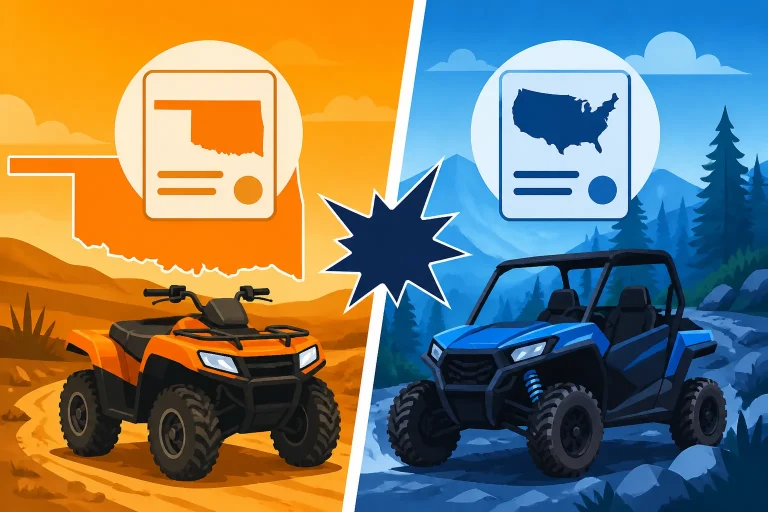
Oklahoma rules are a separate layer. A private park’s house rules do not replace requirements that apply under state or local law. Conversely, a rule that applies on public land may not automatically apply in the same way to a private facility. The answer depends on the activity, location, and rule involved. If you are unsure whether a legal requirement applies to the park, ask the operator what it requires and confirm the legal question with an appropriate official source.
This distinction is especially important for permits. Oklahoma has land-access permit requirements for certain public lands and activities, but a private park’s admission process is not automatically the same thing. Do not buy a public-land permit just because you are going riding, and do not assume a park ticket covers any separate permit needed for a public area you plan to visit afterward. Review Oklahoma Land Access Permits Explained and confirm the specific property’s status with the operator.
| Question | Who usually sets the answer | What to verify before riding |
|---|---|---|
| Is a waiver required? | Park operator | Who must sign and whether online completion is accepted |
| Which machines may enter? | Park operator, subject to applicable law | Vehicle type, dimensions, tire or equipment limits, and trail suitability |
| Are helmets or other protective gear required? | Park rules and potentially applicable law | Requirements for each age group and machine type |
| Can a child ride? | Park rules and applicable law | Minimum age, supervision, machine size, and guardian paperwork |
| Can passengers ride? | Park rules, vehicle design, and applicable law | Whether the machine is built for passengers and whether the park permits them |
| Is a public-land permit needed? | Depends on the land and activity | Whether the property is private or public and what access authorization applies |
| Does insurance cover a crash? | Your insurer and policy terms | Off-road use, passenger coverage, liability, theft, and exclusions |
| Can you camp, bring a pet, or drink alcohol? | Park rules and applicable law | Current property policies, designated areas, and any restrictions |
A useful rule of thumb is to treat a park’s posted rules as entry conditions and state or local requirements as separate legal obligations. If one is stricter than the other, follow the stricter condition for that visit unless the operator or a qualified authority confirms a different interpretation.
Ask what rules apply beyond the gate
Some parks have riding areas, campgrounds, parking areas, access roads, and neighboring public routes. Rules may change between those locations. A helmet requirement, speed limit, alcohol policy, or vehicle restriction at a campsite may not be worded the same way as the rule on a trail.
Ask whether the park rules apply to the full property, only to riding areas, or also to access roads and campsites. If the operator identifies a public road or public land connection, verify those rules separately. Oklahoma Private Ranch Waivers and Questions to Ask the Park Office Before You Go can help you prepare the right questions.
Read the Rules Before You Pack
A park’s rules are practical instructions, not fine print to skim at the gate. The best time to discover that your machine is not permitted, your child cannot ride a particular trail, or your dog must stay at camp is before you have loaded the trailer.
Start with the operator’s current website or booking information, then call if anything is missing. Rules can differ by location and may change with weather, trail conditions, staffing, events, or land-use restrictions. An old social media post or a friend’s memory is not a reliable substitute for a current answer.
Machine type and trail access
Ask whether the facility accepts the exact type of machine you plan to bring: ATV, UTV, dirt bike, youth quad, or another vehicle. A park can accept one category while restricting another. A four-seat side-by-side may face different trail limits from a small ATV because of width, turning room, or trail design.
Confirm any restrictions on:
- Overall width, length, or weight
- Two-wheel-drive or four-wheel-drive vehicles
- Sport machines, utility machines, or youth-sized machines
- Dirt bikes or motorcycles
- Modified suspensions, tires, or exhaust systems
- Trailers used inside the property
- Machines that do not have required safety equipment
- Vehicles that are not registered or cannot be identified
Do not rely on the machine’s marketing description. If the park has a width limit, measure the vehicle as it sits, including accessories that extend beyond the body. A machine that barely fits a limit on paper may be difficult to use on a narrow trail or bridge.
Ask whether all trails are open to your machine or whether the park separates routes by vehicle type. A route suitable for a dirt bike may be too narrow for a side-by-side. A trail that is technically open may still be a poor fit for a long or wide vehicle. The operator’s trail map and staff guidance are more useful than guessing from a general description.
Rider age, supervision, and passengers
A park can set its own minimum ages, supervision rules, or skill requirements. These may be more restrictive than what a family expects. Ask whether age limits differ for driving, riding as a passenger, using a particular trail, or operating a particular class of machine.
For children, clarify all of the following before the trip:
- Whether a parent or guardian must sign the waiver
- Whether the parent must be present at check-in
- Whether a child can ride alone or must be directly supervised
- Whether there is a minimum age for a passenger
- Whether youth machines must meet size or power limits
- Whether the park has a separate youth riding area
- Whether protective gear is required and what standard is accepted
- Whether a child can ride with an adult in a UTV
Never assume that a vehicle’s seat count makes every passenger arrangement acceptable. Follow the manufacturer’s seating design and the park’s passenger policy. A child should not ride in a cargo area, on a rack, or in a seat not intended for a passenger. If the rules are unclear, ask the park before loading.
For more detail on policies that can vary by property, see Oklahoma Private Ranch Age Rules and Oklahoma Private Park Helmet Rules. The park’s current posted policy should still be your final check for that visit.
Speed, direction, and trail conduct
Parks commonly use posted speeds, one-way routes, passing rules, and restricted zones to reduce conflicts. Follow posted limits even if the trail looks empty. Blind corners, steep slopes, dust, loose gravel, and mixed vehicle traffic can make a familiar speed unsafe.
Ask about the park’s rules for:
- Passing another rider
- Stopping or parking on trails
- Riding in groups
- Following a lead rider or guide
- Using a winch or recovery strap
- Riding after rain or during closures
- Entering marked areas or private property
- Riding after dark
- Operating near pedestrians, campers, or staff
Do not create your own route around a closed trail. Closures can protect riders from hazards, prevent property damage, or reflect landowner restrictions. If a sign is missing or a route is blocked, turn around and ask staff rather than assuming the barrier is optional.
Noise, exhaust, and environmental rules
A park may restrict noisy machines, certain exhaust systems, or riding near campsites during quiet periods. It may also prohibit littering, cutting trees, disturbing wildlife, damaging vegetation, or leaving marked routes. These rules protect the property and help keep riding access available.
Ask whether the park has sound checks or equipment restrictions. If you have changed the exhaust, check before traveling. A machine that is legal to own may still fail a private park’s admission standard.
Leave the site as you found it. Pack out trash, keep fuel and fluids contained, and report spills or damage promptly. If the park provides wash areas, use them as directed; do not assume you can wash mud, fuel, or oily residue into a drainage area.
Waivers for Children and Groups Need Extra Attention
A parent’s signature does not make a child ready to ride, and it does not necessarily satisfy every park requirement. Operators may require a parent or legal guardian to sign, remain on site, accompany the child, or complete separate paperwork. The details vary, so confirm them before you arrive.
When a child is part of the group, contact the park with the child’s age and the type of machine involved. Describe whether the child will drive, ride as a passenger, or use a youth machine. A general question such as “Are kids allowed?” may not get you the answer you need.
Prepare the paperwork in advance
If waivers are available online, complete them only through the operator’s official process. Check whether each person needs an individual waiver, whether adults must sign for minors, and whether every participant must check in in person. Bring identification if the park asks for it, and keep confirmation emails or booking details accessible.
Before signing for a child, make sure you understand what you are accepting on the child’s behalf. Read the document rather than assuming it is identical to one you signed somewhere else. If another adult is bringing your child, ask whether that adult can sign, whether a parent’s prior authorization is needed, and what proof the park requires.
A group leader should not assume that one person can complete a waiver for everyone. Each participant may need to accept the terms personally, and a parent or guardian may need to complete separate paperwork for each minor. Clarify that in advance so the group is not delayed at check-in.
Match the machine to the rider
A youth rider needs a machine suited to their size and experience, not simply a vehicle that the park allows. Check the manufacturer’s operating guidance, make sure the controls can be reached comfortably, and confirm that the rider can stop and steer safely. A machine that feels manageable in a yard can behave very differently on a slope, in loose sand, or around other riders.
The same caution applies to adult beginners. Choose routes that match actual ability, not the most confident person in the group. Ask the operator how trails are rated and whether a beginner route avoids steep, narrow, or high-traffic sections.
Protective equipment should fit correctly. A helmet that shifts, a loose strap, or eye protection that fogs can become a problem quickly. If you are buying gear through Amazon or another retailer, check sizing and return conditions before the ride, and do not assume a product listing alone confirms that equipment meets a park’s stated standard. Bring the gear the park requires, even if you expect to ride only briefly.
Make a group plan before riding
Groups should decide how they will handle separation, breakdowns, and emergencies. Establish a meeting point, keep track of who is riding which machine, and agree that the group will stop if someone falls behind. Do not let a more experienced rider disappear over the next hill while newer riders struggle to keep up.
Before leaving the staging area, identify:
- The park’s emergency contact or check-in point
- How to report an injury or mechanical problem
- Where the group can regroup
- Whether phones work across the property
- Which routes fit each machine
- Who carries a first-aid kit and basic recovery equipment
- Whether the park has restrictions on group size or organized rides
For a large group or an organized event, ask whether advance approval, a reservation, or additional paperwork is required. Do not assume that a normal day-use admission covers a club ride, fundraiser, guided outing, or commercial activity.
Common Rules That Catch Visitors Off Guard
Many problems at private riding parks are not dramatic legal disputes. They are preventable surprises: an unapproved passenger, a dog that cannot enter the campground, a loud machine turned away at check-in, or a campsite rule that differs from what visitors expect.
Helmets and protective equipment
A park may require helmets for everyone, only certain ages, or particular types of machines. A rule may also specify eye protection, long sleeves, boots, or other gear. Confirm the details for drivers and passengers separately. Never assume that a roll cage, seat belt, or enclosed cab removes a helmet requirement unless the operator says so and the applicable rule supports it.
If a helmet is required, make sure it fits and fastens correctly. Keep eye protection clean and secure, and use footwear suitable for the machine. For children, inspect the fit rather than relying on a helmet that was purchased for an older sibling.
Alcohol and impairment
Parks may prohibit alcohol in riding areas, restrict it to designated camping locations, or ban it across the property. Policies can differ, and a private operator may be stricter than visitors expect. Check the current rule before bringing alcohol, and never operate a machine while impaired.
Do not assume that someone who is not driving can ignore park alcohol rules. A policy may cover passengers, campsites, event areas, or the entire property. For more, see Oklahoma Private Park Alcohol Rules.
Camping, pets, and quiet hours
A park that allows riding may not allow overnight camping, or it may require a separate reservation. Ask about tent and RV areas, hookups, fire restrictions, generator use, check-in times, and whether the campsite is close to the riding area. Confirm what happens if you arrive after the office closes.
Pet rules can cover more than whether animals are allowed. They may address leashes, waste cleanup, noise, campsite boundaries, and whether pets can enter riding areas. Do not bring a dog to the trailhead assuming it can ride in a UTV or wait safely beside a vehicle. Check the operator’s policy and plan for the animal’s comfort and safety. Oklahoma Private Park Pet Rules covers the questions worth checking.
Quiet hours matter even when the park is far from town. A loud machine, generator, music, or late-night gathering can disturb other campers and may violate the property’s rules. Confirm the hours and where they apply. Oklahoma Private Park Camping Rules and Oklahoma Private Park Quiet Hours are useful related reads.
Speed limits and machine restrictions
A posted speed limit is a maximum, not a target. Slow down near people, campgrounds, parking areas, trail intersections, and dusty stretches where visibility is poor. If the park has a specific lower limit in camp or on a main road, follow the sign even if the trail is otherwise open. See Oklahoma Private Park Speed Limits for more on the kinds of limits a facility may set.
If a machine is too wide, too loud, or not suited to the terrain, the operator may limit where it can go or refuse entry. Ask before making a long drive. Describe the machine honestly, including modifications and accessories that affect its dimensions.
Fire, weather, and trail closures
A park may restrict campfires, charcoal grills, generators, or smoking during dry conditions. Weather can also change what trails are safe or open. Heavy rain may make a route slippery or cause damage; heat can make a long ride risky without water and shade.
Check the forecast and the park’s operating status before you leave. Ask whether admission is refundable if weather closes the trails, whether a reservation can be moved, and how the park announces closures. Do not continue on a trail simply because it was open earlier in the day. Conditions can shift quickly.
A Practical Check-In and Ride Plan
A little preparation can turn check-in from a scramble into a quick confirmation. Use this sequence when planning a private-park visit.
- Choose the property and confirm it is open. Check operating hours, reservation requirements, trail availability, and any temporary closures directly with the operator.
- Describe your machines. Give the staff the vehicle type, number of seats, approximate width, and any major modifications. Ask which trails each machine may use.
- Ask about age and passenger rules. Give the ages of the riders and explain who will drive, who will ride as a passenger, and whether any rider is a beginner.
- Review the waiver process. Find out whether forms are online, whether every adult must sign, what a parent must complete for a minor, and whether anyone needs to appear at check-in.
- Confirm the rules that affect your plans. Ask about helmets, speed limits, alcohol, pets, camping, fires, quiet hours, and nighttime riding.
- Check the permit and insurance questions separately. Confirm whether the property or any planned extension onto public land requires a separate access permit. Call your insurer about off-road coverage rather than treating the waiver as proof of insurance.
- Pack for the park’s requirements. Bring required safety gear, water, identification if requested, paperwork, and basic supplies. If you buy missing gear through Amazon, verify the fit and the park’s acceptance criteria before leaving.
- Attend the orientation or briefing. Listen for trail direction, closures, emergency procedures, and areas that are off limits.
- Inspect the machine. Check tires, brakes, throttle return, lights if required, fuel, and any equipment the park expects. Secure loose cargo and confirm that passengers have suitable restraints and seats.
- Ride within your group’s ability. Start on an easier route, keep a manageable pace, and turn around if the conditions or trail difficulty do not feel right.
Questions to ask before you book
A short call can prevent a wasted trip. Be specific rather than asking only whether “ATVs are allowed.” You might ask:
- Do you allow my exact machine type and width?
- Are all trails open to side-by-sides, or are there vehicle-specific routes?
- What are the age rules for drivers and passengers?
- What does a parent or guardian need to complete for a minor?
- Are helmets required for every rider?
- Is the waiver completed online or at the gate?
- Do you allow camping, pets, fires, or generators?
- What are the rules for alcohol and quiet hours?
- Are trails open after rain, or can conditions close them?
- Is there a separate permit or fee for any area we plan to use?
- What is the process if someone is injured or a machine breaks down?
- What happens to a reservation if the park closes because of weather?
Write down the answers and the name or role of the person you spoke with. If you receive a verbal answer that conflicts with a written rule, ask which instruction controls and request clarification before traveling.
At the gate
Give staff accurate information. Do not hide a passenger, machine modification, or underage rider to avoid a restriction. If the staff says a vehicle or person does not meet the policy, ask whether there is a permitted alternative, such as a different trail or a separate riding area. Do not argue your way past a rule that is clearly posted.
Keep the waiver confirmation, park map, and emergency contact information where you can access them. If the park uses wristbands, vehicle stickers, or entry tags, make sure each rider knows where it belongs and what it signifies. Do not transfer it to someone who has not checked in.
If a rule is not posted where visitors can see it, ask for the current version. Clear instructions help both riders and operators. If you encounter a dangerous condition, report it promptly rather than assuming staff already knows.
What to Do If You Disagree With a Rule or Waiver
You are not required to ride. If a waiver contains language you do not understand or a rule conflicts with your plans, pause before signing or unloading. Ask the operator to explain the practical meaning of the policy. If the answer is not clear, decide whether you are comfortable proceeding.
Do not alter a waiver, cross out language, or sign on behalf of another adult unless the operator has explicitly authorized that process. A changed form may not be accepted and can create confusion about whether you have completed the park’s entry requirements. For legal advice about a waiver’s effect, speak with a qualified attorney.
If you believe a park rule conflicts with a legal requirement, do not rely only on another visitor’s interpretation. Ask the operator for the rule in writing and consult an appropriate official source or qualified professional. The same is true if the park is near a public road, wildlife area, or other land with separate access rules.
After an incident, prioritize safety. Get medical help when needed, notify park staff, and follow the operator’s reporting procedure. Write down what happened while details are fresh, including the location, time, trail conditions, people involved, and any witnesses. Take photographs only if it is safe to do so. Keep copies of the waiver, rental agreement, receipts, and insurance communications.
A respectful conversation is usually the fastest way to solve a misunderstanding. If you still cannot agree with a policy, leaving without riding is safer than taking a chance on an exception that staff has not approved.
Disclaimer
This article is for general informational purposes only and does not constitute professional advice. Laws, prices and regulations vary by location and change over time. Consult a qualified professional for guidance on your specific situation.