What Oklahoma Game Wardens Check on Public Land
A stop from an Oklahoma game warden can involve more than a hunting license. On public land, the important questions may be whether you’re allowed to ride there, whether your machine and permit meet that area’s rules, and whether you’re following hunting-season restrictions. This guide explains what to have ready, what wardens may ask, and how to avoid treating different kinds of public land as if they shared one rulebook.
Start With Where You Are and What You’re Doing
“Public land” is not one uniform riding area. Oklahoma has wildlife management areas, land-access areas, state parks, federal land, and other places with their own managers and rules. A machine that is allowed on one designated route may be prohibited on another property, even if both are open to the public.
Before riding, identify the exact property and its managing agency. Then check the current rules for that property, including any seasonal closures, route restrictions, permit requirements, and vehicle limits. A map pin or a trailhead sign can help you establish your location, but neither replaces checking the rules.
That distinction matters during a warden contact. A rider may have a valid permit and still be somewhere they cannot ride. Or a machine may be legal on a designated road but not on the surrounding land. The first practical question is therefore not only, “Do I have a permit?” It is also, “Am I on an authorized route, at an allowed time, for an allowed purpose?”
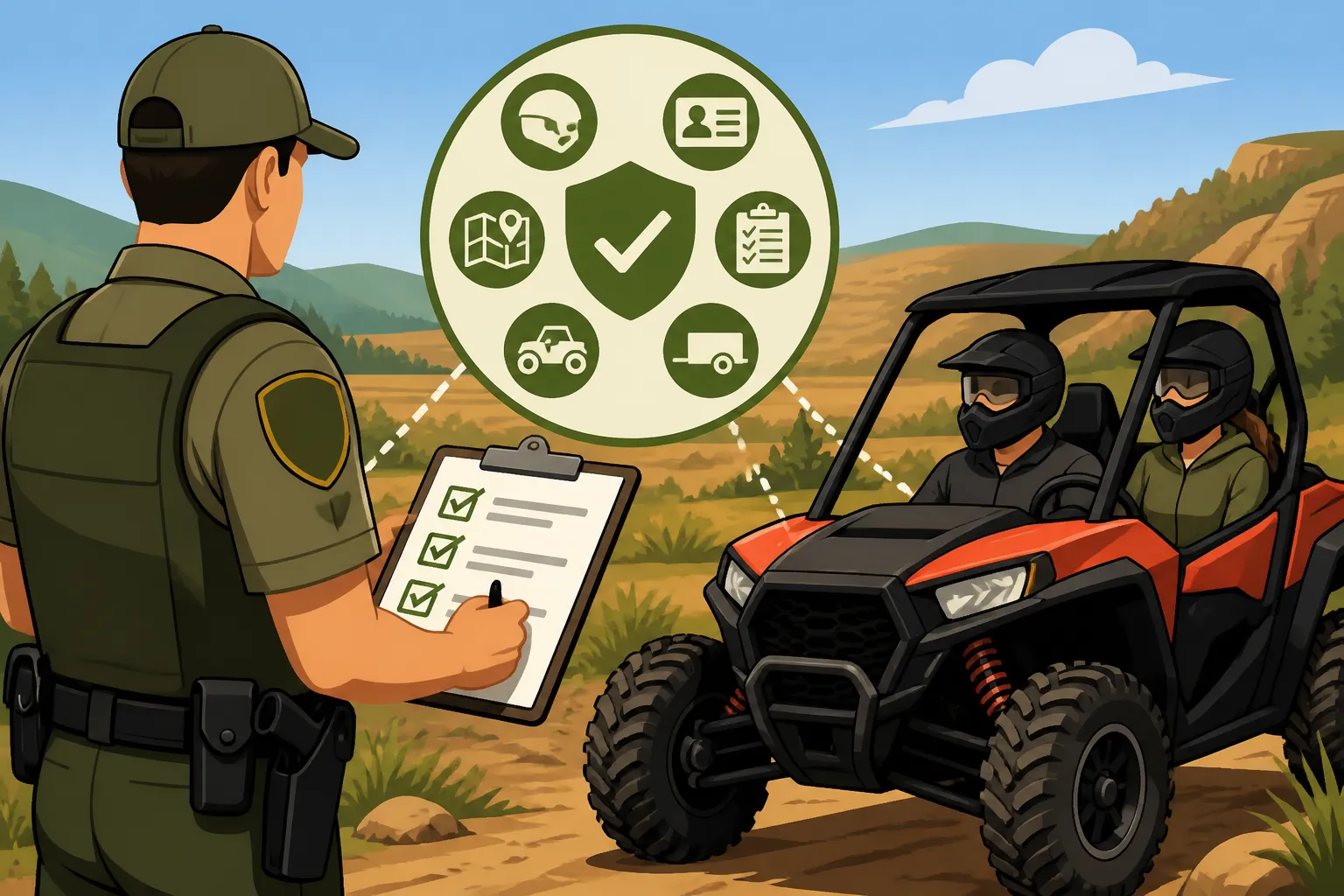
| What a warden may ask about | What to be ready to show or explain | Why it matters |
|---|---|---|
| Your location | Property name, access point, route, and map | Rules differ by property and route |
| Your access permit | Permit or proof of exemption, where applicable | Some public-land access requires a separate permit |
| Your machine | Ownership or registration documents if requested or relevant | Helps resolve questions about who owns or is operating it |
| Your route and timing | Where you entered and where you are going | Seasonal and designated-route restrictions may apply |
| Hunting activity | License, tags, harvest information, or permission as relevant | Wildlife rules apply even when you arrived by ATV or UTV |
| Your equipment and passengers | Required safety equipment and whether the machine is carrying permitted passengers | Vehicle and property rules may limit how you ride |
Game wardens are not the only people who may check compliance. Park personnel, other conservation officers, law enforcement officers, or property staff may also enforce rules within their authority. The person you meet and the precise rule being enforced depend on where you are.
Permits and Proof of Access
A land-access permit is not the same thing as an ATV registration decal, a hunting license, or permission to ride every public trail. Each serves a different purpose. The permit question is about access to particular land; registration concerns the machine; a hunting license concerns hunting privileges; and the property’s own rules determine where and when riding is allowed.
Oklahoma’s land-access rules can depend on residency, age, the land involved, and the reason for being there. Some residents may qualify for an exemption, while visitors generally should not assume that an Oklahoma resident’s exemption applies to them. The rules can also differ between state-managed areas and other public or privately managed property.
For a broader explanation of the different permit types and where to begin, see Oklahoma Land Access Permits Explained. If you are a resident, review Oklahoma’s Resident Land Access Permit; if you are visiting from out of state, start with Oklahoma’s Nonresident Land Access Permit. Families should check the age rules rather than assuming that a child either always needs or never needs a permit. Do Oklahoma Kids Need a Permit? addresses that question.
Have proof ready before you reach the property
If a permit applies to your visit, carry proof in a form the property accepts. That might mean a physical copy, an official digital record, or another approved method. Do not assume that a screenshot, a purchase receipt, or a photo of someone else’s permit will be accepted as proof for you. Confirm what the property recognizes before leaving home.
Keep the permit accessible but secure. A phone stored under a pile of gear is hard to retrieve during a check, and a paper copy can be damaged by water or mud. Some riders keep a paper backup in a dry bag even when they rely on a phone. A small document pouch bought through Amazon or another retailer can help keep papers together, but the pouch does not replace an actual permit or proof of exemption.
If you believe you are exempt, be prepared to explain why. An exemption may depend on details such as age, residency, or the type of access involved. Have identification available if it helps establish those details, and check the current official rules rather than relying on what a friend remembers from a prior season.
Know what your permit does not cover
A land-access permit does not automatically authorize riding outside the land or routes it covers. It does not grant permission to cross private property, ride closed roads, ignore a seasonal restriction, or use a trail that excludes your machine type. A permit also does not necessarily replace a hunting license, a park fee, or a separate requirement imposed by another land manager.
This is a common source of confusion for visitors. Someone may buy the correct permit for a public-access program and still need to pay a separate fee at a private riding park. Conversely, a state park pass or a private park wristband does not automatically satisfy access rules for a wildlife management area. Check the requirements for each place on your itinerary.
Machine, Ownership, and Registration Questions
A warden’s main concern may be wildlife or access rules, but the machine can become part of the conversation if its status or use is unclear. Be able to identify your ATV or UTV and explain who owns it. If you borrowed it, rented it, bought it recently, or inherited it, know whose name appears on the paperwork and how to reach that person.
Carry relevant ownership or registration documents when they are required or useful for the kind of riding you are doing. Requirements depend on the machine, where it is operated, and the applicable rules. A registration decal does not grant permission to ride on closed land, and a land-access permit does not serve as proof that a machine belongs to you.
For help understanding what ownership proof may be useful on a ride, see Oklahoma Proof of Ownership on the Trail. Riders using a machine with unusual paperwork should sort out the issue before the trip, rather than trying to explain a missing bill of sale or an uncertain ownership history at a trailhead.
Make the machine identifiable
Before loading up, check that the machine’s identification number is present and readable. Make sure any registration decal that applies is displayed as required. A missing, damaged, or obscured identification marking can complicate an otherwise ordinary stop, particularly if the machine has been borrowed or recently purchased.
Photographing the machine and its identification details before a trip can help you keep a record, but a photo is not a substitute for required documents. It is also sensible to keep purchase paperwork or other ownership records in a secure place, not loose on an open rack where they can blow away.
If you are riding a borrowed machine, ask the owner for the details you would need to answer basic questions: who owns it, where the paperwork is, and whether the machine is registered when registration applies. If it is rented, keep the rental agreement accessible and follow the rental company’s instructions about where you may ride.
Do not confuse registration with road use
An ATV registration or decal is not a general road permit. A machine that is registered for off-road use may still be prohibited from a public road, and rules for a street-legal UTV are a separate issue. Likewise, having a road plate does not authorize riding on a closed trail or through an area that excludes motor vehicles.
If a route uses a public road or crosses one, check the specific rules for that road and location. Do not infer that a road is open to ATVs because it is gravel, unpaved, or near a trailhead. Property maps, posted signs, and local rules can all matter.
Routes, Seasons, and Land-Use Restrictions
A warden may ask where you came from, which route you are following, or why you are in a particular area. Those are practical questions when access is restricted to designated roads, when a property has seasonal limits, or when a rider appears to have left an authorized route.
Before starting, identify the route you plan to use and the boundaries of the area. Keep an official map or current route information available, especially in places where phone service is weak. A consumer map or a route shown in an online post may be outdated or may show a road that is not open to recreational riding.
Some land-access areas have restrictions tied to hunting seasons or other management needs. The rules can specify when motorized access is allowed, which roads can be used, whether off-road travel is restricted, and what activities are permitted. Do not assume that land open to hunters is also open to general ATV recreation, or that access remains unchanged throughout the year.
For rules specific to wildlife management areas, start with Oklahoma WMA Access for a Quad. If you are riding on timber company land or another property with a limited access arrangement, read Oklahoma Timber Land Access Rules before you go. These properties may have conditions that are very different from a developed public riding park.
Read signs at the entrance and along the route
Signs may identify a closed area, a seasonal restriction, a vehicle limit, a speed limit, or a route boundary. Treat them as part of the rules, not as suggestions to follow only when convenient. If a sign conflicts with something you read online, stop and confirm the current rule with the land manager before continuing.
A gate is not an invitation to go around it. A closed gate, barrier, or “no motor vehicles” sign may be there to protect wildlife, limit erosion, prevent conflicts with other visitors, or enforce a seasonal closure. Do not assume that a gate is open because it is unlocked or that a track around it is an approved route.
Stay on authorized roads and trails
The line between a designated road and surrounding ground may be easy to miss, particularly in woods, grassland, or a broad clearing. Use the property’s official map and marked routes. If you cannot tell whether a track is open, do not treat tire marks as proof that it is legal to ride.
Going off route can create problems beyond a citation. It can disturb habitat, damage soil, create conflicts with hunters or other visitors, and make rescue harder if the machine becomes stuck or breaks down. A GPS track saved from a previous visit does not establish that the route is open now.
If a warden tells you that your route is closed or your location is restricted, stop safely and listen. Ask for clarification if you do not understand which route or boundary is involved. Do not argue while moving, continue farther into the area, or try to settle the issue by relying on a map app alone.
Hunting, Wildlife, and Seasonal Activity
Public-land checks often involve hunting because riders and hunters may use the same property at the same time. A warden may ask whether you are hunting, transporting game, carrying a firearm, or traveling through an area with an active season. Even if your reason for visiting is recreation, wildlife rules still apply to what you carry and do.
If you are hunting, have the licenses and any required tags or permits appropriate to your activity. Be prepared to explain what you are hunting, where you have been, and whether you have harvested an animal. Keep tags, harvest records, and other required information in the form the current rules require. The details vary with the species, season, and method of take, so check the official rules for that hunt.
A land-access permit alone is not a hunting license. A hunting license alone does not necessarily authorize ATV access to every property or route. The two questions should be checked separately. Oklahoma Hunting Access by Machine can help explain how machine access and hunting access intersect.
When a machine is used to retrieve game
A machine may be useful for transporting gear or reaching an authorized route, but its use for retrieving game can be subject to specific restrictions. Do not assume that being able to drive to a location means you may drive off road to reach a downed animal. A property may limit off-road travel, specify where a machine can be operated, or allow particular activity only under defined conditions.
Check the rules for the property and the hunt before relying on a machine for retrieval. If you have a question in the field, ask a warden or the land manager rather than taking a route that might cross a closed area or damage sensitive ground.
Firearms and other hunting equipment
If you carry a firearm, understand the rules for transporting and using it on that property. Requirements can vary depending on whether you are hunting, traveling through the area, or simply riding. A firearm secured on the machine does not make every location or activity lawful, and rules for discharge, transport, and hunting methods are not interchangeable.
Store equipment so it cannot fall, shift, or interfere with steering and braking. Keep ammunition, bows, and other gear secured. If you ride with a group, make sure every rider knows who is carrying a firearm and how the group will handle stops and trail crossings.
Avoid alcohol or impaired riding, particularly in hunting areas and on public routes. Impaired operation creates risk for riders, other visitors, and wildlife and can lead to serious legal consequences. When a machine is used during a hunt, the combination of firearms, rough terrain, and limited visibility makes sober, deliberate operation especially important.
Passengers, Safety, and Equipment
A warden or property employee may look at how the machine is being used, not just at the paperwork. That can include whether a passenger is riding on a machine designed for passengers, whether the rider is following posted speed limits, and whether the machine is being operated in a way that creates a hazard.
Never assume that a seat or cargo rack is a passenger seat. Follow the manufacturer’s seating limits and the property’s rules. A child riding on a machine should have a properly fitted helmet and should be able to reach the controls only when the machine is suitable for their size and experience. For age-specific rules, see Oklahoma Rules for Young Riders.
Helmets, eye protection, and protective clothing are practical safeguards even where a particular rule does not require them for every adult rider. Riders under 18 should pay especially close attention to applicable helmet requirements. A cage or other rollover protection on a UTV does not make seat belts optional; use the safety equipment designed for the machine.
Carry basic supplies for the conditions and distance you expect to travel. On remote land, a breakdown can turn a short ride into a long wait. A sensible kit may include water, a first-aid kit, a tire repair method, a tool roll, a charged phone, a map, and a way to contact help. Amazon can be one place to compare first-aid kits or weather-resistant document pouches, but check that the equipment fits your machine and the terrain rather than buying solely by a product description.
Keep the machine and cargo under control
Secure tools, fuel containers, firearms, and other cargo so they cannot fall into the trail or shift during a turn. Do not exceed the machine’s load limit. Keep racks and windshields clear of items that block your view or interfere with controls.
Stay at a speed that allows you to stop within the distance you can see. That matters on narrow trails, around blind corners, near pedestrians, and where hunters may be walking. Dust, brush, hills, and low light can conceal other visitors.
If a machine becomes disabled, move it out of the way when it is safe to do so. Do not leave it blocking a road or trail without warning other riders. If you need assistance, give the property name, nearest access point, and route marker rather than relying only on a phone’s approximate location.
Respect other visitors and wildlife
Public land is shared space. Slow down near hikers, horseback riders, campsites, and other machines. Give animals room, avoid chasing wildlife, and do not use a vehicle to harass or pursue animals. Noise, dust, and reckless riding can affect other visitors and may bring attention from wardens or property staff.
A quiet, organized stop is often the easiest stop. Pull to a safe place, turn off the engine if asked, keep your hands visible, and avoid reaching into a bag or compartment without explaining what you are doing. If you need to retrieve a document or identification, say so first.
If a Warden Stops You
A warden contact does not automatically mean you have done something wrong. It may be a routine check, a question about access, or a request for information related to hunting activity. Stay calm, follow lawful instructions, and answer clearly. If you do not understand a question, ask for it to be repeated.
Be ready to identify yourself and explain your activity. If asked about your route, give a straightforward answer. If you are unsure whether you are on a designated trail, say so and ask which route is authorized. Do not invent a reason for being there or claim that a permit covers something you have not confirmed.
If asked to show a permit or document, retrieve it carefully and explain what it is. Keep paperwork in a consistent place so you are not searching through tools or hunting equipment. A phone-based permit may be difficult to show if the battery is depleted or service is unavailable, which is one reason to check whether a paper backup is accepted.
If a warden identifies a violation, listen to the explanation and ask which rule or property restriction applies if that is not clear. Do not obstruct the contact or try to leave. If you disagree, the appropriate way to challenge a citation is through the process stated on the paperwork, not by arguing on the trail.
After the contact, write down what happened while details are fresh: the property, approximate location, time, officer’s name or identifying information if provided, and what you were told. Keep the citation or notice and follow its instructions. If the matter involves a permit, access boundary, or hunting regulation you do not understand, contact the relevant agency or a qualified professional for guidance.
A Pre-Ride Check That Prevents Most Problems
A short check before you unload can prevent a long conversation later. Confirm the property name, current access rules, and the route you intend to ride. Then check your permit status, machine paperwork, hunting documents if relevant, and the basics of your safety equipment.
Use this process for each property, not just the first stop of the trip:
- Identify the exact land manager and property.
- Confirm that motorized riding is allowed for your machine type and purpose.
- Check whether an access permit, park fee, hunting license, or other document applies.
- Review seasonal closures, designated routes, speed limits, and any special restrictions.
- Make sure ownership or registration documents are available when applicable.
- Check helmets, passenger seating, lights, cargo security, and the machine’s condition.
- Save a current map or route information and carry a backup if phone service may be unreliable.
- Tell someone where you plan to ride and when you expect to return.
Do not rely solely on an old social-media post, a trail app, or another rider’s memory. Rules can change, and a route that was open on a previous visit may be closed or restricted now. If information is unclear, call or contact the property manager before driving there.
A practical setup is simple: permit and identification in one accessible place, machine documents stored securely, route information available offline, and gear packed so that nothing has to be unpacked on the shoulder. Amazon may help with basics such as a dry document pouch or a compact first-aid kit, while official land-manager information is where you should confirm access rules and permits.
The main takeaway is that a warden may be checking several separate things: your right to be on that property, your right to ride that route, your hunting activity, and how you are operating the machine. A decal or permit can answer one question without answering the others. Know the land, carry the proof that applies to your visit, and stay on authorized routes.
Disclaimer
This article is for general informational purposes only and does not constitute professional advice. Laws, prices and regulations vary by location and change over time. Consult a qualified professional for guidance on your specific situation.