Oklahoma Rules for Young Riders
Oklahoma Rules for Young Riders
If your child wants to ride an ATV or UTV in Oklahoma, the hard part is knowing which rules apply to their age, the machine, and the place you plan to ride. A rule for a public road may not be the same as a park’s admission policy, and a permit exemption is not permission to ride anywhere. This guide helps you sort those details before loading up.
Start With the Place, Not Just the Rider’s Age
Oklahoma does not have one simple set of youth-riding rules that answers every question for every machine. The rules can depend on whether your child is riding on private property, a public trail, a wildlife management area, a private park, or a road. The machine matters, too: a youth quad, adult ATV, and street-legal UTV can fall under different requirements.
Before a ride, identify the setting and ask the land manager or property owner what applies there. Then check the rules for the machine and the young rider. A parent’s permission, for example, does not override a park’s minimum-age policy or make a road open to ATVs.
| Where the child rides | What to check first | Common point of confusion |
|---|---|---|
| Private property | Owner permission, safe boundaries, machine fit, and any applicable state rules | Permission to ride does not make the machine suitable for the child |
| Public trail or riding area | Area access rules, helmet requirements, permit rules, and any age restrictions | A statewide permit exemption may not waive the site’s other rules |
| Wildlife management or timber land | Access season, designated routes, permits, and age-related exemptions | Access may be limited to specific dates or purposes |
| Private off-road park | Park minimum age, waiver, supervision, passenger, helmet, and equipment rules | A parent may need to sign a waiver but cannot disregard the park’s rules |
| Public road | Whether that road is open to the machine and whether the driver meets road-use requirements | An ATV registration decal is not a road plate |
| Street-legal UTV route | Driver eligibility, license, insurance, equipment, and road restrictions | Being old enough to operate a UTV off-road does not establish eligibility to drive one on a street |
This is why an answer like “my child is old enough to ride” is incomplete. Old enough for what machine, on which property, and under whose rules? For a broader overview, see Oklahoma ATV Age Requirements and Oklahoma Rules Riders Get Wrong.
It also helps to separate four kinds of requirements:
- State law: Rules that apply under Oklahoma law in the situations covered by that law, such as helmet requirements for young ATV riders.
- Land access rules: Requirements set for a particular public land area, including permits, seasons, and permitted routes.
- Park or property rules: Conditions set by a private park or landowner, which may be stricter than general state requirements.
- Safety decisions: Practical choices—such as starting with a smaller, slower machine—that may be sensible even when they are not expressed as a legal age limit.
A rule in one category does not automatically replace the others. A child may be exempt from a particular land-access permit and still need to wear a helmet, follow the property’s rules, and ride a machine that they can control.
Age, Supervision, and Choosing a Suitable Machine
Parents often want a single minimum age for riding an ATV or UTV. In practice, do not assume that one age number answers every question. The setting, machine, and activity may each have separate rules. A public road has different eligibility requirements from a private field, and a passenger’s eligibility is not the same as a driver’s.
When considering a machine for a child, focus on whether they can safely operate that exact machine—not just whether they have ridden before. A child who can manage a small youth quad on level ground may not be ready for a larger, heavier machine, steep terrain, loose sand, deep mud, or a multi-passenger UTV. Power, speed, braking, weight, seat height, and throttle response all affect how much control a young rider actually has.
Match the machine to the rider
Before the first ride, check whether the rider can:
- Reach and use the controls without stretching or shifting into an unstable position.
- Operate the throttle and brake deliberately, including during a quick stop.
- Keep a firm grip and maintain balance over the terrain you expect to ride.
- Turn and stop the machine without help.
- Understand and follow simple riding instructions.
- Recognize when to slow down, stop, or ask for help.
Those are practical checks, not a substitute for the manufacturer’s age and size guidance. Read the owner’s manual for the specific machine. If a machine is recommended for an older or larger rider, do not treat adult supervision as a way to make it fit a smaller child.
A good first ride is deliberately uneventful: a flat, open, familiar area, low speed, no passengers, and enough room to practice starting, stopping, and turning. Leave hills, obstacles, water crossings, traffic, and group rides for later—if they are appropriate at all.
Supervision is an active job
A responsible adult should be close enough to intervene and should be watching the young rider, not just riding somewhere in the same group. Stay within a range where you can see the child and communicate. Avoid putting a new rider at the back of a fast group, where they may feel pressured to keep up or may be left without help.
Give instructions before the engine starts. Agree on a stop signal, what to do if the machine stalls, and where the rider should wait if separated from the group. Explain that the child should not follow another rider out of sight or try to catch up by riding faster. For more on supervision and shared rides, see Oklahoma Parent Riding With a Child.
Passengers need separate consideration
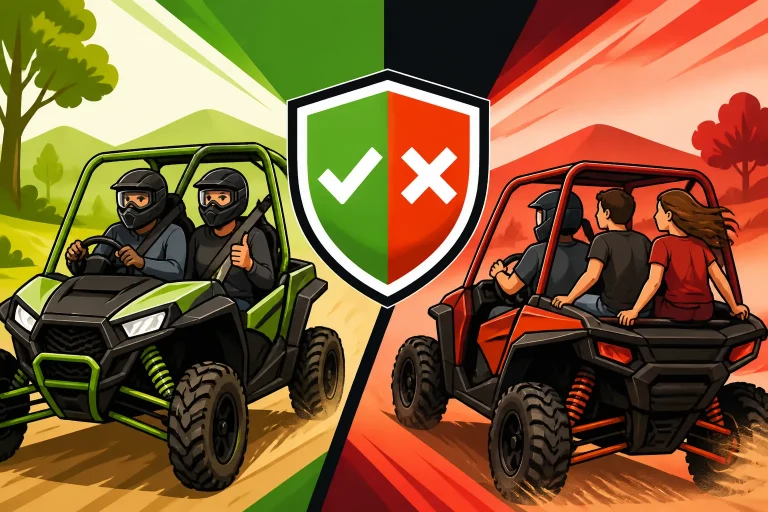
Do not assume that a child can ride as a passenger on any ATV or UTV simply because an adult is driving. A quad may not be designed for a passenger, and adding one can affect the driver’s control and the machine’s balance. On a UTV, follow the manufacturer’s seating and restraint instructions and do not exceed the number of passengers the machine was built to carry.
The site may also have its own passenger rules. A park might restrict which riders can sit in a particular vehicle or require age-appropriate restraints. Check the rule before arriving, and do not improvise a seat or carry a child on a rack, fender, or other spot not intended for passengers. See Oklahoma Rules for a Child Passenger for related guidance.
Helmets and Protective Gear for Riders Under 18
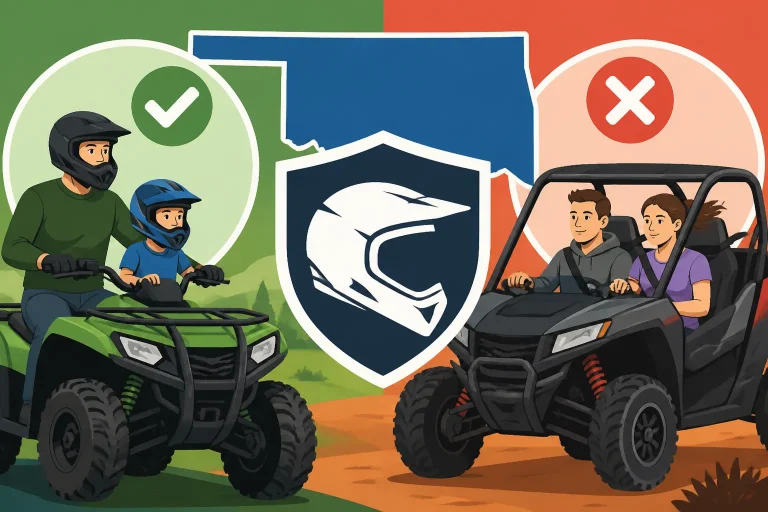
Oklahoma’s rules require young ATV riders covered by the state requirement to wear a helmet. As a safe planning choice, make a properly fitted helmet part of every youth ride, even if you are unsure whether a particular private-property situation is covered by a legal requirement. A private park may also set its own helmet rule, and that rule can apply to adults as well as children.
For more detail on the age-related law, see Oklahoma ATV Helmet Law Age. Do not treat a parent’s permission, a short ride, or the child’s experience as a substitute for required protective gear.
Choose a helmet that fits and is made for the activity
A helmet should fit the young rider’s head securely, stay in place when the chin strap is fastened, and be suitable for motorized riding. A loose helmet may shift or come off in a crash. A helmet that is too small can be uncomfortable enough that a child is tempted to loosen the strap or remove it.
Check the label and product documentation for the applicable safety standard, and confirm that the helmet is intended for the type of riding you plan to do. Do not assume a bicycle helmet, novelty helmet, or unverified used helmet meets the requirements for ATV riding. If you compare products on Amazon, verify the exact model and safety information rather than relying on a listing title or a photo.
Let the child try the helmet on before the ride. Ask them to look up, down, and side to side; the helmet should remain secure and should not block their vision. Fasten the chin strap according to the manufacturer’s directions. If a helmet has been in a crash or has damage, follow the manufacturer’s guidance on whether it must be replaced.
Protect more than the head
A helmet is essential, but it is only one part of sensible riding gear. Consider:
- Eye protection that stays in place and allows the rider to see clearly.
- Gloves that fit without limiting grip or control.
- Long sleeves, durable pants, and sturdy footwear that cover the rider’s legs and feet.
- Clothing suitable for the weather and terrain.
- On a UTV, the seat belt and any other restraint the manufacturer provides.
Gear needs to fit the child. Oversized gloves can interfere with controls, loose clothing can snag, and footwear that slips off easily is not a good choice. On sandy or dusty trails, eye protection is especially useful. In warm weather, dress for heat and plan breaks, but do not remove safety equipment while the vehicle is moving.
A child may resist gear that feels hot or awkward. Let them try it on at home, adjust the fit before the ride, and explain which items must stay on. When shopping, whether through a local dealer or on Amazon, use the manufacturer’s sizing instructions and check that the particular product is designed for the intended use. A product page alone cannot tell you whether a helmet fits your child.
Permits, Public Land, and Out-of-State Riders
A land-access permit is not a general license to ride anywhere in Oklahoma. It applies to the access program and places it covers. It does not automatically provide entry to a private park, authorize riding on a closed trail, or make an ATV legal on a public road.
Oklahoma has age-related exemptions for resident riders in the land-access permit system. Residents under 18 may be exempt from the permit requirement that applies to other riders in covered circumstances. That exemption is about the permit; it does not mean a young rider is exempt from helmet, land-use, seasonal, or site-specific requirements.
Nonresident families should not assume that a child’s age creates the same exemption. The permit rules for visitors can differ from those for residents. Check the current requirements for the specific land and rider before traveling. Oklahoma Resident Land Access Permit and Oklahoma Visitors From Texas provide related information for planning.
Check the land category
A riding area’s name or public status is not enough to determine its rules. A state-managed riding area, wildlife management area, timber-company property open under a public-access arrangement, and private ranch park may have different access conditions.
For each destination, confirm:
- Whether ATVs and UTVs are allowed.
- Whether the area is open during your planned dates.
- Whether a permit, check-in, or other access step is required.
- Which roads or trails are open to the machine.
- Whether there are additional rules for young riders, passengers, helmets, or supervision.
- Whether a child must be accompanied by an adult.
Some public access is seasonal or tied to a particular use, such as hunting. A family should not assume that an area open to riders at one time of year is open year-round. Public land may also require riders to stay on designated roads or trails. If a map, sign, or land manager says a route is closed, a permit does not override that restriction.
See Oklahoma Land Access Permits Explained for the general permit framework and Oklahoma WMA Access for a Quad for the distinction between having access and being allowed to ride in a particular place or season.
Reciprocity does not mean every out-of-state decal works everywhere
A visiting rider should not assume that a registration decal from another state replaces every Oklahoma access requirement. Registration, land access, park admission, and road authorization are different questions. The rules may depend on where the visitor rides and what the vehicle is doing.
If you are bringing a child from another state, check both the access requirements and any helmet or age rules that apply in Oklahoma. A permit exemption available to an Oklahoma resident may not apply to a nonresident child. When the answer is unclear, ask the relevant land manager or agency before the trip, rather than relying on a friend’s experience at a different riding area.
Keep required documentation accessible, and explain to the young rider that access has boundaries. A route that is legal for an adult machine may not be open to a youth rider’s vehicle, and a trail being physically passable does not mean it is open to motorized use.
Roads, Crossings, and Street-Legal UTVs
An ATV registration decal does not automatically authorize a machine to travel on public roads. Road access depends on the type of road, local rules, the machine’s classification, and any applicable state requirements. A child’s riding experience on private land does not create road privileges.
Oklahoma has a street-use framework for qualifying UTVs, but it is separate from ordinary off-road use. Under the street-legal UTV rules, the driver must meet the applicable age and licensing requirements. The listed minimum driving age is 16, and the driver must satisfy the license requirements for that vehicle use. Do not treat that as a general rule allowing a 16-year-old to drive any ATV or UTV on any road.
For the details, see Oklahoma Street Legal UTV Requirements and What License a 16-Year-Old Needs for a Street UTV. Confirm current requirements before a young person drives on a public street, especially if the UTV was modified or its registration status has changed.
An off-road ride is not a road trip
Do not let a child ride an ATV along a road simply because the machine is registered or the road looks quiet. Rules for county roads, city streets, highways, and road crossings can differ. Local ordinances and posted restrictions matter. Even where a crossing is allowed, that does not mean the ATV may travel along the roadway.
Before taking a route that touches a road, establish whether the route is allowed and where any crossing must occur. Children need to understand that they must stop and wait for an adult if a planned route reaches an unexpected road or a closed gate. They should never be told to “just cross quickly” without confirming that the crossing is permitted and safe.
A street-legal UTV is not automatically allowed on every road, either. Some road types remain restricted, and an eligible driver still has to meet equipment, insurance, and other requirements. A parent should not use the vehicle’s road plate as proof that a particular route is open.
Keep young riders out of traffic decisions
Even where road use is lawful for an eligible driver, a busy road or complex intersection is a poor setting for teaching a child to ride. If a young person is not legally eligible to drive the UTV on the road, an adult should drive. If a road is not open to the machine, use a trailer or another lawful route rather than asking the child to ride along the shoulder.
Make the road plan before leaving home. Review the route, the machine’s status, and local rules, and do not assume a map app shows ATV access. For more on road distinctions, see Oklahoma Rules for Riding a County Road and Oklahoma Rules for Crossing a Highway.
Private Parks, Trails, and Property Rules
Private riding parks can set rules that are stricter or more detailed than the general state rules. A park may have minimum ages for particular machines, age limits for passengers, supervision requirements, waivers for minors, or separate restrictions for trails and camping areas. Call or check the park’s current rules before making a long drive. See Oklahoma Private Park Minimum Ages and Oklahoma Private Park Helmet Rules.
Do not rely on a general statement such as “kids are welcome.” Ask what that means for your child and machine:
- Can the child ride their own ATV, or only ride as a passenger?
- Does the park have a minimum age for riding a specific vehicle?
- Must a parent or guardian remain with the child?
- Are helmets required for all riders or only young riders?
- Does the park require a waiver, and who must sign it?
- Are there trail sections that children or youth machines cannot use?
- Are there separate rules for nighttime riding, camping, or group rides?
A signed waiver does not make an otherwise prohibited activity acceptable. Nor does it guarantee that a child can ride a particular trail. Staff can turn riders away if they do not meet the park’s conditions.
On private property, get clear permission from the owner and agree on boundaries before the ride. Permission to use one field does not necessarily include permission to use a neighboring pasture, creek bed, oil lease road, or access road. Gates, livestock, farm equipment, and other people may create hazards that are not obvious to a visiting child. Explain where the young rider may go and where they must stop.
Use a route that fits the child
A marked trail may still be too difficult for a new rider. Look at the surface, slope, visibility, traffic, obstacles, and distance. Sand can reduce steering control; loose rocks can upset a small machine; mud can hide ruts or water; and blind corners can put a child in the path of faster riders.
Start with terrain the child can handle and stop if conditions change. Rain, dust, crowding, or fatigue can make a familiar trail harder. Give the child permission to turn back rather than pressure them to finish a loop. For family destination planning, Oklahoma Trails for Kids can help you compare options, but confirm current access and local rules directly with the area.
If you are checking gear online, Amazon product descriptions can help you compare sizes or features, but they do not establish what a riding park accepts. Check the park’s requirements and the gear manufacturer’s information. When a helmet, restraint, or other item has to meet a particular standard, verify the exact model rather than relying on a general search result.
A Practical Pre-Ride Checklist for Parents
A short check before starting can prevent common mistakes. Use this list whenever the setting, machine, or rider changes.
- Name the destination. Identify the property, trail system, park, or road route. Do not use “public land” as a substitute for checking the specific area.
- Confirm access. Find out whether the area is open to your machine and whether access is limited by season, permit, check-in, or route designation.
- Check the rider’s status. Consider the young person’s age, residency, role as driver or passenger, and the rules of the place where they will ride.
- Choose an appropriate machine. Read the owner’s manual and make sure the rider can operate the controls and handle the vehicle on the expected terrain.
- Fit protective gear. Check the helmet, strap, eye protection, gloves, clothing, footwear, and UTV restraints before the engine starts.
- Set clear boundaries. Point out where the rider may travel, where they must stop, and what to do if separated from the group.
- Plan supervision. Keep the child in sight and avoid group speeds or routes that encourage them to ride beyond their ability.
- Review road contact. Make sure any road use or crossing is lawful for the vehicle and driver. If you are not sure, choose a different route.
- Check conditions again. Weather, trail closures, crowding, and fatigue can change what is safe after you arrive.
- Stop when needed. A rider who is tired, upset, overheated, or struggling with control should take a break or end the ride.
For a younger child, the first outing should be short and simple. A parent can demonstrate how to start, stop, turn, and wait, then let the rider practice one skill at a time. A child who cannot reliably stop when asked is not ready to ride farther away or faster. Reassess as they grow, but do not assume that age alone means a larger machine or more challenging trail is appropriate.
If your child is ten
For a ten-year-old, focus on a properly sized youth machine, direct adult supervision, a helmet, and an uncomplicated practice area. Check the vehicle manual and the specific property’s rules before riding. Do not infer that a child can operate an adult-size machine just because a friend of the same age has done so. See [Oklahoma Rules for a Ten-Year-Old Rider] for an age-specific discussion.
If your child is sixteen
A 16-year-old may be eligible to drive a qualifying street-legal UTV if they meet the applicable requirements, but that does not give them blanket permission to drive every off-road machine on public roads. Verify the driver’s license, vehicle, equipment, insurance, and route requirements. For an off-road ride, continue to apply the rules for the land and park. See [Oklahoma Rules for a Sixteen-Year-Old Rider].
Do not treat a safety course as either a magic key or a wasted step
A course can help a young rider learn control, trail awareness, and safe decision-making, even where a course is not generally required by state law. It does not replace a helmet, a suitable machine, an access permit when one is required, or a park’s age policy. If you are considering instruction, Oklahoma Safe Riders Program is a useful place to start.
The most reliable family routine is straightforward: check the place, check the machine, check the rider, and check the rules again when any of those change. Keep an eye on current agency and park guidance, especially before traveling or riding on public land. When a rule is unclear, ask the organization that manages the destination rather than relying on an assumption.
Disclaimer
This article is for general informational purposes only and does not constitute professional advice. Laws, prices and regulations vary by location and change over time. Consult a qualified professional for guidance on your specific situation.