Oklahoma Rules for an Out-of-State Decal
An out-of-state ATV or UTV decal can help show that a machine is registered where it is based, but it does not automatically grant every kind of access in Oklahoma. What you need depends on the machine, the land you plan to ride and whether you intend to use public roads. Keep the decal and paperwork together, and check each destination’s rules before traveling.
What an Out-of-State Decal Does in Oklahoma
A decal from your home state is evidence of registration there. It is not a universal Oklahoma pass. It does not, by itself, prove ownership, meet every local access requirement or make an off-road machine legal on a public road.
For a visitor bringing a properly registered machine from another state, the home-state registration is an important document to carry. But the rules can depend on whether your state requires registration, whether the machine is registered there, and how you plan to use it in Oklahoma. A sticker by itself may not answer those questions. Bring the registration card or certificate as well, and keep it available while riding.
Oklahoma’s own registration and title requirements are a separate issue, particularly for machines owned by Oklahoma residents. If you have moved to the state or plan to establish Oklahoma as the machine’s home, do not assume your old decal settles the matter. See Oklahoma Registration for a New Resident and Oklahoma Rules for an Out-of-State Machine for those situations.
| What you have or plan to do | What the out-of-state decal may show | What it does not automatically establish |
|---|---|---|
| Visit Oklahoma with a machine registered in your home state | The machine is registered there, subject to the home state’s rules | Permission to ride on every Oklahoma property or road |
| Ride on land with its own access requirements | The machine may have current home-state registration | That you have any required land-access permit |
| Use a public road | The machine may be registered off-road in another state | That the machine meets Oklahoma road-use rules |
| Show ownership or identify the machine | A registration record may help connect the machine to you | Ownership if the registration is not in your name or does not match the machine |
The practical answer is to treat the decal as one piece of paperwork, not the only one. Carry proof of registration, proof of ownership if available, and any permit required for the place you are visiting. If the machine’s serial number, owner name or registration status does not match the paperwork, resolve that before setting out.
For a closer look at the specific question of whether Oklahoma recognizes another state’s sticker, see Does Oklahoma Recognize Another State’s ATV Decal?. The key distinction is that recognition of a home-state registration is not the same as permission to ride anywhere in Oklahoma.
Land Access Permits Are Separate From Registration
Oklahoma does not have one decal that grants access to every riding area. State-managed areas, timber company land, private parks and other properties can each set their own requirements. A valid out-of-state registration does not replace a land-access permit where one is required.
This matters especially when a destination is open for a particular activity or season rather than general, unrestricted riding. Some land access requirements are tied to the property and the kind of use, not to where the machine is registered. Before you leave, check the destination’s current rules for riders, permits, season dates, designated routes and check-in procedures.
If you plan to ride on Honobia Creek or Three Rivers, confirm whether you need the applicable land-access permit for your visit. Permit requirements can vary by residency and eligibility. Start with Oklahoma’s Nonresident Land Access Permit and How to Buy an Oklahoma Land Access Permit, then verify the current details with the official permit seller or land manager.
A land-access permit and an ATV registration decal serve different purposes:
- Registration connects a machine to a registration system and may show that the machine is registered in its home state.
- A land-access permit authorizes a person to use particular land when that property’s rules require it.
- A park fee or admission pass covers access under the park’s rules; it does not necessarily cover a different property.
- A road plate or street-use approval relates to road operation and is not a substitute for off-road land access.
Do not assume that a permit for one riding area covers another. Likewise, a state park or private park may have its own admission, waiver, equipment or age requirements, regardless of the machine’s out-of-state decal. If the trip includes more than one destination, check the rules for each one separately. [Oklahoma Permit Questions Parks Hear] can help you identify what to ask before arriving.
When checking requirements, be precise about the location. “Riding in Oklahoma” is too broad to get a reliable answer. Ask which permit applies to that exact property, whether it applies to nonresident riders, whether it must be purchased before arrival, and what proof the rider must show. If a park or land manager requires a permit, have the confirmation accessible on your phone or carry a printed copy when practical.
A Decal Does Not Make an ATV or UTV Road-Legal
An off-road registration decal from another state does not turn an ATV or UTV into a street-legal vehicle in Oklahoma. Road use is governed by separate rules and may depend on the type of machine, the road and any applicable local authorization.
Do not ride on a public road just because the machine has a registration sticker, lights, mirrors or other equipment. Those features alone do not establish that the machine qualifies for road use. Oklahoma has specific rules for street-legal UTVs, and local rules can also affect where off-road machines may travel. Review Oklahoma Street Legal UTV Requirements and Oklahoma Rules for Riding a County Road before planning a road route.
A road crossing is also different from riding along a road. A machine may be subject to narrow crossing rules without being allowed to travel along the highway or street. Check the applicable rules for the exact road and route; do not treat an out-of-state decal as permission to use either.
If you are visiting from Texas, Kansas, Arkansas or Missouri, start with the applicable visitor information, such as Oklahoma Visitors From Texas. A neighboring state’s registration or trail decal does not necessarily carry the same privileges across the border. Reciprocity, where it applies, should not be read as a blanket exemption from Oklahoma’s land-access, road-use or local rules.
The distinction is useful when planning a ride:
| Riding situation | Check before you go |
|---|---|
| Private off-road park | Admission, waiver, age rules, equipment rules and whether the park accepts your documentation |
| Public land or timber company property | Permit eligibility, permitted dates, designated routes and check-in requirements |
| County road or city street | Whether riding is allowed there and whether the machine qualifies for that use |
| Crossing a public road | The specific crossing rules and whether the route is permitted |
| Trailering between riding areas | Access requirements at each destination; the machine’s decal does not transfer access from one property to another |
When the trip includes public roads, review Oklahoma’s Street-Legal UTV Class Explained as well. A machine that qualifies for a road plate may have different registration and equipment obligations from a machine that is registered only for off-road use. Do not rely on another state’s classification to determine how Oklahoma treats it.
What to Carry and Check Before You Ride
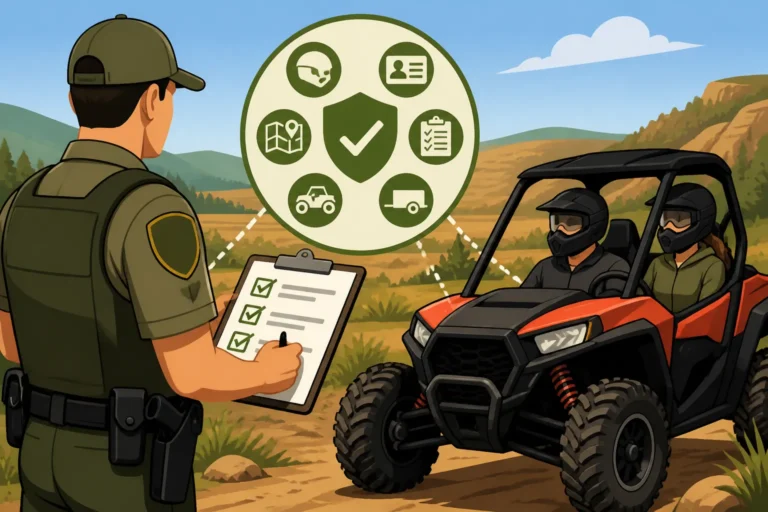
A little preparation can prevent a border-crossing paperwork problem from turning into a wasted trip. Keep the documents together and make sure the machine’s identifying details match the records.
Before loading the machine, use this checklist:
- Check the home-state registration. Confirm that it is current and applies to the machine you are bringing. Carry the registration card or certificate, not just the decal.
- Match the paperwork to the machine. Compare the owner name and serial number or VIN on the machine with the documents. If the number is hard to read, photograph it before travel and review Oklahoma Proof of Ownership on the Trail.
- Confirm the destination’s access rules. Ask the land manager or park whether a nonresident needs a permit, whether a reservation or check-in is required, and which areas are open to your type of machine.
- Separate off-road access from road use. If your route involves a public road, check whether that specific use is legal. Do not assume registration in another state provides road privileges in Oklahoma.
- Carry permit evidence. Keep any permit, pass or admission confirmation where you can show it. A decal does not substitute for a separate permit.
- Check for changes before departure. Rules, operating seasons, closures and permit procedures can change. Confirm current requirements with the official agency, park or land manager rather than relying on an old receipt or an online discussion.
If the machine is not registered in your home state, or you cannot produce paperwork that matches it, contact the appropriate agency or destination before traveling. Explain that the machine is an out-of-state ATV or UTV, where it is registered or titled, and where you intend to ride. Ask what proof is acceptable and whether any Oklahoma registration or permit applies to your situation.
A seller’s receipt, bill of sale or title can help establish ownership, but it does not necessarily take the place of registration or a required access permit. For a used machine, make sure the paperwork follows the machine and that the serial number is legible. If you bought it recently, keep the sale documents with the registration during the trip.
The safest planning rule is simple: use the out-of-state decal as evidence of home-state registration, then check Oklahoma’s separate requirements for the land and roads on your itinerary. If you are unsure whether a particular decal is accepted, ask the relevant agency or land manager before riding rather than relying on the sticker alone.
Disclaimer
This article is for general informational purposes only and does not constitute professional advice. Laws, prices and regulations vary by location and change over time. Consult a qualified professional for guidance on your specific situation.