Passenger Rules Inside a Private Riding Park
A passenger may be allowed on one machine at an Oklahoma riding park and turned away on another. The key questions are whether the vehicle was built for two, whether the passenger meets the park’s age and safety rules, and what the waiver requires. Check those details before loading up; a private park can set conditions that differ from public-land rules.
Start with the machine’s passenger capacity
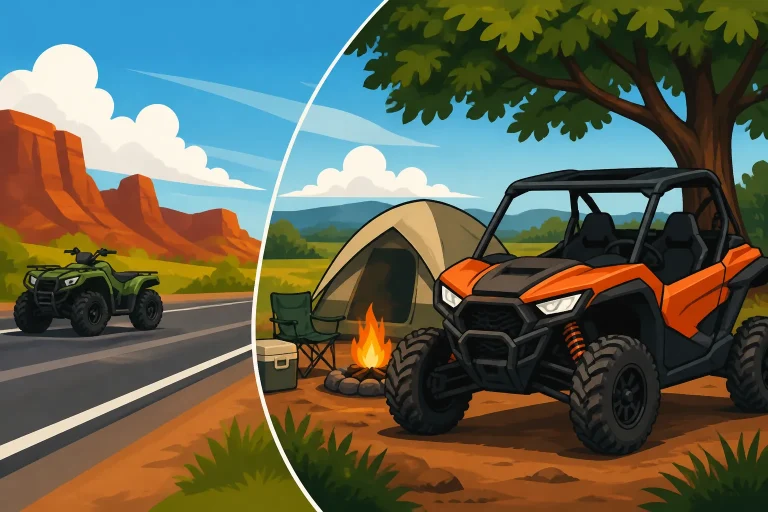
A private park’s permission to ride does not make every machine safe or suitable for a passenger. Start with the manufacturer’s seating capacity and the vehicle’s equipment. A quad built for one rider should not carry a second person on the rack, fenders, or an improvised seat. A passenger can shift the machine’s balance, interfere with the driver’s control, and be thrown off in a turn or on uneven ground.
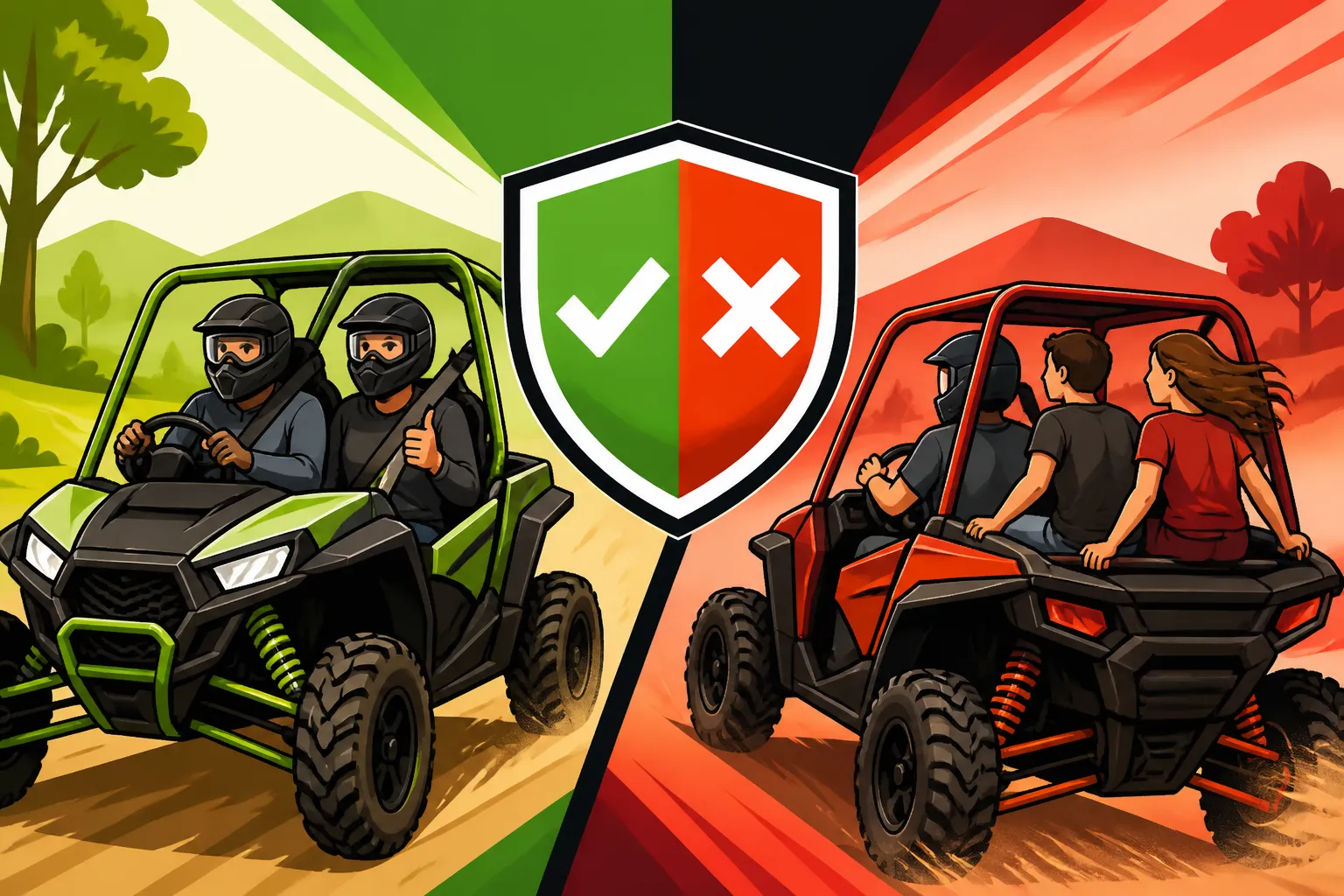
A two-seat quad or a UTV with an approved passenger seat is a different matter, but the park may still have restrictions. Its rules may distinguish between single-seat and two-seat models, require passengers to stay in designated seats, or set limits on how many people can ride at once. A UTV’s passenger capacity is not unlimited just because it has a bench: follow the number of seats and restraints provided by the manufacturer.
For a quick comparison:
| Machine or situation | What to verify before riding |
|---|---|
| Single-seat quad | Do not carry a passenger unless the manufacturer designed and equipped the machine for one |
| Two-seat quad | Confirm the passenger seat, footrests, handholds, and any park conditions |
| UTV or side-by-side | Use designated seats and restraints; confirm the park allows the passenger’s age |
| Passenger who is a child | Ask about minimum age, fit in the seat, helmet, and adult-supervision rules |
| Passenger on a trailer, rack, or cargo bed | Do not assume it is allowed; ask the park and follow the vehicle’s intended seating |
These are practical safety checks, not a substitute for the park’s posted rules. The basic principle also appears in Passengers Only If the Machine Was Built for Them. For UTV-specific passenger considerations, see Oklahoma Rules for Passengers on a UTV.
A passenger needs to be able to sit securely, keep hands and feet inside the vehicle, and use the provided handholds or restraints. If a child cannot sit upright with their feet supported or cannot use the seat belt as intended, the machine may not be a safe fit even if a park’s minimum age rule would otherwise allow entry. Do not modify or defeat a restraint to make a passenger fit.
Check the park’s age, helmet, and restraint policies
Private parks set admission and riding conditions for their own property. One park may admit younger passengers in a UTV with a full cage and seat belts; another may set a higher minimum age, require a helmet for every passenger, or bar young children from riding altogether. Policies can also vary by machine type or trail area. A rule that applies to a passenger in a UTV may not apply to a passenger on a quad.
Ask the park directly about the specific passenger and machine you plan to bring. “Can my child ride?” is less useful than: “Can a child of this age ride as a passenger in this model of UTV, and what restraint and helmet rules apply?” Give the park the vehicle type and number of seats, and ask whether any restrictions apply to a particular trail or riding area.
Useful questions include:
- Is there a minimum age for a passenger? Does it differ for a quad and a UTV?
- Does the passenger need to meet a height, size, or seat-belt-fit requirement?
- Are helmets required for passengers? Are there additional requirements for children?
- Must UTV passengers wear seat belts at all times?
- Are doors, nets, or other occupant restraints required?
- Can a passenger ride in a two-seat quad, or only in a UTV?
- Are passengers allowed on every trail, or only on designated routes?
- Does the driver need to meet a minimum age or show a license?
- Does a parent or guardian need to sign paperwork for a minor?
The park’s terms may appear on its website, reservation page, entrance signs, or waiver. If answers conflict, contact the office before traveling and follow the current instruction given by staff. You can also review [Oklahoma Private Park Minimum Ages] and Oklahoma Private Park Helmet Rules for related questions, but the individual park’s policy is what you need to confirm for that visit.
Do not assume a park’s helmet policy is identical to a rule for riding on public land or roads. A private operator may require helmets even where a state rule does not impose the same condition on that situation. The reverse is not a reason to skip protective gear: a helmet that fits and is appropriate for off-road riding is a sensible precaution for a passenger, especially a child. Ask what standard and equipment the park accepts rather than relying on a general assumption.
For UTVs, the passenger should use the seat belt or other restraint provided and keep the body within the protected occupant area. A cage alone does not keep someone seated during a rollover. If the belt is damaged, missing, or cannot be worn properly, do not carry a passenger in that seat. Quads generally do not have the same occupant protection as a UTV, so secure seating, foot placement, passenger experience, and the park’s approval matter especially.
Understand waivers and the difference between private and public access
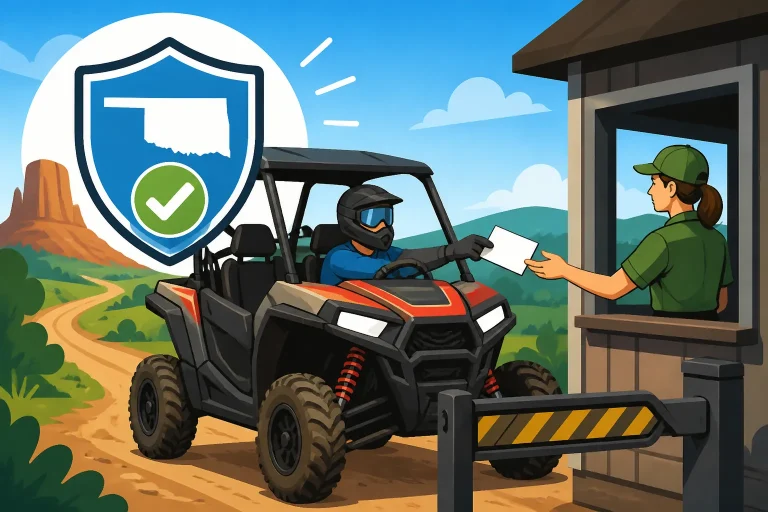
A private park may require each rider, passenger, or parent to sign a waiver before entry. A waiver can describe risks, allocate responsibility, and confirm that the person agrees to the park’s conditions. It does not mean the operator has approved every passenger or every way of riding. Read the form and posted rules, and ask staff about any condition that is unclear before signing or unloading.
For a minor, the park may require a parent or legal guardian to complete paperwork. Do not assume that one adult’s signature covers every child or every vehicle; ask how the park handles minors and whether the child must be present when the form is completed. Related information is available in Oklahoma Private Park Waivers and Signing a Liability Waiver Before a Private Ranch Ride.
Private-park admission is also separate from permits for certain public lands. A private park typically controls access through its own admission process and rules, while public-land programs can have separate permit requirements. A state land-access permit should not be treated as a pass to a private park, and a private park’s entry fee or waiver should not be treated as permission to ride elsewhere. For context on public-land permits, see Oklahoma Land Access Permits Explained.
That distinction matters when a trip includes more than one riding destination. A permit that applies to a particular public area may not cover a privately operated facility, and a private park’s rules do not automatically carry over to another property. Check each location separately, including whether it has a day-use process, reservation requirement, check-in procedure, or restrictions for passengers. The [Oklahoma Private Park Minimum Ages] page covers another part of the same planning problem.
Keep proof of any required booking or admission handy, and make sure every passenger knows the park’s rules before entering the riding area. A waiver does not replace a helmet, a working seat belt, or a suitable passenger seat. Nor does permission to ride as a passenger mean the passenger can drive; the park may have separate driver-age and supervision rules.
Plan the passenger check before you leave
A short check at home can prevent a long delay at the gate. Confirm the machine’s intended seating, inspect the passenger equipment, and verify the park’s current rules for the passenger’s age and vehicle type. If you are relying on an online policy, check that it applies to the location and riding area you plan to use. When in doubt, call the park and describe the exact setup.
Use this sequence:
- Identify the machine. Confirm whether it is a single-seat quad, a two-seat quad, or a UTV, and check the manufacturer’s passenger capacity.
- Check the passenger fit. Make sure the person can sit in the intended seat and use the footrests, handholds, and restraint as designed.
- Ask about age and equipment. Confirm age limits, helmet rules, and seat-belt or other restraint requirements for that passenger and vehicle.
- Review entry paperwork. Find out whether a waiver or registration is required for the passenger, and whether a parent or guardian must sign for a minor.
- Confirm where passengers are allowed. Ask whether the park has trail restrictions, occupancy limits, or separate rules for different riding areas.
- Do not improvise. If the machine lacks a passenger seat or the passenger cannot use the safety equipment, take a different vehicle or leave the passenger off that ride.
If the park gives a clear answer that the passenger is not allowed, do not try to solve the problem by placing the passenger on cargo space or by carrying extra people in a vehicle. Choose a machine with an approved passenger position or arrange a separate ride. That protects the passenger and avoids an argument at the entrance.
When a park’s website leaves a question unanswered, its staff are the best source for the conditions at that location. Ask before driving out, especially when bringing children, a borrowed UTV, or a machine with aftermarket seating. The Questions to Ask the Park Office Before You Go checklist can help you cover passenger rules along with other access details.
The practical bottom line is straightforward: the park must allow the passenger, the machine must be designed for that passenger, and the rider must be able to use the required safety equipment correctly. Verify all three before the trip rather than relying on another park’s policy or a general understanding of Oklahoma rules.
Disclaimer
This article is for general informational purposes only and does not constitute professional advice. Laws, prices and regulations vary by location and change over time. Consult a qualified professional for guidance on your specific situation.