Oklahoma Rules for Farm Machines on Roads
Riding an ATV or UTV on Oklahoma roads can feel like navigating a minefield of rules, and when you throw farm work into the mix, it gets even more confusing. Many folks use their machines daily for tasks like checking fences, moving hay, or tending to livestock, and they often need to cross a road or travel a short distance between properties. This guide will cut through the confusion, explaining exactly when and how your farm machine can legally hit the pavement in Oklahoma without landing you in hot water.
Understanding Oklahoma's "Instrument of Husbandry" Exception
The biggest piece of the puzzle for farm machines on Oklahoma roads is understanding what the state calls an "instrument of husbandry." This isn't just some legal jargon; it's the core definition that dictates whether your ATV or UTV gets special road-use privileges or is treated like any other off-road vehicle. If your machine fits this definition, the rules for riding it on public roads change dramatically, often making it much easier to get your work done without needing a full street-legal conversion.
What Qualifies as an Instrument of Husbandry?
Oklahoma law defines an "instrument of husbandry" as a vehicle that is "used exclusively for agricultural purposes, including without limitation, the planting, cultivating, harvesting, or treating of crops, and the raising of livestock." This is super important because it's not just about what the machine is (like an ATV or UTV), but what it's used for. A shiny new side-by-side bought for weekend trail riding at [Little Sahara State Park in Oklahoma] won't qualify. But that same side-by-side, if it spends its life hauling feed, checking cattle, or pulling a small sprayer on a working ranch, absolutely can.
Think of it this way: your grizzled old quad, the one with the dented rack and the mud-splattered tires from constantly traversing pastures and checking water tanks, is a prime candidate. The law looks at the primary function. If its main job is to support agricultural operations, it falls under this umbrella. This can include everything from a heavy-duty utility UTV designed to pull trailers and sprayers to a standard ATV used for quick trips between barns or out to the back forty. The key is that "exclusive use" for agriculture. If you're also taking it joyriding every other weekend, you might stretch the definition a bit too far for a traffic stop.
Distinguishing Farm Machines from Recreational Vehicles
This distinction is crucial, not just for your peace of mind, but for avoiding fines. A typical recreational ATV or UTV, even if you sometimes use it to haul firewood, is not considered an instrument of husbandry. These machines, unless they meet specific criteria for [Oklahoma's Street-Legal UTV Class Explained] and carry an annual road plate, are generally prohibited from public roads. The law aims to provide flexibility for agricultural operations, not to create a loophole for recreational riders to bypass road-use restrictions.
For example, if you live on a rural property and use your ATV to mow your yard or pick up mail at the end of your driveway, that's not typically considered agricultural use. However, if you're a farmer needing to drive your UTV down a section line road to access a separate field parcel for planting, that fits the instrument of husbandry definition perfectly. The intent behind the trip, and the machine's primary function, are what truly matter here. It's about legitimate farm work, not convenience. Many farmers find that adding utility accessories, perhaps from a brand like SuperATV, which makes heavy-duty racks, winches, and toolboxes, helps solidify the "farm machine" identity for their vehicles, even if that's not the legal definition itself.
Permitted Road Use for Oklahoma Farm Machines
Once you've established your ATV or UTV is genuinely an "instrument of husbandry," a whole new set of possibilities opens up for road use in Oklahoma. However, it's not a free-for-all. There are very specific places and situations where these machines are allowed on public ways, and understanding these boundaries is essential to staying within the law and ensuring your safety.
County Roads and Section Line Access
The most common place you'll find farm machines operating on Oklahoma roads is on county roads and section lines. These are the lifeblood of rural communities, connecting farms, fields, and ranches. [Oklahoma Farm Use on County Roads] is explicitly recognized, allowing ATVs and UTVs classified as instruments of husbandry to travel on them. This is incredibly helpful for farmers who might have parcels of land separated by a public road or need to get from the barn to a distant pasture.
However, there's a nuance here: local control. [Oklahoma County Commissioners and ATV Roads] have the authority to make decisions regarding which county roads, if any, are open to ATV and UTV traffic beyond the instrument of husbandry exception. For farm machines, this exception generally holds firm, but it's always wise to be aware of any local ordinances in your specific county, especially if you're pushing the boundaries of typical farm use. For example, while you can drive your UTV a quarter-mile down a county road to check on a pivot, don't expect to cruise it into the nearest town for groceries, even if it's on a county road. The spirit of the law is for necessary farm operations.
Crossing State and Federal Highways
This is where things can get a bit more nerve-wracking for operators. While continuous travel on state and federal highways is generally prohibited for off-road machines, instruments of husbandry are typically allowed to cross them. This is often necessary when a farm property is bisected by a highway or a farmer needs to access fields on the opposite side. However, these crossings come with strict conditions that prioritize safety.
The general rule is that you must make these crossings as directly and safely as possible. [Oklahoma Highway Crossings in Daylight] are strongly emphasized for visibility. You can't just meander down the highway; you must cross straight over. Furthermore, these crossings are often limited to highways where the posted speed limit is 35 mph or less, and it must be done during daylight hours. This minimizes the risk of collisions with faster-moving traffic. Imagine you're operating a large tractor; the UTV, as an instrument of husbandry, gets similar consideration for these necessary, short-distance maneuvers. It's about being expedient and making sure you're seen.
Exemptions for Short-Distance Travel Between Fields
Beyond just crossing, Oklahoma law also makes allowances for short-distance travel on public roads when it's directly related to moving farm machinery or implements between fields. This is not about joyriding or running errands. This is for the practical necessity of agricultural work. For instance, if you're moving a sprayer or a small utility trailer with feed attached to your UTV, and you need to travel a mile down a state highway to get from Field A to Field B, the law often provides an exception under the instrument of husbandry rule.
This flexibility acknowledges that modern farms aren't always contiguous parcels. They often consist of scattered fields, and transporting equipment efficiently is vital. Again, the emphasis is on direct, necessary travel. You can't take a scenic detour. The purpose of the trip must be solely for farm operations. If you've accessorized your UTV with a strong winch, perhaps from SuperATV, for pulling heavy loads or getting out of mud in the field, it also reinforces its utility for serious farm work during these short road movements.
Here's a quick look at where your farm machine can and can't go:
| Road Type | Instrument of Husbandry Use | Typical Recreational ATV/UTV Use (without road plate) |
|---|---|---|
| County Roads | Generally permitted for direct farm-related travel. | Generally prohibited, unless specific local ordinance allows. |
| Section Lines | Generally permitted for direct farm-related travel. | Generally prohibited. |
| State Highways | Permitted for direct crossings (35 mph limit, daylight). | Prohibited for any use, including crossings. |
| Federal Highways | Permitted for direct crossings (35 mph limit, daylight). | Prohibited for any use, including crossings. |
| City/Municipal Streets | Typically prohibited, unless specific local ordinance allows and it's direct farm use. | Prohibited. |
| Private Farm Roads | Always permitted. | Always permitted. |
Limitations and Safety Considerations for Farm Machine Road Use
While the "instrument of husbandry" exception offers critical flexibility for Oklahoma farmers, it doesn't mean you can throw caution to the wind. There are vital limitations and safety considerations that must be adhered to when operating your farm machine on public roads. Ignoring these not only puts you at risk of a citation but, more importantly, endangers yourself and others on the road.
Speed and Travel Distance Restrictions
Even when permitted on county roads or for highway crossings, instruments of husbandry are subject to speed and distance limitations. While not always explicitly quantified for every scenario in state statutes, the underlying principle is that these machines should be operated safely and efficiently for their purpose, not at highway speeds. For highway crossings, the "35 mph or less" posted speed limit rule for the highway itself is a good indicator of the type of road deemed safe for such maneuvers. [Oklahoma Crossing Rules at 35 mph] highlights this critical threshold.
For travel on county roads, you're generally expected to operate at speeds appropriate for the road conditions and type of vehicle, often well below the posted car speed limit. Remember, ATVs and UTVs have different handling characteristics than cars, especially when loaded with farm equipment. Traveling long distances is generally discouraged. The intent is to facilitate access for farm work, not to replace a pickup truck for extended trips. If you need to travel several miles, especially on a more heavily trafficked road, it's almost always safer and more compliant to trailer your machine.
Lighting and Visibility Requirements
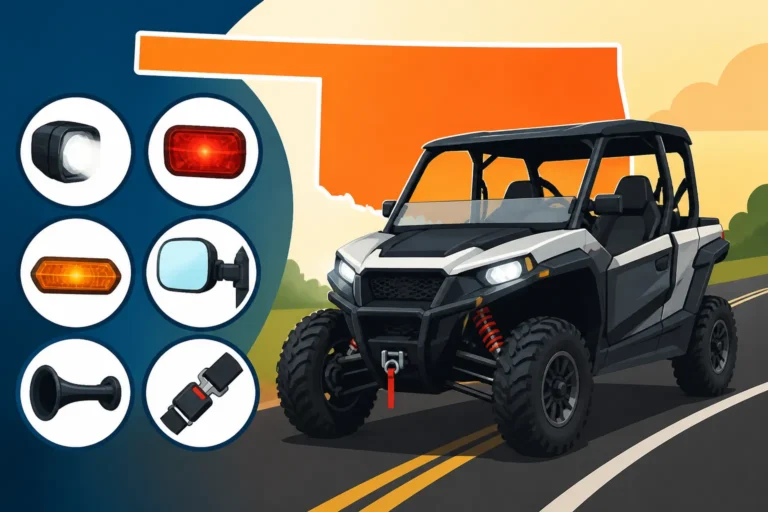
Visibility is paramount, particularly for vehicles that are slower-moving or have a smaller profile than traditional cars. If you're operating an instrument of husbandry on a public road, even for a short distance or a crossing, you need to be highly visible. This means ensuring your machine has adequate lighting, especially if there's any chance you'll be out at dawn, dusk, or in adverse weather. While [Oklahoma Lighting Rules on a Machine] might focus on street-legal conversions, the spirit of safety applies here too.
At a minimum, ensure you have working headlights and taillights. Many farmers go above and beyond, adding amber flashing lights, reflective tape, or even a brightly colored flag on a whip antenna (similar to what's required at [Little Sahara's 1,600 Acres in Oklahoma]) to enhance visibility. [Making Yourself Visible on a Rural Road at Night] is not just good advice; it's a critical safety measure that could prevent a serious accident. If your machine is older or doesn't have robust lighting, considering aftermarket upgrades, perhaps from a vendor like SuperATV, can significantly improve your safety profile.
Driver Age and Licensing Considerations
A common question is whether you need a driver's license to operate an instrument of husbandry on public roads. For general off-road use, there are [Oklahoma ATV Age Requirements] and helmet laws, but when you hit a public road, even with an exemption, different rules can apply. While the "instrument of husbandry" exemption often waives some of the typical registration and titling requirements (though not always excise tax – [Oklahoma Ag Permit Holders and Excise Tax] is a related topic), it doesn't automatically exempt the driver from licensing.
Generally, anyone operating a motor vehicle on a public road in Oklahoma is expected to hold a valid driver's license. While you don't need a special "M" endorsement like for a motorcycle, having a standard driver's license is crucial. This ensures the operator has demonstrated basic knowledge of road rules and driving competency. For youth operators on a farm, this means that while they might ride freely on private farm property, taking the machine on a public road, even briefly for farm work, usually requires them to be of legal driving age and possess a license. Always verify the most current regulations for your specific situation.
Carrying Passengers and Equipment
When using your ATV or UTV as an instrument of husbandry, consider the safety implications of carrying passengers and equipment. Factory-designed passenger seats are usually fine for the number of people the machine was built for, but overloading or carrying passengers in areas not designed for them is a big no-no. [Oklahoma Passenger Rules on a Quad] or for a UTV are generally about carrying only the number of people the machine was manufactured to hold.
For equipment, ensure all loads are securely fastened and do not obstruct the driver's view or interfere with the machine's operation. Overloaded machines handle poorly, increasing the risk of rollovers or loss of control, especially on uneven rural roads. If you're pulling a small trailer, make sure it's properly hitched, in good repair, and also visible, particularly at night. The goal is to perform your farm tasks efficiently and safely, minimizing any potential hazards to yourself or others sharing the road.
Disclaimer
This article is for general informational purposes only and does not constitute professional advice. Laws, prices and regulations vary by location and change over time. Consult a qualified professional for guidance on your specific situation.