Oklahoma Penalties Capped at $25
Navigating the rules for riding your ATV or UTV on public roads in Oklahoma can feel like trying to solve a complicated puzzle, and the fear of getting a hefty ticket often keeps many riders off local roads entirely, even when they might legally be allowed. It's frustrating to want to use your machine to get to a hunting spot or cross a county road, only to be paralyzed by uncertainty about what’s allowed and what fines you might face. This guide is here to untangle Oklahoma’s specific regulations for ATVs and UTVs on public roads, clearly outlining when and where you can ride, what equipment you need, and, importantly, shedding light on the state's remarkably low penalty cap for most off-road vehicle infractions.
Understanding Oklahoma's Approach to ATV/UTV Road Use
Oklahoma has a unique perspective when it comes to off-road vehicles like ATVs and UTVs on public roadways. Unlike some states that might broadly restrict them, Oklahoma carves out specific pathways for their use, while still holding true to their primary design as off-road machines. It’s not a free-for-all, but it's also not a complete lockout, which can be confusing for both new and long-time riders. The key is understanding the distinctions the state makes and which rules apply to your particular machine and intended use.
The "Off-Road" Nature of Most ATVs and UTVs
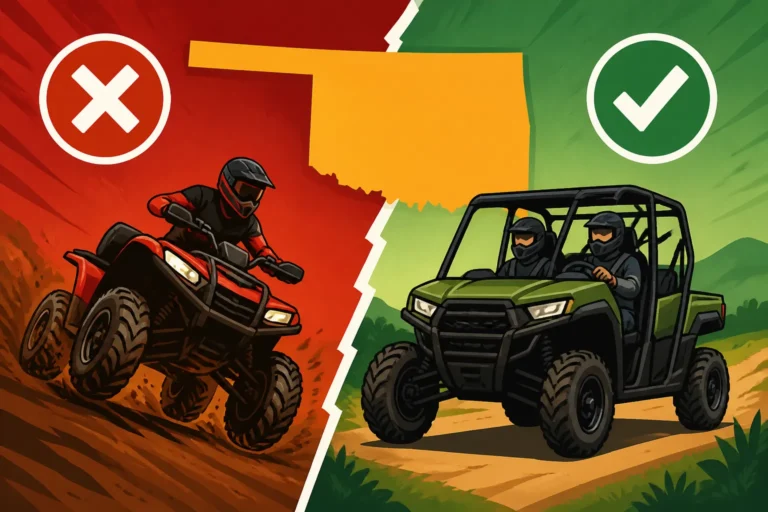
For the vast majority of ATVs and UTVs in Oklahoma, the default status is "off-road." This means they are designed, manufactured, and primarily intended for use on private land, designated trails, or off-road parks. They often lack the essential safety and identification features that street-legal vehicles are required to have, such as turn signals, rearview mirrors, and proper headlamps and taillamps for road speeds. This inherent off-road design is why state law generally prohibits them from being operated on public streets, roads, and highways. It's a safety measure, aimed at preventing collisions between vehicles with vastly different operational characteristics. The state assumes that if your machine doesn't have a specific road plate, it belongs off the pavement.
Imagine you've just bought a brand-new sport quad, built for tearing up the dunes at Little Sahara. Its knobby tires, high ground clearance, and lack of traditional headlights and brake lights (beyond what's needed for trails) immediately tell you it's not designed for sharing the road with sedans and pickups. The law sees it the same way. Trying to run errands on such a machine would not only be unsafe but also a clear violation of its designated use. This fundamental distinction is crucial for understanding why certain restrictions exist and why some machines require significant modifications to become street-legal.
The Specific Exceptions for Road Use
Despite their off-road classification, Oklahoma law does provide several specific exceptions that allow ATVs and UTVs onto public roads under certain conditions. These aren't loopholes; they are carefully defined circumstances where the state has determined that limited road use is permissible and, in many cases, necessary for property owners and recreational enthusiasts. These exceptions generally fall into categories like agricultural use, crossing public roads, or operating in municipalities that have specifically opted to allow them.
One of the most common exceptions allows for the crossing of a public highway. This is vital for farmers needing to move between fields or hunters trying to access different parts of a property divided by a road. Another significant exception involves local ordinances. County commissioners and city councils have the authority to open certain roads within their jurisdictions to ATVs and UTVs, recognizing the practical needs of their residents. However, these local rules vary wildly, so what's legal in one county or town might be prohibited just a few miles down the road. It means riders must be diligent in checking local rules, a task that can often feel more complex than it should be. The state has also created an entirely separate class for street-legal UTVs, offering a more comprehensive path for road use, which we'll dive into next.
Oklahoma's Street-Legal UTV Class and Its Rules
In 2021, Oklahoma made a significant change, creating a specific pathway for UTVs to become street-legal and obtain a traditional license plate. This was a game-changer for many owners who wanted to use their side-by-sides for more than just off-road adventures, whether it was for short commutes, running errands in town, or simply getting from one property to another without trailering. It's a class designed to bridge the gap between purely off-road machines and standard passenger vehicles, requiring specific modifications and adherence to a new set of rules to ensure public safety.
Equipment Requirements for a Road Plate
Transforming your UTV into a street-legal machine in Oklahoma involves more than just slapping on a license plate; it requires a host of equipment upgrades to meet safety standards. Think of it like taking a rugged off-road beast and giving it the manners and features required for city driving. Your UTV must be equipped with working headlamps and taillamps that meet federal standards for road vehicles, not just basic trail lights. You'll also need brake lights that illuminate when the brakes are applied, signaling your intentions to other drivers.
Beyond lighting, turn signals are a must, clearly indicating your turns, both front and rear. A horn, audible from a distance, is also required for signaling. A rearview mirror and at least one side-view mirror are essential for maintaining visibility of traffic around you. Many riders turn to aftermarket suppliers like SuperATV for high-quality, road-legal components such as turn signal kits, mirrors, and even DOT-approved tires, ensuring their machine meets all the necessary specs. These components are vital for safety, allowing your UTV to communicate its presence and intentions effectively in traffic. In essence, your machine needs to mimic the basic safety features of a car or truck, making it predictable and visible to others on the road. For a comprehensive list, you can refer to [Oklahoma Equipment Required for Street UTVs].
Driver and Insurance Requirements for Street UTVs
Once your UTV is properly equipped, the state also imposes requirements on who can drive it and what kind of financial responsibility they must carry. These rules are in place to ensure that individuals operating these modified machines on public roads are capable and that potential damages from accidents are covered. First and foremost, the driver must be at least sixteen years old. This aligns with the minimum age for obtaining a standard driver's license, recognizing that operating a street-legal UTV requires the same level of maturity and driving skill as any other vehicle on the road. You can learn more about this in [Oklahoma Drivers Must Be 16 for a Street UTV].
Unlike motorcycles, however, Oklahoma does not require a special "M" endorsement on your driver's license to operate a street-legal UTV, which is a welcome relief for many riders. This means a standard Class D driver's license is sufficient, provided you meet the age requirement. The other critical component is insurance. Just like cars and trucks, street-legal UTVs must carry liability insurance to cover potential damages or injuries in an accident. Proof of insurance is required at the time of registration and must be maintained as long as the UTV is operated on public roads. This ensures that if an accident occurs, innocent parties are not left with unrecoverable costs. [Oklahoma Insurance at Street Registration] provides more details on this requirement. These driver and insurance rules underscore the fact that once a UTV gets a road plate, it's treated much like any other vehicle sharing the asphalt.
General Road Rules for Off-Road Machines Without a Street Plate
Even if your ATV or UTV isn't tricked out with turn signals and a horn for street-legal status, there are still specific, limited scenarios where Oklahoma law permits these machines on public roads. These allowances are not for joyriding or commuting but are primarily designed for utility, access, or crossing purposes. Understanding these nuances is key to avoiding issues with law enforcement and using your machine responsibly. It's a delicate balance between allowing practical use and maintaining road safety for everyone.
Crossing Highways and Section Lines
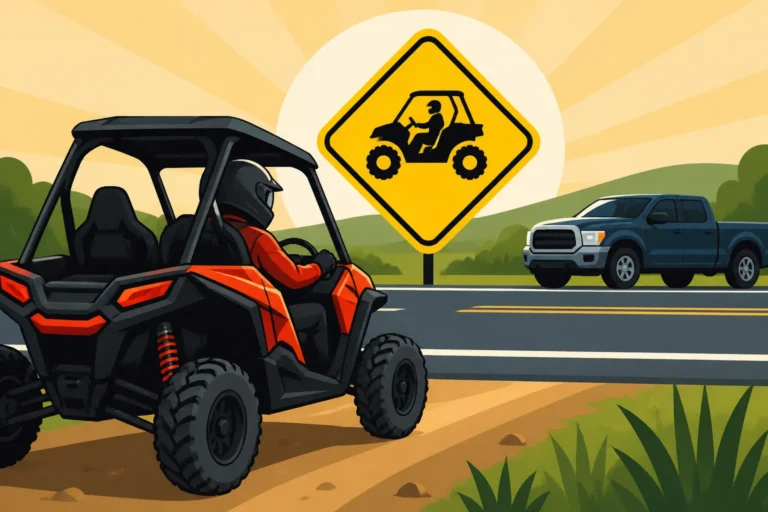
One of the most common and practical allowances for off-road machines is the ability to cross public roads, including highways and section lines. This is particularly crucial in rural Oklahoma, where properties are often bisected by public thoroughfares. You might need to cross a county road to get from your pasture to your hayfield, or navigate a highway to reach a different hunting lease. Oklahoma law permits these crossings, but with strict conditions designed to minimize risk. Crossings must be made as close to a 90-degree angle as possible, perpendicular to the flow of traffic, and only when safe to do so. This means no riding down the shoulder for a quarter-mile to find a better crossing point; it’s a direct shot across.
Furthermore, there are speed restrictions and daylight requirements for these crossings. [Oklahoma Crossing Rules at 35 mph] states that crossings are generally limited to highways where the posted speed limit is 35 mph or less, although there are specific exceptions. All crossings must be made during daylight hours, enhancing visibility for both the ATV/UTV rider and other motorists. It’s about being seen and minimizing your time spent on the pavement. You can’t just stop in the middle of a highway to chat with a friend; the intent is strictly to transit from one side to the other as quickly and safely as possible. Always yield to oncoming traffic, and consider mounting a bright orange flag on a whip, especially if you're crossing a frequently traveled road, even though it may not be legally required for every crossing, it significantly boosts your visibility.
Farm and Ranch Use Exemptions
Oklahoma has long recognized the essential role ATVs and UTVs play in agriculture and ranching. For those using their machines strictly for farming or ranching operations, there are specific exemptions that allow for limited use on county roads. These machines, often referred to as "instruments of husbandry," are critical for tasks like checking fence lines, moving tools between barns, or herding livestock. The law understands that prohibiting such use would significantly hinder agricultural productivity and efficiency.
Under these exemptions, a farmer or rancher can operate their ATV or UTV on a county road to get between different parts of their farm or ranch. However, this is not an open invitation to cruise down the road for personal errands. The use must be directly related to the agricultural operation. [Oklahoma Farm Use on County Roads] explains that this means hauling feed, checking on cattle, or transporting equipment for farm work is generally permitted. These machines are not typically required to have the full complement of street-legal equipment when used under this exemption, but common sense and safety still prevail. Visibility, especially at dawn or dusk, is paramount. Slow-moving vehicle signs or flashing amber lights are highly recommended, even if not explicitly mandated for every scenario, to alert other drivers to your presence. These exemptions are a lifeline for Oklahoma’s rural community, acknowledging the practical necessities of farm life.
Local Ordinances and County Roads
Beyond state-level exemptions, local governing bodies—specifically county commissioners and municipal governing bodies—have the power to open certain roads within their jurisdictions to ATV and UTV traffic. This decentralization allows local communities to tailor regulations to their unique needs and traffic patterns. For instance, a rural county with vast expanses of unpaved roads might open them up entirely to off-road vehicles, recognizing that many residents use them for daily tasks. Conversely, a bustling city might maintain strict prohibitions to prioritize traditional vehicle traffic and pedestrian safety.
It's absolutely critical for riders to be aware of these local rules. Just because you see someone riding their UTV down a city street doesn't mean it's legal everywhere. [Oklahoma Municipal Ordinances That Open Streets] details how cities and counties can enact these ordinances. The responsibility falls squarely on the rider to research and understand the specific rules for the area they intend to ride in. This often means checking with the county sheriff's office, city hall, or reviewing local government websites. Some areas might open all county roads, others only specific routes, and some might set speed limits or restrict hours of operation. A good practice is to always confirm the current ordinances before you head out, especially if you're riding in an unfamiliar part of the state.
Who Enforces These Rules and What They Look For
When it comes to enforcing Oklahoma's ATV and UTV road rules, you might encounter a variety of law enforcement officers. It's not just state troopers; local deputies, city police, and even park rangers can issue citations if you're found to be in violation. Knowing who might pull you over and what they typically look for can help you avoid unwelcome interactions and ensure you're riding legally and safely.
State Troopers, Game Wardens, and Local Deputies
In Oklahoma, enforcement of ATV and UTV laws on public roads can come from several different agencies. State Troopers, primarily responsible for highway safety, will certainly stop off-road vehicles operating unlawfully on state highways. Their focus will be on machines not meeting street-legal requirements, unsafe operation, or improper crossings. They are typically well-versed in the statewide regulations and the street-legal UTV class.
County Sheriff's Deputies are often the primary enforcers on county roads, especially in rural areas where ATVs and UTVs are more common. They will be checking for compliance with county ordinances, proper use under agricultural exemptions, and general safe operation. City Police Departments will enforce any municipal ordinances within city limits, and they tend to be the most restrictive, as city streets usually see higher traffic volumes. Finally, don't forget about Oklahoma Game Wardens. While their primary role is enforcing hunting and fishing regulations, they also have jurisdiction over state lands, wildlife management areas (WMAs), and often enforce off-road vehicle laws on or near these areas. They might stop you if you're riding an ATV or UTV unlawfully on WMA roads or crossing public roads to access hunting grounds without permission. [Oklahoma Park Rangers as Enforcers] also highlights their role. Essentially, if you're on public land or a public road, any sworn law enforcement officer has the authority to intervene.
Common Violations That Draw Attention
When an officer spots an ATV or UTV on a public road, there are a few common violations that immediately catch their eye. The most obvious is an off-road machine being operated on a public street without a valid street-legal plate and the necessary equipment. If your UTV doesn't have turn signals, mirrors, and DOT-approved tires, or if your ATV is simply cruising down a highway, that's a red flag. Speed is another major factor; even in areas where limited road use is allowed, excessive speed is a safety hazard and an easy way to get pulled over.
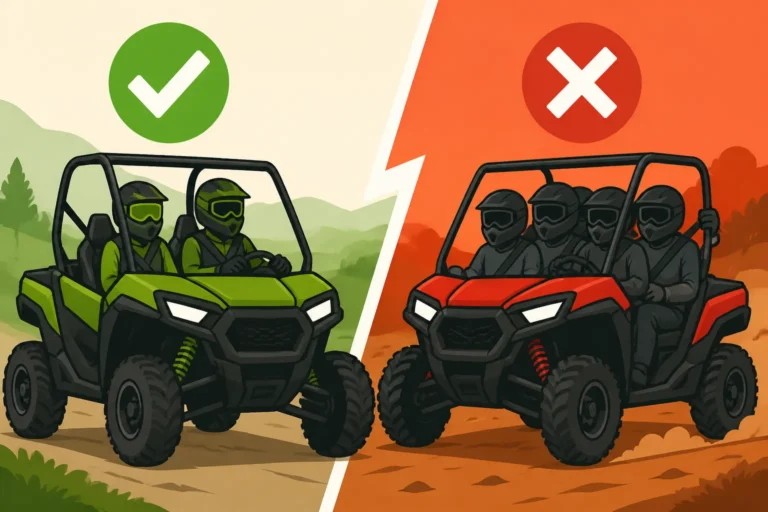
Beyond the machine itself, driver behavior is crucial. Reckless driving, weaving in and out of traffic, or operating under the influence will absolutely draw attention, regardless of whether the machine is street-legal or not. Carrying a child passenger on a single-rider ATV or having more passengers than the machine was designed for is also a common violation. Officers are looking for anything that compromises public safety or clearly indicates non-compliance with the established laws. They want to see that riders are being responsible, making proper crossings, and adhering to local rules. Simply put, operate your machine as if you were driving a car—respectful of traffic laws, visible, and cautious—to avoid unnecessary attention.
The $25 Penalty Cap: What It Means and What It Doesn't
This is the big one, the piece of information that surprises many riders and often alleviates a lot of anxiety about potential fines. Oklahoma law actually sets a relatively low cap on penalties for most off-road vehicle infractions. While this doesn't mean you should disregard the rules, it certainly provides a level of reassurance that a minor misstep won't result in a crippling financial burden.
How the Penalty Cap Works for ATV/UTV Infractions
Oklahoma's specific statute (Title 47, Section 11-1116.3, or similar for off-road vehicles) often limits the maximum fine for most violations of ATV and UTV road rules to a mere $25. This is significantly lower than penalties for many other traffic infractions, which can easily run into hundreds of dollars. This $25 cap applies to things like operating an off-road vehicle on a public road without proper authorization, improper crossings, or not having required equipment for a street-legal UTV (though repeated violations might escalate). [Oklahoma Penalties Capped at $25] highlights this specific legislative detail.
This cap is a testament to the state's intent to regulate, but not excessively punish, the use of these machines. It acknowledges that many violations might stem from confusion about the rules rather than malicious intent. However, it's crucial to understand that while the fine itself is capped at $25, there are almost always court costs and administrative fees added on top of that. So, while the ticket might read $25, your out-of-pocket expense could still be higher, often in the range of $100-$150 once all fees are included. Nonetheless, it’s a far cry from the $500+ fines you might face for other traffic offenses, making it less of a deterrent and more of a regulatory nudge.
Situations Where the Cap Doesn't Apply
It's vital to stress that the $25 penalty cap is not a blanket immunity from severe consequences. There are critical situations where this cap absolutely does not apply, and the penalties can be very steep. The most significant exception is operating an ATV or UTV while under the influence of alcohol or drugs (DUI/DWI). Off-road vehicles are still considered vehicles for DUI purposes, and an impaired driver will face the same severe penalties as if they were driving a car, including hefty fines, license suspension, and potential jail time. This is a serious offense, and the off-road nature of the machine offers no leniency.
Similarly, if your actions lead to property damage or personal injury, the $25 cap is irrelevant. You could be held civilly liable for damages, and if criminal charges like reckless endangerment or assault are brought, those penalties will far exceed $25. Fleeing from law enforcement, driving on private property without permission (trespassing), or engaging in truly reckless or dangerous behavior that endangers others will also lead to much more significant fines and charges, completely bypassing the $25 cap. The cap is for specific ATV/UTV rule infractions, not for general criminal behavior or severe traffic violations. Always ride sober, responsibly, and with respect for property and other people to avoid these far more serious consequences.
Avoiding Penalties: Best Practices for Oklahoma Riders
With the rules and potential penalties in mind, the best strategy is always prevention. By adopting a few best practices, you can significantly reduce your chances of running into trouble with law enforcement and ensure your riding experiences are enjoyable and hassle-free. It's about being informed, prepared, and respectful of the laws and other road users.
Knowing Your Local Ordinances
The number one best practice for avoiding penalties related to ATV/UTV road use in Oklahoma is to know your local ordinances. State law provides a framework, but counties and cities have considerable power to open or restrict local roads. What’s allowed on a county road in rural Atoka County might be strictly forbidden on a city street in Norman. Never assume that just because one area permits it, another does too. Before you venture out onto any public road, make a quick phone call to the local sheriff’s office or city hall, or check their official websites. Ask specific questions about ATV/UTV use on county roads, city streets, and for crossing purposes.
If you ride frequently in different parts of the state, it's a good idea to keep a mental (or even physical) note of these varying rules. This diligence will save you a lot of headaches and potential citations. Even if the penalty is capped at $25, dealing with a stop, the paperwork, and the court costs is an inconvenience nobody wants. Being informed about [Oklahoma Municipal Ordinances That Open Streets] is your first line of defense against accidental violations.
Equipping Your Machine for Safe Road Crossings
Even if your ATV or UTV isn't street-legal, equipping it for maximum visibility during permitted road crossings is a smart move that goes a long way in preventing accidents and drawing unwanted attention. While not always legally mandated for a simple crossing, things like bright flags on whips, additional lighting, and reflective tape make you stand out. A bright orange flag mounted high on a flexible whip, especially if you're crossing a busier road, alerts drivers to your presence from a distance, giving them more time to react. Many riders find these accessories, available from companies like SuperATV, to be invaluable safety additions.
Consider adding extra LED lighting, particularly to the rear, if your machine's factory lights are minimal. Even during daylight crossings, extra brightness can be helpful. Reflective tape on the rear of your machine can enhance visibility, especially in varied lighting conditions or if there's any dust in the air. For those with a street-legal UTV, maintaining all required equipment in good working order – turn signals, mirrors, horn, headlights, and brake lights – is non-negotiable. Regular checks before each ride ensure everything is functioning correctly. Being prepared means not only following the letter of the law but also going the extra mile to ensure your safety and the safety of others on the road.
| Feature / Scenario | Street-Legal UTV (Road Plate) | Off-Road ATV/UTV (Limited Road Use) |
|---|---|---|
| Primary Use | Road & Off-Road | Off-Road (Private Land/Trails) |
| Driver's License Required | Yes (standard Class D) | No (for off-road use only) |
| Minimum Driver Age | 16 | Varies (often 10+ with supervision) |
| Insurance Required | Yes (liability for road use) | No (for off-road use only) |
| Registration Required | Yes (annual renewal for road plate) | Yes (one-time $11 registration) |
| Equipment Requirements | Head/Tail/Brake lights, Turn Signals, Horn, Mirrors, DOT Tires | Basic lights for trail visibility (not street legal) |
| Road Crossing Allowed | Yes (as a street vehicle) | Yes (specific conditions, 90-degree angle, daylight) |
| County Road Use | Yes (as a street vehicle) | Yes (if local ordinance allows, or for farm use) |
| State Highway Use | Yes (except interstates/US highways) | No (only specific crossings) |
| Penalty Cap for Infractions | $25 (plus court costs) | $25 (plus court costs) |
Disclaimer
This article is for general informational purposes only and does not constitute professional advice. Laws, prices and regulations vary by location and change over time. Consult a qualified professional for guidance on your specific situation.