October to January: The Timber Land Riding Window
Oklahoma’s timber-company riding areas can look like year-round public trail land, but access is seasonal and tied to hunting rules. The main riding window runs from October into January, and showing up outside it can mean a wasted tow. Here’s how to plan around the dates, permits, deer-license requirement and road restrictions before you unload.
When the Timber Land Riding Window Opens and Closes
Some privately owned timber land in southeastern Oklahoma is available for public access under agreements, but that does not make it an all-season OHV park. Riding is limited to a defined fall and winter window. The general period runs from October through January, with machines required to be off the land after January 15. Confirm the current dates and conditions before each trip, since access arrangements and rules can change.
That January cutoff matters when you plan a weekend. A trip in early January may fit the season, while a later date can fall outside the riding window even if the weather is good and the roads look passable. Do not treat “January” as meaning the entire month is open. Check the rules for the specific property and make sure your machine is off the land by the stated cutoff.
The window is also not a guarantee that every road is open throughout the season. A land manager may close routes or limit access because of conditions, timber operations, fire danger, or other management needs. Recent rain can make Oklahoma’s clay roads slick, and a road that was passable on a previous visit may be difficult after a storm. Check both seasonal rules and current access notices before towing out.
Timber land is different from a state park or private OHV ranch. You may not find a staffed gate, marked trail system, or office to answer questions when you arrive. Plan ahead and read the applicable rules, including Oklahoma Timber Land Access Rules and Oklahoma Deer Season Access Windows. If you are comparing timber property with designated riding areas, Oklahoma ATV Trails: Where to Ride can help you identify other options with different access arrangements.
What the window does and does not mean
The season sets the time when riding may be allowed; it does not grant permission by itself. Riders still need to meet permit and hunting-license requirements, follow route restrictions, and stay within the land covered by the access arrangement. The window also should not be confused with the dates for a particular deer season. A deer season may have its own dates and conditions, so check the current hunting regulations as well as the land-access rules.
| Planning question | What to expect | What to verify before leaving |
|---|---|---|
| When can I ride? | The general timber land window is October through January | The current season dates for the specific area |
| What is the January cutoff? | Machines must be off the land after January 15 | Any current closure or removal instruction |
| Does the season alone give me access? | No; permit and deer-license rules may also apply | Which documents and permits apply to your trip |
| Can I ride anywhere on the property? | No; route and off-road travel rules apply | Which designated roads are open |
| Is access guaranteed for every trip? | No; closures and operating conditions can change | Current notices from the land manager |
If your plan depends on a particular weekend, treat date checking as part of trip preparation, not a last-minute detail. Save the current rules or have them available offline. A phone signal may be unreliable in remote areas, and you may need to check boundaries or road designations without service.
Permits, Deer Licenses and Who Can Ride
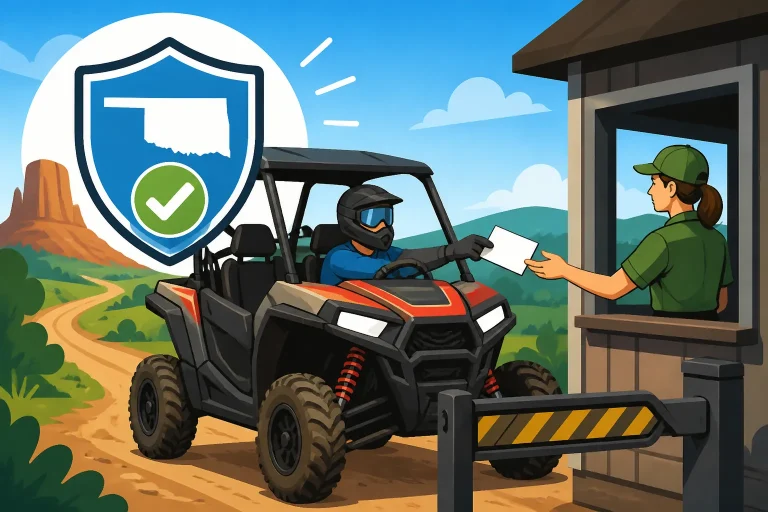
Timber-company property has its own access conditions. A general Oklahoma land access permit is not necessarily the only requirement, and it does not replace a hunting credential when the timber-land rules require one. Riders should confirm the documents required for their circumstances and for the exact property they intend to enter.
A key condition on the timber land described by the access rules is that only licensed deer hunters may ride. That means a person who wants to ride but does not meet the hunting-license requirement should not assume that a general riding permit is enough. Likewise, carrying a deer license does not automatically remove the need for a land-access permit or other required authorization.
The distinction is easy to miss because Oklahoma has more than one kind of access arrangement. A permit for public land access and a property-specific permission are not interchangeable in every situation. Review Oklahoma Land Access Permits Explained and the specific information for Oklahoma Permits for Honobia Creek or Oklahoma Permits for Three Rivers, depending on where you are headed. These areas include timber land access, but their details should be checked individually.
Before your trip, make sure each person in the riding group is covered by the applicable rules. Do not assume that one rider’s permit or hunting license covers passengers or other machines. Rules can differ by age, residency, permit type and land unit. Check the current requirements for every rider, including children and out-of-state visitors. Oklahoma Hunting Access by Machine is useful background if your trip combines riding and hunting access.
A pre-trip document check
Use this checklist before loading the machines:
- Identify the exact timber land area and confirm that it is open for riding on your planned dates.
- Check whether each rider needs a land-access permit and whether an age or residency exemption applies.
- Confirm that each rider meets the deer-license requirement for riding on that property.
- Review whether the permit must be carried in a particular form, such as on a phone or as a physical document.
- Check for unit-specific rules, closures, or additional conditions.
- Keep required documents accessible during the ride rather than buried in a trailer or stored only in a vehicle that stays at camp.
If you are unsure which permit applies, ask the appropriate land manager or permit issuer before traveling. The How to Buy an Oklahoma Land Access Permit and Oklahoma Land Access Permit Cost articles can help with the general permit process, but the property-specific rules still control where and when you may ride.
Also check whether the riding area is part of a Wildlife Management Area or another managed tract. WMA rules can differ from timber-company access rules, and the fact that nearby land is open does not mean all adjoining ground has the same status. See Oklahoma WMA Access for a Quad for the separate questions riders should ask about WMA access.
Where You May Ride and What Restrictions Apply
The seasonal window is only one part of the rules. On timber land, riders should expect to stay on designated roads rather than treating the property as an open trail network. A visible track, logging road, or path on a map is not automatically an authorized route. Follow signs and current maps, and do not create a new route by driving around a gate or obstruction.
Road-only travel helps protect the land and reduces conflicts with timber operations, hunting activity, and other users. It also makes it easier to stay within the permitted area. If a road is blocked or marked closed, turn around and use an authorized route. Do not assume that bypassing a closure on the edge of the road is allowed. Read Designated Roads Only on Timber Land and 25 mph on Timber Company Roads before you ride.
The speed limit is another detail that riders should check rather than guess. The listed timber-land rule is 25 mph on timber-company roads, but posted signs and current instructions should always take priority if they are more restrictive. Keep speed low near other vehicles, hunters, pedestrians, gates, and blind curves. Dust can reduce visibility, and logging trucks or other work vehicles may use the same road.
Off-road travel is limited even when the reason seems practical. For example, a deer-retrieval rule is not blanket permission to ride off-road wherever you choose. The applicable rule allows travel only under its stated conditions, including a limit of half a mile off-road to retrieve a downed animal. Review Half a Mile Off Road for a Deer and follow the current land rules carefully. Do not use retrieval provisions as a reason to explore, shortcut, or reach an otherwise unauthorized area.
Camping also has specific conditions. The listed rule allows primitive camping within fifty yards of a road, but that should not be read as permission to camp anywhere on the property or to ignore closures, fire restrictions, or other posted limits. Check the current requirements and choose a site that does not block traffic or damage the surrounding land. Camping Within Fifty Yards of a Road explains the distance rule and why campsite location matters.
Respect property boundaries and other users
Timber land may be privately owned even when public access is allowed. Stay within the authorized tract and do not cross onto adjoining private property, a closed unit, or a route that is not included in the access agreement. A GPS track can help with navigation, but it cannot establish legal access by itself. Use current maps and signs, and turn back if boundaries or permissions are unclear.
Expect to share the roads. Hunters may be walking or positioning vehicles near routes, and timber operations may bring large equipment onto roads. Give other users room, slow down when visibility is poor, and avoid blocking gates or work areas. Do not disturb wildlife, damage trees or roads, or leave trash behind. A single careless ride can create problems for future access.
How to Plan a Trip Without a Wasted Tow
The safest approach is to make the date, paperwork and route checks before the trailer leaves home. The season is short compared with year-round riding areas, and several requirements have to line up. A phone call or a careful review of current official rules is easier than discovering a closure after a long drive.
Start by naming the exact destination. “Timber land near Honobia” or “the Three Rivers area” may not be precise enough to identify the access rules or boundaries. Confirm the tract, the entry point and which roads are open. If your group plans to visit more than one area, check each separately rather than assuming one permit or set of dates applies everywhere.
Next, verify the timing. Confirm that your planned ride falls inside the current window, and remember the January removal date. If you are staying overnight, make sure the whole trip fits the access period and any camping restrictions. A ride that starts before the cutoff but continues beyond it may still violate the rule requiring machines to be off the land by the deadline.
Then review the group’s documents. Each rider should know what permit and deer-license requirements apply to them. Keep proof available during the ride, and make sure guests understand that a host’s credentials may not cover them. For a family trip, check age-related rules for each child rather than assuming the adult requirements apply uniformly.
Finally, prepare for limited services and changing conditions. Download maps and rules before entering areas with poor reception. Bring enough fuel, water and basic repair supplies for the ride you intend to make, and let someone know your route and expected return. Avoid riding after heavy rain if the roads are unsafe or access is restricted. If you need a different type of trip, choose a designated OHV area rather than pushing beyond the timber land’s restrictions.
A practical go/no-go check can be as simple as this:
- The exact property and entry point are confirmed.
- The current riding window includes your dates.
- The January cutoff will not be exceeded.
- Every rider has the required permit and deer credentials.
- You have checked closures, permitted roads and speed limits.
- Your route and any overnight plan comply with the land’s rules.
- You have a backup destination if access is closed.
Timber land can offer a very different ride from a managed OHV park, but the trade-off is that access depends on a narrow season and specific conditions. Plan around the rules rather than treating the property like open riding terrain. If any key detail is unclear, confirm it with the official land manager before you tow.
Disclaimer
This article is for general informational purposes only and does not constitute professional advice. Laws, prices and regulations vary by location and change over time. Consult a qualified professional for guidance on your specific situation.