Half a Mile Off Road for a Deer
A downed deer can be difficult to recover from Oklahoma timberland, especially when thick brush, steep ground, or distance from a road gets in the way. The half-mile retrieval allowance is a limited exception, not permission to ride wherever you want. This guide explains where it may apply, what to check before moving your machine, and how to retrieve game without turning a short trip into a land-access problem.
What the half-mile deer retrieval rule means
It is a limited exception to designated-road travel
On certain Oklahoma timber company lands open to public access, riders are generally expected to keep their machines on designated roads. A limited allowance may let a licensed deer hunter travel off those roads—up to half a mile—to retrieve a downed animal. The important point is that this is a retrieval exception, not general off-road access for hunting, scouting, or exploring.
That distinction matters when you are standing beside a deer and deciding whether to unload your ATV or UTV. The allowance is tied to retrieving an animal, so the route should be direct and related to reaching or bringing out the deer. Riding farther into the woods to look for another spot, taking a scenic loop, or using the exception as a shortcut to a different road can go beyond what the rule is meant to allow.
For the broader land-access context, see Oklahoma Timber Land Access Rules and Designated Roads Only on Timber Land. The half-mile detail should be understood within the rules for the particular timberland area you are using, rather than treated as a statewide permission that applies to every public or private hunting property.
Check that you are on land where the allowance applies
Oklahoma has different kinds of riding areas, and their rules are not interchangeable. Timber company land with public access is not the same as a state wildlife management area, a private ranch park, a county road, or a landowner’s property. A rule that applies to one access program may not apply at the next trailhead or across a fence line.
Before you ride, identify the property and the access program that governs it. Timberland access can involve seasonal limits, permits, hunting requirements, speed restrictions, and designated-road rules. The land may also be subject to temporary closures or posted restrictions. Start with Oklahoma Land Access Permits Explained and Oklahoma Hunting Access by Machine if you need to sort out the difference between riding access and hunting access.
A useful habit is to check the specific area’s current signs and instructions before unloading. If the posted rules are unclear, ask the land manager or the office responsible for that access area. Do not assume that a deer retrieval exception applies simply because you are on rural land or because another property allows similar travel.
Who may use the retrieval allowance and when
Confirm your hunting and access eligibility first
The half-mile exception is associated with retrieving a deer during a permitted hunting opportunity; it is not a general privilege for every rider on timber company property. Make sure you meet the area’s hunting and access requirements before relying on it. That can include having the appropriate hunting license, land-access permit, and permission to use the property during the applicable season.
The riding window can be especially easy to misunderstand. Timberland access may be seasonal, and the rules may connect machine use to deer hunting rather than year-round recreation. Read Riding Timber Land Requires a Deer License Too and October to January: The Timber Land Riding Window before planning a trip around a hunt. If you are visiting from outside Oklahoma, check the applicable nonresident requirements as well.
This is not just paperwork for its own sake. Imagine arriving at a gate with a machine, hunting gear, and a plan to retrieve a deer, only to discover that the access season has ended or the permit you have does not cover that land. Sorting out eligibility ahead of time is much less frustrating than trying to interpret a rule beside a locked gate or after a long drive.
Keep the retrieval trip tied to the animal
A practical way to stay within the purpose of the exception is to make the route as direct as conditions allow. If the deer is downhill in brush, for example, plan a careful approach that gets you to the animal and back toward the designated road without creating extra tracks. Avoid turning the retrieval into a wider loop to search nearby cover or reach another hunting location.
Also think about what “half a mile” refers to in the specific area’s instructions. Do not assume that you can travel half a mile in every direction from any point, or that a route beyond the limit is acceptable because the animal is difficult to move. If the wording on local signs or materials is unclear, ask the land manager before riding off-road.
| Situation | Safer interpretation | What to check |
|---|---|---|
| You are riding on a designated timber road | Stay on the marked or recognized route | Road designations, seasonal access, and speed rules |
| A deer is down off the road | Consider the limited retrieval allowance only if it applies there | Hunting eligibility, property rules, and the half-mile limit |
| You want to scout or reach another spot | Do not treat the retrieval exception as general off-road access | Whether off-road travel is separately permitted |
| The boundary or route is unclear | Pause before leaving the road | Signs, maps, access instructions, or land-manager guidance |
| Conditions make the route unsafe | Do not force the machine through | Terrain, water, soil, machine limits, and safer recovery options |
Plan the route before you leave the road
Mark the road, the deer, and property boundaries
A little preparation can prevent a confusing ride through timber, especially where roads branch, visibility is limited, or the property boundary is close. Before hunting, note the designated road you used and the likely direction and distance to the area where you expect to be. If you find a deer, stop and assess the route before moving the machine.
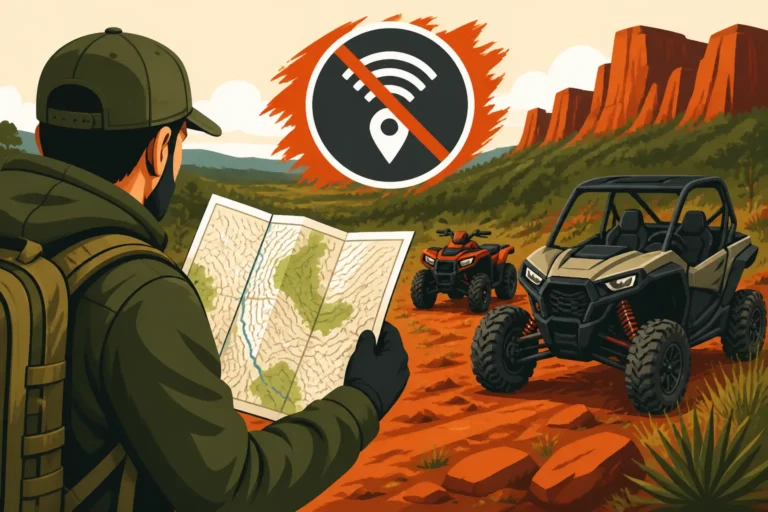
A mapping tool such as onX Offroad can help you orient yourself and review routes, but a digital map should not replace posted rules or permission from the land manager. Check your map before the ride, save the relevant area for use where service is unreliable if the app supports that option, and compare what you see on the screen with signs and physical landmarks. A line on a map does not authorize travel across land that is closed or privately owned.
This is also a good time to set a clear boundary for your group. If one rider is navigating, have the others wait until the route is understood rather than following the first set of tire tracks. A creek, fence, or old logging road can look like an easy route on the ground while leading away from the legal access area.
Consider terrain and recovery before moving the machine
A half-mile can feel short on a map and become a serious challenge on the ground. Wet clay, hidden stumps, steep slopes, soft streambanks, and thick brush can make a route unsafe or damaging. A loaded ATV or UTV may handle differently than it did on the way in, and towing or carrying a deer can affect balance, braking, and turning.
Before committing, ask whether the machine can travel the route without damaging the land or putting anyone at risk. Avoid forcing your way through standing water, fragile ground, fences, or vegetation that would require cutting or breaking a path. If the route is too steep, muddy, or obstructed, consider whether the deer can be moved by hand in stages or whether you need help from another hunter.
onX Offroad may be useful for checking your position against roads and boundaries, but keep your attention on the terrain itself. GPS position can be imperfect beneath dense tree cover, and a mapped track may not show a washed-out crossing or a new obstruction. Use the map as one planning aid—not as proof that a route is open.
Ride responsibly and avoid common mistakes
Keep speed, season, and road rules in view
The off-road retrieval allowance does not erase the other requirements for riding timberland. Pay attention to the permitted access period, any required permit, and road-specific rules. For example, 25 mph on Timber Company Roads covers a separate restriction that may still matter while you are traveling to and from the retrieval area.
Be especially cautious about assuming access continues after the hunting or riding window. Seasonal rules can change what roads are open and who may use them. Review Why Machines Come Off Timber Land After January 15 before planning a late-season trip, and check for any local updates or closures. A route that was available during one part of the season may not remain open later.
The machine should also be appropriate for the route and load. A small youth quad, a two-seat ATV, and a four-seat side-by-side do not handle the same way in brush or on uneven ground. Keep passengers within the machine’s intended capacity, secure equipment, and avoid carrying a load that blocks the operator’s view or makes the vehicle unstable.
Common misreadings that can cause trouble
One common mistake is treating the half-mile allowance as a general radius for riding anywhere in the woods. It is more prudent to treat it as a narrow exception associated with retrieving a downed deer, and only where the applicable land rules allow it. Another mistake is assuming that a hunting license alone gives a rider permission to leave designated roads. Hunting eligibility and machine-access rules are related, but they are not automatically identical.
A third mistake is relying entirely on a map app. onX Offroad can help you understand where you are and plan around roads, but it cannot decide whether a property owner has closed an area or whether a specific route is allowed. Confirm access with signs and official area instructions. If you are unsure, stay on the designated road until you can get a clear answer.
Finally, do not let pressure to recover the animal quickly override safe judgment. If a route crosses a boundary, enters a posted closure, or would require risky riding, stop and reassess. Being able to explain that you were retrieving a deer does not make every route or condition acceptable. A careful, direct trip—and a willingness to ask before riding—protects both the hunter and future access for other riders.
Disclaimer
This article is for general informational purposes only and does not constitute professional advice. Laws, prices and regulations vary by location and change over time. Consult a qualified professional for guidance on your specific situation.