Why Oklahoma Red Clay Turns Slick After Rain
Oklahoma red clay can feel firm and predictable, then turn slick after a short shower. That sudden change catches riders out on hills, shaded trails, and rutted approaches, especially when a machine’s tires are already packed with mud. This guide explains why clay loses grip, how to judge trail conditions, and what to do before and during a wet-weather ride.
Why Oklahoma red clay gets slippery after rain
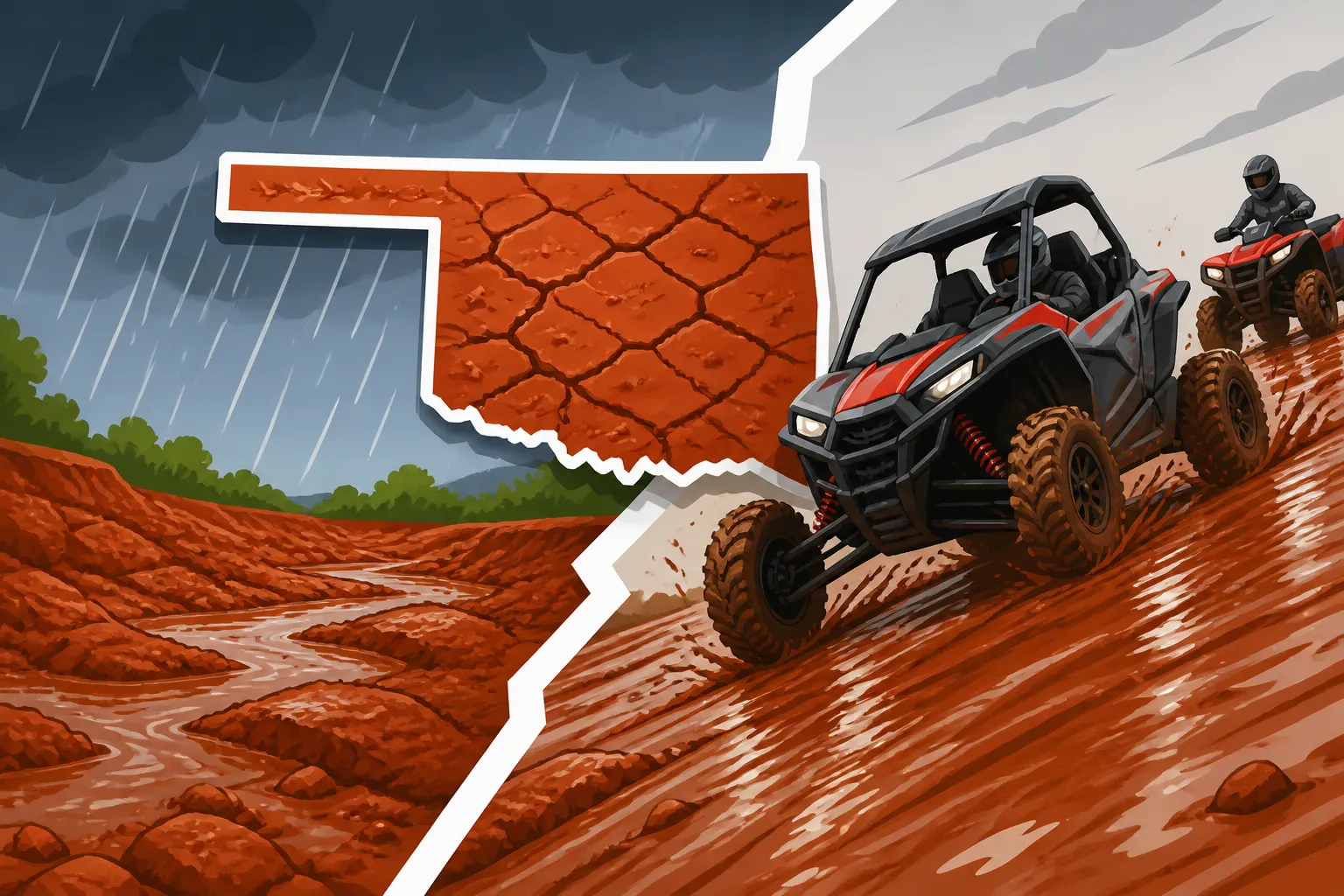
Red clay is made up of very fine mineral particles. When the ground is dry, those particles can pack together and form a surface that feels hard under tires. Rain changes the conditions: water softens the soil, fills spaces between particles, and can create a thin, slick layer on top. Instead of biting into a firm trail, a tire may slide across a surface that behaves more like wet paste.
The exact change depends on the soil, slope, shade, traffic, and amount of rain. A light shower can make some compacted clay unexpectedly slick, while a better-drained trail may remain manageable after heavier rain. That is why the sky alone does not tell you whether a route is safe.
Fine particles and water reduce grip
Clay particles are much smaller than the grains in sand. When dry, they can press closely together. Once wet, the surface may soften and smear under tire pressure. If the tires cannot push through that layer to reach firmer ground, they lose traction.
This is especially noticeable when braking or turning. A rider may expect the machine to slow or change direction promptly, but the tires can keep sliding. On a slope, even a small loss of grip can become a bigger problem because gravity continues pulling the machine downhill.
A common scenario is a rider entering a bend at a familiar speed. The trail looks only damp, but the outer edge has a thin film of mud. The front tires drift wide, or the rear swings around under throttle. The lesson is not that every wet clay trail is impossible; it is that a surface can look harmless while offering much less grip than it did when dry.
Traffic can turn a wet trail into a polished surface
Repeated passes from ATVs, UTVs, trucks, and maintenance equipment can compact wet clay. Tires also push the softened soil around, leaving ruts and raised ridges. As more machines travel over the same line, the surface can become smoother and more slippery.
Ruts create their own hazards. A tire may follow a rut when the rider wants to steer out of it, or climb a raised edge and suddenly change direction. Water can collect in the low spots, hiding their depth. A rut that was easy to cross when dry may pull at a tire when wet.
This is one reason conditions can vary across a single riding area. A shaded, heavily traveled section may stay slick after a sunny open stretch has started drying. Before heading out, check current notices and ask the riding area about recent conditions. [Oklahoma Trail Conditions Before You Tow] and [Oklahoma Trail Closures After Rain] are useful starting points when planning around weather.
Terrain and drainage matter as much as rainfall
A flat, exposed trail may dry faster than a shaded hollow or narrow cut between slopes. Water naturally runs downhill, so low points, creek approaches, and the bottoms of dips may stay wet after higher ground has improved. North-facing slopes and wooded sections can also remain damp longer because they receive less direct sun and airflow.
The soil itself varies around Oklahoma. A route can include clay, gravel, rock, sand, and leaf-covered ground within a short distance. Areas such as the San Bois near Robbers Cave and the Ouachita region have varied terrain, so one general description cannot predict every trail segment. Check the riding area's rules and local trail information instead of assuming that a whole park has one consistent surface. [Oklahoma ATV Trails: Where to Ride] can help you compare riding areas before making a trip.
How to judge trail conditions before you ride
A forecast is useful, but it is only one piece of the decision. Recent rainfall, overnight temperatures, shade, drainage, and the number of machines on the trail all affect how quickly clay becomes rideable. A route that is fine in a sunny, breezy afternoon may remain slick in a wooded hollow after the same amount of rain.
If you are towing a machine to a park, a quick call or check of official park updates can save a long drive and an unpleasant decision at the entrance. For mapped routes, onX Offroad can help you review your planned route and keep your location in context, but confirm access and closures with the land manager or riding area. A map does not tell you whether a specific muddy slope is safe today.
Look for signs that the trail is too wet
Pay attention to the ground underfoot before unloading or committing to a long route. If boots sink deeply, clay sticks in thick layers, or the surface smears when pressed, the trail may be too soft for responsible riding. Fresh standing water over a rut is another warning: you may not know how deep the rut is until a wheel drops into it.
Watch for signs of recent damage, too. Deep tire grooves, exposed roots, widening trails, and muddy water flowing across the route can indicate that traffic is cutting up a wet surface. If the trail is already breaking apart, riding through can make the damage worse and create hazards for the next group.
A cautious first few minutes can tell you a lot. At a safe, level spot, use gentle throttle and braking to feel how the machine responds. If it slides under modest input, do not assume the next hill or turn will be easier. Turn around while you still have room rather than testing the limits on a steep or narrow section.
Check the route, not just the entrance
Conditions often change with elevation, shade, and drainage. A park entrance or staging area may be dry while the trails are still wet. Likewise, an open section may be firm while a shaded ravine remains slick. If you are riding with a group, agree on a conservative pace and a turnaround point before entering unfamiliar terrain.
Use a map to understand where your route goes, but treat it as a planning aid rather than a live trail-condition report. onX Offroad may help you orient yourself and plan around known routes, especially when cell reception is limited, provided you prepare the map before leaving coverage. Confirm that the route is open and that your machine is allowed there. [Oklahoma Trail Difficulty Ratings] can also help you think about whether the planned terrain matches the group’s experience, but weather can make any trail more demanding than its usual rating suggests.
If the riding area says trails are closed after rain, respect the closure. A closed trail may need time to drain and recover. Riding around a barrier or creating a bypass can damage vegetation and soil, and may put the rider on land or a route that is not open to the public.
How to ride red clay safely when it is damp
When conditions are merely damp and the area remains open, the safest adjustment is usually to slow down and make every control input smoother. Sudden throttle, hard braking, and sharp steering can overwhelm the limited grip available. Leave more space between machines, because the rider ahead may slide or stop unexpectedly.
A passenger in a UTV should also know that a wet trail can feel different from a dry one. Warn passengers before steep descents or uneven turns, and make sure everyone is secured according to the machine’s instructions. If the trail becomes too slick for the driver to remain in control, stop somewhere stable and turn back rather than pressing on.
Use smooth inputs and choose your line carefully
On level ground, keep a steady, gentle pace. Avoid spinning the tires to force a way through mud; wheelspin can dig deeper ruts and leave the machine with less support. When approaching a turn, slow down before the slickest part rather than braking hard while already cornering.
On a hill, assess the route before climbing or descending. A steep clay slope with no firm escape route is a poor place to experiment. If the surface is breaking away or the tires are sliding under light throttle, choose another route or wait for better conditions. Do not stop on a steep incline unless necessary; if you must stop, prioritize a stable position and follow the machine’s operating guidance.
Avoid passing other riders in narrow muddy sections. Give the machine ahead room to clear a hill or turn, and do not follow so closely that you have no time to react. Basic courtesy matters even more when stopping or turning around is difficult. [Oklahoma Trail Etiquette Locals Expect] is relevant whether the trail is dry or slick.
Tires help, but they cannot overcome every condition
Tire tread and pressure affect how a machine handles, but no tire makes wet clay risk-free. Tires clogged with sticky mud may lose the open tread spaces that help them grip. Aggressive throttle can make that problem worse by packing more mud into the tread or digging down to softer soil.
Choose equipment for the terrain you ride most often and follow the manufacturer’s recommendations for your machine. Avoid changing tire pressure without understanding the limits for the tire, wheel, load, and riding conditions. A setup that works well in one surface may not be appropriate elsewhere. [What Tires Work on Loose Sand and Clay] can help you think through how surface type affects tire choice.
If the machine becomes stuck, stop before repeated attempts turn a small problem into a deep hole. Check the ground around the tires, look for a safe path out, and keep people clear of moving wheels and recovery equipment. A winch or tow strap should only be used with suitable equipment and a safe anchor point. For more on getting out without making the situation worse, see [Winching a Machine Out of Deep Clay Mud].
| Trail sign | What it may indicate | Safer response |
|---|---|---|
| Clay smears or sticks heavily to boots | The surface is soft and may offer poor traction | Test cautiously on level ground or turn back |
| Water sits in deep ruts | The rut depth and bottom may be hidden | Avoid entering unless you can assess it safely |
| Tires slide with gentle input | Grip is already limited | Reduce speed and avoid steep or narrow routes |
| Fresh deep tracks and widening edges | The trail may be deteriorating under traffic | Stay on the established route or leave |
| Park notice says the route is closed | The trail may be unsafe or vulnerable to damage | Do not ride around the closure |
When to postpone and how to protect the trail
Postponing a ride is frustrating, especially after packing the trailer, coordinating friends, and making the drive. Still, riding a soft clay trail can damage the route and put people at risk. A machine can slide off a hillside, become stuck in a rut, or force others to attempt a difficult recovery. The cost of waiting is often smaller than the time and effort involved in a rescue or trail repair.
When you are uncertain, contact the riding area and ask specific questions: Which sections are open? Are shaded trails still holding water? Are there restrictions for UTVs or larger groups? Is there a recommended route for the current conditions? A map app such as onX Offroad can help you organize your route and keep track of where you intended to ride, but the park or land manager remains the best source for access decisions and closures.
Know when turning around is the right call
Turn back if the machine repeatedly loses traction on mild terrain, if the route has deep standing water you cannot assess, or if the only way forward requires aggressive throttle. Also stop if you see substantial erosion, a washout, or a slope that has become difficult to climb or descend safely.
Do not let a group’s schedule dictate a risky decision. One rider may feel comfortable continuing while another is already struggling. Agree in advance that anyone can call for a turnaround without being pressured to keep up. A change of plan is better than leaving someone stuck or injured far from the staging area.
After rain, follow posted closures even if the ground looks dry at the entrance. Trail managers may close routes to protect vulnerable surfaces, and conditions farther along may differ from what you can see. [Oklahoma Riding After Heavy Rain] offers more context for planning around wet-weather conditions.
Leave the trail better than you found it
Stay on the established route. Cutting around a muddy patch can widen the trail and damage plants, while repeated wheelspin can deepen ruts and channel water. If a section is too muddy to cross without tearing it up, turn around or use an approved alternate route.
Clean mud from your machine before it dries, paying attention to the tires, brakes, radiator area, and moving parts according to the owner’s manual. Mud can hide damage and add weight, while a thick buildup can affect how components work. Check the machine before the next ride rather than assuming it is ready to go because it made it back to the trailer.
When riders give wet trails time to drain and recover, the route is more likely to remain enjoyable for everyone. Checking conditions, riding gently when it is appropriate, and respecting closures are simple habits that protect both the machine and Oklahoma’s riding areas.
Disclaimer
This article is for general informational purposes only and does not constitute professional advice. Laws, prices and regulations vary by location and change over time. Consult a qualified professional for guidance on your specific situation.