How to Register an ATV in Oklahoma
Let's be real, navigating the ins and outs of vehicle registration can feel like trying to ride a trail blindfolded, especially when it comes to ATVs and UTVs in Oklahoma. It's confusing trying to figure out what paperwork you need, where to go, and how much it's going to cost, leading many to put off legalizing their machines. This guide is here to untangle that knot, walking you through every step of how to register your ATV or UTV in Oklahoma so you can hit the trails or get to work on your property without a worry.
Understanding What Needs Registration and Titling in Oklahoma
Before we even talk about forms and fees, it's super important to understand what Oklahoma considers an off-road vehicle for registration purposes and how that impacts what you need to do. It’s not as straightforward as registering a car, and getting it wrong can cause some real headaches down the line.
Which Machines Are Included?
When we talk about off-road vehicles in Oklahoma, we're casting a pretty wide net. This includes your standard ATVs (quads), the ever-popular UTVs or side-by-sides, dirt bikes, and other off-road motorcycles. Basically, if it's got an engine and isn't primarily designed for highway use, the state probably wants it titled and registered. This is where a lot of people get confused because they think "off-road" means "off-the-books." Nope, not in Oklahoma!
Now, it's worth noting that some UTVs can be made street-legal in Oklahoma, which involves a whole different set of registration rules, yearly renewals, and equipment requirements. But for the vast majority of us who just want to ride the trails or use our machines on private land, we're talking about the standard off-road registration. Don't confuse the two, or you'll find yourself needing two sets of paperwork and paying different fees. For this guide, we're focusing on the true off-road machines.
The Critical Cutoff Dates
This is probably one of the biggest points of confusion for folks trying to register an older machine. Oklahoma has specific "cutoff dates" that determine whether your ATV or UTV needs a title, or if a simple bill of sale will suffice. These dates are crucial because they dictate the type of paperwork you'll need to present at the tag agency.
For ATVs (quads), the critical date is July 1, 2005. If your ATV was manufactured before this date, Oklahoma does not require a prior title to register it. You'll simply need a bill of sale to prove ownership. This is a huge relief for many who bought an older quad from a friend or a private seller and never got a title. You can read more about [Oklahoma ATV Cutoff of July 2005].
For UTVs and side-by-sides, the cutoff date is July 1, 2008. Similarly, if your UTV was manufactured before this date, you only need a bill of sale. If it was made after this date, you'll need a title from the previous owner or a Manufacturer's Statement of Origin (MSO) if it's new. Understanding [Oklahoma UTV Cutoff of July 2008] can save you a ton of legwork and frustration. These dates are part of what makes [Oklahoma's 2005 and 2008 Cutoff Dates] so important to know.
Why Titling Comes Before Registration
Here’s another key difference from car ownership: in Oklahoma, for off-road vehicles, you essentially title your machine, and the "registration" is a one-time fee paid at that initial titling. It’s not an annual renewal like you might be used to with your truck or car. This is why you often hear people say [Oklahoma ATV Registration You Pay Once] – because it’s true!
When you go to the tag agency, you’re primarily going to establish ownership and get a title issued in your name. Once that title process is complete, you pay the specific off-road registration fee, and that’s pretty much it. There's no ongoing annual payment for your off-road machine to keep its registration current. This means [Oklahoma Registration Never Renews], which is a pleasant surprise for many. So, while you're getting it "registered," the core legal process is about getting that title in hand, proving you own it according to the state. [Oklahoma Titles ATVs and UTVs] are standard, meaning there are no "salvage" brands or special designations for off-road machines like there might be for wrecked cars.
Your Step-by-Step Guide to ATV/UTV Registration
Alright, now that we understand the basics of what needs to be registered and the role of those cutoff dates, let’s get into the actual process. This is where most people get bogged down, but with a clear checklist, it’s totally manageable.
Gathering Your Essential Documents
This is the most critical step. Show up at the tag agency without the right paperwork, and you'll be sent home empty-handed, possibly with a late fee looming over your head.
For a New Machine Purchased from a Dealer:
If you just bought a shiny new ATV or UTV from a dealership, you'll need:
- Manufacturer's Statement of Origin (MSO): This is essentially the birth certificate for your new machine, proving it’s never been titled before. The dealer will provide this to you. [Oklahoma Requires an MSO for a New Machine] and it’s non-negotiable for a brand-new purchase.
- Dealer Invoice or Bill of Sale: This document confirms your purchase price, which is vital for calculating excise tax. Make sure it clearly itemizes the machine's price. [Oklahoma Dealer Invoices at Titling] are standard practice.
- Proof of Identity: Your valid Oklahoma driver's license or state ID.
- Proof of Oklahoma Residency: Sometimes your ID is enough, but they might ask for a utility bill or mail with your current address if it's a new ID.
For a Used Machine Purchased from a Private Seller (Manufactured After Cutoff Dates):
If you bought a used ATV (2005 or newer) or UTV (2008 or newer) from a private party, you'll need:
- The Original Oklahoma Title, Signed Over to You: The seller must sign the title in the appropriate buyer/seller sections, effectively transferring ownership. Make sure they fill out all the necessary fields accurately, including the sales price. This is crucial for [Oklahoma Titles After a Private Sale].
- A Bill of Sale: Even with a signed title, a clear, dated bill of sale is highly recommended. It serves as an additional record of the transaction, especially for the purchase price, which again, is needed for excise tax. You can find excellent templates online from resources like LawDepot, which help ensure all the necessary information is included. A good bill of sale protects both buyer and seller.
- Proof of Identity: Your valid Oklahoma driver's license or state ID.
For a Used Machine Purchased from a Private Seller (Manufactured Before Cutoff Dates):
If your ATV (2004 or older) or UTV (2007 or older) falls before those cutoff dates, the process is actually simpler regarding prior titles:
- A Bill of Sale: This is your primary document for proof of ownership. Since a prior title isn't required by the state for these older machines, a well-drafted bill of sale is paramount. Make sure it includes: the full names and addresses of both buyer and seller, the date of sale, the purchase price, a detailed description of the machine (make, model, year, VIN), and signatures from both parties. Again, services like LawDepot offer templates that can help you create a legally sound document.
- Proof of Identity: Your valid Oklahoma driver's license or state ID.
- What if there's no paperwork at all? This is a tough spot, but not impossible. For [Oklahoma Machines With No Paperwork], you'll likely need to file a Declaration of Vehicle Purchase Price and potentially have a law enforcement officer verify the VIN, depending on the circumstances. It's always best to try and get a solid bill of sale, even for older machines.
Calculating the Costs Involved
Nobody likes surprise fees, so let's break down what you can expect to pay when you register your off-road machine in Oklahoma.
- The One-Time Registration Fee: This is the big one we keep talking about. It's a flat fee of $11. That's right, just eleven dollars for the lifetime of your ownership. [Oklahoma Charges $11 at Titling] and you won't pay it again unless you transfer ownership to someone else. This fee covers the cost of issuing your registration and front decal.
- Excise Tax: Ah, taxes. Oklahoma levies a 4.5% excise tax on the purchase price or declared value of your ATV or UTV. This is not sales tax, but an excise tax that applies when a vehicle is titled. [Oklahoma's 4.5 Percent Excise Tax] is consistent across many types of vehicles. If you buy from a dealer, they might collect this for you. If you buy privately, you'll pay it at the tag agency. The declared purchase price on your bill of sale or title is what they'll use.
- Titling Fee: There's a small fee to process and issue your actual title document, typically a few dollars.
- Tag Agency Processing Fees: Tag agencies are independent contractors, and they charge a small fee for their services, which is usually just a few dollars.
- Late Penalties: If you don't title and register your machine within 30 days of purchase, you'll start accruing late penalties. These can add up quickly, costing you a dollar for every day you're late, though they are capped. We'll dive into this more below, but suffice it to say, it's cheaper to go early! [Oklahoma ATV Registration Cost] is often less than people expect, primarily because of that low, one-time registration fee.
Where to Go and What to Expect
Once you have all your documents in order and a good idea of the costs, it's time to head to the tag agency.
- Finding a Tag Agency: You can visit any licensed tag agency in Oklahoma. They are often independently owned businesses but are authorized by the state to handle these transactions. Alternatively, you can go to a Service Oklahoma location.
- At the Counter: Be prepared to fill out an application for title and registration. This form will ask for details about you and your machine, including the VIN, make, model, and year. You'll hand over your supporting documents, and the clerk will review everything. Understanding [Oklahoma's ATV Registration Application Explained] can help you prepare.
- Payment: You'll pay all applicable fees at this time: the $11 registration fee, the 4.5% excise tax, titling fees, and agency fees.
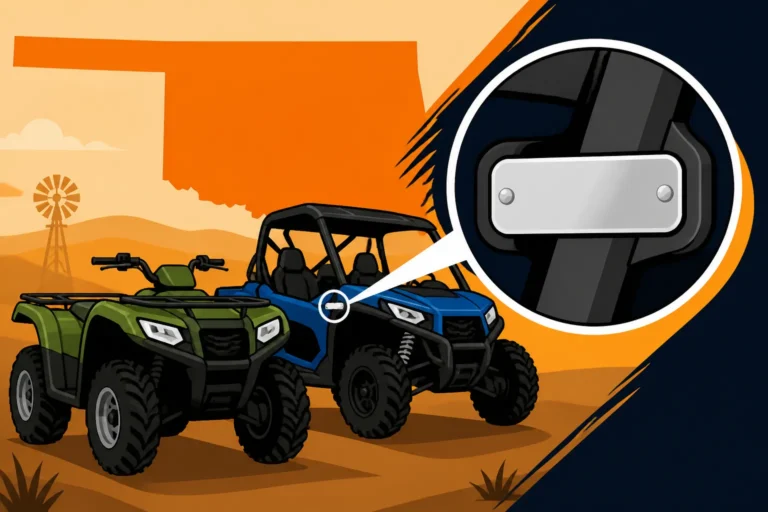
- Receiving Your Documents: Once everything is processed and paid, you'll receive your new title (either immediately or mailed to you later, depending on the agency and the state's processing times) and your unique registration decal. This decal, as mandated by the state, is [Oklahoma Issues a Front Decal, Not a Plate]. It's a small sticker that gets affixed to the front of your ATV or UTV, showing it's legally registered. You must get this done within [Oklahoma's 30-Day Registration Deadline] to avoid penalties.
Common Scenarios and Avoiding Headaches
Even with the clearest instructions, sometimes unique situations pop up. Let's tackle some of the common questions and potential pitfalls riders face during the registration process.
Dealing with Late Registration Penalties
Life happens, and sometimes that 30-day window after purchase slips by. But ignoring it won't make the problem go away – it will only make it more expensive. Oklahoma charges a penalty for late registration. This penalty is typically $1.00 per day after the 30-day grace period. While that might not sound like much, it adds up fast! Missing the deadline by a month means an extra $30, by two months an extra $60, and so on.
The good news? There's a cap. [Oklahoma Late Penalties Capped at $100]. So, while it can definitely add to your costs, it won't break the bank like some other states' penalties. However, it's still best to avoid it. If you're nearing the 30-day mark and can't get to a tag agency, make it a priority. Don't let those [Oklahoma Late Registration Fees] pile up unnecessarily.
Transferring Ownership and Used Purchases
This is where a lot of confusion arises, especially for first-time buyers or sellers.
When You Buy from a Private Seller:
As the buyer, you are responsible for titling and registering the machine in your name. If the machine was manufactured after the cutoff dates (2005 for ATVs, 2008 for UTVs), the seller must provide you with the signed-over Oklahoma title. Without it, you won't be able to title it in your name, which effectively means you don't legally own it. Along with the title, always get a detailed bill of sale. This protects you, verifies the purchase price for excise tax, and documents the VIN. Sites like LawDepot provide state-specific bill of sale templates that can be incredibly helpful to ensure all legal bases are covered, making the transfer smooth for [Buying From a Private Seller in Oklahoma].
When You Sell to a Private Buyer:
As the seller, your responsibility is to sign over the title (if applicable) and provide a bill of sale to the buyer. Make sure you accurately fill in the odometer reading (even though Oklahoma ATVs don't have an odometer rule, it's good practice to mark "exempt" if there's no odometer) and the sales price on the title or bill of sale. It's often a good idea to meet the buyer at a tag agency to complete the transfer right then and there. This ensures the title is transferred out of your name and into theirs, removing your liability for the machine. Remember, [Registration Stays With the Owner, Not the Machine], so while your old registration is effectively dead, the machine itself will be re-registered by the new owner for $11.
Agricultural Exemptions
Historically, agricultural permits offered broad exemptions for off-road machines used exclusively for farming or ranching. However, the rules have changed over time. While [Oklahoma Agricultural Permit Exemptions] still exist, they no longer exempt your ATV or UTV from the initial titling and registration process.
What they do still exempt you from is the 4.5% excise tax. If you use your machine solely for agricultural purposes, you can declare this when you register, and you won't have to pay that excise tax. This can be a significant saving, especially on a newer, more expensive UTV. So, while you still pay the $11 registration and titling fees, you get a break on the tax. For more details, you can look into how [Farm Permits Still Save You the Excise Tax]. Just be ready to affirm that your machine truly is for agricultural use, as there can be penalties for falsely claiming this exemption.
After Registration: What to Know About Your Decal and Beyond
So, you’ve done the hard work, navigated the paperwork, and paid your fees. Congratulations, your ATV or UTV is now legally registered in Oklahoma! But what comes next? Understanding how to maintain your registration (or lack thereof for off-road machines) and what to do if your decal fades is important.
Your Permanent Registration Decal
Once you complete the registration process, the tag agency will issue you a small decal. This isn't a license plate, but a sticker that serves as proof of your machine's registration. [Oklahoma Issues a Front Decal, Not a Plate], and this decal is designed to be placed prominently on the front of your machine. For ATVs, it usually goes on the plastic cowl or fender; for UTVs, often on the front bumper or frame. [Oklahoma Decals on the Front of a Machine] are what law enforcement will look for if they need to verify your registration.
This decal is your visible sign that you've completed the one-time registration process. It's unique to your machine and stays with it as long as you own it. Keep it clean and visible, as it's your primary proof of registration while you're out riding.
No Annual Renewals for Off-Road Machines
This is one of the biggest benefits of Oklahoma's off-road vehicle registration system: once you pay that initial $11 fee, you're done! There are no annual renewal notices from the state, no yearly fees, and no new stickers to apply each year. It truly is a "pay once, never renew" system. [Oklahoma Charges Nothing to Renew] for ATVs and UTVs.
This is a stark contrast to car registration and is a common point of confusion for new owners. Many expect to get a renewal notice in the mail each year and are surprised when nothing arrives. This is by design for off-road machines. Your registration is considered permanent for as long as you own that specific ATV or UTV. This makes budgeting for [Oklahoma ATV Registration You Pay Once] simple – it’s a one-and-done cost.
What to Do If Your Decal is Lost or Damaged
While your registration doesn't expire, the physical decal itself can get damaged, fade from sun exposure, or even accidentally peel off during an intense ride or wash. If your decal becomes unreadable, lost, or damaged, you'll want to replace it. Having a clear, visible decal is important for compliance.
To get a replacement decal, you'll need to visit a tag agency again. You'll typically fill out a short form requesting a duplicate registration decal and pay a small fee, usually just a few dollars, to cover the cost of printing and issuing a new one. This process is straightforward and ensures you remain in compliance without needing to re-register your entire machine. Don't let a faded decal lead to unnecessary questions from park rangers or law enforcement; get it replaced promptly. Details on this process can be found in [Oklahoma Decal Replacement If Lost].
| Scenario | Required Documents | Fees (Shape of Cost) | Key Action/Note |
|---|---|---|---|
| New Machine (Dealer Purchase) | MSO, Dealer Invoice, Photo ID | $11 Reg, 4.5% Excise, Titling, Agency Fees | Must register within 30 days of purchase. |
| Used Machine (Post-Cutoff) | Signed Title, Bill of Sale, Photo ID | $11 Reg, 4.5% Excise, Titling, Agency Fees | Ensure seller provides a proper title transfer. |
| Used Machine (Pre-Cutoff) | Bill of Sale, Photo ID | $11 Reg, 4.5% Excise, Titling, Agency Fees | A detailed Bill of Sale (e.g., from LawDepot) is critical. |
| Late Registration | Same as above, plus explanations for delay | $1/day penalty (capped at $100) | Register immediately to minimize penalties. |
| Agricultural Use | Same as above, plus Ag use declaration | $11 Reg, Titling, Agency Fees (Excise Tax Exempt) | Must truly be for agricultural purposes. |
| Lost/Damaged Decal | Proof of identity, (potentially) original registration paperwork | Small duplicate decal fee | Visit any tag agency for a replacement. |
Disclaimer
This article is for general informational purposes only and does not constitute professional advice. Laws, prices and regulations vary by location and change over time. Consult a qualified professional for guidance on your specific situation.