Oklahoma’s Street-Legal UTV Class Explained
Have you ever gazed at your trusty UTV, ready for an adventure, and wished you could just drive it down the road to the gas station, or maybe even to that secret fishing spot without having to load it onto a trailer? For years, that dream felt out of reach for many Oklahoma off-road enthusiasts, filled with confusion and the fear of getting a ticket. This comprehensive guide is here to shed light on Oklahoma's unique street-legal UTV class, clarifying what it takes to get your side-by-side on public roads legally, who can drive one, and where you can actually take it.
The Journey to Street Legality: How Oklahoma Got Here
For a long time, the rules for off-road vehicles on public roads in Oklahoma were pretty restrictive and, frankly, often frustratingly vague for riders. Most ATVs and UTVs were strictly considered off-highway vehicles, meant for trails, private land, or designated riding areas like Little Sahara. The idea of taking your side-by-side on a county road or through a small town was often met with conflicting information and the constant worry of breaking the law. Riders were left scratching their heads, wondering why they couldn't simply drive their machine across town when it felt perfectly capable and safe.
A New Era for UTV Owners
Thankfully, the landscape for UTV owners in Oklahoma has evolved. A significant shift came about with legislation that specifically created a "street-legal" UTV class, acknowledging the growing popularity and utility of these machines beyond just pure recreation. This change was a huge relief for many, opening up new possibilities for farmers, ranchers, small business owners, and even recreational riders who just wanted a little more freedom. No longer are you strictly confined to a trailer and a designated off-road park for every single outing. This new class isn't just about fun; it’s about practicality, making UTVs even more versatile tools for everyday life and adventure across the Sooner State. It means less time loading and unloading, and more time enjoying your machine, whether it's for work or play.
What Oklahoma's Street-Legal UTV Law Really Means
When we talk about "street-legal" UTVs in Oklahoma, we're not talking about making every single side-by-side suddenly acceptable for highway speeds. Instead, it refers to a specific category of UTVs that meet certain criteria and are allowed on certain public roadways, generally those with lower speed limits. This isn't a blanket permission slip for all off-road vehicles, and it's certainly not an invitation to take your machine on an interstate. Instead, it carves out a defined space, offering a regulated pathway for UTV owners to use their machines on public roads in a controlled and legal manner. It's about providing a practical solution for local travel, farm-to-field access, or getting to that hidden fishing spot just a few miles down the blacktop. The law defines what equipment you need, how you register it, and importantly, where you can and cannot ride, aiming to balance rider freedom with public safety.
Equipping Your UTV for Oklahoma Road Readiness
Converting your UTV from a pure off-road warrior to a street-legal machine in Oklahoma requires more than just a quick decision; it demands specific equipment upgrades to meet safety and legal standards. It’s all about making your UTV behave and look more like a traditional road-going vehicle, ensuring you can signal your intentions, be seen by others, and generally operate safely in traffic. This might feel like a laundry list of items, and it can be a bit of an investment, but each piece serves a crucial purpose in keeping you and others safe on the asphalt.
Mandatory Lighting and Signaling Devices
One of the first things you'll need to address is your UTV's lighting and signaling system. On the trails, a couple of headlights and taillights might suffice, but on the road, you need to communicate your presence and intentions clearly to other drivers. This means having proper headlamps that can illuminate the road ahead, as well as functional taillights that clearly show when you’re braking. But it doesn't stop there.
Crucially, your UTV must be equipped with functioning turn signals, both front and rear, to indicate when you're changing lanes or turning. Many UTVs don't come with these from the factory, so this is often an aftermarket installation. You’ll also need brake lights that activate when you depress the brake pedal, and these must be visible from a certain distance, just like on a car or truck. Finally, a horn is a non-negotiable item, allowing you to alert other drivers or pedestrians to your presence in a quick and effective manner. Aftermarket providers like SuperATV offer comprehensive kits that include all the necessary lighting and signaling components, making the conversion process much smoother. These kits often include everything from the turn signal switch to the LED lights themselves, designed to integrate seamlessly with your UTV's existing electrical system.
Mirrors and Windshields: Visibility and Protection
Beyond lighting, proper visibility is paramount when operating on public roads. This means outfitting your UTV with mirrors that allow you to see what’s happening behind and to the sides of your machine without constantly turning your head. Oklahoma law typically requires at least one rearview mirror, and many riders opt for a full set of side mirrors for enhanced peripheral vision. These don't have to be massive, but they do need to be securely mounted and provide a clear, unobstructed view.
Equally important is a windshield. While some off-road enthusiasts prefer the open-air feel, a windshield is critical for protecting the driver and passengers from road debris, insects, and the elements when traveling at speed on paved surfaces. Not just any piece of plexiglass will do; it generally needs to be made of safety glass or an equivalent durable, shatter-resistant material that won't obscure your vision if it gets scratched or impacted. Many aftermarket windshields are designed to meet these safety standards and fit a variety of UTV models, often with quick-release clamps for easy removal if you're heading back to the dirt.
Seatbelts, Brakes, and Tires: Core Safety Features
Even if your UTV is primarily for off-road use, it likely came with basic safety features, but for street legality, these need to be in tip-top shape and meet certain standards. First and foremost, all occupants must have access to and use properly functioning seatbelts. These are usually factory-installed, but it's vital to ensure they are not frayed, damaged, or otherwise compromised. Just like in a car, seatbelts are your first line of defense in a sudden stop or collision.
Your braking system also needs to be in excellent working order, capable of bringing your UTV to a safe and controlled stop within a reasonable distance. This means checking your brake pads, fluid levels, and making sure there's no sponginess in the pedal. And finally, tires. While knobby off-road tires are fantastic for mud and rocks, they aren't always ideal for pavement. For street-legal use, your tires need to be DOT-approved, meaning they meet certain safety standards for road use, providing adequate traction and durability on hard surfaces. This is a crucial detail many riders overlook, but it’s a non-negotiable for road safety and compliance.
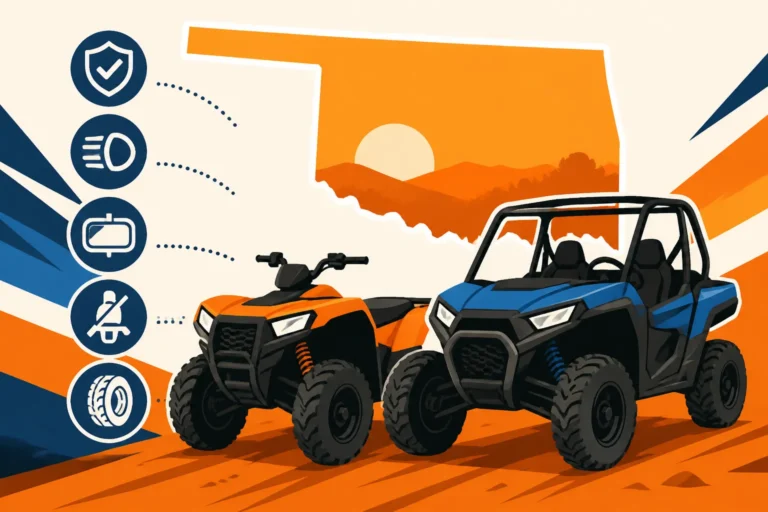
Here's a quick look at the key equipment requirements:
| Equipment Category | Specific Requirements for Street Legal UTVs |
|---|---|
| Lighting & Signaling | Headlights (low/high beam), Taillights, Brake Lights, Front & Rear Turn Signals |
| Audible Warning | A functional Horn |
| Visibility | At least one Rearview Mirror (typically side mirrors are added), Safety Windshield |
| Occupant Safety | Seatbelts for all designated seating positions |
| Braking System | Functional Service Brakes (foot-operated) and Parking Brake |
| Tires | DOT-approved for street use |
| Other | License Plate Light, Exhaust System, Reflectors, Speedometer |
Who Can Drive a Street-Legal UTV on Oklahoma Roads?
Just because your UTV now has all the bells and whistles for street legality doesn't mean anyone can hop in and take it for a spin on public roads. Oklahoma law has specific requirements for the driver, ensuring that anyone operating these machines on the pavement has the necessary qualifications and legal standing. This isn't just about adhering to regulations; it's about promoting safety for everyone on the road, including the UTV driver, passengers, and other motorists.
Age and Driver's License Requirements
The primary requirement for driving a street-legal UTV in Oklahoma is straightforward: you must hold a valid driver's license. This is not the place for learners' permits or for unlicensed joyrides. If you wouldn't be allowed to drive a car or truck on the road, you certainly can't drive a street-legal UTV. This means that generally, drivers must be at least 16 years old and possess a standard Class D operator's license, or a commercial driver's license (CDL) if that's what they hold. There's no special "UTV license" or additional endorsement required beyond the standard driver's license. [Oklahoma Drivers Must Be 16 for a Street UTV] clarifies this point directly. This streamlines the process, as most adult riders already possess the necessary credential. It’s a common misconception that you might need a motorcycle endorsement, but thankfully, [Oklahoma Skips the Motorcycle Endorsement] for these specific street-legal UTVs, making them more accessible to the average driver.
No Special Endorsement Needed, But Responsibility Is Key
As mentioned, one of the more rider-friendly aspects of Oklahoma's street-legal UTV class is that you don't need a motorcycle endorsement (often called an "M" endorsement) on your driver's license. This is a significant distinction from some other states or from operating certain types of two-wheeled off-road vehicles. For many, obtaining a motorcycle endorsement involves additional testing and sometimes specific training, which can be a barrier. By not requiring it, Oklahoma recognizes the different operational characteristics of UTVs compared to motorcycles, putting them closer to cars or trucks in terms of licensing.
However, with this leniency comes a heightened sense of personal responsibility. Just because you don't need a special endorsement doesn't mean you can disregard road rules or drive carelessly. Operating a UTV, even a street-legal one, can feel different from driving a car. Their smaller size, different center of gravity, and open cabin environment demand a driver who is alert, defensive, and understands the unique dynamics of their machine. You are expected to know and obey all traffic laws, just like any other motorist, from speed limits to stop signs to signaling turns.
Passenger Rules and Youth Riders
When it comes to passengers, the rule of thumb for street-legal UTVs aligns with common sense and factory design: you can only carry as many passengers as the manufacturer intended and for whom there are designated seating positions with seatbelts. If your UTV is a two-seater, you can carry one passenger. If it’s a four-seater, you can carry three passengers, and so on. Overloading a UTV is not only illegal but extremely dangerous, compromising stability and control, especially on paved roads.
For youth riders, the rules about helmets still apply, particularly for those under the age of 18. Even though a street-legal UTV might have a roll cage, [Oklahoma Helmet Law for Riders Under 18] is still in effect for occupants of UTVs on public roads. So, if you're taking your child for a ride, ensure they have a properly fitted, DOT-approved helmet. Beyond helmets, the driver must be licensed, meaning a child cannot operate a street-legal UTV on public roads, even if an adult is present as a passenger. The licensed driver must be the one at the controls.
Where Can You Legally Ride a Street-Legal UTV in Oklahoma?
So, you've got your UTV tricked out with all the street-legal goodies, and you're a licensed driver. Now for the million-dollar question: where can you actually ride this thing? This is where many riders stumble, as the rules aren't as simple as "any road." Oklahoma's street-legal UTV class has specific limitations on where these machines can and cannot operate, primarily focusing on local roads and avoiding high-speed arteries.
Allowed Roadways: City Streets and County Roads
The good news is that street-legal UTVs are generally allowed on city streets and county roads. This is a massive boon for local travel, allowing you to run errands in town, visit neighbors, or access trails and properties without the hassle of trailering. However, there's a crucial caveat: these roadways must typically have a posted speed limit of 35 mph or less. This ensures that UTVs, which aren't designed for sustained high speeds, aren't mixed with fast-moving traffic, reducing the risk of accidents.
It's important to remember that local control plays a significant role here. While the state law provides the framework, individual cities and counties retain the authority to pass their own ordinances regarding UTV use on their local streets. This means what's permissible in one town might be restricted in another. [Oklahoma County Commissioners and ATV Roads] highlights how local authorities have a say in opening or closing specific roads to off-road vehicles. Before you venture out, especially into an unfamiliar municipality, it’s always wise to check their specific ordinances. A quick call to the city clerk or county commissioner's office can save you a headache later.
Prohibited Roadways: Interstates and US Highways
Here's the firm rule: street-legal UTVs are absolutely prohibited from operating on interstates and US highways. These are designed for high-speed traffic, and a UTV, even a street-legal one, simply isn't built to safely keep up or withstand the forces of large vehicles traveling at 70+ mph. This isn't just a legal restriction; it's a critical safety measure. Driving a UTV on these roads would be incredibly dangerous for everyone involved. [Oklahoma Street UTVs Stay Off Interstates] and [Oklahoma Street UTVs Stay Off US Highways] are clear on this point.
Similarly, other state highways or turnpikes might also be off-limits, particularly those with higher speed limits. The general principle is to keep street-legal UTVs on lower-speed, local roads where they can safely integrate with traffic. Always err on the side of caution. If a road feels too fast or too busy for your UTV, it likely is.
Crossing Roads and Special Considerations
While driving on certain roads is restricted, crossing a highway or state road can sometimes be permitted, often under very specific conditions. For example, [Oklahoma Highway Crossings in Daylight] rules typically allow for direct crossings of state or US highways, provided the crossing is made at an intersection and perpendicular to the flow of traffic, in daylight hours, and the highway has a posted speed limit of 35 mph or less. These are very specific rules designed to minimize the time a UTV spends in high-traffic, high-speed zones.
You cannot ride alongside a highway for any significant distance, even if you are just trying to get from one county road to another. These crossings are strictly for bridging two legal riding areas, not for extending your journey on a prohibited road. Always approach these crossings with extreme caution, yielding to all traffic and making sure the path is clear before proceeding. The goal is to move across the road as quickly and safely as possible, minimizing your exposure.
Registering and Insuring Your Street-Legal UTV in Oklahoma
Getting your UTV ready for the road means more than just adding equipment; it also involves jumping through the necessary bureaucratic hoops to make it officially street-legal. This includes proper registration and ensuring you have the right insurance coverage. Ignoring these steps can lead to hefty fines, legal troubles, and leave you financially vulnerable if an accident occurs.
The Street-Legal UTV Registration Process
Unlike the typical ATV registration, which is a one-time fee and never renews, a street-legal UTV requires annual registration. This makes sense, as it’s now considered more akin to a car or truck for road use. You'll need to visit a tag agency, just like you would for any other vehicle. When you go, be prepared to present your proof of ownership (like a title or MSO for a new machine), a declaration of the purchase price for excise tax purposes, and proof that your UTV meets all the required safety equipment standards. [Oklahoma Street UTV Annual Renewal] is a key difference to remember compared to your standard off-road machine registration.
The tag agency will process your paperwork, collect any applicable excise tax (Oklahoma's 4.5% rate applies here, just like other vehicles), and issue you a unique street-legal UTV license plate and annual decal. This plate is what distinguishes your machine as legally road-worthy. It's important to remember that this process is separate from the standard off-road registration; you might even have both if you primarily use your UTV off-road but also want the flexibility of street legality. [Oklahoma Annual Plates for Street UTVs] signifies that this is a recurrent cost and obligation, much like any other registered vehicle.
Understanding Insurance Requirements
Another critical difference for street-legal UTVs is the requirement for liability insurance. When you register a standard off-road ATV or UTV for trail use, Oklahoma does not require you to carry insurance. However, once you put that UTV on public roads with a street-legal plate, it falls under the same insurance mandates as cars and trucks. This means you must carry minimum liability coverage, which protects you financially if you cause an accident that results in injury or property damage to others. [Oklahoma Insurance at Street Registration] is a non-negotiable step.
While liability is the legal minimum, many riders opt for more comprehensive coverage, especially given the investment in a UTV and its modifications. Collision coverage can help repair or replace your UTV if it's damaged in an accident, regardless of fault. Comprehensive coverage can protect against theft, vandalism, fire, or natural disasters. Talk to your insurance agent to discuss your options and ensure your policy adequately covers your street-legal UTV for both on-road and off-road use, as some policies might have exclusions. It's peace of mind worth investing in.
Costs Associated with Street Legality
Converting and registering a street-legal UTV involves several financial considerations that go beyond the initial purchase price of the machine itself. These costs can add up, so it's wise to budget for them upfront.
- Equipment Upgrades: This is often the most significant upfront cost. Depending on what your UTV came with from the factory, you might need to purchase and install turn signal kits, horns, mirrors, a DOT-approved windshield, and potentially new tires. The cost for these parts can vary widely based on your UTV model and the quality of aftermarket components.
- Excise Tax: Oklahoma's 4.5% excise tax applies to the declared purchase price of the UTV when it is first titled for street-legal use, or upon transfer of ownership. This is similar to buying a car and is a one-time tax at the point of titling.
- Registration Fees: The actual fee for the street-legal license plate and annual decal is a modest amount, but remember it's an annual expense. [Oklahoma Street UTV Plate Costs] are a recurring line item in your budget.
- Insurance Premiums: Your insurance costs will depend on your chosen coverage limits, your driving record, the type of UTV you own, and where you live. This is another annual or semi-annual expense that needs to be factored in.
- Potential Dealer Fees: If you're purchasing a new UTV and having the dealer handle the street-legal conversion and registration, they might charge additional "doc fees" or setup charges. Always get an itemized breakdown of costs.
These are ongoing expenses that differ significantly from simply owning an off-road-only machine, where the main costs are often just fuel, maintenance, and perhaps park fees. When you plan to make your UTV street-legal, think of it more like adding a small, specialized vehicle to your household fleet.
Common Misconceptions and Pitfalls for Riders
With any new set of regulations, especially concerning vehicles that blur the lines between off-road and on-road, there are bound to be misunderstandings. Oklahoma's street-legal UTV class is no exception. Many riders, with the best intentions, can misinterpret rules or overlook crucial details, leading to potential tickets or even dangerous situations. Let's clear up some of the most common pitfalls.
"Street-Legal" Doesn't Mean "Go Anywhere"
Perhaps the biggest misconception is that once your UTV has a street-legal plate, it magically becomes a regular car. This couldn't be further from the truth. As we've discussed, there are strict limitations on where these machines can operate. You cannot just hop on the nearest interstate or US highway, even for a short distance. The "street-legal" designation primarily applies to lower-speed municipal streets and county roads. Thinking your street-legal UTV can navigate all public roads like a car is a recipe for a costly ticket and a potentially dangerous situation. It's vital to remember that the classification opens up some roads, not all roads.
Another common pitfall involves the varying local ordinances. Just because the state allows street-legal UTVs on county roads with a 35 mph limit doesn't mean every single county or city has embraced them. Some municipalities might have stricter local rules or even prohibit them entirely on certain roads within their jurisdiction. It is your responsibility to check local regulations before you ride. Assuming that state law automatically overrides all local rules is a mistake many have made. [Oklahoma Ordinance Lookups Before You Ride] can save you from an unexpected citation.
The Difference Between ATV and UTV Registration
It's also crucial to understand that the street-legal class specifically refers to UTVs (Utility Task Vehicles, often called side-by-sides), not traditional ATVs (All-Terrain Vehicles, or quads). While some states might have provisions for street-legal ATVs, Oklahoma's specific legislation creating this class targets UTVs. This distinction is based on design, stability, and passenger capacity, making UTVs generally more suitable for road use with the appropriate modifications.
Furthermore, the standard Oklahoma ATV registration that costs a nominal fee and never renews is completely separate from the annual street-legal UTV registration. If you want to use your UTV on public roads, you need the annual street-legal plate, regardless of whether you already have the basic off-road registration decal. These are two distinct systems serving different purposes. Don't assume your existing ATV decal covers your UTV for road use; it absolutely does not.
The Temptation of Speed and Unsuitable Roads
UTVs can be powerful machines, and it's tempting to push their limits, especially when you're on a smooth, open road. However, they are not designed for sustained high-speed travel like cars. Their handling characteristics, suspension, and braking systems are optimized for off-road conditions, not necessarily for quick maneuvers or emergency stops at 60 mph. Pushing a street-legal UTV beyond its comfortable and safe speed limits, even on an allowed road, increases the risk of losing control, rollovers, or having an accident.
Similarly, riding on roads that are permitted but feel unsafe due to traffic volume or poor visibility is another trap. Just because you can ride a particular county road doesn't mean it's always the best or safest choice. Use your judgment. If you're on a winding road with blind corners and heavy truck traffic, reconsider your route. Safety should always be your top priority, even above legal permission. Adhering to [Oklahoma Crossing Rules at 35 mph] highlights the careful nature of these permissions.
Modifying Your UTV for Road Use: Aftermarket Options
So, you've decided to take the plunge and make your UTV street-legal. The good news is that the aftermarket industry is booming, providing a plethora of options to help you meet Oklahoma's requirements. From individual components to complete kits, you can find almost everything you need to transform your off-road machine into a road-ready vehicle.
Choosing the Right Aftermarket Components
When it comes to modifying your UTV for street use, quality and compliance are key. You'll need to source components such as:
- Turn Signal Kits: These are typically complete wiring harnesses with LED front and rear turn signals, a dash-mounted switch, and sometimes a horn button. Look for kits that are designed for your specific UTV model for easier installation. Many reputable brands offer these, including options from SuperATV, known for their durable UTV accessories.
- Mirrors: You'll likely need side mirrors for better visibility, and some riders also add a center rearview mirror. Ensure they are robust enough to handle vibrations and provide a clear, unobstructed view.
- Windshields: As mentioned, a safety-rated windshield is crucial. Options range from full glass windshields to durable polycarbonate, often with hard coatings for scratch resistance. Consider features like vents for airflow or wiper kits for rainy conditions.
- Horns: A simple 12V horn is usually sufficient. Make sure it's loud enough to be effective but not excessively jarring.
- DOT-Approved Tires: If your current off-road tires aren't DOT-approved, you'll need a set that is. These tires offer better wear characteristics and traction on pavement, while still often providing decent performance off-road.
When selecting components, always prioritize those that explicitly state they are designed for street-legal conversions or meet DOT standards where applicable. Cheaper, non-compliant parts can not only fail to meet legal requirements but also compromise your safety.
DIY Installation vs. Professional Help
Once you have your components, you have a couple of options for installation:
- DIY Installation: If you're comfortable with basic automotive wiring, tools, and following instructions, many aftermarket kits are designed for do-it-yourself installation. This can save you money on labor costs. Companies like SuperATV often provide detailed instructions and even video tutorials to guide you through the process. Be sure to budget enough time and have the right tools on hand. Double-check all connections and ensure everything is securely mounted and functional before hitting the road.
- Professional Installation: If you're not mechanically inclined, or prefer to ensure everything is installed correctly and safely, taking your UTV to a reputable powersports dealer or an off-road customization shop is a wise choice. They have the expertise and specialized tools to perform the conversion efficiently and correctly, ensuring all components meet the necessary standards. While this adds to the cost, it provides peace of mind that your UTV is properly equipped and ready for its street-legal inspection. They can also often advise on [Oklahoma Equipment Required for Street UTVs] and confirm compliance.
Ongoing Maintenance for Street-Legal UTVs
Once your UTV is street-legal, its maintenance needs will shift slightly. While regular off-road maintenance (oil changes, air filter cleaning, checking belts) remains crucial, you'll also need to pay attention to components that see more wear on pavement:
- Tire Wear: Road driving, especially on hard turns, can wear out off-road tires quickly. Monitor your DOT-approved tires for uneven wear and proper inflation.
- Brake System: Increased use on roads means more brake engagement. Regularly inspect brake pads, rotors, and fluid levels.
- Lighting and Signals: Routinely check that all your headlights, taillights, brake lights, and turn signals are functioning correctly. Bulbs can burn out, and wiring can come loose with vibrations.
- Suspension Components: While UTV suspension is robust, extended road use can still lead to wear on bushings, ball joints, and tie rods. Listen for any new noises or changes in handling.
Treating your street-legal UTV like the hybrid vehicle it is, blending off-road capability with on-road compliance, will ensure it remains safe, reliable, and legal for all your adventures.
The Benefits and Drawbacks of Going Street Legal
Deciding whether to make your UTV street-legal in Oklahoma involves weighing the advantages against the potential downsides. For many, the benefits far outweigh the drawbacks, but it’s important to have a clear-eyed view of both sides before investing time and money.
The Perks of Road Access
The most immediate and obvious benefit of a street-legal UTV is the enhanced convenience and freedom it offers. No longer are you strictly beholden to a trailer for every move. Imagine these scenarios:
- Local Errands and Commuting: For those living in rural areas or small towns, a street-legal UTV can become a practical vehicle for quick trips to the local store, the post office, or even to work if the commute involves low-speed roads. It saves fuel compared to a truck and often offers easier maneuverability.
- Farm and Ranch Use: Farmers and ranchers can immensely benefit from the ability to drive their UTVs directly from one field to another, or to access different parts of their property without having to stay strictly on private land. [Oklahoma Farm Use on County Roads] becomes much more practical and integrated into daily operations.
- Accessing Trails and Hunting Spots: Instead of driving your truck to a trailhead that's just a few miles down a county road, you can simply hop in your UTV and drive there. This not only saves time but also adds to the enjoyment of the journey. For hunters, it means getting to a hunting lease or a specific stand without relocating your truck.
- Community and Leisure Rides: In communities where local ordinances permit, street-legal UTVs open up opportunities for leisurely rides through town, parades, or simply enjoying the open air with friends and family. It transforms the UTV from a purely recreational or work-specific tool into a more versatile lifestyle vehicle.
- Increased Utility and Enjoyment: Ultimately, being street-legal expands the utility of your UTV, making it a more integral part of your daily life and increasing the overall enjoyment you get from your investment. The hassle of loading and unloading a trailer for short distances is eliminated, making spontaneous rides possible.
The Considerations and Challenges
While the benefits are compelling, there are also factors to consider that might make street legality less appealing or more complex for some riders:
- Cost of Conversion: The initial investment in aftermarket parts (turn signals, mirrors, windshield, horn, DOT tires) can be significant. This cost needs to be weighed against how often you'll actually use the street-legal capability.
- Ongoing Fees and Insurance: Unlike a basic off-road registration, street-legal UTVs require annual registration renewals and mandatory liability insurance. These recurring costs add to the overall expense of ownership. [Oklahoma Street UTV Annual Renewal] is a fixed, recurring expense.
- Limited Road Access: Despite being "street-legal," the restrictions on interstates, US highways, and roads with speed limits over 35 mph mean your UTV still isn't an all-purpose road vehicle. This limitation can be frustrating if your desired routes involve higher-speed roads.
- Safety Concerns on Pavement: UTVs are designed primarily for off-road environments. While modifications improve safety for road use, they still handle differently than cars, especially at higher speeds or in emergency maneuvers. Drivers must remain extra vigilant and aware of their machine's limitations when mixing with car traffic.
- Local Ordinance Variability: The patchwork of local city and county ordinances can be a headache. What's legal in your hometown might be prohibited in the next county over, requiring diligent research before venturing into unfamiliar territory. This inconsistency can lead to confusion and accidental violations.
- Increased Scrutiny: Operating a UTV on public roads can sometimes draw more attention from law enforcement, who might be more likely to pull you over for a routine check to ensure compliance with all equipment and driver requirements.
Ultimately, the decision to make your UTV street-legal comes down to your individual needs, how you plan to use your machine, and whether the added costs and responsibilities align with the convenience and freedom you stand to gain. For many Oklahoma riders, it's a game-changer, but it's not a one-size-fits-all solution.
Disclaimer
This article is for general informational purposes only and does not constitute professional advice. Laws, prices and regulations vary by location and change over time. Consult a qualified professional for guidance on your specific situation.