A Class Created by a 2021 Bill
It can feel incredibly frustrating to own a UTV in Oklahoma and constantly wonder where you're legally allowed to ride. For years, the rules for taking your side-by-side on public roads were murky at best, often leaving riders guessing and sometimes, unfortunately, facing fines. This guide is here to cut through that confusion, explaining how a pivotal 2021 bill changed the game, what it takes to get your UTV street-legal in the Sooner State, and the definitive rules you need to follow to enjoy the open road with peace of mind.
Understanding Oklahoma's Street-Legal UTV Classification
Before 2021, if you wanted to take your UTV on the road in Oklahoma, you were pretty much limited to farm use or very specific, usually short, crossings of county roads. Many riders felt trapped, having invested in capable machines that they could only enjoy off the pavement. The desire to connect trails, ride to a local store, or simply get to a hunting lease without trailering felt like an impossible dream for many. This frustration was widespread, and it led to a significant shift in the state's approach to these popular vehicles.
The Game-Changing 2021 Legislation
The landscape for UTV owners in Oklahoma changed dramatically with the passage of a crucial bill in 2021. This legislation wasn't just a tweak; it was a wholesale re-evaluation of how utility terrain vehicles could be classified and used on public roads. Before this, UTVs were lumped into a category that made broad street use practically impossible, leading to a lot of confusion and inconsistency in enforcement across different counties and municipalities. Riders, local law enforcement, and even tag agencies were often at odds about what was permissible. The new law brought clarity and, more importantly, a legal pathway for UTVs to become street-legal. It created a distinct class of vehicle, acknowledging the growing popularity and utility of side-by-sides for more than just recreational or agricultural purposes. This legislative change was a welcome relief for countless riders who had been advocating for clearer, more expansive road access for their machines.
This new classification didn't just appear out of nowhere. It was the result of years of conversations, lobbying efforts, and a recognition that UTVs had evolved. They weren't just glorified golf carts anymore; many were designed with features that made them safer and more capable on paved surfaces. The bill essentially provided a framework for these machines to meet safety and equipment standards typically associated with other on-road vehicles, allowing them to integrate into the existing traffic flow, albeit with specific restrictions. It was a forward-thinking move that helped Oklahoma catch up with other states that had already established similar street-legal UTV provisions, giving riders here more freedom while still prioritizing public safety.
What Exactly is a "Street-Legal UTV" in Oklahoma?
So, what does it truly mean to have a "street-legal UTV" in Oklahoma under this new classification? It's important to understand that this isn't about slapping a license plate on any off-road machine and hitting the highway. Instead, it defines a specific type of UTV that has been equipped and registered to meet rigorous on-road standards. Think of it less as a blanket permission slip and more as a detailed checklist that your vehicle must satisfy before it can legally traverse public roads. Unlike the standard [Oklahoma ATV Registration You Pay Once] which gets you an off-road decal for trail use, a street-legal UTV requires an entirely different type of registration, complete with an annual plate or decal, much like a car or truck.
This distinction is crucial because it differentiates a UTV built and outfitted for road use from an ATV or UTV intended purely for dirt, mud, or sand. A typical off-road ATV, for example, is usually much smaller, designed for a single rider (or sometimes two), and lacks many of the safety features needed for street driving. A street-legal UTV, by contrast, needs to have a full suite of safety and operational equipment installed, ranging from proper lighting to a windshield. The idea is to ensure that these vehicles, when on public roads, are as visible, controllable, and safe as possible, minimizing risks for both the UTV occupants and other motorists. It's a comprehensive approach that aims to integrate these machines responsibly into the broader traffic system.
Essential Equipment for Oklahoma Street-Legal UTVs
Getting your UTV street-legal in Oklahoma isn't just a matter of signing a form; it's about physically equipping your machine to meet specific safety and operational standards. This can feel like a daunting list, but many of these items are things you might already have or can easily add with aftermarket kits. The core idea is to make your UTV as visible and controllable as any other vehicle on the road.
Mandatory Safety Gear for Road Use
To be considered street-legal in Oklahoma, your UTV must be outfitted with a comprehensive list of safety equipment. This isn't just a suggestion; it's a legal requirement that will be checked when you go to register your machine for road use. Let's break down what you'll need:
- Headlights and Taillights: Your UTV must have at least two headlights, capable of both high and low beams, and they need to be white in color. Similarly, you'll need at least two taillights, emitting red light, clearly visible from the rear. These are non-negotiable for visibility, especially if you plan to ride at dusk or dawn.
- Brake Lights: Integrated into your taillights, these must illuminate when the brake pedal is pressed, signaling to vehicles behind you that you're slowing down or stopping.
- Turn Signals: Both front and rear turn signals are required. These need to be amber in color at the front and either amber or red at the rear. You can find excellent aftermarket turn signal kits from companies like SuperATV that integrate seamlessly with most UTV models, making this modification straightforward. Having clear turn signals is paramount for communicating your intentions to other drivers, preventing potential accidents.
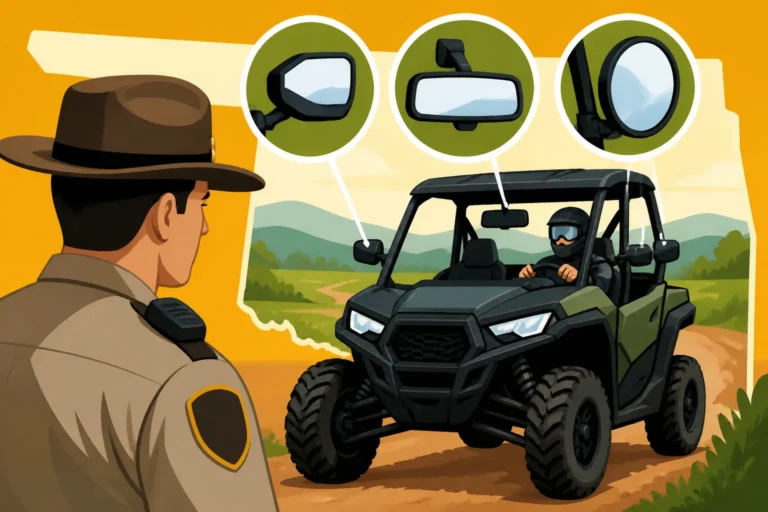
- Mirrors: You must have at least one rearview mirror, typically mounted centrally, providing a clear view of the road behind you. Many riders also opt for side mirrors for enhanced visibility, though often not strictly mandated, they are a wise addition for safety.
- Horn: A functioning horn is required, allowing you to alert other drivers or pedestrians to your presence when necessary. It's a small but vital safety feature.
- Windshield and Wipers: Your UTV needs a windshield made of safety glass or an equivalent approved material. If it has a windshield, it must also have a functional windshield wiper system to ensure clear visibility in inclement weather.
- Seatbelts: Every occupant of the UTV must have a properly installed and functioning seatbelt, similar to those found in cars. These are your primary safety restraint in the event of a sudden stop or collision.
- Tires: Your tires must be DOT (Department of Transportation) approved, meaning they are designed and tested for road use. Off-road-only tires might not meet these standards, so check your tire's sidewall for the DOT stamp.
- Brakes: A robust braking system that can effectively stop the vehicle is, of course, a requirement.
- Muffler/Exhaust System: Your UTV must be equipped with a muffler that prevents excessive or unusual noise. This is to ensure that street-legal UTVs blend in with other traffic noise and don't become a nuisance.
Ensuring all these components are in place and working correctly isn't just about avoiding a ticket; it's about your safety and the safety of everyone else on the road.
The Registration and Titling Process for Street Use
Once your UTV is properly equipped, the next crucial step is to navigate the registration and titling process to get that coveted street-legal tag. This part can feel a bit different from how you might have handled an off-road ATV in the past. Remember, this isn't the [Oklahoma ATV Registration You Pay Once] that you might be familiar with for machines used solely off-road. Instead, you're essentially registering your UTV as a motor vehicle for on-road use, which comes with its own set of requirements and annual renewals.
Your journey starts at an authorized Oklahoma tag agency. You'll need to bring all your ownership documents, which typically include the manufacturer's statement of origin (MSO) if it's new, or a proper title and bill of sale if you purchased it used. The tag agency will verify your VIN and ensure your paperwork is in order for a standard vehicle title. This title will then be used to apply for your street-legal UTV registration. Be prepared for specific fees associated with titling and registration. Unlike the one-time off-road decal, [Oklahoma Street UTV Plate Costs] and [Oklahoma Street UTV Annual Renewal] are part of the deal for a street-legal machine. This means you'll be paying a registration fee every year to keep your road privileges.
Crucially, Oklahoma also requires proof of liability insurance when registering a street-legal UTV. This is different from the off-road registration where insurance isn't typically mandated. So, before you head to the tag agency, make sure you have an active insurance policy for your UTV that covers on-road liability. You can learn more about this by looking up [Oklahoma Insurance at Street Registration]. The tag agency clerks are generally very helpful, but it's always a good idea to call ahead or check the Service Oklahoma website for the most up-to-date requirements and forms. Walking in prepared with all your documents, proof of insurance, and the understanding that you'll be getting an annual plate will make the process much smoother.
Navigating Oklahoma Roads: Rules and Restrictions
Now that your UTV is equipped and registered for street legality, it's time to hit the pavement! But holding that street-legal plate doesn't mean every road is open to you. Oklahoma has specific rules about where street-legal UTVs can operate, as well as distinct requirements for drivers and passengers. Understanding these limitations is just as important as having the right equipment.
Where You Can (and Can't) Ride
This is where many riders can get tripped up, assuming that "street-legal" means "any street." Unfortunately, that's not always the case, and knowing the boundaries is crucial to avoid a citation. Generally, street-legal UTVs are permitted on most county roads and city streets, unless a local ordinance specifically prohibits them. This is a significant point because [Oklahoma Municipal Ordinances That Open Streets] can vary wildly from town to town. Just because one city embraces street-legal UTVs doesn't mean the next one will. It's always a good practice to check with the specific municipality if you plan to ride within city limits.
However, there are clear no-go zones that apply statewide. Street-legal UTVs are explicitly prohibited from operating on interstate highways. This means you won't be taking your side-by-side on I-35 or I-40. Furthermore, most U.S. highways (like US-69 or US-75) are generally off-limits as well. There are provisions, however, for crossing certain highways. For instance, you might be allowed to cross a highway if it's posted at a speed limit of 35 mph or less, and this crossing must happen during daylight hours. This is a very specific allowance and not a general permission to drive on those highways. You can read more about [Oklahoma Highway Crossings in Daylight]. For county roads, the power often lies with the local authorities; [Oklahoma County Commissioners and ATV Roads] can designate certain county roads open or closed to UTV traffic. So, while you have more freedom with a street-legal UTV, it’s not an "anything goes" situation, and staying informed about local rules is key.
Driver Requirements and Operational Guidelines
Beyond knowing which roads you can use, it's equally important to understand who can drive a street-legal UTV and the specific rules that govern their operation on Oklahoma's roads. These aren't suggestions; they are laws designed to ensure safety for everyone sharing the pavement.
First and foremost, the driver of a street-legal UTV in Oklahoma must be at least 16 years old. This is a firm age requirement, so [Oklahoma Drivers Must Be 16 for a Street UTV]. Unlike motorcycles, you do not need a special motorcycle endorsement (often called an "M" endorsement) on your driver's license to operate a street-legal UTV. This is good news for many riders, as it simplifies the process of getting on the road. For specific details, check out [No M Endorsement Needed].
When it comes to passengers, your street-legal UTV can carry as many passengers as it was designed and equipped for by the manufacturer. If your UTV has seats and seatbelts for four people, then four people can legally ride. However, every passenger must use a seatbelt, and the machine must not be overloaded beyond its manufacturer's capacity. Additionally, for younger riders, [Oklahoma Helmet Law for Riders Under 18] still applies. Any rider or passenger under the age of 18 must wear a DOT-approved helmet while riding on public roads. This is a critical safety rule that applies across all motorized vehicles for minors.
Once you're on the road, your street-legal UTV must adhere to all standard traffic laws. This means obeying posted speed limits, stopping at stop signs and red lights, using your turn signals, and yielding the right-of-way as required. You are expected to operate your UTV like any other motor vehicle, following the flow of traffic and being mindful of your surroundings. While the ability to ride on roads opens up new opportunities, it also comes with the responsibility of being a safe and law-abiding driver.
Common Pitfalls and Key Considerations
Venturing into the world of street-legal UTVs in Oklahoma can be exciting, but it's also easy to make assumptions that can lead to problems. Many riders encounter common misconceptions or overlook important details that can quickly turn a fun ride into a costly headache. Let's talk about some of these potential pitfalls and what you need to keep in mind.
Don't Confuse Off-Road Registration with Street-Legal Plates
This is perhaps the most common mistake riders make: assuming that having an Oklahoma ATV registration decal means they're good to go on public roads. Let me be absolutely clear: the off-road decal you get for your ATV or UTV is for off-road use only. It signifies that your machine is registered for trails, parks, and private land. It absolutely, positively, does not grant you permission to drive on city streets or county roads without the specific street-legal equipment and an annual street-legal plate. [Oklahoma Registration Never Renews] for an off-road machine, but a street-legal UTV requires yearly renewal. This is a fundamental distinction that, if misunderstood, can lead to serious consequences.
Many riders, fresh from buying a UTV, will get their off-road registration and decal, perhaps even paying the small one-time fee, and then mistakenly think they've completed all necessary steps to drive wherever they please. The off-road decal is typically a small sticker placed on the front of your machine, as outlined in [Oklahoma Issues a Front Decal, Not a Plate]. This is vastly different from the standard license plate or annual decal required for street-legal vehicles. If you're pulled over on a public road with only an off-road decal, without the proper street-legal equipment and an annual plate, you could face fines, penalties, and even impoundment. The laws are distinct for a reason, and it's essential to respect that difference to avoid any unpleasant surprises from law enforcement.
Local Ordinances Still Matter
Even with a fully equipped and properly registered street-legal UTV, your journey isn't a free-for-all across every single paved surface in Oklahoma. While the state law provides a framework for street legality, individual cities and counties retain significant power to regulate or restrict UTV use within their own jurisdictions. This means that while state law might allow street-legal UTVs on certain types of roads, a specific city or county can still pass an ordinance that further limits or outright prohibits their use on streets within their boundaries. This can be incredibly frustrating for riders who travel, as the rules can literally change from one town line to the next.
Imagine you're planning a weekend trip to a new town with your street-legal UTV, hoping to ride from your cabin to a local diner. Before you even load up, it's absolutely critical to perform some due diligence. You need to investigate the local ordinances of that specific city or county. Many riders have been caught off guard, believing their state-level street-legal status covered them everywhere, only to find a local "no UTVs on city streets" rule in place. This is where resources like [Oklahoma Ordinance Lookups Before You Ride] become invaluable. A quick call to the city clerk's office or a search on the municipal website can save you a lot of grief. Don't assume; always verify. Local control over road access is a powerful tool, and understanding its impact is a key part of responsible street-legal UTV ownership in Oklahoma.
Comparing Off-Road vs. Street-Legal UTV Requirements in Oklahoma
To help clarify the differences between an off-road machine and a street-legal UTV, here's a quick comparison. This should make it easier to see why one doesn't automatically become the other.
| Feature | Off-Road UTV/ATV (Standard Registration) | Street-Legal UTV (Annual Road Plate) |
|---|---|---|
| Registration Type | One-time off-road decal (e.g., [Oklahoma ATV Registration You Pay Once]) | Annual vehicle plate/decal (e.g., [Oklahoma Yearly Decals for Street UTVs]) |
| Renewal | Never renews (e.g., [Oklahoma Registration Never Renews]) | Annual renewal required |
| Cost Shape | Low, one-time fee at titling | Initial titling fees + annual registration fees |
| Proof of Insurance | Not typically required for registration | Required for registration (e.g., [Oklahoma Insurance at Street Registration]) |
| Road Access | Primarily off-road, farm use, or limited crossings | County roads, city streets (where permitted), highway crossings (limited) |
| Prohibited Roads | All public roads unless specific crossing/farm exemptions | Interstates, most U.S. highways (except for specific crossings) |
| Required Equipment | Basic factory equipment (often no turn signals, mirrors, horn, windshield) | Extensive safety equipment (headlights, turn signals, mirrors, horn, windshield, DOT tires, etc.) (e.g., [Oklahoma Equipment Required for Street UTVs]) |
| Driver Age | No specific state-wide minimum for off-road use (park rules vary) | 16 years old (e.g., [Oklahoma Drivers Must Be 16 for a Street UTV]) |
| License Endorsement | Not applicable | No motorcycle ('M') endorsement required (e.g., [No M Endorsement Needed]) |
This table highlights just how distinct these two classifications are. Having an off-road registration is like having a permit for your backyard; it doesn't give you the right to drive on the street without the proper vehicle modifications and a separate, annual street-legal plate.
Disclaimer
This article is for general informational purposes only and does not constitute professional advice. Laws, prices and regulations vary by location and change over time. Consult a qualified professional for guidance on your specific situation.