Oklahoma Rules for Riding a County Road
Riding your ATV or UTV on a county road in Oklahoma can often feel like a guessing game. One minute you're thinking it's perfectly fine to cross that gravel road to get to your next pasture, the next you're wondering if a state trooper might be around the bend. The rules aren't always crystal clear, and the last thing any of us wants is a ticket or, worse, an accident because we misunderstood the law. This guide aims to clear up all that confusion, breaking down the specific rules and exceptions that govern riding your off-road machine on Oklahoma's county roads, helping you ride confidently and legally.
Oklahoma's Baseline Rules for OHVs on County Roads
Let's start with the fundamental truth: in Oklahoma, ATVs and UTVs are primarily designed and intended for off-road use. This means that, by default, they are generally not allowed on public roads, including county roads. The state's traffic code treats these machines differently from cars, trucks, or even motorcycles, recognizing their distinct design for rough terrain rather than paved or graveled public thoroughfares. This baseline rule is crucial because every exception or allowance for road use branches off from this initial prohibition. It's not about being a nuisance; it's about safety and maintaining the flow of traffic, given that these machines often have different braking, signaling, and speed capabilities than street-legal vehicles.
However, Oklahoma law isn't a blanket ban. There are specific, carved-out situations where operating your ATV or UTV on a county road becomes permissible. These exceptions are typically tied to practical necessities rather than recreational joyriding. Think about the rancher needing to move cattle across a road, or the farmer needing to access an isolated field. The law attempts to balance the safety concerns of mixing off-road vehicles with road traffic against the very real needs of Oklahomans who rely on these machines for work and property access. Understanding these exceptions is key to staying on the right side of the law. You can dive deeper into the overarching requirements in [Can You Drive a UTV on the Road in Oklahoma?].
One of the most common misconceptions is that if a road is unpaved or lightly traveled, it automatically qualifies as an "off-road" area. This isn't true. A county road, whether it's gravel, dirt, or even just two ruts through a field, is still considered a public roadway if it's maintained by the county and accessible to the public. This means the rules of the road apply, even if it feels like you're out in the middle of nowhere. Ignoring this distinction can lead to fines and legal trouble. Always assume a county road is a public road unless you have specific, verifiable information to the contrary, such as a county ordinance opening it up.
Understanding the "Instrument of Husbandry" Exemption
The "Instrument of Husbandry" exemption is a significant, but often misunderstood, pathway for using your ATV or UTV on county roads in Oklahoma. Simply put, this exemption allows owners to operate their off-road machines on public roads if the machine is being used for agricultural purposes, essentially treating it as a piece of farm equipment. This is a lifeline for many rural Oklahomans who rely on their ATVs and UTVs for daily tasks that often require crossing or briefly traveling on county roads. It acknowledges the practical realities of farming and ranching in a state where properties are often divided by public access routes.
To qualify under this exemption, your ATV or UTV must genuinely be used as an "instrument of husbandry." This means you're using it in direct connection with farming, ranching, or other agricultural operations. Examples include checking fences, moving livestock, transporting tools or feed between fields, or spraying weeds. It's not intended for recreational use, even if you happen to own a farm. If you're just out for a ride with your buddies on a Sunday afternoon, even if you own hundreds of acres, that recreational ride on a county road would likely not fall under this exemption. The intent and primary use at the time of operation are what truly matter. For a more detailed look, check out [Oklahoma's Instrument of Husbandry Exception].
It's also important to remember that even with the "instrument of husbandry" exemption, there are still limitations and common-sense guidelines. You're typically allowed to cross a public road or travel a short distance along it to get from one part of your property to another, or to access a field. However, this isn't an open invitation to drive for miles down a county road like you would a car. The spirit of the law is about facilitating essential agricultural work, not general transportation. Moreover, basic safety rules still apply: operate responsibly, be aware of other traffic, and yield the right-of-way. Using accessories from companies like SuperATV, such as cargo beds or sprayer attachments, can help demonstrate the utility nature of your machine if questioned, showcasing its role as a working vehicle.
While the "instrument of husbandry" exemption is robust for agricultural use, it's vital to clarify that this specific exemption does not exempt your machine from titling and registration requirements if it falls within the cutoff dates. Even if you only use your ATV or UTV on your farm and occasionally cross a county road, the state still requires it to be titled and registered if it's a quad manufactured after July 1, 2005, or a side-by-side manufactured after July 1, 2008. There was a time when farm permits offered more blanket exemptions, but those rules have changed. Now, the exemption primarily applies to excise tax for agricultural machines and allows limited road crossings for work, not to skip the registration process entirely. For more information on what constitutes [Oklahoma Farm Use on County Roads], you should consult specific agricultural guidelines.
The Authority of County Commissioners to Open Roads
While state law sets the general framework for ATV and UTV use on county roads, there's a crucial layer of local control: Oklahoma's county commissioners have the power to open certain county roads or sections of roads to off-road vehicles. This provision acknowledges that what works for a densely populated suburban county might not make sense for a vast, sparsely populated rural county where ATVs and UTVs are essential for everyday life and accessing remote properties. This local flexibility is designed to allow counties to tailor regulations to their unique needs and traffic patterns.
When county commissioners decide to open a road, they typically do so through a resolution or ordinance. This is a formal, public action that designates specific roads or areas where ATVs and UTVs are permitted. It's not something that happens informally or by word of mouth. These resolutions often come with their own set of rules, such as specific hours of operation, speed limits, or even equipment requirements beyond what state law might mandate for off-road use. For instance, a county might require machines to have working headlights and taillights even during daylight hours if they're on an open county road. It's paramount for riders to actively seek out and understand these local ordinances, as simply assuming a road is open because you've seen others on it can lead to trouble. [Oklahoma County Commissioners and ATV Roads] provides more context on this important local power.
How do you find out if your county, or a county you plan to ride in, has opened any roads? Your best bet is to contact the county clerk's office or the county commissioner's office directly. They can provide information on any resolutions that have been passed regarding ATV and UTV use on county roads. Many counties also publish these ordinances on their official websites. It’s also wise to check with local law enforcement, like the county sheriff’s office, as they are the ones who will be enforcing these rules on the ground. A quick call can save you a significant headache. Never rely on hearsay; always get official confirmation, as local rules can vary dramatically from one county line to the next.
It's important to differentiate between a county opening specific roads and the general right to cross a highway or section line. Even in counties where no roads are officially open to continuous ATV/UTV travel, state law typically allows for the crossing of roadways—including county roads, state highways, and even some U.S. highways—under specific conditions. These conditions usually involve crossing at a 90-degree angle, yielding to all traffic, and doing so only in daylight hours. This is a quick maneuver designed to connect one piece of property to another, not to travel along the road. Knowing the difference between an officially opened road and a legal crossing point is fundamental to safe and legal operation.
Special Considerations for Street-Legal UTVs on County Roads
In recent years, Oklahoma has established a specific legal class for "street-legal" UTVs, which operate under a different set of rules than traditional ATVs or non-street-legal UTVs. This class allows certain UTVs, once properly equipped and registered, to be driven on many public roads, including county roads, in a manner much closer to conventional vehicles. This is a game-changer for many UTV owners who want the versatility of their machine for both work and limited recreational travel on public routes. However, it comes with its own stringent requirements that must be met precisely. To truly understand this new class, delve into [Oklahoma's Street-Legal UTV Class Explained].
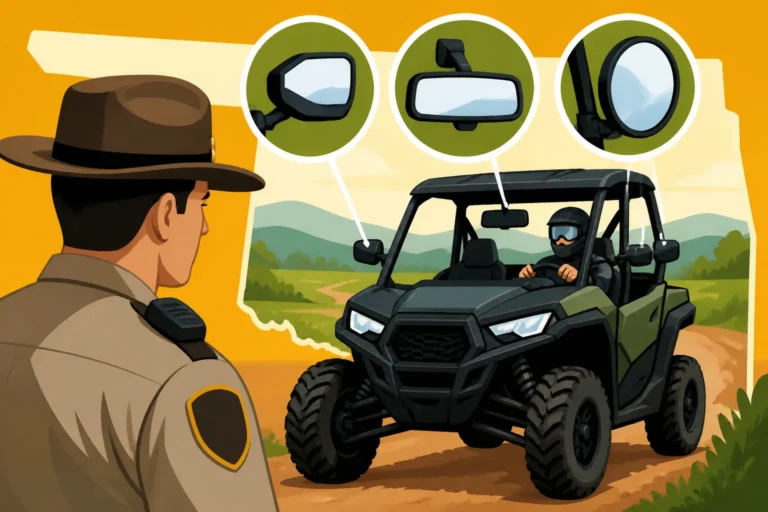
For a UTV to be considered street-legal in Oklahoma, it must undergo a series of modifications and pass specific inspections to ensure it meets safety standards akin to those for passenger cars or motorcycles. This means adding equipment such as headlamps, taillamps, brake lights, turn signals, a horn, a windshield, and rearview mirrors. Many riders turn to aftermarket parts from reputable manufacturers like SuperATV to equip their UTVs with these essential safety items. Once properly equipped, the UTV must then be registered with a special "street-legal" license plate, distinct from the one-time ATV/UTV decal. This plate signifies that the machine has met all the necessary requirements and is cleared for road use where permitted.
| Feature / Requirement | Standard OHV on County Road (Exemption Based) | Street-Legal UTV on County Road |
|---|---|---|
| Registration | One-time decal (if applicable) | Annual street-legal plate |
| Purpose | Primarily agricultural/husbandry work; crossing | General transportation (with limits) |
| Equipment | Basic safety (lights for night riding) | Full suite: head/tail/brake lights, turn signals, horn, mirrors, windshield |
| Driver's License | Not explicitly required (but recommended for safety) | Valid driver's license required |
| Insurance | Not legally required for off-road use | Legally required for road use |
| Speed Limits | Often lower or "reasonable and prudent" | Must obey posted road speed limits (within vehicle's capability) |
| Roads Permitted | Limited crossings, county-commissioner opened roads | Most county roads (with state/federal highway exceptions) |
| Interstates/US Hwys | Never allowed on interstates; limited US Hwy crossing | Never allowed on interstates; generally not allowed on US highways |
While street-legal UTVs are permitted on most county roads, they still have limitations. They are generally prohibited from interstates and often from many U.S. highways, particularly those with higher speed limits. Also, the driver of a street-legal UTV must be at least 16 years old and possess a valid driver's license – unlike some other off-road scenarios, a learner's permit won't cut it. Furthermore, proper insurance is mandatory for street-legal UTVs, just as it is for cars and trucks. All of these points highlight that while the street-legal designation opens up new possibilities, it also brings with it the full responsibilities and requirements of operating a traditional motor vehicle on public roads. You will want to look at [Oklahoma Equipment Required for Street UTVs] if you are considering this option.
Finally, even with a street-legal UTV, local ordinances can still play a role. While state law allows street-legal UTVs on many roads, individual municipalities or counties might have additional restrictions or specific areas where they are still prohibited. It's always best practice to check local rules wherever you plan to ride, especially if you're venturing into a new area. The intent of the street-legal UTV class is to integrate these machines more seamlessly into road traffic, but safety and local control remain paramount. Ensure you understand [Oklahoma Insurance at Street Registration] requirements before hitting the pavement.
Disclaimer
This article is for general informational purposes only and does not constitute professional advice. Laws, prices and regulations vary by location and change over time. Consult a qualified professional for guidance on your specific situation.