Does Your Quad Need a Spark Arrester in Oklahoma?
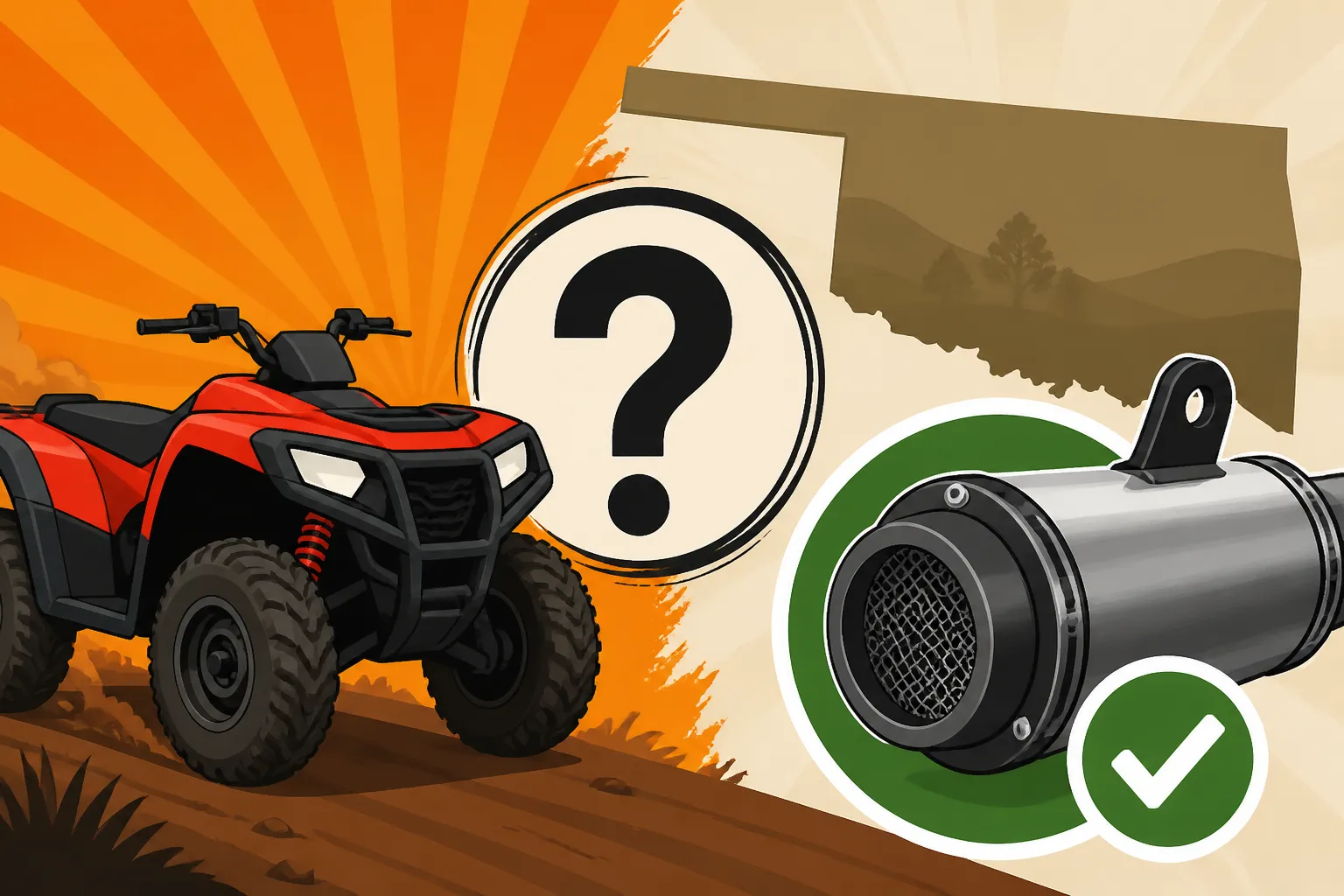
A spark arrester may seem like a small exhaust detail, but it can determine whether your ATV or UTV is properly equipped for a public-land ride in Oklahoma. The short answer is yes: spark arresters are required on public lands, including the Ouachita National Forest. Here’s what that means, what to check on your machine, and how to avoid assuming that a stock or aftermarket exhaust automatically qualifies.
The short answer: yes on public lands
If you plan to ride an ATV or UTV on public land in Oklahoma, treat a spark arrester as required equipment. According to the USDA Forest Service, off-highway vehicles on national forest lands must have a state-approved muffler and a spark arrester. That applies to riding in the Ouachita National Forest, where the USDA Forest Service oversees off-road vehicle trails and lands in Oklahoma.
A spark arrester helps prevent hot particles from escaping the exhaust and igniting dry vegetation. It is a fire-safety feature, not just a way to quiet the machine. The requirement is relevant even if your machine runs well, has a muffler, or has never caused a problem.
The key distinction is between riding on public land and riding somewhere with different land management. A private riding area may have its own equipment rules, and public land managers may provide specific instructions for their sites. Don’t assume a rule for one place automatically answers what applies at another. Check with the land manager before you tow.
| Where you plan to ride | What to assume about a spark arrester | What to confirm |
|---|---|---|
| Ouachita National Forest trails in Oklahoma | Required for off-highway vehicles, along with a state-approved muffler, according to the USDA Forest Service | Whether your specific exhaust setup meets the forest’s requirements |
| Other public land in Oklahoma | Treat a spark arrester as required | The land manager’s current equipment and access rules |
| Private riding property | Don’t assume the national forest requirement is the property’s only rule | The property’s own equipment, fire, and access policies |
If the Ouachita National Forest is on your route, review Oklahoma Ouachita National Forest Access before leaving. Trail access, closures, and equipment expectations are separate questions: a route being open does not mean every machine configuration is acceptable.
What the requirement means for your ATV or UTV
A muffler and a spark arrester are related parts of an exhaust system, but the requirement identifies both. A muffler alone should not be treated as proof that your machine has an approved spark arrester. Nor does a quiet exhaust, by itself, establish compliance.
The practical question is whether the exhaust system on your exact machine includes a suitable spark arrester and whether the equipment meets the requirements for the place you intend to ride. Model and exhaust configuration matter. A system that came with one machine may not fit another, and a replacement exhaust may have different equipment from the original.
Before buying or installing a component, check the owner’s manual and ask the manufacturer or a qualified dealer about compatibility with your machine. If you are comparing replacement parts on Amazon, use the exact make, model, and model year to narrow the search, then verify the part details with the manufacturer or seller. A marketplace listing is not, by itself, confirmation that the part satisfies a land manager’s requirements.
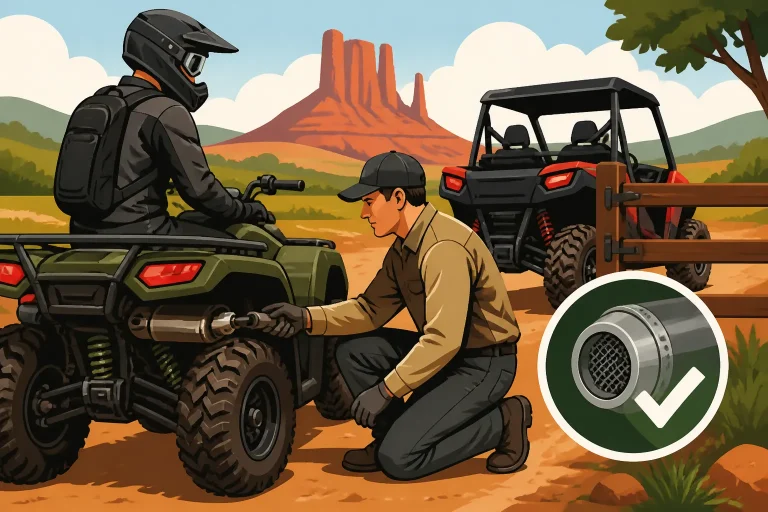
Be especially cautious if the exhaust has been modified. A previous owner may have changed or removed components, or a replacement system may not include a spark arrester. Don’t rely on appearance, sound, or a seller’s casual assurance. If you cannot confirm what is installed, ask a mechanic or contact the land manager before riding.
The same basic question applies whether you ride a quad or a side-by-side: is the machine an off-highway vehicle being used on public land, and does its exhaust have the required equipment? Don’t assume a UTV is exempt because it is larger or has a cab. For route planning, Oklahoma Trails That Allow Side-by-Sides and Oklahoma Trails That Allow Dirt Bikes can help you check vehicle access, but trail eligibility is not a substitute for confirming the machine’s equipment.
How to check your machine before heading out
A quick check at home is easier than discovering an equipment issue at a trailhead. Use this process before a public-land ride:
- Confirm where you’ll ride. Identify the land manager and verify that the route is open to your type of machine. For conditions and closures, see Oklahoma Trail Conditions Before You Tow.
- Identify your exhaust setup. Check the owner’s manual and any records from a dealer or prior owner. If the machine has an aftermarket exhaust or has been modified, confirm which parts are installed.
- Ask about the specific requirement. Contact the land manager if you’re unsure whether your equipment qualifies. Explain the machine and exhaust setup rather than asking only whether “a spark arrester” is needed.
- Inspect the equipment. Once the exhaust is cool, look for obvious damage, missing parts, or signs that the arrester has been removed. Follow the manufacturer’s instructions for inspection and maintenance.
- Keep the system intact. Don’t remove or bypass an arrester to improve sound or performance. If it needs repair or cleaning, follow the manufacturer’s guidance or get help from a qualified mechanic.
- Check for additional fire rules. Equipment compliance does not necessarily mean every activity is allowed during dry conditions. Review Oklahoma Fire Restrictions in Dry Months and any site-specific notices before your trip.
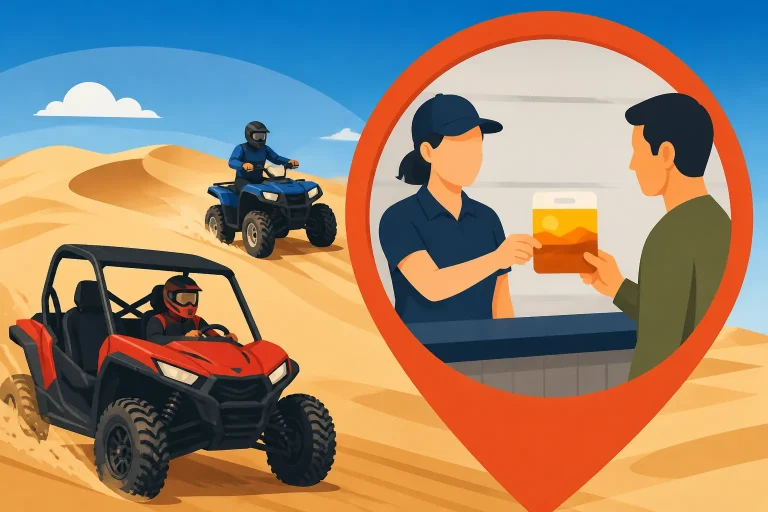
If a riding area checks equipment at the entrance, being ready to explain what is fitted to your machine can make the check straightforward. Requirements and procedures can vary by site, so avoid relying on another rider’s description of what was accepted at a different location. The article Spark Arrestor Checks at a Riding Area Gate covers what to think through when equipment is reviewed before entry.
Also keep permits and equipment requirements separate in your planning. A permit or other access authorization does not replace required safety or fire-prevention equipment. If you’re still sorting out where a permit applies, Oklahoma Land Access Permits Explained is a useful companion.
Common assumptions that can cause trouble
“The machine has a muffler, so it must have a spark arrester.”
Not necessarily. The USDA Forest Service identifies a state-approved muffler and a spark arrester as required equipment on national forest lands. Confirm both rather than treating one as a substitute for the other.
“It came from the dealer with the exhaust installed, so it must be compliant.”
That may be a helpful starting point, but it doesn’t settle the question. The machine could have been altered since purchase, and equipment rules are tied to where you ride. Check the current setup and confirm it with the relevant land manager.
“A used machine already passed inspection somewhere.”
Acceptance at one location does not prove that the machine meets the rules at another. Ask about the exact land and trail system you plan to use, especially if you bought the machine used or cannot verify its exhaust history.
“Only ATVs need to worry about this.”
The USDA Forest Service requirement applies to off-highway vehicles on national forest lands. Don’t assume a UTV is exempt. Confirm the rules for your machine type and intended route.
“If the trail is open, my machine is ready.”
Access and equipment are separate issues. A trail may be open while a machine still lacks required equipment. Before loading up, check trail status, vehicle access, fire restrictions, and the exhaust setup. Oklahoma Trail Etiquette Locals Expect can help with the broader responsibilities of riding around other trail users and land managers.
The safest approach is simple: for public-land riding in Oklahoma, plan on having a spark arrester, confirm that your machine’s exhaust is properly equipped, and check with the land manager if the details are unclear. That extra verification is worthwhile when fire risk and access depend on equipment you may not be able to assess by sound or appearance alone.
Disclaimer
This article is for general informational purposes only and does not constitute professional advice. Laws, prices and regulations vary by location and change over time. Consult a qualified professional for guidance on your specific situation.