Oklahoma Visitors From Arkansas
An Arkansas registration sticker or trail permit does not automatically give you permission to ride everywhere in Oklahoma. The key is to separate paperwork for the machine from permits for the land: Oklahoma’s requirements depend on where you plan to ride, and individual parks can add their own rules. Here’s how to check the right requirements before you cross the state line.
What reciprocity does and does not cover
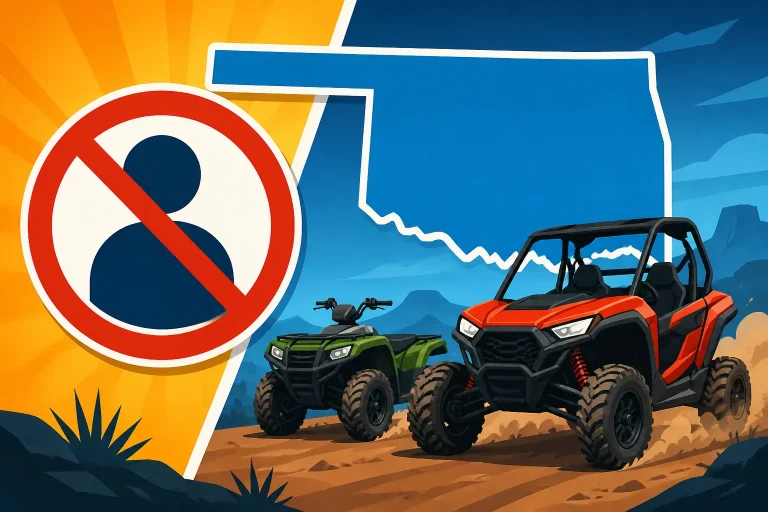
There is no single Oklahoma “visitor permit” that opens every trail or public riding area. Instead, you may encounter different requirements for the machine, the land, and the riding facility. Arkansas paperwork can help show that your ATV or UTV is yours, but it is not a substitute for an Oklahoma permit where one is required.
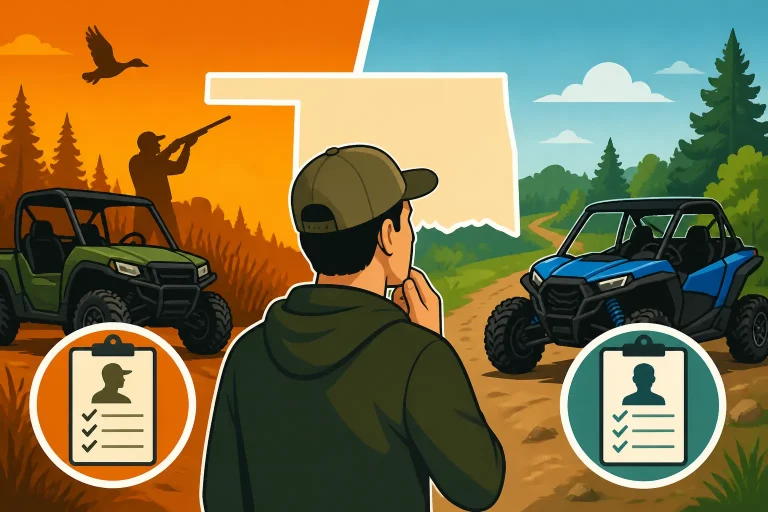
Start with these three separate questions:
- What paperwork identifies your machine? Keep the Arkansas registration or ownership documents you have, along with a bill of sale if you recently bought the machine. Carrying paperwork is useful if an officer or land manager asks who owns the vehicle. For more detail, see Oklahoma Proof of Ownership on the Trail.
- Does the place you are visiting require an access permit? Some Oklahoma public-land riding opportunities have a land access permit requirement, including designated timberland areas. That requirement is separate from any registration or decal on your machine.
- Does the riding area have its own entry rules? State parks, private parks and other managed properties can set their own fees, hours, equipment rules and age requirements.
So, if you have a valid Arkansas registration, do not assume it covers Oklahoma land access. Likewise, buying an Oklahoma land access permit does not automatically register your machine or give you permission to ride on a road.
The phrase “out-of-state reciprocity” can cause confusion because people use it to mean different things. A state may recognize certain paperwork issued elsewhere for one purpose, while still requiring a separate permit for a particular riding area. Check the rules that match your destination and activity rather than relying on a general assumption about reciprocity. Does Oklahoma Recognize Another State’s ATV Decal? explains why an out-of-state decal and land access are not the same issue.
| What you are checking | What Arkansas paperwork may do | What to verify in Oklahoma |
|---|---|---|
| Proof of ownership | Helps show ownership or identify the machine | What documents to carry and whether the machine’s paperwork is complete |
| Machine registration or decal | May identify the machine under Arkansas rules | Whether Oklahoma recognizes it for the specific use you have planned |
| Public-land access | Does not itself grant access to Oklahoma property | Whether the site requires an Oklahoma land access permit |
| Private or state riding area entry | Does not replace the site’s admission process | Fees, operating hours, vehicle rules and other facility requirements |
| Riding on a road | Does not automatically make an ATV or UTV road-legal in Oklahoma | The road’s rules and whether your vehicle is allowed there |
For the machine-specific side, review Oklahoma Rules for an Out-of-State Machine before you go. That is especially important if you have a dirt bike, a modified UTV or a machine with paperwork that does not clearly match its make, model or vehicle identification number. Rules can differ by vehicle type and intended use, so an Arkansas decal alone should not be treated as a universal authorization.
When Arkansas visitors need an Oklahoma land access permit
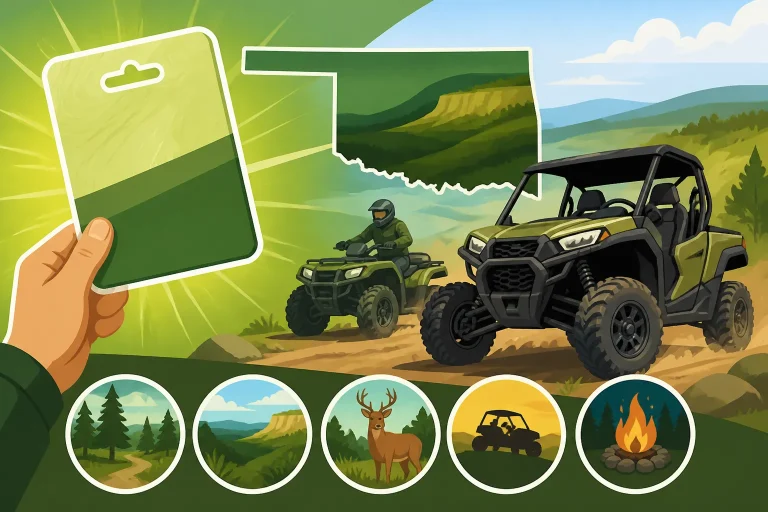
The main permit issue for many nonresident riders is access to designated public-land areas, not simply entering Oklahoma with an ATV. Oklahoma land access permits apply to particular lands and activities; they are not a general pass for every trail, state park or private riding area. Check the current rules for the specific location before setting out. Oklahoma Land Access Permits Explained gives an overview of the distinction.
Honobia Creek and Three Rivers are examples of timberland areas where a land access permit may be part of the riding requirements. Access can also be limited by the property’s current operating rules, season, designated roads or other restrictions. A permit does not mean every road or off-road route on the property is open to ATVs and UTVs. Confirm that riding is allowed on the dates you plan to visit and identify the routes you may use.
For visitors from Arkansas, residency matters when choosing a permit. A nonresident permit option may be different from the resident option, and an Arkansas driver’s license or address does not make you an Oklahoma resident. Do not assume that a resident age exemption or permit category applies to a nonresident just because the rider is a child or older adult. Review Oklahoma Resident vs Nonresident Permits and confirm eligibility with the permit provider.
The right permit may also depend on how long you will be in Oklahoma. A short visit and repeated visits over a season can lead to different choices. Before purchasing, verify which areas the permit covers, when it is valid, whether each rider needs a separate permit and how the permit must be displayed or carried. A permit for one land program is not necessarily accepted at another location. For short stays, check Oklahoma Three-Day Permit Rules; for the purchase process, see How to Buy an Oklahoma Land Access Permit.
Keep the land permit accessible while riding. If the rules allow an electronic copy, save it somewhere you can reach without cell service and consider carrying a backup. If the permit must be shown on request, make sure the person riding knows where it is. A permit tucked away in a truck or trailer may be inconvenient when a land manager asks to see it at the riding site.
Do not confuse these land permits with registration for the machine. The permit is permission to access certain land under specified conditions. It does not prove that you own the ATV or UTV, fix missing ownership paperwork, authorize riding on a closed route, or make a machine legal for public-road use.
Before buying a permit, make a short destination list and check each place separately:
- Is the site open to ATV or UTV riding on your planned dates?
- Is an Oklahoma land access permit required there?
- Does the permit cover the specific parcel or activity?
- Does every rider need a permit, or does the rule apply another way?
- Are there seasonal, check-in, route or operating-hour limits?
- Are separate admission or camping charges required?
For timberland areas, use the site’s official instructions rather than assuming the rules are identical to a typical state park trail system. Oklahoma WMA Access for a Quad can help clarify that public land is not a single category with one set of access rules.
Choose a riding area before relying on a permit
An Arkansas rider’s easiest planning step is to choose the destination first, then work backward through its rules. A permit that covers one public-land program may not cover a state park, private ranch or commercial OHV area. Conversely, a park’s entry fee or waiver may not meet a public-land permit requirement elsewhere.
Ask the destination or managing agency these specific questions:
- Are ATVs and UTVs both allowed, or are some vehicle types excluded?
- Is the area open for riding during my visit?
- Do nonresidents need a separate land access permit?
- Is there a required check-in, tag, wristband or proof of payment?
- Are there restrictions on helmets, flags, lighting, passengers or sound?
- Can I ride after dark, camp nearby or bring a trailer onto the property?
- What happens if weather closes the riding area?
The answer may be different for a private park than for public land. A private park can require a waiver and establish its own rules for rider ages, passengers, speed, camping or pets. A state-managed site may have separate admission and operating requirements. Read the facility’s current directions rather than assuming that an Oklahoma land permit serves as a park pass. For comparisons of riding locations, Oklahoma ATV Trails: Where to Ride is a useful starting point.
Road access needs its own check. An ATV or UTV that is allowed on a trail is not automatically allowed on the road used to reach the trailhead. Oklahoma has specific restrictions on off-road machines and road use, and local rules may also matter. Do not ride along a public road just because it appears to connect two parts of a property. Use a trailer or a route the managing authority has confirmed is open to your machine. If you are visiting a particular town or county, check the local ordinance and posted signs as well as state rules.
This is also where “street legal” claims need careful attention. Equipment added to a machine, a road plate from another state or an Arkansas registration document does not necessarily settle whether the vehicle may be driven on an Oklahoma road. A street-legal category can carry different equipment, insurance and registration requirements from trail-only use. If road riding is part of your plan, verify those requirements separately before leaving Arkansas.
Weather and site conditions can change the practical answer, too. A trail may be technically open but unsuitable after heavy rain, or a property may close routes to prevent damage. Call or check the official site shortly before departure, especially for a long drive. Oklahoma Trail Conditions Before You Tow can help you plan around closures and conditions rather than finding out after you arrive.
A pre-trip checklist for Arkansas riders
Use this checklist for each machine and each destination. It helps catch the common mistake of treating ownership documents, access permits and park admission as one thing.
- Write down every place you plan to ride. Include public land, private riding parks, campgrounds and any roads you expect to use. Rules can change from one property to the next.
- Confirm that the machine is allowed. Check whether the destination accepts your vehicle type and whether there are restrictions on size, passenger capacity or trail access.
- Check the ownership paperwork. Bring Arkansas registration or other ownership documents you have, plus a bill of sale for a recent purchase. Make sure the VIN on the machine agrees with the paperwork.
- Ask about Oklahoma permits. If the destination is a land access program area, confirm the nonresident permit requirements, coverage and validity period. Do not assume an Arkansas permit carries over.
- Read the destination’s rules. Check hours, seasonal access, check-in instructions, helmet and flag requirements, passenger rules, camping limits and any waiver requirement.
- Separate trail use from road use. Verify whether each road on your route is open to the machine. If you cannot confirm legal road access, haul the vehicle instead of riding it.
- Save proof where you can reach it. Keep digital copies of permits and paperwork, but bring a backup if service is unreliable or the site requires a physical document.
- Recheck before departure. Verify access status, fees and operating rules with the responsible agency or park. Fees and permit conditions can change, so confirm current figures directly with the provider.
If a permit question remains unclear, ask the agency or site manager to answer it for your exact situation: Arkansas resident, vehicle type, destination and planned dates. That is more useful than asking only whether “Oklahoma accepts Arkansas tags,” because the answer may differ for machine identification, public-land access and road use.
A little advance checking can prevent a wasted trip, but it also helps keep your ride within the rules. Bring the machine’s ownership documents, obtain the land permit required for the specific area, and follow the destination’s operating rules. Those are separate steps, and none should be assumed to replace the others.
Disclaimer
This article is for general informational purposes only and does not constitute professional advice. Laws, prices and regulations vary by location and change over time. Consult a qualified professional for guidance on your specific situation.