Oklahoma Rules for a Sixteen-Year-Old Rider
A sixteen-year-old in Oklahoma may be old enough for some kinds of riding but still face rules tied to the machine, the land and the route. The main things to check are helmet requirements, land access permits, a park’s own age policies and whether the ride involves a public road. Sorting those out before leaving home can prevent a denied entry or an unsafe ride.
What Oklahoma’s rules mean for a sixteen-year-old
There is no single rule that answers whether a sixteen-year-old can ride every ATV or UTV everywhere in Oklahoma. Requirements depend on where the machine will be used and what kind of machine it is. A teenager riding trails on private property, entering a public riding area and driving a street-legal UTV are different situations.
A useful starting point is to separate four questions:
- Who owns or controls the riding land? Public land, a private park and private property can have different conditions.
- Is the machine an ATV, UTV or another kind of off-road vehicle? Rules and equipment expectations may differ.
- Is the ride off-road or on a public road? An off-road registration decal is not the same as permission to drive on streets.
- Is the rider a resident or a visitor from another state? Some land access permit exemptions depend on residency.
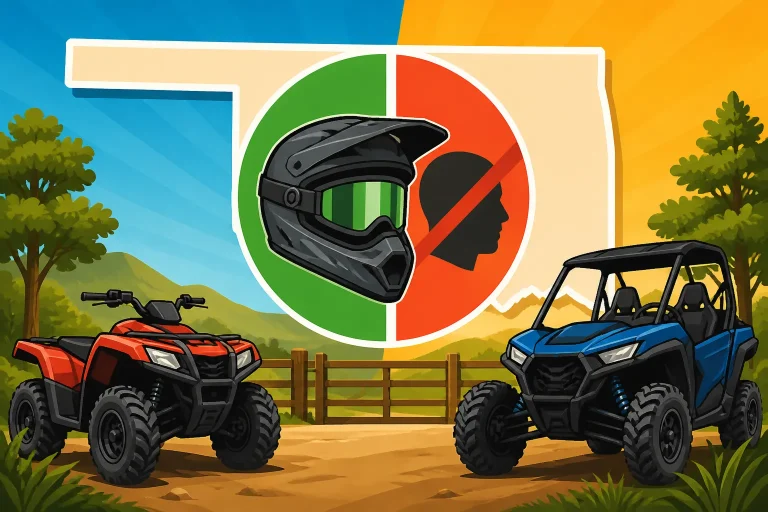
At sixteen, a rider is still under eighteen. That matters for Oklahoma’s helmet requirement on public land: riders under eighteen must wear an appropriate helmet when the rule applies. Check the requirements for the particular riding area, and do not assume that a helmet rule disappears because a teen has a driver license or rides a larger machine. For more detail on age and helmet coverage, see Oklahoma ATV Helmet Law Age.
When shopping for a helmet, fit and the recognized safety standard matter more than a general “youth” label. The helmet should fit snugly, stay in place when fastened and be suitable for the type of riding planned. A helmet bought through Amazon or another retailer still needs to meet the applicable standard; a listing title or product photo alone is not proof. Check the label and the riding area’s current rules before using it.
Oklahoma does not require every ATV rider to complete a statewide safety course as a general condition of riding. That does not mean training is unnecessary. A sixteen-year-old should know the controls, braking, safe speed and passenger limits before taking a machine onto a trail. A parent or guardian can also set stricter limits than the law or a park does, such as requiring a supervised first ride or restricting use to a smaller, familiar area. The related overview Oklahoma Rules for Young Riders can help put age-related precautions in context.
A machine’s size and power deserve particular attention. A rider may be legally old enough to operate a machine in one setting but still be poorly matched to its weight, acceleration or handling. Follow the manufacturer’s age and operating guidance, and consider whether the teen can control the machine on the terrain—not just whether they can reach the pedals or handlebars.
| Riding situation | What a sixteen-year-old should check |
|---|---|
| Public riding land | Helmet requirements, access permits, posted restrictions and site rules |
| Private off-road park | Minimum age, supervision, waiver, machine and passenger policies |
| Private property | Owner permission, safe operating area and any applicable local rules |
| Public road | Whether the machine and road use are allowed, plus driver and equipment requirements |
| Visit from another state | Whether the rider needs an Oklahoma land access permit despite an out-of-state decal |
Land access permits and out-of-state visits
An access permit is not a universal ticket to ride anywhere in Oklahoma. It applies to particular land or programs, and it is separate from a park’s admission fee, a machine’s registration decal and permission from a private landowner. Before heading out, identify the exact property and ask what the entry requirements are for that location.
For some Oklahoma land access rules, residents under eighteen are exempt from the permit requirement. That exemption is based on Oklahoma residency, not simply the rider’s age. A sixteen-year-old visiting from another state should not assume the same exemption applies: nonresidents generally do not receive the age-based resident exemption for the relevant access permit. Confirm the current requirement for the property before traveling. See Do Oklahoma Kids Need a Permit? and Oklahoma Resident vs Nonresident Permits for the distinction.
The permit question is especially important for access to certain timber-company lands. Those areas can have additional restrictions beyond the permit itself, including seasonal access limits, allowed routes and conditions tied to hunting activity. A permit does not cancel those restrictions. Before riding, check the property’s rules and the current access window. Oklahoma Land Access Permits Explained explains why the type of land matters.
A visitor’s existing registration or decal is a separate issue. Oklahoma’s treatment of an out-of-state decal does not automatically settle whether the rider needs a land access permit, pays a park fee or may use a particular route. Check those questions independently. The article Does Oklahoma Recognize Another State’s ATV Decal? covers the registration question; for land access, use the rules for the specific property.
Before leaving, make a short property-specific checklist:
- Confirm that the area is open to the machine type you are bringing.
- Check whether an Oklahoma land access permit is required for the rider’s residency and age.
- Check whether a separate admission charge, reservation or check-in applies.
- Read any seasonal, route, speed, helmet and passenger restrictions.
- Carry proof of permission or any required permit in the form the site accepts.
This is worth doing even if the family has ridden the same property before. Access conditions can vary by location, season or land manager. A public area and a privately operated park may use completely different systems, and an exemption for one permit does not necessarily waive a separate park rule.
For private property, get clear permission from the landowner or the person responsible for the site. Do not treat an unlocked gate, an existing tire track or an old invitation as current permission. A private owner or park can set conditions such as age limits, adult supervision, a signed waiver or restrictions on which machines are allowed. Those conditions may be stricter than the state’s general rules.
Private parks, public roads and safe trip planning
Private riding parks can set their own entry requirements. A sixteen-year-old may be allowed to ride at one park and be restricted at another, so check directly with the park before loading the machine. Ask whether a minor must be accompanied by an adult, who must sign the waiver, whether the rider may operate alone, and whether a particular machine or trail has age or skill limits. Also verify the park’s helmet policy: a public-land requirement and a private park’s policy are related safety issues, but they are not necessarily the same rule.
A parent should check passenger rules as well. A quad designed for one person should not be treated as a two-person machine just because a passenger can sit behind the rider. UTV passenger limits also depend on how the vehicle was built and equipped. A teen riding as a passenger still needs to follow the applicable helmet and site rules. For more on age and helmets, see Oklahoma Helmet Rules Bind Under 18.
A public road raises a different set of questions. An ATV registration decal does not by itself make an off-road machine street legal, and permission to ride trails does not automatically allow road use. Oklahoma has a separate street-legal UTV framework, with requirements tied to the vehicle, driver and equipment. A sixteen-year-old who plans to operate a street-legal UTV should confirm the current driver qualification and registration rules before using a road. Start with Oklahoma’s Street-Legal UTV Statute and What License a 16-Year-Old Needs for a Street UTV.
Do not assume a street-legal UTV rule applies to a regular ATV, or that it allows the same machine on every road. Local rules and road classifications matter. For ordinary trail riding, keep the machine off public roads unless the specific use is permitted. If a route involves a road crossing or a short road segment, check the applicable restrictions rather than relying on another rider’s example.
A practical pre-ride routine helps a teenager build good habits without turning the outing into a paperwork exercise:
- Match the machine to the rider. Check the manufacturer’s guidance, the teen’s control and experience, and the terrain.
- Check the destination. Confirm it is open, accepts the machine type and allows a sixteen-year-old under the planned supervision arrangement.
- Resolve permits and entry rules. Check residency-based access requirements, fees or reservations, and any separate park conditions.
- Prepare safety gear. Use a correctly fitting helmet where required and appropriate protective clothing for the ride.
- Agree on boundaries. Set speed, route, stopping and communication expectations before the group separates.
- Recheck road exposure. If the plan includes a public road, verify that the vehicle and driver meet the specific rules for that use.
For a teen who has limited experience, begin on a suitable, familiar route rather than a difficult trail, steep slope or crowded riding area. Set a pace that leaves room to stop, and explain how to respond to changing terrain, other riders and unexpected obstacles. An adult should remain close enough to help, particularly on a first visit or when conditions are unfamiliar.
The most common planning mistake is treating age as the only deciding factor. At sixteen, a rider may meet one age requirement but still need a helmet, a permit, adult supervision or permission for a specific machine or route. Another common mistake is assuming an out-of-state decal covers every access requirement. Keep the questions separate: machine registration, land access, park entry and road legality each have their own rules.
When the details are unclear, call the land manager or park office and describe the exact plan: the rider’s age and residency, the machine type, and whether the ride will be off-road or on a public road. That focused question is more useful than asking generally whether “kids can ride.” It also gives a family a chance to confirm any current requirements before spending time and money on a trip.
Disclaimer
This article is for general informational purposes only and does not constitute professional advice. Laws, prices and regulations vary by location and change over time. Consult a qualified professional for guidance on your specific situation.