Why Dust Hangs Over a Section Road in Summer
Riding your ATV or UTV on Oklahoma's rural section roads during the summer can quickly turn into a gritty, low-visibility adventure you never signed up for. That thick, persistent cloud of dust trailing behind you, or worse, hanging stubbornly in front of you, is a common frustration for riders and rural residents alike. This guide will dive deep into why these dusty conditions are so prevalent across our state in the warmer months and offer practical insights for navigating them safely.
The Anatomy of an Oklahoma Section Road and Its Dust Problem
Oklahoma's landscape is as diverse as its history, but one thing many rural areas share is a vast network of unpaved section roads. These aren't just quaint country lanes; they're often vital arteries for agricultural operations, hunting access, and connecting isolated communities. Unfortunately, they're also prime candidates for becoming major dust generators, especially when the mercury climbs and the rains disappear. Understanding the fundamental characteristics of these roads helps explain why the dust seems to have a permanent residence in the air.
What Makes Oklahoma Dirt Roads So Prone to Dust?
At the heart of Oklahoma's dust problem are our unique soil compositions. Across much of the state, you'll find a mix of red clay, sandy loam, and various silty soils. While these soils are great for growing wheat or raising cattle, they behave quite differently under the constant pounding of vehicle traffic, especially without proper moisture. When these surfaces dry out, the binders that hold the soil particles together weaken. Heavy farm equipment, pickup trucks, and yes, even our ATVs and UTVs, continuously pulverize these surfaces. This breaks down larger soil aggregates into incredibly fine dust particles that are easily lifted into the air. Imagine grinding coffee beans until they're a fine powder; that's essentially what happens to our roadbeds over time, creating an endless supply of airborne grit.
Many of these roads were built with minimal engineering beyond grading, relying on the natural compaction of the soil and periodic maintenance. Unlike paved roads, which offer a stable, sealed surface, dirt roads are constantly interacting with the elements. The lack of a permanent, cohesive surface means that every passing vehicle acts like a mini-pulverizer, stirring up the loose material. This is why you can often see a distinct plume even after just a few vehicles have passed, indicating the sheer volume of fine particles just waiting to become airborne. If you're planning a route, remember that these roads are distinct from city streets or even some county-maintained gravel roads. It's important to understand [Oklahoma Rules for Riding a Section Line] before you head out.
The Role of Summer Heat and Drought
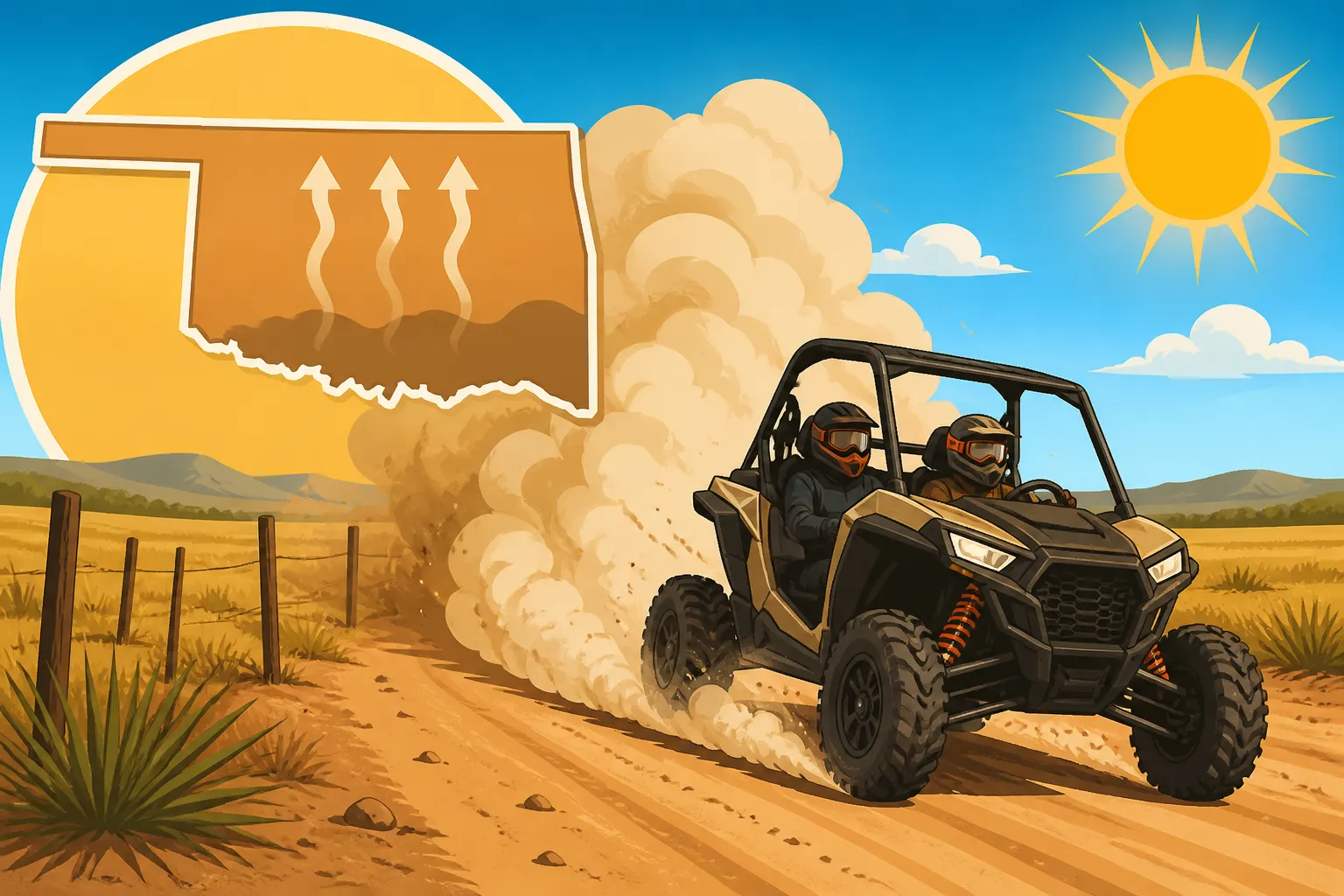
Oklahoma summers are legendary for their intense heat and often prolonged periods of drought. It's not uncommon to go weeks, or even months, without significant rainfall, especially from June through September. This combination of baking sun and parched ground creates the perfect storm for dust. The ground becomes utterly desiccated, drawing every last drop of moisture out of the roadbeds. Without moisture to bind the soil particles, they become incredibly loose and free-moving.
When a vehicle, particularly a fast-moving one like a UTV, travels over these super-dry surfaces, the tires don't just roll; they churn and throw up plumes of fine dust. This dust, being so light, can hang in the air for an incredibly long time, especially on still days with little wind. It creates a suffocating, almost opaque curtain that significantly reduces visibility for everyone on the road. The problem isn't just aesthetic; it's a real safety hazard. Think about pulling out of your driveway onto a section road and encountering a dust cloud so thick you can't see the approaching traffic. It's a disorienting and dangerous experience that becomes alarmingly common during the peak of summer. The relentless sun just keeps baking the moisture out, ensuring a fresh supply of dust day after day until a significant rain event provides some temporary relief.
How ATV and UTV Riding Contributes to and Navigates Dusty Conditions
We love our off-road machines for their ability to tackle diverse terrain, but it's important to acknowledge how their design and use interact with these dusty section roads. While we're often the ones dealing with the consequences, our riding habits and machine types can certainly contribute to the problem. However, there are also numerous ways we can gear up and adapt our riding styles to make these dusty encounters safer and more tolerable.
The Impact of Off-Road Vehicles on Unpaved Surfaces
ATV and UTV tires are designed for traction on loose and uneven surfaces, with aggressive tread patterns that dig in and propel the machine forward. While excellent for trails or mud, these same treads are incredibly efficient at churning up and lifting fine dust particles on dry, unpaved roads. Unlike the smoother, often shallower treads of car or truck tires, off-road tires act like miniature tillers, breaking up the surface and throwing material into the air. The lighter weight distribution of an ATV, combined with its open design, means more of that dust gets immediately airborne and directed into the rider's face or into the path of following vehicles.
UTVs, with their larger footprint and often higher speeds, can generate even more substantial dust clouds. The aerodynamic flow around a side-by-side, especially one without a full enclosure, can suck dust right into the cabin, coating everything and everyone inside. While it might seem like we're just adding to the problem, many of us ride these roads out of necessity for access to hunting leases, fishing spots, or simply to connect to trails. It's a shared environment where agricultural vehicles, local residents, and off-road enthusiasts all contribute to the wear and tear that creates the dust. Understanding [Oklahoma Rules for Riding a County Road] is essential, as these rules often apply to section lines too.
Strategies for Riders to Cope with Dust and Enhance Visibility
Riding in heavy dust requires a proactive approach to both personal safety and machine protection. The good news is that there are many effective strategies to minimize the impact of dust on your experience and keep you safe.
Personal Gear is Non-Negotiable: First and foremost, protect yourself. A good quality, full-face helmet with a sealed visor is paramount. Pair this with goggles that seal well against your face to keep fine particles out of your eyes, which can cause irritation and significantly impair your vision. Investing in a dust mask or balaclava is also crucial for respiratory health. Breathing in fine dust over extended periods isn't just uncomfortable; it can be detrimental to your lungs. Think about the feeling of grit in your teeth after a short ride – that's just a fraction of what your lungs are trying to filter out.
Machine Modifications for Mitigation: Your machine can also be adapted to better handle dusty conditions. A full windshield on a UTV is a game-changer, deflecting much of the direct dust impact. Companies like SuperATV offer a range of windshields, from full to half, and even rear panels that can significantly reduce the amount of dust swirling into your cab from the rear. Cab enclosures, also available from manufacturers like SuperATV, take this a step further, sealing off the interior from the elements. Don't forget about your machine's engine! A good quality air filter, perhaps with a pre-filter or snorkel system, can protect your engine from ingesting excessive dust, which can quickly degrade performance and shorten engine life. These aren't just comfort items; they're investments in the longevity of your machine and your riding pleasure.
Smart Riding Techniques: When riding in a group, spacing out is critical. Leave ample distance between machines so that you're not constantly riding in the dust cloud of the rider in front of you. A good rule of thumb is to maintain a distance that allows the dust from the machine ahead to settle or dissipate before you enter that space. Slowing down can also help, as less speed generally means less dust stirred up. However, sometimes a steady, moderate pace is better than constantly speeding up and braking, which can churn up more dust. Always be mindful of other vehicles. On these rural roads, you might encounter large farm equipment, mail carriers, or local residents. In dusty conditions, visibility is severely compromised, so slow down, move to the side, and make sure you're seen. For night riding, which can be even more treacherous with dust, review [Making Yourself Visible on a Rural Road at Night] and ensure your machine's [Oklahoma Lighting Rules on a Machine] are up to par. Remember, a dust cloud can make your machine almost invisible, even in daylight.
The Broader Implications of Dust for Residents and the Environment
The dust problem on Oklahoma's section roads extends far beyond the discomfort of ATV and UTV riders. It impacts the health and daily lives of rural communities, poses significant safety challenges for all road users, and presents an ongoing maintenance headache for local authorities.
Health and Safety Concerns for Rural Communities
For those living along these unpaved roads, summer dust isn't just an occasional nuisance; it's a persistent assault on their quality of life. The constant inhalation of fine particulate matter can exacerbate respiratory conditions like asthma and allergies, and prolonged exposure can contribute to more serious health issues over time. Imagine living in a home that, despite your best efforts, is perpetually covered in a fine layer of red dust, both inside and out. It's an exhausting and demoralizing reality for many.
Beyond health, the safety implications are profound. Dust clouds dramatically reduce visibility, not just for ATV riders but for everyone on the road. This increases the risk of collisions between vehicles, as well as accidents involving pedestrians, cyclists, or even livestock that might wander onto the road. Trying to navigate a section road when you can't see more than a few feet in front of you is incredibly dangerous. School buses, delivery trucks, and emergency vehicles all have to contend with these conditions, slowing down response times and increasing the potential for incidents. Local residents often face a constant battle with dust coating their homes, vehicles, and even their gardens. It's more than just a cleaning chore; it's an environmental factor that directly affects their well-being and property values.
Mitigation Efforts and What Riders Can Expect
Local county commissioners and road departments are well aware of the dust problem and often employ various strategies to mitigate it, though these efforts face significant challenges across the vast unpaved road networks of Oklahoma. The most common and immediate solution is watering the roads. A water truck will spray the road surface, temporarily binding the dust particles with moisture. However, this is a short-term fix, as the intense Oklahoma sun quickly evaporates the water, bringing the dust back within hours or a day. Grading the roads, which involves using heavy machinery to smooth and compact the surface, can also help reduce the amount of loose material, but again, this is a cyclical process that needs frequent repetition.
In some areas, more advanced dust suppressants, such as calcium chloride or magnesium chloride, are applied. These hygroscopic salts draw moisture from the air, helping to keep the road surface damp and bind the dust particles more effectively for a longer period. However, these treatments are more expensive and not feasible for every mile of unpaved road. Riders should understand that while efforts are made, the sheer scale of the problem and the environmental conditions mean that dusty roads will remain a reality in Oklahoma summers. When you encounter these conditions, remember that patience and shared responsibility are key. Be courteous to other road users, slow down, and ensure your machine is equipped for safety. The [Oklahoma County Commissioners and ATV Roads] often make decisions about road maintenance and access, so their efforts directly affect your riding experience.
Here’s a quick overview of dust mitigation strategies for riders and local authorities:
| Strategy | Rider Action | Local Authority Action | Effectiveness | Duration | Cost |
|---|---|---|---|---|---|
| Visibility/Safety | Wear goggles/helmets, use reflective tape | Improve road signs, clear sightlines | High (personal) | Ongoing | Low (rider) |
| Personal Protection | Use dust masks, full-face helmets, ride spaced out | N/A | High (personal) | Per ride | Moderate |
| Machine Protection | Install windshields/enclosures, use pre-filters | N/A | High (machine) | Long-term | High (rider) |
| Road Surface Treatment | N/A | Watering roads, grading, applying chemical suppressants | Variable (road) | Short to Moderate | High (public) |
| Riding Habits | Slow down, maintain distance, be courteous | N/A | High (community) | Per ride | None |
Ultimately, sharing these dusty roads means we all need to do our part. Equipping your machine with items like a SuperATV windshield, wearing appropriate safety gear, and practicing defensive riding techniques will go a long way in making your summer rides on Oklahoma's section roads enjoyable, despite the ever-present dust. Always be prepared for limited visibility and be ready to adapt to whatever the road conditions throw your way, or rather, kick up into your path.
Disclaimer
This article is for general informational purposes only and does not constitute professional advice. Laws, prices and regulations vary by location and change over time. Consult a qualified professional for guidance on your specific situation.