Making Yourself Visible on a Rural Road at Night
Riding your ATV or UTV on rural Oklahoma roads at night can feel incredibly risky, not just for your safety but for the unsuspecting drivers around you. It's a real fear, the thought of blending into the darkness and not being seen until it's too late. This guide is designed to tackle that very concern, offering practical, in-depth advice on maximizing your off-road machine's visibility after the sun goes down, helping you navigate those county roads and crossings with greater confidence and safety.
Understanding the Risks of Night Riding on Rural Oklahoma Roads
Let's be honest, those wide-open rural roads in Oklahoma are fantastic during the day. The scenic views, the feeling of freedom – it's why we love our off-road machines. But when dusk settles, and then night fully takes over, the dynamics change entirely. The very quiet and emptiness that makes these roads appealing also makes them incredibly dangerous for ATVs and UTVs that aren't properly equipped for night visibility. The stakes are much higher out here than in a well-lit urban environment, where other drivers expect to see all sorts of vehicles.
The Hidden Dangers Beyond Your Headlights
When you're out on a rural Oklahoma road at night, your headlights illuminate only a small cone directly in front of you. What about everything else? The dangers extend far beyond what your factory lights can reveal. For starters, other drivers, especially those who aren't expecting a smaller, slower-moving off-road vehicle, simply won't see you until they're right on top of you. Their high beams might pick you up eventually, but that's often not enough time to react.
Then there's the wildlife. Deer, coyotes, even cattle can wander onto county roads, especially in less populated areas. Your headlights might catch their eyes, but a sudden appearance from the side can lead to a dangerous collision. And it's not just animals. Think about unexpected obstacles like potholes that have developed since your last pass, fallen branches, or even unlit farm equipment that might be moving slowly along the shoulder. These machines, often dark green or rust-colored, are designed to blend into the landscape, not stand out at night. Without proper lighting, your machine effectively becomes a ghost on the road.
Why Standard ATV Lighting Isn't Enough for Road Use
Most ATVs and UTVs roll off the assembly line with lighting perfectly adequate for their intended purpose: off-road trails, fields, and work around the property. They're designed to help you see the path directly ahead, not necessarily to make you highly visible to others sharing a public roadway. The factory headlights often have a focused beam that's great for spotting obstacles on a trail but doesn't project the wide, encompassing light pattern needed for road use.
Furthermore, the tail lights are typically small and mounted low, sometimes getting caked with mud or dust, drastically reducing their effectiveness. They might be bright enough for your buddy following you on a trail, but they're easily lost in the glare of a pickup truck's headlights on a dark county road. Side visibility is almost nonexistent with standard setups, leaving your flanks vulnerable when crossing intersections or making turns. The minimal lighting means that from a distance, or from an oblique angle, your machine can appear as nothing more than a faint flicker, if anything at all, making it nearly impossible for others to gauge your speed or trajectory. This is especially true when navigating brief, permitted road sections as outlined in rules like [Oklahoma Crossing Rules at 35 mph] or for agricultural purposes described in [Oklahoma Farm Use on County Roads].
Essential Lighting Upgrades for Nighttime Visibility
When it comes to sharing rural Oklahoma roads after dark, relying solely on factory lighting is a gamble you don't want to take. The goal isn't just to see where you're going, but crucially, to be seen by every other vehicle and person on or near that road. This means thinking about lighting from every angle – front, rear, and sides – and understanding that different types of light serve different, vital purposes.
Front-Facing Lighting: Seeing and Being Seen
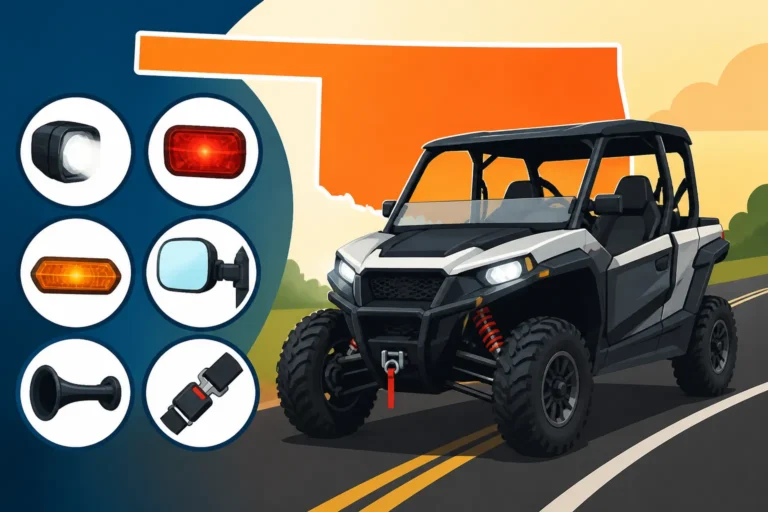
Your primary factory headlights are a start, but they're rarely enough. For true visibility and to illuminate your path effectively on a dark rural road, consider significant upgrades. LED light bars are a game-changer here. Brands like SuperATV offer a wide range of LED light bars that can throw a massive amount of light down the road. You can choose from flood beams that spread light widely, spot beams that focus it far down the road, or combo beams that give you the best of both worlds. Mounting a good quality LED light bar across your front bumper or roofline can dramatically increase your forward visibility, allowing you to spot wildlife, potholes, or unlit farm equipment much earlier.
Beyond light bars, auxiliary spotlights can be mounted lower to fill in gaps or provide additional punch. Upgrading your actual headlights to brighter, higher-wattage LED bulbs (if your machine's electrical system can handle it) can also make a noticeable difference. The key is to ensure that your front lighting isn't just making you see better, but that the sheer amount and spread of light make your machine impossible to miss for oncoming traffic, giving them ample warning of your presence.
Rear and Side Visibility: Protecting Your Back and Flanks
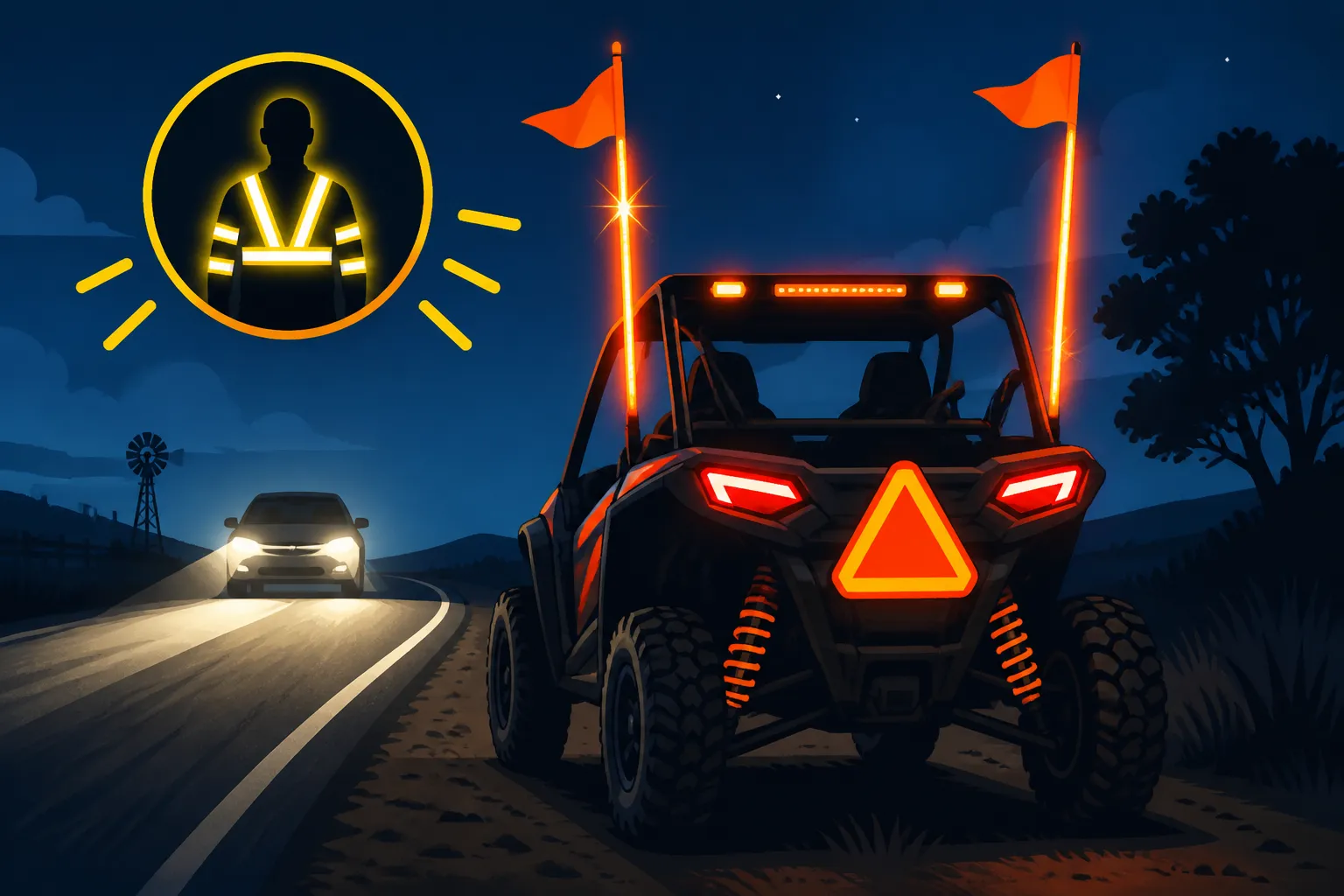
While seeing ahead is critical, being seen from behind and the sides is arguably even more important for accident prevention on public roads. Many rural road collisions involving ATVs happen when they are struck from behind or on the side. Start with your rear lighting. Replace your standard tail lights with brighter, larger LED units. Consider adding additional red brake lights, perhaps higher up on a roll cage or cargo rack, to make it undeniable when you're slowing down. The more red light you can project to the rear, the safer you'll be.
For side visibility, think about amber LED marker lights that can be mounted along the sides of your machine, perhaps on the fenders or roll cage. These give a clear indication of your machine's width, which is crucial for drivers approaching from side roads or attempting to pass. This is especially important for UTVs, which are wider than ATVs.
Another incredibly effective, yet often overlooked, passive visibility enhancement is reflective tape. This isn't just for kids' bikes! High-quality, automotive-grade reflective tape applied strategically to the rear and sides of your machine, and even to the front, can reflect headlights from other vehicles, making you visible even before they're close enough for your lights to truly register. It’s a low-cost, high-impact solution.
Here's a quick look at some common lighting upgrades and their benefits:
| Upgrade Type | Benefit | Typical Placement | Cost/Effort Level |
|---|---|---|---|
| LED Light Bar | Excellent forward illumination, high visibility | Front bumper, roofline, grill guard | Medium to High |
| Auxiliary Spotlights | Focused long-distance light, fill-in illumination | A-pillars, bumper, brush guard | Medium |
| Brighter Headlight Bulbs | Enhanced factory headlight output | Existing headlight housings | Low to Medium |
| Brighter LED Tail Lights | Increased rear visibility, better brake light | Existing tail light housings, additional mounts | Low |
| Amber Side Markers | Clearly defines machine width | Fenders, roll cage, side body panels | Low |
| Reflective Tape | Passive visibility from all angles | Rear bumper, side panels, fenders, roll cage, wheels | Low |
Turn Signals and Hazard Lights for Communication
For UTVs that are designated as street-legal, like those that can get [Oklahoma Road Plates for a Street-Legal UTV], turn signals and hazard lights are not just recommended, they're mandatory [Oklahoma Turn Signals and Mirrors]. But even if your ATV or UTV isn't fully street-legal and you're only making permitted crossings, adding turn signals is a brilliant idea. Hand signals are difficult to see at night, if not impossible, and often confusing for other drivers. A clear, flashing amber light indicating your intention to turn or change direction is invaluable for safety.
Many aftermarket kits exist that allow you to easily add turn signals to your ATV or UTV, even if it's not a full street-legal conversion. Look for systems that integrate with your existing electrical system and provide bright, visible signals both front and rear. Additionally, a hazard light function, which flashes all your turn signals simultaneously, is critical if you have to stop on the side of a road or are moving particularly slowly. This acts as an emergency beacon, drawing maximum attention to your presence and predicament.
Passive Visibility Enhancements Beyond Lights
While active lighting systems are paramount, they aren't the only tools in your visibility arsenal. Passive enhancements, which rely on reflecting light or increasing your machine's profile, are equally important. They act as a backup, or even a primary, visibility measure in situations where your active lights might not be enough or if they're obscured by dust or mud.
Strategic Placement of Reflective Materials
We touched on reflective tape earlier, but let's really dive into its power. This isn't just about a strip here and there. Think strategically. Apply high-quality, weather-resistant reflective tape to every possible surface that can catch light: the front fenders, the rear bumper, the side panels, the roll cage (especially on UTVs), and even the spokes or edges of your wheels. The idea is to create a "halo" of reflected light around your machine from every angle.
Consider using different colors: white or silver for the front, red for the rear, and amber for the sides, mimicking standard road vehicle lighting. This not only makes you visible but also helps other drivers instantly understand which direction your machine is facing. For instance, when you're making a quick highway crossing, as allowed under [Oklahoma Highway Crossings in Daylight] (though night crossings amplify the danger), those reflective strips on your sides can be the first thing a driver sees from a distance. Don't forget reflective details on your helmet and riding gear too – more on that next.
Flags, Whips, and Other Height Enhancements
While often associated with dune riding, particularly at places like Little Sahara, where a [Oklahoma's 10-Foot Whip Rule] and orange flag are mandatory, whips can also contribute to visibility on certain rural roads. A tall, sturdy whip with an attached LED light can provide an additional vertical light source that sits much higher than your machine's body. This height can be particularly effective at making you visible over hills or dips in the road, or above tall crops in fields adjacent to the road.
Even without an LED, a bright orange flag on a whip provides some passive visibility during twilight hours. While not a substitute for robust active lighting, a lighted whip adds another dimension to your overall visibility strategy, especially in areas where you might be temporarily obscured by terrain or vegetation. It catches the eye and breaks up the horizontal landscape, signaling your presence.
The Role of Reflective Clothing and Gear
Your machine can be lit up like a Christmas tree, but what about you? As the rider, you are also a crucial part of the visibility equation. Always wear high-visibility clothing, especially a reflective vest, when riding on or near public roads at night. These vests are typically made of fluorescent materials that stand out in daylight and have retro-reflective strips that bounce back light at night.
Your helmet is another prime location for reflective enhancements. Many helmets come with some reflective decals, but you can always add more. Reflective strips on the sides, front, and back of your helmet ensure that your head is visible, which is often the highest point of your moving machine. Consider gloves with reflective elements as well. This gear isn't just about making you visible while riding; if you have to dismount for any reason – a mechanical issue, checking a map, or helping a friend – your reflective clothing ensures that you remain a visible presence on the road, even when your machine's lights might be momentarily obscured or turned off.
Oklahoma's Rules for ATV/UTV Road Use and Visibility
It's crucial to understand that even with all the best visibility upgrades, ATVs and UTVs are primarily off-road vehicles. Oklahoma law has specific, limited provisions for their use on public roads, and these rules are designed with safety in mind. Knowing these regulations is just as important as knowing your machine's capabilities.
Understanding Permitted Road Crossings and Use Cases
In Oklahoma, you can't just cruise your ATV or UTV down any public road like you would a car. The law is quite clear: off-road vehicles are generally prohibited on public streets and highways. However, there are specific, limited exceptions. You might be allowed to cross a highway or street, provided it's done during daylight hours and at an angle of approximately 90 degrees to the roadway, and only if the posted speed limit is 35 mph or less. For instance, [Oklahoma Daylight Crossing Rules] and [Oklahoma Crossing Rules at 35 mph] detail these specific conditions. These are quick, direct movements – not prolonged travel.
There are also allowances for agricultural use, where a machine might be operated on a public road for short distances to get from one field to another, as described in [Oklahoma Farm Use on County Roads]. Some municipal or county ordinances might open specific local roads to ATV/UTV use, but this is highly localized and requires checking specific city or county rules. You might find information on [Oklahoma Municipal Ordinances That Open Streets] if such rules exist for your area. These are exceptions, and they generally do not permit night riding without extraordinary care and specific equipment.
Equipment Requirements for Street-Legal UTVs
If you're making your UTV truly "street-legal" in Oklahoma, it's a different ballgame. This process involves registering it with the state and obtaining a proper road plate. When you register a UTV for street use, you commit to meeting a much more stringent set of equipment requirements, which directly impacts nighttime visibility. This isn't just about being seen; it's about being equipped like a standard road vehicle.
To get that coveted road plate, your UTV will need, at a minimum, working headlights, tail lights, brake lights, and turn signals – both front and rear. It also requires a horn, a rearview mirror, and often side mirrors. All of these components must meet specific standards for brightness and functionality. For a comprehensive list, you'll want to review resources like [Oklahoma Street Legal UTV Requirements], and details such as [Oklahoma Turn Signals and Mirrors] and [Oklahoma Horns on a Street UTV] are critical. The annual renewal of these street UTV decals further emphasizes the commitment to ongoing safety and visibility standards. These are not merely suggestions; they are legal necessities for operating on public roads.
The Importance of Common Sense and Caution at Night
Even with all the fantastic upgrades from brands like SuperATV and all the reflective gear, common sense remains your most powerful tool for night riding on rural roads. The simple truth is that even the brightest lights cannot completely eliminate the risks associated with operating an off-road machine in the dark alongside full-sized vehicles.
Always assume that other drivers cannot see you, no matter how much light you're putting out. Drive defensively. Reduce your speed, especially around blind corners, crests of hills, and intersections. Your reaction time and the reaction time of others are both reduced significantly in the dark. Be extra vigilant for animals, which are much harder to spot against a dark backdrop. Avoid distractions like loud music or phone use. Focus entirely on your surroundings and the road ahead. If you can avoid riding on public roads at night, do so. If it's absolutely necessary for a brief crossing or agricultural use, proceed with extreme caution, and ensure your machine is equipped to the absolute maximum for visibility. Remember, the goal is to get home safe, and sometimes, that means erring on the side of caution.
Disclaimer
This article is for general informational purposes only and does not constitute professional advice. Laws, prices and regulations vary by location and change over time. Consult a qualified professional for guidance on your specific situation.