Buying a Nonresident Permit Before You Leave Home
Buying a nonresident permit before traveling to Oklahoma can prevent a wasted trip, but the tricky part is knowing what the permit covers. It is not a general pass for every trail or public property. Here’s how to check whether you need one, buy the right authorization in advance, and arrive with proof you can access.
What an Oklahoma nonresident land access permit covers
The nonresident land access permit is associated with access to particular Oklahoma wildlife management areas, including Honobia Creek and Three Rivers. It is not a statewide ATV permit, a trail pass for every public riding area, or permission to ride wherever you see an open gate.
That distinction matters because Oklahoma has several kinds of riding access. A wildlife management area, state park, private off-road park, and timber company property can each have different entry rules. An authorization for one place does not automatically grant access to another.
Before purchasing, match the permit to the actual location and activity on your itinerary. If you plan to ride on managed timberland, check which roads are open to machines, whether access is seasonal, and whether riders must follow additional check-in or use rules. Permission to enter an area is not permission to ride off designated routes. Start with the area-specific information for Oklahoma Permits for Honobia Creek and Oklahoma Permits for Three Rivers.
| Where you plan to ride | What to verify before buying |
|---|---|
| Honobia Creek or Three Rivers | Whether the current nonresident land access permit applies, which activities it covers, and the active access dates |
| Another wildlife management area | Whether that area allows ATV or UTV use and whether it has a separate permit or other restrictions |
| A state park riding area | The park’s entry, riding, and vehicle requirements; a land access permit may not cover these |
| A private off-road park | Admission, waiver, machine, age, and proof-of-payment rules set by the operator |
| Timber company land | Whether public access is currently open and which roads or activities are allowed |
The permit is most relevant when your ride includes the areas it is designed for. It may not be necessary for every trip involving an Oklahoma trail, and having it does not guarantee access if a property is closed, a route is restricted, or you arrive outside the permitted access period.
It also does not replace your machine’s registration requirements. A land access permit relates to access to a specific place; registration is a separate matter. If you are visiting from another state, check the rules for your machine and the areas you plan to ride, including Does Oklahoma Recognize Another State’s ATV Decal?. A permit to enter a managed area should not be treated as proof that your ATV or UTV is registered properly.
Similarly, do not assume that a hunting license, an access permit, and permission to ride are interchangeable. A hunting license may be required for hunting, while riding access can have its own conditions. Check the rules for both activities if your trip combines riding and hunting. [Oklahoma Hunting License and Land Access] explains why these permissions should be considered separately.
Check whether you need the permit and which option fits
Start with your route, not the permit menu. Write down the exact riding areas you intend to visit, then check each area’s current rules. If your trip is limited to a private park or a state park, the nonresident land access permit may not be the authorization you need. If you plan to enter Honobia Creek or Three Rivers, check the current nonresident requirements for those areas before you buy.
Nonresident status can make a meaningful difference. Do not assume that an exemption available to Oklahoma residents also applies to visitors. In particular, age-related exemptions are not necessarily the same for residents and nonresidents. Review Oklahoma Resident vs Nonresident Permits and Oklahoma Permit Exemptions by Age, then verify your specific situation with the official source.
Compare the permit period with your actual trip
An annual permit may make sense if you expect to visit more than once or spend an extended period in an area covered by it. A short-term option, where currently offered, may fit a brief visit better. Availability and conditions can change, so check the official permit choices rather than relying on an old receipt, an online discussion, or a previous trip’s rules.
Think through the dates carefully. Managed-land access can be seasonal, and a permit that is valid for a period of time does not necessarily mean every route is open for all of that period. A planned weekend can still fall outside the current access window or coincide with a temporary closure. Check both the permit’s validity and the area’s current opening information.
Here is a practical comparison:
| Trip pattern | What to check |
|---|---|
| One short visit | Whether a short-term option is currently available and covers the activity you have planned |
| Several visits during the year | Whether an annual option covers the intended areas and dates |
| Riding and hunting on the same trip | Whether you need separate access authorization and hunting credentials |
| Riding different public and private properties | The rules and fees for each property; one permit may not cover them all |
| A trip with uncertain dates | Whether the permit’s start date can be selected and what happens if plans change |
Do not choose a permit solely because its name sounds broad. Read the coverage wording and confirm that your riding area and purpose are included. If you are unsure whether a particular ATV activity is permitted, ask the agency or area manager directly before paying.
The local riding rules deserve a separate check, too. Some public areas restrict machines to designated roads or limit access to a particular season. Those restrictions can differ from the entry-permit rules. Oklahoma WMA Access for a Quad is a useful starting point for understanding why a permit alone may not settle every riding question.
Buy the permit before leaving home
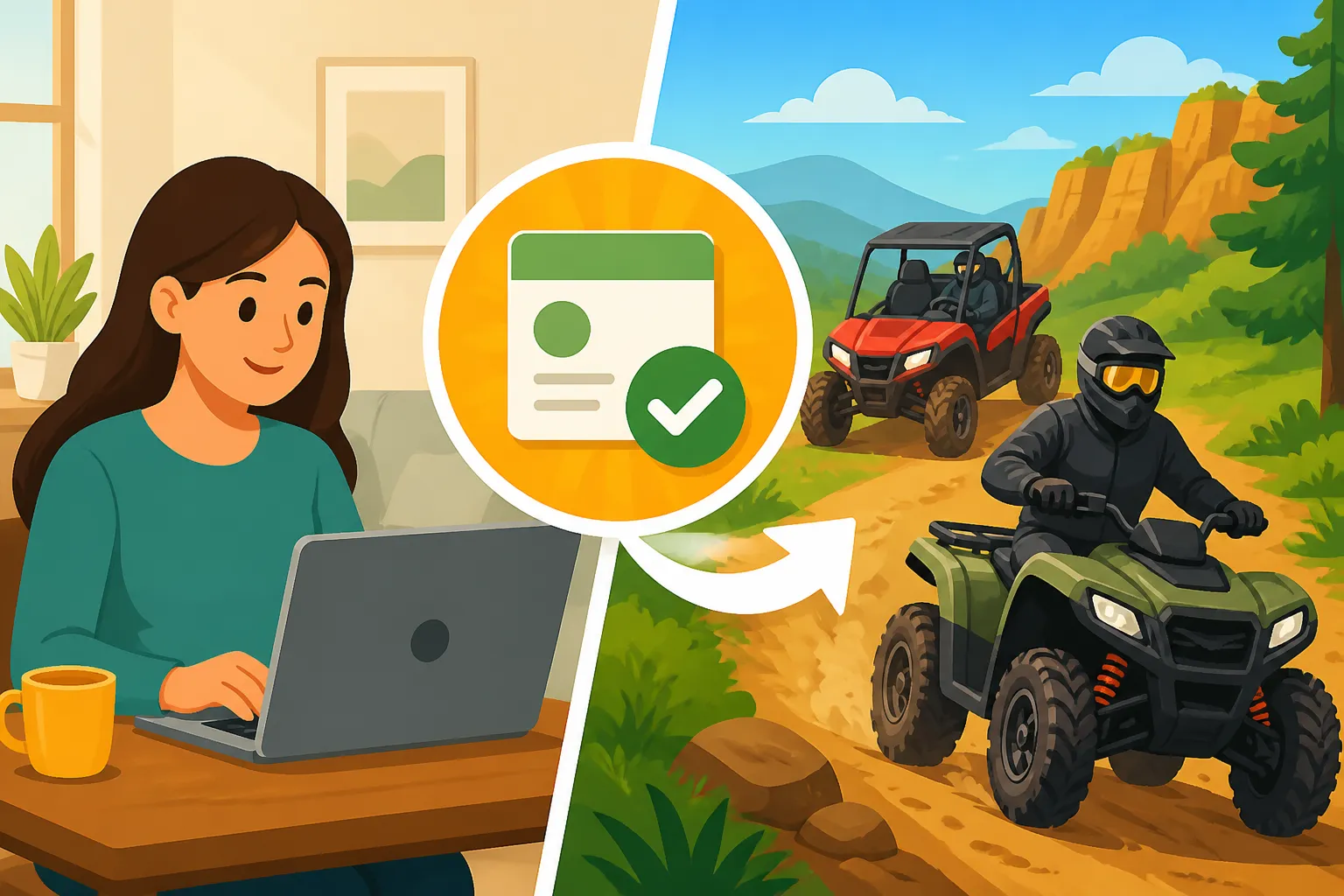
Purchasing in advance gives you time to catch a wrong choice or an incomplete transaction before you are on the road. Use the Oklahoma Department of Wildlife Conservation’s current licensing or permit channel, or a sales outlet the agency identifies as authorized. Begin from the agency’s official information, especially if a search result or third-party page offers to sell a similarly named credential.
The exact purchasing screens and available methods can change. The safest approach is to confirm the current instructions with ODWC before paying and keep a record of what you selected.
A practical purchase sequence
- Confirm your destination. Identify the exact wildlife management area or other property, not just the nearest town or general region. Verify that your planned riding activity is allowed there.
- Check the access rules and dates. Look for seasonal limits, closures, route restrictions, and any check-in requirements. If the agency publishes an area map or current notice, consult it before you buy.
- Choose the correct permit type. Confirm that the option is for a nonresident and that it covers the area and activity you intend. Compare any short-term and longer-duration choices using your actual travel dates.
- Review separate credentials. If you will hunt as well as ride, check hunting-license requirements independently. If the property has a separate admission fee or permit, account for that too.
- Enter your details carefully. Use the requested name and identifying information consistently. Check dates, permit category, and property selection before completing payment.
- Save the confirmation. Keep the receipt and permit details somewhere you can reach without relying on a live phone connection. If the agency allows you to print or download the permit, save a copy before departure.
- Check the official information again before the ride. Closures, access dates, or proof rules can change after a purchase. Confirm that your planned area remains open and that you know what to show at the gate or during an inspection.
For official purchase information, see Where to Buy an Oklahoma Land Access Permit. If you are comparing the annual and short-term choices, also check Oklahoma’s $10 Three-Day Permit for the short-term option’s current details; confirm current terms and charges directly before relying on them.
Buying online does not necessarily mean that every part of the process is complete. A confirmation may prove payment but not explain where you may ride, which roads are open, or how to meet a check-in requirement. Read any instructions that come with the permit rather than stopping at the payment screen.
Keep proof easy to find
Save the permit confirmation to your phone before leaving home, and consider keeping a printed copy as a backup. Rural riding areas may have weak or no mobile service. A screenshot or downloaded document can be easier to retrieve than trying to sign in at a gate, but check the agency’s current rules for accepted proof. Do not assume that a payment receipt is an acceptable substitute for the permit itself.
If you purchase through an authorized outlet, keep the receipt and any permit document you receive. Confirm whether the permit is tied to your name, a particular date range, or another identifying detail. If a friend is purchasing for a group, ask whether each nonresident needs a separate permit or whether the current rules allow any shared arrangement. Avoid guessing from the way a group’s purchase was handled at a different park.
What to check before you tow and arrive
The last useful check is not another payment screen. It is confirming that the destination is open and that your machine and planned ride fit the property’s rules.
Managed public land may have a defined access season, and roads that are open to ordinary traffic are not automatically open to off-highway vehicles. Check the current map and notices for your particular area. If the rules specify designated roads, stay on them. If access is restricted by weather, fire conditions, wildlife management, or another closure, a valid permit does not override that restriction.
Also plan for how you will find the entrance and meet any required arrival procedure. Check whether the area uses a gate, kiosk, check-in point, or another process. Some access locations are remote, so save the directions and relevant map information before you leave service. Bring the machine’s registration and ownership documents if appropriate, but do not confuse those documents with the land access permit.
A quick pre-departure checklist helps:
- Confirm the property name and the entrance you intend to use.
- Confirm your permit is valid for that property, activity, and date.
- Check current closures, access windows, and route restrictions.
- Save the permit and directions for offline access.
- Check whether you must check in or display proof in a particular way.
- Carry any separate hunting license, park admission, or other required credential.
- Make sure your machine meets the rules for the area and for the journey to it.
If the property’s rules are unclear, ask before hauling. It is much easier to resolve a question from home than at a locked entrance with a trailer behind you. The right question is specific: name the area, say whether you will ride an ATV or UTV, give the planned dates, and describe whether you will also hunt. That gives the agency or manager enough context to distinguish an access permit from other requirements.
Common mistakes that lead to trouble
Assuming the permit works statewide. It is not a blanket pass for every Oklahoma trail, public property, or private park. Match it to the specific area.
Buying the resident option by mistake. Check your residency category carefully. A resident exemption or price does not automatically carry over to a nonresident.
Treating hunting permission as riding permission. The two may have separate conditions. If your trip includes both activities, verify both.
Ignoring the season or a temporary closure. A permit can be valid while a route or property is closed. Check current notices close to departure.
Riding beyond designated routes. Entry authorization does not erase route limits. Follow maps, signs, and posted instructions, and do not take an unmarked shortcut.
Relying on a phone connection at the gate. Save the confirmation and directions offline. Check what form of proof is accepted rather than assuming that an email will be enough.
Assuming a land permit covers a park fee. A private park or state park can set its own entry and riding charges. Confirm those separately.
Expecting an out-of-state decal to settle every requirement. Registration rules and land access rules address different things. Check both before travel.
If you need the distinction between the permit and other credentials in more detail, One Permit Covering Honobia Creek and Three Rivers explains the shared-area aspect, while Why Timber Company Land Needs Its Own Permit helps clarify why access to one managed property does not automatically open another.
Frequently Asked Questions
Can I buy a nonresident permit before I reach Oklahoma?
Usually, the point of checking the official purchase channel in advance is to complete the process before travel. Confirm the current sales method, permit dates, and proof requirements with ODWC, then save the permit confirmation offline.
Does the nonresident land access permit let me ride anywhere in Oklahoma?
No. It applies only to the access and locations described by the current permit terms. State parks, private parks, other wildlife areas, and timber company land may have separate rules or permissions.
Does the permit replace an Oklahoma ATV registration requirement?
No. A land access permit and machine registration serve different purposes. Check the registration rules for your machine and separately confirm what the riding area requires.
Do I need a hunting license if I am only riding?
Do not assume that a hunting credential is required simply because you are buying an access permit, or that the permit replaces a hunting license when you plan to hunt. Verify the current requirements for your activity and destination before purchasing.
Disclaimer
This article is for general informational purposes only and does not constitute professional advice. Laws, prices and regulations vary by location and change over time. Consult a qualified professional for guidance on your specific situation.