Where the Under-18 Helmet Rule Comes From
Oklahoma’s under-18 helmet rule can be confusing because the legal requirement, land-access conditions and private-park policies may come from different places. Knowing which rule applies helps families choose the right helmet and avoid assuming that an out-of-state permit or registration changes what a young rider must wear.
The legal source of Oklahoma’s under-18 helmet rule
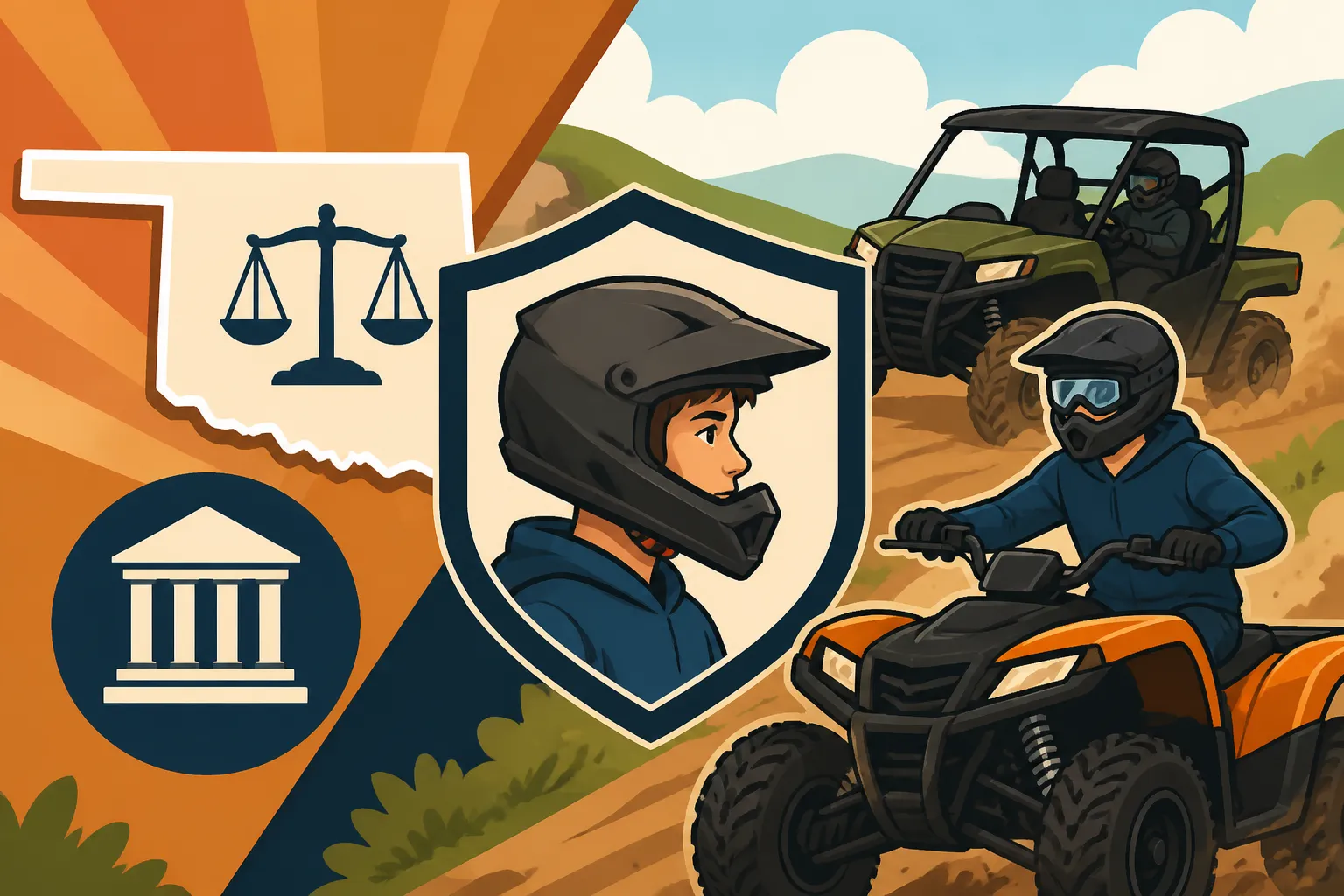
Oklahoma’s ATV road-use rules are found in Title 47 of the Oklahoma Statutes, including Section 11-1116. That is the statutory starting point for understanding the helmet requirement associated with covered ATV operation. The rule is a state law, not a condition created by a registration decal or an out-of-state riding permit.
That distinction matters because people often encounter helmet rules in several different settings. A family may read a statute, check a state land-access requirement, review a park’s admission rules and then see a trailhead sign. Those rules can overlap, but one does not necessarily replace the others. A park can set its own conditions for entry, while a state statute governs the conduct it covers.
For the age threshold, the practical point is straightforward: riders under 18 should plan to wear a helmet when operating or riding as a passenger on an ATV in circumstances covered by Oklahoma’s rule. Don’t treat the requirement as applying only to the person driving. If a young person is riding along as a passenger, the passenger’s age matters too. For a fuller age-focused explanation, see Oklahoma ATV Helmet Law Age and Oklahoma Helmet Rules Bind Under 18.
The statute’s existence does not mean every type of off-road machine, property or riding activity is governed by identical wording. ATV and UTV designs differ, and a UTV may have a protective cage, seat belts and other equipment that an ATV does not. A separate law, land manager or park operator may address those differences. Avoid using a rule written for one machine or location as a shortcut for another.
When the exact scope is important—for example, if a young person will ride on a particular public road or public property—check the current statutory text and ask the relevant land manager or law-enforcement agency how it applies there. The safest practical plan is simpler than trying to find a loophole: provide a suitable helmet for every rider under 18, including passengers.
What “comes from the law” does and does not mean
The helmet rule is not created by a parent’s permission, an ATV registration or a land-access permit. Those documents deal with different requirements. Registration addresses the machine’s status; a permit can authorize access to a particular area; and a helmet requirement addresses rider safety and lawful operation.
A young rider can therefore have the right paperwork and still be required to wear a helmet. Likewise, wearing a helmet does not grant permission to ride somewhere that is closed to ATVs, eliminate a permit requirement or make an otherwise prohibited road trip legal.
The distinction is useful when comparing advice from different sources. A clerk may explain registration paperwork, while a park office explains its admission rules and a statute defines a state-law requirement. Each answer may be accurate within its subject. If the answers seem to conflict, first identify the activity and location each one covers.
Which riders and situations need particular care
For families, the most useful rule of thumb is to check the age of every person on the machine, not just the driver. A child riding as a passenger is still a rider. A young person who takes over driving during the day remains subject to the age-related requirements that apply to the operator.
Do not assume that a passenger is exempt because an adult is driving. Nor should you infer that a child is exempt because the machine is used for farm work, is owned by a family member, or is registered in another state. Those facts may matter to other rules, but they do not automatically remove an age-based helmet obligation.
Machine type and location deserve separate checks:
| Situation | What to check | Safe planning approach |
|---|---|---|
| A rider under 18 operates an ATV | The applicable Oklahoma statute and location rules | Have the rider wear a suitable helmet |
| A rider under 18 is a passenger | The same age and location questions, including passenger coverage | Provide a helmet for the passenger too |
| The machine is a UTV with a cage | The law and the specific park or land manager’s rules for that machine | Don’t assume a cage alone removes every helmet requirement |
| The ride is on private land | Any state rule that applies and the landowner’s conditions | Get permission and follow posted or communicated safety rules |
| The ride is at a private riding park | The park’s current admission and equipment rules | Confirm requirements for each rider and vehicle before travel |
| The rider is visiting from another state | Oklahoma law and the destination’s access rules | Treat the local requirement as something to verify, not something an out-of-state decal settles |
A UTV’s cage and restraints can affect the rules a park applies, but the vehicle’s design is not a general permission to ignore an applicable helmet requirement. Some parks distinguish between an open machine and a vehicle with an enclosed or protective structure. Others may set a helmet condition for minors across several vehicle types. Confirm the policy for the exact machine and riding area.
Private land also calls for care. The fact that a ride is not on a public road does not, by itself, establish that no helmet rule applies. The relevant statute may have a defined scope, and the landowner or operator can impose additional safety conditions. If the situation is unclear, ask the property manager rather than relying on a broad claim that “private property is different.”
For rules aimed at children and teens, Oklahoma Rules for Young Riders is a useful companion. It helps separate the helmet question from other age-related limits or supervision expectations that can apply to youth riding.
How permits and out-of-state documents fit in
A permit and a helmet rule answer different questions. A land-access permit is about whether a rider may use certain land under the permit’s conditions. Registration concerns the machine’s registration status. Neither should be treated as a helmet exemption unless an official rule specifically says so.
That is particularly important for visitors. A rider may bring an ATV registered or marked in another state, or may hold a permit issued for a specific kind of access. Those documents do not automatically displace Oklahoma requirements that apply to the activity. Before traveling, check both the permit conditions and the rules for the destination. The same principle applies if the permit holder is an adult but a child will ride on the machine: the permit does not answer the child’s helmet question.
For public land, check the land manager’s current conditions as well as the state-law question. Access rules can be specific to a site, season or permitted activity. A permit that covers access does not necessarily allow every machine, rider or activity at every location. Oklahoma Land Access Permits Explained can help clarify the role of permits, while [Oklahoma Rules for an Out-of-State Decal] addresses the separate issue of visiting riders and machine markings.
A quick pre-ride check can prevent the common mistake of treating one piece of paperwork as an all-purpose authorization:
- Identify the machine: ATV, UTV or another type of vehicle.
- Confirm the exact riding location and whether it is public, private or park-managed land.
- Check whether a permit, registration or other access document is needed.
- Review the helmet requirements for each rider, including passengers and anyone under 18.
- Check the destination’s posted rules, especially if it is a private park or managed riding area.
- If the answers differ, ask the authority responsible for the specific location or requirement.
The aim is not to make a family carry unnecessary documents or contact multiple offices for every ordinary ride. It is to keep separate obligations separate. If a trip involves a public riding area, a permit requirement, a private park or a visiting rider, checking the relevant rules before loading the trailer is more reliable than assuming that a registration decal settles every question.
Confirming the rule for a particular ride
If the legal wording seems unclear, describe the situation precisely when you ask for guidance. Include the rider’s age, whether the person will drive or ride as a passenger, the type of machine, and where the ride will take place. “Does a child need a helmet?” may get a broad answer; “Does a passenger under 18 need a helmet on this ATV at this riding area?” is more useful.
Ask the park or land manager about its own policy, but don’t rely on the park to interpret every state-law question. Conversely, a state-law answer may not cover a stricter park rule. Confirm both when both could apply.
A useful preparation habit is to keep the helmet question on the same checklist as the permit and trail-access check, not buried in a general packing list. That makes it less likely that a family arrives with the right authorization but not enough helmets for its riders.
Choosing and checking a helmet for a young rider
The law’s age threshold is only part of the practical problem. A helmet needs to fit the rider and be appropriate for the activity. A child wearing an adult helmet that moves freely, sits too low or blocks vision may be less protected than the family expects. Choose a model intended for the type of riding, then follow the manufacturer’s fit and use instructions.
Check that the helmet is designed to meet the safety standard required for the use and location. Requirements can differ by setting, and a park may specify what it accepts. Don’t rely only on the word “protective” in an online listing, a product title or a seller’s description. Look for the relevant certification information on the helmet and its documentation, and verify that it matches the requirement that applies. Which Federal Safety Standard a Helmet Must Meet covers the standard question in more detail.
A practical fit check should include the following:
- The helmet sits level on the head, rather than tilted far back or forward.
- It feels snug and does not shift excessively when the rider moves their head.
- The chin strap fastens securely and stays adjusted.
- The rider can see and hear adequately for the intended use.
- The helmet is in good condition and has not been involved in a crash or damaged in a way that affects its protective function.
- The child can put it on correctly and keep it fastened throughout the ride.
Children grow, so a helmet that fitted last season may not fit now. Recheck fit before the first ride of a new season, after a growth spurt and whenever the helmet’s position or comfort changes. If the helmet is borrowed or handed down, inspect it carefully and confirm its history and fit rather than assuming it is suitable because it looks intact.
When shopping, evaluate the actual helmet and its certification details, not just the retailer or brand. Amazon and other online marketplaces may offer many choices, but a listing alone cannot establish that a particular helmet fits a child or satisfies a location’s requirements. Check the product information carefully and inspect the label and condition when it arrives. If you cannot verify the required standard or the fit is poor, choose another option.
A helmet is not a substitute for other precautions. Use passenger positions designed by the manufacturer, keep children within the machine’s intended capacity and follow the riding area’s rules. On a UTV, use the installed restraints as directed; on an ATV, avoid carrying a passenger unless the machine was designed to carry one. Oklahoma Passengers the Factory Allowed explains why the machine’s passenger design matters.
What to do before riding at a park or on public land
A helmet requirement can be enforced differently depending on where the ride occurs. A park operator may check equipment at entry, post rules at the gate or require riders to comply with conditions in a waiver. Public-land managers may have their own access rules. A family should not assume that a rule encountered at one location applies identically everywhere—or that a rule not posted at one gate means no requirement exists.
Before leaving home, contact the destination if any detail is uncertain. Ask whether the requirement applies to every person under 18, whether it includes passengers, and whether the policy differs for a caged UTV. Also ask what certification or labeling the park accepts if its rules specify a standard. It is better to resolve those points before travel than to discover at the entrance that a helmet is unacceptable.
Check that each rider has a helmet of the right size. If several children will share equipment, make sure each has a proper fit rather than relying on one adjustable or oversized helmet. Pack the helmets where they are easy to reach, and make fastening them part of the pre-ride routine. A helmet left in the truck does not protect a rider on the trail.
If an officer, ranger or park employee raises a helmet concern, stay calm and ask which requirement applies to the situation. Note the location, vehicle type and rider’s role, then review the rule with the responsible office afterward if needed. Avoid arguing from an unrelated permit or from another park’s policy. A respectful question can clarify whether the issue is state law, a land-access condition or a site-specific rule.
For riding at a private venue, Oklahoma Private Park Helmet Rules is relevant because a private operator may set conditions beyond the minimum rule families have in mind. For public-land trips, check the destination’s current access details rather than assuming that a general permit covers equipment and conduct.
Frequently Asked Questions
Where does Oklahoma’s under-18 helmet rule come from?
The state-law starting point is Oklahoma’s ATV road-use statute in Title 47, including Section 11-1116. The rule’s application depends on the activity and setting, and a park or land manager may have additional requirements.
Does an out-of-state registration or decal exempt a young rider?
Do not assume so. Registration or a decal concerns the machine, while a helmet rule concerns the rider and the activity. Visitors should check Oklahoma requirements and the destination’s conditions.
Does the rule apply to a child riding as a passenger?
Families should plan for every rider under 18 to wear a helmet when the applicable rule requires one, including passengers. Confirm any site-specific policy for the vehicle and location.
Can a UTV cage replace a helmet?
A cage does not automatically cancel a helmet requirement. The applicable law and the riding area’s rules determine what is required for that machine and rider.
What should a family do if a park and a general rule seem different?
Ask the park about its admission policy and consult the authority responsible for the legal requirement. Follow the rules that apply to the ride rather than treating a permit, registration or another park’s policy as a substitute.
Disclaimer
This article is for general informational purposes only and does not constitute professional advice. Laws, prices and regulations vary by location and change over time. Consult a qualified professional for guidance on your specific situation.