Oklahoma Private Ranch Age Rules
A private ranch ride can sound simple until the park asks how old each rider is, who will supervise, and whether a child may ride as a passenger. Oklahoma does not have one age rule that fits every private riding property. The ranch’s own policy, the machine, and applicable safety laws all matter. Here’s how to check the rules before you load up.
Why private ranch age rules vary
A private off-road ranch can set admission and riding conditions for its property. One park may allow younger children on a small youth quad, while another may require riders to be older, accompanied by an adult, or able to operate a machine independently. A third may have different policies for youth quads, full-size ATVs, and side-by-sides.
That variation is why a general answer such as “children can ride at age 10” is not reliable for every Oklahoma ranch. A park’s minimum age may depend on the activity and the vehicle, not just the rider’s birthday. Its rules may also distinguish between driving, riding as a passenger, and entering the property with an adult.
Before you go, separate three questions:
- Can the child enter the park? Some properties set admission rules for minors, even if they are not going to ride.
- Can the child operate a machine? The ranch may set minimum ages, experience expectations, or supervision requirements.
- Can the child ride as a passenger? This usually depends on whether the vehicle was designed for passengers and on the park’s own policy.
The state and the property have different roles. A ranch can enforce its own rules as a condition of using its trails. Those rules may be stricter than the minimum that applies under state law. A waiver does not automatically replace a legal requirement, and being on private property does not mean the ranch has no safety rules.
The practical takeaway is to ask the specific property about the exact machine and rider. If you are taking a 12-year-old on a youth quad, the answer may not be the same as for a 12-year-old riding in a full-size side-by-side. For more on how age policies differ across venues, see Oklahoma Private Park Minimum Ages and How Young a Rider a Private Park Will Admit.
| Question to ask | Why it matters |
|---|---|
| What is the minimum age to operate this type of machine? | A ranch may set separate rules for youth quads, adult ATVs, and UTVs. |
| Does the age rule change with engine size or vehicle class? | A child may qualify for one machine but not another. |
| Is an adult required to ride along or supervise nearby? | “Supervision” can mean different things at different properties. |
| Can a child ride as a passenger? | Passenger permission may depend on the machine’s design and park policy. |
| Does every minor need a parent or guardian at check-in? | A minor may need an adult present to complete paperwork. |
| What helmet and protective gear must the child wear? | State rules and park policies may both be relevant. |
Age limits, machine size, and a child’s ability
A listed minimum age is a starting point, not proof that a particular child is ready for a particular machine. A child who meets a park’s age limit may still have trouble reaching the controls, holding a steady riding position, or using the brakes reliably. The adult planning the trip should consider the rider’s size, experience, judgment, and ability to follow directions.
Ask whether the ranch assigns machines by age, height, experience, or a combination. Some properties may let families bring their own machines, while others may have rental or activity-specific requirements. If the rider will bring a personal quad, give the park the machine’s type and approximate size when asking about admission. Do not assume that a rule for a small youth machine also applies to a larger adult quad.
For a younger rider, think about the demands of the terrain as well as the vehicle. Loose sand, uneven trails, steep slopes, deep ruts, and changing surfaces can make a machine harder to control. A child who is comfortable on a flat yard may not be ready for an unfamiliar trail. Ask the ranch whether it has beginner areas and whether riders can start on an easier route before joining a group.
A useful readiness check is whether the child can:
- Reach and operate the throttle and brakes without stretching or shifting position.
- Keep both hands on the controls and maintain a stable riding posture.
- Follow stop, slow-down, and return instructions promptly.
- Understand that the machine must stay on designated routes.
- Ride at a controlled pace without trying to keep up with faster adults.
- Stop and ask for help when conditions feel uncomfortable.
These are practical checks, not substitutes for the park’s age policy or any applicable legal requirement. A child who cannot control the machine consistently should not ride it just because an adult is nearby.
It can also help to talk through the day before arriving. Explain that the group may need to split up if riders have different skill levels. Agree on a meeting point and a signal for stopping. Make clear that a child should not follow another rider onto a trail or feature without permission.
For age-specific considerations beyond private ranch rules, see Oklahoma Rules for Young Riders, [Oklahoma Rules for a Ten-Year-Old Rider], and [Oklahoma Rules for a Sixteen-Year-Old Rider]. Those topics can help families think through a child’s situation, but the park’s current policy still controls whether that child may participate there.
Supervision and waivers for minors
Ranch policies often require an adult to accompany a minor, sign paperwork, or remain responsible for the child during the visit. The details matter. “An adult must be present” could mean that a parent or guardian must check in with the child, stay on the property, or ride with the group. It does not necessarily mean the adult must be on the same machine or trail at every moment.
Ask who the ranch accepts as the responsible adult. Some properties may require a parent or legal guardian to sign for a minor; another adult bringing the child may not be able to complete the paperwork on the parent’s behalf. If a grandparent, relative, or family friend is taking the child, confirm the property’s procedure before the trip.
A waiver is a separate issue from the age limit. A park may require an adult to complete a release for each minor, and some may ask for the child’s information or a separate acknowledgment. Read the documents carefully and check whether the waiver covers the activity the child will actually do. Do not treat signing a waiver as permission for a child to ride a machine that the park otherwise restricts.
Before travel, ask:
- Does the parent or legal guardian need to be physically present?
- Can another adult bring the child with written permission?
- Does each minor need an individual waiver?
- Must the adult stay with the child while riding?
- Does supervision mean riding together, following nearby, or being available at the property?
- Is there a different rule for a teen riding independently?
- What identification or paperwork should the adult bring?
A park may also set group rules that affect supervision. For example, an adult managing several children on different machines may not meet the property’s expectations if each young rider needs close attention. A safer plan is to keep the group small enough for the adult to see and communicate with the children, especially on unfamiliar trails.
Parents or guardians should make sure the child understands the limits before the ride begins. Agree on which trails are permitted, whether the child may ride ahead, and what to do if separated. If the child is riding a separate machine, set a pace that lets the adult keep the rider in view rather than relying on the child to catch up.
For more on paperwork and adult responsibility, see Parents Sign the Waiver for a Minor Rider and Oklahoma Supervision at a Private Park. The ranch’s instructions should settle any venue-specific questions.
Helmets, passengers, and other safety rules
Age policies are only one part of a child’s eligibility to ride. Helmet rules, protective equipment, passenger restrictions, and operating instructions may also apply. A private ranch can require gear even where a rider believes it is optional, and the applicable state rules may depend on where and how the machine is being used. Check both the law and the property’s current requirements rather than assuming one replaces the other.
Ask the park what helmets it accepts and whether it requires additional gear, such as eye protection, long sleeves, gloves, or over-the-ankle footwear. Find out whether it provides equipment or whether each rider must bring their own. If you are buying a helmet through Amazon or another retailer, check the actual helmet label and the ranch’s stated standard; a product listing or general description is not enough to confirm that a particular helmet will meet the venue’s rules.
Fit is especially important for children. A helmet should sit securely and stay in position when the rider moves their head. An adult-sized helmet that is loose is not a good substitute for properly fitted youth equipment. The child should be able to see and hear adequately while wearing it, and the fastening system should be used as instructed by the manufacturer.
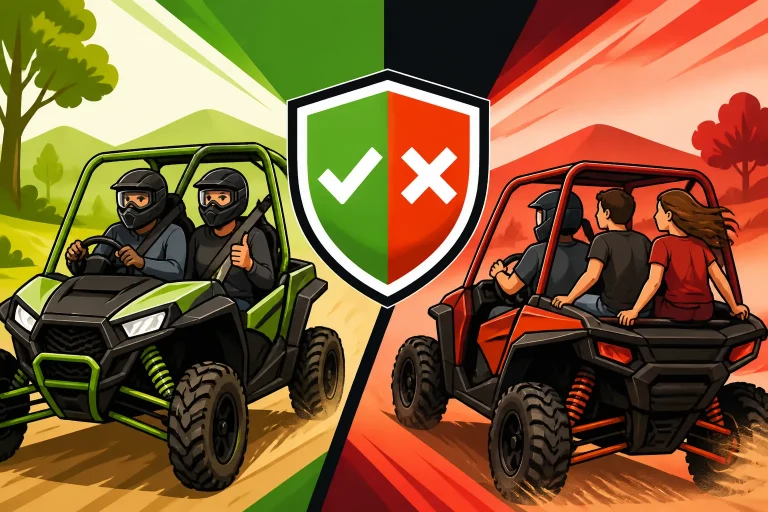
Passenger rules deserve their own check. A child should not ride as a passenger on a single-rider quad or on a vehicle that is not designed to carry a passenger. Even on a side-by-side, the ranch may set age or seating conditions. Ask whether the child may ride in a particular seat, whether a responsible adult must be the driver, and whether the child needs to meet any minimum size or restraint requirement.
A seatbelt, door, or handhold does not by itself confirm that a particular child is allowed to ride in that vehicle under the ranch’s rules. The machine’s design, the owner’s instructions, applicable safety requirements, and the property’s policy all matter. Keep children seated in the designated position and use the restraints the manufacturer provides.
A park may also require an adult to ride with a young child rather than allowing the child to operate a separate machine. The policy may differ by trail, vehicle type, or activity. Do not assume that a passenger rule for one UTV applies to every model or that it allows the child to ride on the back of a quad.
See Oklahoma Private Park Helmet Rules, Passenger Rules Inside a Private Riding Park, and Oklahoma Rules for Passengers on a UTV for related safety considerations. For youth helmet requirements more broadly, Oklahoma Helmet Rules Bind Under 18 is a useful companion topic. Confirm what applies to the specific activity and property before departure.
How to confirm the ranch’s rules before you go
A short call or message to the ranch can prevent a long drive that ends at check-in. Ask about the exact rider, vehicle, and activity rather than asking only, “Can kids ride?” A clear question gives staff the information they need to give a useful answer.
Use this process:
- Identify each rider’s age. If the park uses age bands, ask which one applies on the day of the visit.
- Describe the machine. Say whether it is a youth quad, adult ATV, or UTV, and whether the child will drive or ride as a passenger.
- Ask about supervision. Clarify whether an adult must be a parent or guardian, must ride along, or simply remain on the property.
- Confirm the gear rules. Ask about helmets, eye protection, footwear, and any equipment the ranch supplies.
- Check paperwork requirements. Find out who signs for a minor and whether the adult must be present at check-in.
- Ask about terrain and beginner options. Find out whether there are trails suitable for a first-time or younger rider.
- Reconfirm close to the visit. Policies and operating conditions can change, so use the ranch’s current instructions.
If the child is near a minimum-age cutoff, ask whether the park counts age on the date of the visit and whether it makes exceptions. Do not plan around an exception unless staff confirms it. If the ranch cannot give a clear answer about a child’s machine or passenger status, ask to speak with the person responsible for rider safety or admissions before you leave home.
When a child is bringing a personal machine, also ask about any equipment or vehicle conditions the property checks. The ranch may have rules about noise, safety equipment, or where machines can be operated. If a child will use a rented machine, ask what the rental process requires and whether the child’s age affects availability.
Keep a record of the answer, especially if you are coordinating several families. A brief written confirmation can help avoid confusion when one adult is handling check-in for multiple minors. Still, follow any updated instructions the ranch gives on arrival.
A simple family plan can make the visit smoother:
- Choose a trail or riding area that fits the least experienced rider.
- Keep children within the supervision distance the ranch requires.
- Make sure each child knows how to stop and where to meet the group.
- Take breaks before fatigue affects attention and control.
- Stop riding if the child is frightened, overheated, or struggling to manage the machine.
- Do not let a child borrow a different machine without checking its fit and the park’s rules.
The goal is not to find the youngest age at which a child can be admitted. It is to match the child, machine, terrain, and supervision plan to what the ranch permits and what the rider can safely handle.
Frequently Asked Questions
Is there one minimum age for riding at every private ranch in Oklahoma?
No single age should be assumed to apply at every property. Private ranches can set their own participation rules, and the minimum may vary by machine, activity, or supervision arrangement. Ask the ranch directly.
Can a parent sign a waiver so a child can ride regardless of age?
A waiver does not automatically override the ranch’s minimum-age or machine rules, and it does not remove any applicable legal requirements. Confirm both the waiver process and the child’s eligibility with the property.
Can a child ride as a passenger in a side-by-side?
Possibly, but do not assume every side-by-side or ranch allows it. Ask whether the vehicle is approved for passengers, which seat the child may use, and whether the park has age or restraint requirements. A child should not ride on a machine or seat not designed for passengers.
Does a private ranch have to follow its own helmet rules?
Riders should follow the property’s posted and communicated safety rules. Applicable state requirements may also matter, depending on the use and location. Confirm both with the ranch and the appropriate official source if the rule is unclear.
Disclaimer
This article is for general informational purposes only and does not constitute professional advice. Laws, prices and regulations vary by location and change over time. Consult a qualified professional for guidance on your specific situation.