Why an Out-of-State Rider Pays Double in Oklahoma
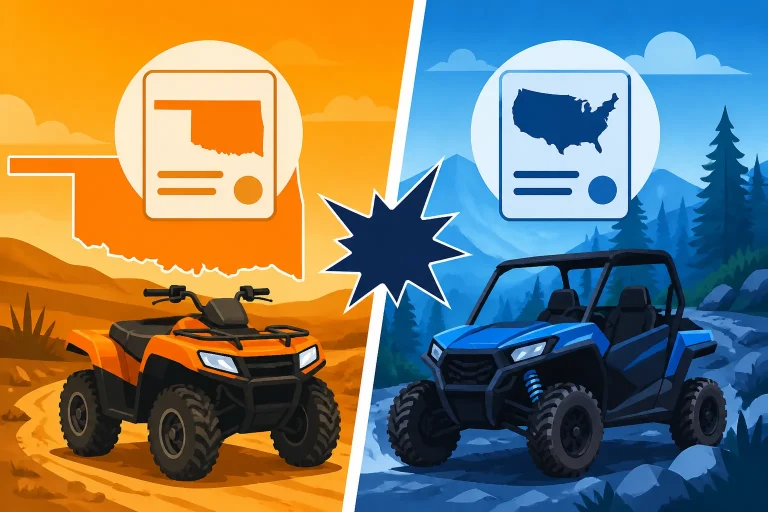
An out-of-state rider can arrive in Oklahoma with a machine, a valid home-state decal and a reasonable assumption that those documents cover the ride. The catch is that a land-access permit may be a separate requirement, and the nonresident annual rate has been set at twice the resident rate. Here’s what that charge covers, when it applies and how to avoid paying for the wrong permit.
Why the nonresident permit costs more
Oklahoma’s land-access permit is not the same thing as ATV registration. It is an access requirement for certain public lands and riding opportunities, including specific wildlife management areas. A registration decal, a title or a permit issued by your home state does not automatically replace it.
The nonresident rate is higher because Oklahoma sets a separate fee for riders who live elsewhere. For the annual land-access permit, that rate has been double the resident rate. The amounts and permit options can change, so check the current Oklahoma Department of Wildlife Conservation information before you travel. The important point is that “double” refers to the permit’s nonresident rate, not a general surcharge on every ride in Oklahoma.
That distinction matters because there is no single statewide ATV pass that gives you access everywhere. Different landowners and riding areas set different conditions. A permit that works for one public-land area may not be needed at a private off-road park, while a private park’s admission or waiver does not cover access to a wildlife management area.
| What you’re doing | Is the land-access permit likely to apply? | What else to check |
|---|---|---|
| Riding a designated wildlife management area | It may be required, depending on the area and activity | Area rules, seasonal access and any hunting-related conditions |
| Riding at a private off-road park | Usually a separate park admission and waiver apply | Park fees, age rules, equipment and operating hours |
| Riding at a state park or public riding area | The area may have its own fee or permit system | Park admission, camping fees and local riding rules |
| Riding private land with permission | The public-land permit may not apply | Written permission, property boundaries and landowner conditions |
| Riding on roads or streets | A land-access permit does not make road use legal | Local road rules, registration, equipment and insurance |
If you are comparing permit categories, Oklahoma Resident vs Nonresident Permits explains the basic difference. For current charges, [Oklahoma Land Access Permit Cost] is a useful companion, but always confirm the active fee schedule with the agency before buying.
A permit is best thought of as permission to use a particular access system, not as a general license to ride wherever you see a trail. Even when you have paid the nonresident rate, you still need to follow the rules for the specific property.
What the permit covers and what it does not
The land-access permit is connected to designated public-land access, not to ownership of your ATV or UTV. It does not title your machine, register it for Oklahoma, make it street legal or give you permission to ride across private property.
That separation can be confusing when you are planning a trip. Riders often use “registration,” “permit” and “day pass” as if they were interchangeable. They are not. The registration process concerns the machine and its required identification. A land-access permit concerns the rider’s eligibility to use covered land. A park pass or admission charge may apply to a specific facility.
Permits for wildlife management areas
Some Oklahoma wildlife management areas have access rules that differ from a privately operated park. The applicable permit can depend on the property, the rider’s status and the purpose of the visit. A land-access permit may be required even if the machine is properly registered elsewhere.
Honobia Creek and Three Rivers are examples of areas associated with Oklahoma’s land-access system. Do not assume that having one permit means every WMA or every kind of activity is automatically covered. Check the current property information before leaving home. One Permit Covering Honobia Creek and Three Rivers explains the connection between those areas, while Oklahoma WMA Access for a Quad focuses on machine access and area-specific rules.
A permit does not override seasonal restrictions, designated-road requirements, speed limits, check-in procedures or hunting rules. For example, timber-company land may have its own access conditions and riding window. The permit is only one part of the authorization you may need. See Why Timber Company Land Needs Its Own Permit before planning a ride on land operated under a separate access arrangement.
Permits for private parks and riding areas
A private off-road park may charge admission, require a waiver or set its own age, helmet, passenger and speed rules. Those requirements are separate from the state’s land-access permit system. Paying for a private park does not mean you have bought an Oklahoma land-access permit, and buying the land-access permit does not pay a private park’s gate fee.
Before you travel, identify the actual property where you intend to ride. A nearby campground, trailhead or riding area may be privately operated even if it sits near public land. Ask the operator what its admission covers and whether it has any requirements for out-of-state machines or riders.
Permits do not authorize road riding
A land-access permit is not a road plate and does not make a quad or side-by-side legal on public roads. Road use is controlled by separate state and local rules, and a road-legal classification may bring its own registration, equipment, insurance and driver requirements. Read Oklahoma Rules for an Out-of-State Machine if your trip includes more than off-road riding.
Likewise, an Oklahoma ATV registration decal should not be mistaken for permission to ride on every public road or trail. Before moving from a trail system onto a road, verify that the route is open to your machine and that the machine meets the requirements for that use. Does Oklahoma Recognize Another State’s ATV Decal? can help with the separate question of how a home-state decal is treated.
Why your home-state permit usually does not eliminate the charge
A home-state registration or trail permit proves something about your machine or your access in that state. It does not necessarily provide the same authorization Oklahoma requires for its own public lands.
That is why reciprocity can be misunderstood. In everyday conversation, people use “reciprocity” to mean that one state automatically honors another state’s permit. But recognition is not universal. A state may accept an out-of-state registration for some purposes while still requiring a separate land-access permit for a particular property.
Think of the documents as answering different questions:
- Registration or decal: Is the machine documented or registered under the relevant system?
- Land-access permit: Is the rider authorized under a particular public-land access program?
- Park admission: Has the rider paid to enter a specific facility?
- Permission from a private landowner: Has the owner allowed this person to ride on this property?
- Road authorization: May this machine use this road, and does it meet the rules for doing so?
One document does not automatically answer all five questions. A Texas, Kansas, Arkansas or Missouri decal, for example, should not be treated as proof that you have met Oklahoma’s land-access requirements. If you are visiting from another state, confirm the Oklahoma permit rule for the area you plan to use rather than relying on what your home state requires.
This is also why a rider can pay the nonresident rate even when the ATV itself is already registered. The fee is based on the rider’s residency category in the land-access program, not on whether the machine has a plate or decal from somewhere else.
The same separation applies to a borrowed machine. If a friend who lives in Oklahoma lends you a quad, your residency status does not change just because the machine belongs to a resident. Conversely, a resident riding a visitor’s machine should not assume the visitor’s home-state registration changes the resident’s permit category. Confirm who needs the permit and what proof is required for the specific activity.
If you are uncertain about a particular property, contact the responsible office before setting out. Tell them where you plan to ride, whether you are a resident or nonresident, what kind of machine you will bring and whether you are riding for recreation or in connection with hunting. Those details can change the answer.
Who may qualify for an exemption
Some riders may qualify for an exemption based on age or another defined status. Exemptions are specific, though, and they should not be assumed to apply to every person in a group.
Oklahoma’s rules have included exemptions for certain resident age groups. Those exemptions do not automatically extend to nonresidents. A visitor who meets an age threshold at home may still need to check Oklahoma’s own eligibility language and prove the status the state recognizes. Oklahoma Permit Exemptions by Age and Do Oklahoma Kids Need a Permit? cover the age-related questions in more detail.
For a family trip, do not buy one permit and assume it covers everyone riding. Make a list of each rider and check whether each person needs an individual permit, qualifies for an exemption or falls under a separate rule. Children riding their own youth machines may be treated differently from children who are passengers, and the answer can depend on the property and the activity.
A hunting license is not a universal substitute for a land-access permit, either. Some public-land access arrangements connect with hunting activity, but recreational riding and hunting access are not always treated the same way. If you are riding during a hunting season, ask whether the area requires a specific license, check-in or permit in addition to the land-access permit.
Do not rely on an exemption just because someone at home told you that “kids ride free” or “older riders do not need one.” Ask whether the exemption is for Oklahoma residents only, whether it applies to the land you will visit and whether it covers the type of riding planned. Keep any documentation needed to support the exemption with you.
For mixed groups, the simplest approach is to verify each rider separately:
- Confirm each person’s state of residence.
- Check whether age or another status creates an exemption.
- Identify the property and activity.
- Confirm whether the permit is individual or covers more than one rider.
- Keep proof of the permit or exemption available during the ride.
That small check can prevent one person in a family or group from being covered while another is not.
Choosing between an annual permit and a short visit option
If you are traveling from outside Oklahoma, the annual nonresident permit may not be the only option. A shorter-duration permit may be available for some visits, but its eligibility, price and covered activities should be confirmed before you buy. Do not assume that a short-term option is available for every property or that it covers the same access as an annual permit.
The right choice depends on where you plan to ride, how often you expect to return and whether the permit applies to the activity you have in mind. A short trip can make a shorter-duration permit worth checking. If you expect to return repeatedly, compare the current options rather than automatically buying several short permits.
When a Three-Day Permit Beats the Annual One can help you think through that comparison. Use the official permit information to verify the current term, start and end dates, purchase process and area coverage. If the permit is tied to a calendar period or particular activity, do not assume its days begin when you first arrive at the trailhead.
A quick comparison can help:
| Your situation | What to investigate |
|---|---|
| One weekend at a covered public area | Whether a short-term permit is offered and applies to your activity |
| Several visits spread through the season | Whether an annual permit is simpler or more economical |
| A single visit to a private park | The park’s admission and waiver, rather than assuming the state permit applies |
| Riding on multiple public properties | Whether one permit covers those specific properties |
| A trip that combines public and private riding | The separate requirements for each location |
Compare the complete cost, not just the permit fee. A visit can also involve park admission, camping, fuel, food, trailer costs and any required equipment. If you are riding a property that requires check-in, add time for that step too.
A permit purchased for the wrong property or category is not a bargain, even if it costs less. Before paying, match the permit description to the exact area and activity. If the online purchasing page is unclear, contact the agency or property office instead of guessing.
How to prepare before you cross the state line
The easiest way to avoid an unpleasant surprise is to confirm the rules while you are still planning the trip. Permits and access conditions are much easier to sort out at home than at a gate or trailhead with a trailer behind you.
Confirm the property first
Do not plan around a broad location name such as a county, forest or lake. Identify the specific riding area, trail system or management unit. Nearby parcels can have different owners and different rules. A road that connects two riding areas may not itself be open to ATV traffic.
Once you know the property, check its official access information for:
- Whether the area permits ATV or UTV use
- Whether the land-access permit applies
- Whether there is a separate admission or day-use charge
- Whether riding is seasonal or limited to certain roads
- Whether advance check-in is required
- Whether the area is closed because of weather, fire danger or another condition
- Whether your machine type is allowed on the route
A permit cannot make a closed road open or turn an undesignated trail into an approved route. If the area requires riding only on designated roads, stay on them even when an inviting track appears nearby.
Buy the correct permit through the right channel
Use the official permit purchase method or the channel identified by the responsible agency. How to Buy an Oklahoma Land Access Permit gives a practical overview of the purchase process. Read the confirmation carefully and save it somewhere you can access without a strong cell connection.
A screenshot or downloaded receipt can be more useful than relying on an email that may not load at a remote trailhead. If the permit is associated with your name, make sure the information is accurate and that every required rider is covered. Do not assume a receipt for one household member authorizes the rest of the group.
Carry documents and useful trip information
Keep the permit confirmation, registration information and any proof supporting an exemption available during the ride. If you have a paper copy, protect it from mud and rain. A waterproof document pouch can help; whether you buy one locally or through Amazon, check that it closes securely and fits the documents you intend to carry.
Amazon can also be a convenient place to find a compact clipboard or organizer for printed confirmations, but it is not an official source for permit rules. Use the agency or property office for the legal requirements, and use retailers only for ordinary trip supplies. If you order gear through Amazon, check that the item fits your machine and that any safety equipment meets the required standard.
For a remote ride, download the permit confirmation and property map before leaving service. A phone battery can fail, and some areas have weak coverage. Keep a paper backup if practical, and tell someone where the group plans to ride and when it expects to return.
Ask questions before the trip, not at the entrance
If a rule is unclear, contact the office that manages the land. Be specific. Instead of asking, “Do I need a permit in Oklahoma?” ask: “I live outside Oklahoma, I plan to ride this machine at this named area for recreation, and I will be there on these dates. Which permit and check-in steps apply?”
That wording helps the person answering distinguish between a private park, a WMA, a state-managed site and a road route. It also reduces the chance that you receive a technically correct answer for a different kind of riding.
Common mistakes that lead to extra costs or a stopped ride
The doubled nonresident rate is not the only way a rider can spend more than expected. Most avoidable problems come from treating different permissions as interchangeable.
Assuming a home-state decal is enough
A decal from another state may show that the machine is registered there. It does not by itself prove you have permission to use an Oklahoma public-land access program. Confirm the requirements for the destination property.
Buying an annual permit for a one-time private-park visit
If you are only riding at a privately operated park, the park’s own admission and rules may be what you need. Check before purchasing a state land-access permit that does not apply to your destination.
Assuming the permit covers the entire group
A permit may be linked to a particular rider or category. Verify whether each person needs a separate permit and whether any age-based exemption applies. A household receipt is not necessarily proof that every rider is authorized.
Confusing recreational access with hunting access
Hunting licenses and land-access permits can relate to the same public land but answer different questions. If your trip includes hunting, wildlife retrieval or travel during a hunting season, check the requirements for both the riding and hunting activity. Oklahoma Hunting Access by Machine is relevant when the machine is part of a hunting trip.
Treating payment as permission to go anywhere
A valid permit does not remove property boundaries, seasonal closures or route limits. It does not grant access to neighboring private land. It does not authorize a rider to leave a designated road or enter a closed section.
Waiting until the last minute
Permit websites, office hours and check-in arrangements may not match your travel schedule. Buy or arrange the permit early enough to resolve a payment or account problem. Save your confirmation offline and carry a backup if the property is remote.
If you keep the distinction clear—registration for the machine, permit for the covered access program, and separate rules for each property—the nonresident rate is easier to understand. You are paying a higher category fee for a specific kind of access, not buying a blanket pass for every ride in Oklahoma.
A practical pre-trip checklist for nonresident riders
Use this checklist before towing your machine into Oklahoma:
- Name the exact riding area. Confirm the property owner or managing agency, not just the nearest town.
- Check that ATVs or UTVs are allowed. Some trails restrict machine types or sizes.
- Confirm whether the land-access permit applies. Ask about the specific property and activity.
- Check the resident or nonresident category. Use the state’s definition of residency, not an informal assumption.
- Compare permit durations. See whether an annual or shorter-term option fits your plans.
- Check individual rider requirements. Do not assume one permit covers a group.
- Verify exemptions. Confirm age and residency conditions and carry proof if needed.
- Look for additional charges. Private parks, campgrounds and public facilities may have separate fees.
- Review property rules. Check seasonal windows, designated roads, check-in steps, speed limits and closures.
- Save proof offline. Keep the permit confirmation and essential trip details accessible without cell service.
- Check the machine separately. Make sure its registration, identification and equipment are appropriate for the planned use.
- Recheck shortly before departure. Conditions and rules can change, especially around closures, fire danger and seasonal access.
If an office gives you an answer by phone, write down the date, the property discussed and any specific instruction. That note is not a substitute for a permit, but it can help you remember what you were told and whom to contact if you need clarification.
The main takeaway is simple: Oklahoma’s nonresident land-access permit has been priced at twice the resident annual rate, but that charge applies to a particular access system. It is not a universal fee for every out-of-state rider, every private park or every road. Identify where you will ride, confirm the permit category and check current requirements with the responsible office before you go.
Disclaimer
This article is for general informational purposes only and does not constitute professional advice. Laws, prices and regulations vary by location and change over time. Consult a qualified professional for guidance on your specific situation.