Titling a Sand Machine Built for Little Sahara
You've just built or acquired that incredible sand machine – maybe it's a custom-fabricated beast designed to conquer every dune at Little Sahara, or perhaps it's a vintage quad you've lovingly restored for peak performance in the sand. Now, the excitement builds, but a nagging question remains: how do you get this unique, off-road marvel legally titled in Oklahoma so you can ride worry-free? This guide will cut through the confusion, walking you through the often-specific requirements for titling your sand machine in Oklahoma, ensuring your dune shredder is ready for legal adventure.
Understanding What "Sand Machine" Means for Oklahoma Titling
When you talk about a "sand machine built for Little Sahara," you're often describing something a little outside the box compared to a standard, showroom-fresh utility ATV or UTV. This distinction can throw a wrench into the usual titling process, as Oklahoma's rules are primarily geared toward mass-produced vehicles with readily available paperwork.
Is Your Dune Rig an ATV, UTV, or Something Else?
First things first, let's categorize your pride and joy. Oklahoma law broadly lumps ATVs (all-terrain vehicles) and UTVs (utility terrain vehicles, often called side-by-sides) into the same general category for titling and registration purposes. However, the specifics of your machine – its age, how it was constructed, and whether it has a clear manufacturer's identity – profoundly influence the documentation you'll need. A "sand machine" could be:
- A highly modified production ATV or UTV: This might be a quad or side-by-side from a major manufacturer like Polaris, Can-Am, or Honda, but it's been extensively modified with aftermarket engines, suspension, roll cages, or custom frames to excel in dune environments.
- A custom-built "sand rail" or buggy: These are often fabricated from the ground up, using parts from various sources, and might not have a single manufacturer or a traditional Vehicle Identification Number (VIN) plate in the usual spot.
- An older, vintage ATV/UTV: Many classic machines still rip at Little Sahara, but their original paperwork might be long lost, making proof of ownership tricky.
Why the Classification Matters for Paperwork
For the Oklahoma Tax Commission and your local tag agency, whether your machine is clearly identifiable as a standard ATV or UTV impacts the expected paperwork. If it's a newer, unmodified machine, they'll expect a Manufacturer's Statement of Origin (MSO) or a clean title. For older or custom builds, the path diverges, requiring alternative proofs of ownership and identification. Understanding this upfront saves you multiple trips and a lot of frustration. The clearer you can make your machine's identity, even if it's a custom build, the smoother the process will be.
Custom Builds and the VIN Challenge
One of the biggest hurdles for custom-built sand machines is the VIN. Every vehicle titled in Oklahoma needs a unique identifier. If your machine is a hybrid of different frames, engines, and parts, or a bespoke creation, it might not have a standard VIN, or the existing VIN might not align with the actual vehicle presented for titling. In such cases, the tag agency might require a VIN inspection by a certified officer or could even assign a state-issued VIN. This adds a layer of complexity that factory-built machines rarely encounter. It's not insurmountable, but it requires patience and a clear explanation of your machine's origins.
Why Little Sahara Machines Have Unique Titling Hurdles
The very nature of a "sand machine" often means it's lived a hard life, possibly changed hands multiple times without proper documentation, or was designed with performance in mind rather than easy titling. This can create specific challenges when you walk into a tag agency.
Older Machines and Missing Records
It's common for older ATVs and UTVs that spend their lives tearing up the dunes to have lost their original paperwork over the years. Maybe a few private sales happened with just a handshake, or the bill of sale was scrawled on a napkin and then misplaced. If you've inherited or bought an older machine with no title or a sparse paper trail, Oklahoma has provisions for [Oklahoma Bills of Sale for Older Machines], but it often requires more legwork on your part to prove ownership and value. This is where you might need to lean on alternative proofs of purchase, sworn affidavits, or even a declaration of facts to establish your legal claim.
Modified Machines and Identifying Data
Imagine you've taken a standard quad frame, dropped in a high-performance engine from a different machine, and added a custom suspension. While this might be a common practice for a Little Sahara dune machine, it can raise eyebrows at the tag agency. The original VIN might no longer accurately reflect the entire vehicle you're presenting. Tag agencies are looking for consistency between the physical machine and the documents. If your modifications are so extensive that the original identifying features are obscured or replaced, you'll need to be prepared to explain these changes and potentially provide documentation for major components. This doesn't mean your modified machine can't be titled, but it does mean you need to be transparent and ready to provide a detailed history.
Navigating the Standard Oklahoma ATV/UTV Titling Process
Even with a unique sand machine, the fundamental steps for titling in Oklahoma remain the same as for any other ATV or UTV. Understanding these basics is your foundation before diving into the specific nuances of your dune rig. Oklahoma generally requires all off-road vehicles to be titled, regardless of where they are primarily used. [Oklahoma Titles ATVs and UTVs] clarifies this requirement for all riders.
Essential Documents for Any Off-Road Machine Title
Whether your sand machine is new off the showroom floor or a vintage marvel, certain core documents are universally required for titling. Having these in order before you visit the tag agency will save you immense time and frustration.
Manufacturer's Statement of Origin MSO for New Machines
If your "sand machine" is a brand-new ATV or UTV, perhaps a high-performance model straight from a dealer that you've only just started customizing, the process begins with the Manufacturer's Statement of Origin (MSO). This document is the equivalent of a birth certificate for your machine. It proves the machine's origin, manufacturer, and initial specifications. [Oklahoma Requires an MSO for a New Machine] explains that dealers provide this to you, often alongside a bill of sale or invoice. Make sure you keep this in a safe place until your titling appointment, as it's the primary document for establishing the machine's initial legal identity. Without it, you cannot title a new machine.
Bills of Sale for Used Machines
For any sand machine that has been previously owned, a detailed bill of sale is absolutely crucial. This document serves as proof of transfer of ownership from the previous owner to you. A good bill of sale should include:
- The full names and addresses of both the buyer and the seller.
- The date of sale.
- A clear description of the machine, including make, model, year, and most importantly, the VIN (Vehicle Identification Number).
- The agreed-upon purchase price.
- Signatures of both parties.
Even if you’ve purchased an older machine with minimal previous documentation, a solid bill of sale from your seller to you is your strongest piece of evidence. If you're using a generic template, make sure it covers all these points. You can find reliable templates online from services like LawDepot, which can help ensure all necessary information is included.
Oklahoma Dealer Invoices at Titling
If you purchased your sand machine from a licensed dealer, they will provide you with a comprehensive invoice. This invoice typically details the sale price, any trade-in value, taxes, and fees. This document, alongside the MSO for new machines or a previous title for used ones, is presented to the tag agency. Dealers are accustomed to the titling process and usually provide all the necessary paperwork correctly formatted. [Oklahoma Dealer Invoices at Titling] outlines why this paperwork is essential, as it helps establish the sales price for excise tax calculations.
Oklahoma Declaration of Purchase Price
Sometimes, the bill of sale for a used machine might be informal, or the purchase price might not be explicitly stated in a way the tag agency finds sufficient. In other instances, you might have acquired the machine through a gift or an inheritance, where there wasn't a "purchase price" in the traditional sense. In these situations, you might be required to complete an "Oklahoma Declaration of Vehicle Purchase Price." This form allows you to formally state the agreed-upon price, or if it was a gift, declare its fair market value. This is important because the state's excise tax is calculated based on this declared value. [Oklahoma Declaration of Purchase Price] ensures that even without a formal dealer invoice, the state can correctly assess the necessary taxes.
The Role of a Tag Agency in Titling Your Dune Machine
Your local tag agency is where all these documents converge and the magic of titling happens. These are the folks who process the paperwork, collect fees, and ultimately issue your title and registration decal. They're your primary point of contact for getting your sand machine legally recognized.
What to Bring to the Tag Agency
Beyond the specific ownership documents mentioned above, you'll need a few other things for your visit:
- Proof of Identity: A valid driver's license or state-issued ID is essential.
- Proof of Residency: Documents like a utility bill or lease agreement can serve as proof that you reside in Oklahoma.
- Method of Payment: Be ready to pay the titling fees, excise tax, and registration costs. These typically include the standard [Oklahoma Charges $11 at Titling] fee, plus the excise tax based on your machine's value.
- The Machine's VIN: Even if you don't bring the machine itself (which is usually not required for a VIN inspection from out of state – [Oklahoma Has No Out-of-State VIN Inspection] explains this distinction), you must have the VIN clearly written down or photographed. Double-check it against all your paperwork.
Oklahoma Registration Application Explained
At the tag agency, you'll fill out an "Application for Oklahoma Certificate of Title for a Vehicle" form. This form collects all the pertinent information about you (the owner) and your sand machine. It asks for details like the make, model, year, color, fuel type, and, of course, the VIN. Be sure to fill it out accurately. If you have any questions, the tag agency staff are there to help. This application is the cornerstone of the entire process, so attention to detail here prevents delays. [Oklahoma Registration Application Explained] goes into further detail about what information this form requires.
Special Considerations for Little Sahara Sand Machines
This is where the unique nature of your dune machine might require some creative problem-solving and a deeper understanding of Oklahoma's flexible titling rules. Don't be discouraged if your machine doesn't have a perfectly pristine paper trail; there are often pathways to get it titled.
Dealing with Missing or Incomplete Paperwork
It's a common scenario: you find the perfect vintage sand rail or an awesome modified quad, but the seller only has a handwritten note, or perhaps nothing at all. This is where patience and persistence come into play.
When a Bill of Sale Isn't Enough or is Missing
If your bill of sale is incomplete, lacks critical information like a VIN, or is outright missing, the tag agency will need more convincing evidence of ownership. This might involve:
- Affidavits: You and the seller (if available) might need to sign a sworn affidavit detailing the sale and acknowledging the lack of a formal title.
- Researching Previous Owners: Sometimes, contacting the state's motor vehicle department with a VIN search can reveal previous registered owners, who might be able to help you acquire a copy of an older title or provide a more formal bill of sale.
- Bonded Title: In some extreme cases where ownership is highly questionable and no prior title can be established, a bonded title might be an option. This is a complex legal process involving a surety bond, protecting the state (and any potential prior owner) against claims of improper ownership. This is typically a last resort and involves higher costs and more hoops to jump through.
For older machines, especially those bought before the state began requiring titles for ATVs, [Oklahoma Machines With No Paperwork] offers some guidance on how to navigate these situations. The key is to provide as much verifiable proof as possible of how the machine came into your possession.
Creating Your Own Bill of Sale
If you're buying a sand machine directly from a private seller who doesn't have a formal bill of sale template, it's wise to create one yourself. You can find numerous templates online, and services like LawDepot offer user-friendly forms that guide you through all the necessary fields. A well-drafted bill of sale is your best defense against future ownership disputes and provides the tag agency with the necessary details for titling. Make sure it explicitly states that the seller is conveying all rights and ownership to you, and includes a clear, legible VIN.
VIN Verification and Custom-Built Machines
The VIN is the unique fingerprint of your machine. Without it, or if it's questionable, titling becomes much harder.
Why VIN Is Crucial Even for Dune Rigs
Every ATV and UTV titled in Oklahoma must have a valid, unique VIN. This number is how the state identifies the machine, tracks its ownership, and ensures it hasn't been reported stolen. Even if your sand machine is a custom build, it needs this identifier. For production machines, the VIN is usually stamped on the frame. For custom builds, you might need to apply for a state-assigned VIN. This process typically involves an inspection by a law enforcement officer or a designated tag agency employee to verify the machine's construction and assign a new, unique identifier.
Dealing with Altered or Unreadable VINs
This is a serious issue. If the VIN on your machine appears to be tampered with, unreadable due to rust or damage, or is missing entirely, it will trigger additional scrutiny. You cannot simply present a machine with a questionable VIN. The tag agency will likely require a VIN inspection by a certified peace officer. This inspection aims to confirm the machine's identity and ensure it's not stolen property. If the VIN is truly unreadable or missing, the officer can initiate the process for a state-assigned VIN, which will then be used for titling. Be prepared for delays and potentially higher fees if this step is required.
Understanding Excise Tax and Fees for Your Sand Machine
Titling isn't free, and understanding the costs upfront helps you budget accordingly. These fees apply to your sand machine just as they would to any other off-road vehicle.
The Standard 4.5% Excise Tax
Oklahoma assesses an excise tax of 4.5% on the declared purchase price or fair market value of ATVs and UTVs at the time of titling. This is a one-time tax, similar to sales tax on other purchases. If you bought your sand machine for $10,000, you'd owe $450 in excise tax. If you declared a lower value for an older machine, the tax would be less. Be honest about the value; understating it significantly can lead to issues if the state questions the declared price. [Oklahoma Excise Tax at Titling] details this important fee.
Other Potential Fees to Expect
Beyond the excise tax, you'll encounter a few other fees:
- Titling Fee: A modest fee for processing the title itself.
- Registration Fee: The annual registration fee for an ATV or UTV in Oklahoma is a flat [Oklahoma Charges $11 at Titling], which surprisingly, you pay once and it never renews! This covers the cost of your decal.
- Lien Filing Fee: If you financed your sand machine, there will be a small fee to record the lien on the title.
- Possible Penalty Fees: If you don't title your machine within 30 days of purchase, you could incur late registration fees. [Oklahoma's 30-Day Registration Deadline] is critical to avoid these extra costs.
The total cost will depend on the value of your machine and whether you meet all deadlines.
Getting Your Sand Machine Ready for the Dunes
Once your sand machine has a shiny new title and registration, you're almost ready to hit the famous dunes of Little Sahara State Park. But there are a couple more steps to ensure you're fully compliant and safe for your first ride.
Beyond Titling: Registration and Decals
Titling and registration go hand-in-hand in Oklahoma. When you title your machine, you'll also register it.
Oklahoma Issues a Front Decal, Not a Plate
Unlike cars or street-legal UTVs, off-road ATVs and UTVs in Oklahoma do not receive a traditional license plate. Instead, you'll be issued a small, adhesive decal. This decal is your proof of registration. [Oklahoma Issues a Front Decal, Not a Plate] explains this unique system. The most common question among riders is where this decal goes.
Oklahoma Decals on the Front of a Machine
For ATVs and UTVs, the registration decal must be displayed prominently on the front of the machine. This allows park rangers and law enforcement officers to easily identify that your machine is properly registered. Typically, this means on the front fender, the front bumper, or a visible part of the grille for a side-by-side. Make sure it's affixed securely and visible, not tucked away where it can't be seen. [Oklahoma Decals on the Front of a Machine] provides more guidance on this.
Final Checks Before Heading to Little Sahara
With your titling and registration complete, you're practically there! But before you load up and head to Waynoka, a few final checks are critical for a safe and legal dune experience.
Safety Gear and Park Requirements
Little Sahara State Park has specific rules to ensure everyone's safety on the dunes. These are separate from state titling and registration rules but are equally important. You'll need:
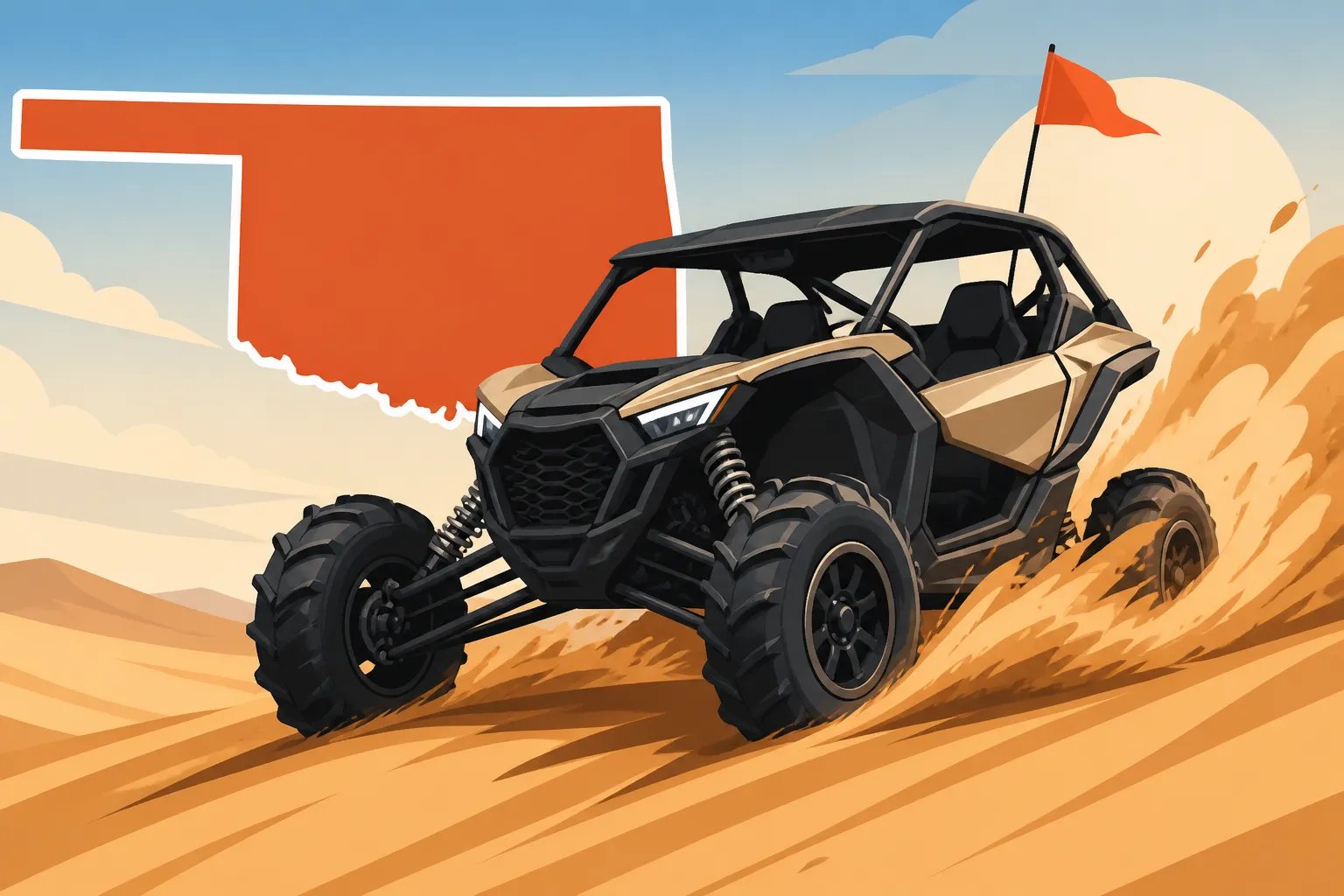
- A 10-Foot Whip Flag: This tall whip with an orange flag makes your machine visible over the tops of dunes, crucial for preventing collisions. [Little Sahara's 10-Foot Whip Rule] is strictly enforced.
- Orange Flag: Specifically, a bright orange flag, measuring at least 6 by 12 inches, needs to be attached to the top of that whip. [Oklahoma's Orange Flag Requirement] is non-negotiable for riding in the dunes.
- Helmets: While not everyone is legally required to wear a helmet by state law, Little Sahara strongly encourages it, and it's simply good sense for any rider, especially in the dynamic dune environment. For riders under 18, helmets are mandatory.
- Lights for Night Riding: If you plan on riding after dark, your machine must have proper lighting – white light to the front, red to the rear.
Oklahoma Dune Riding Explained
Familiarize yourself with all of Little Sahara's rules and regulations before you arrive. Check the park's official website or call them directly for the most current information on fees, camping, and any specific requirements. Understanding the nuances of dune etiquette and safety will make your experience much more enjoyable and keep you out of trouble. [Oklahoma Dune Riding Explained] offers a broader overview of what to expect when riding in Oklahoma's premier sand destination.
With your sand machine properly titled, registered, and equipped, you're ready to carve up the dunes and create unforgettable memories at Little Sahara!
Disclaimer
This article is for general informational purposes only and does not constitute professional advice. Laws, prices and regulations vary by location and change over time. Consult a qualified professional for guidance on your specific situation.