Oklahoma’s Fine Cap for ATV Violations
It's an all too common scenario: you're out enjoying your ATV or UTV, maybe on some familiar back roads, or you're just trying to get from your hunting blind to the next section of your property, and suddenly, there are flashing lights in your rearview. The thought immediately races through your mind: "How much is this going to cost me?" Riders in Oklahoma often grapple with confusion and anxiety when it comes to navigating the rules about where they can and can't ride their off-road machines, especially on public roadways. This comprehensive guide aims to clear up the mystery surrounding fines for ATV and UTV violations in Oklahoma, focusing specifically on the state's surprising fine cap and what it really means for your wallet.
Understanding Oklahoma's Off-Road Machine Road Rules
Oklahoma has a unique landscape when it comes to ATV and UTV use, especially concerning public roads. While the appeal of cruising down a county road or quickly crossing a highway is strong, the laws are often misunderstood.
The General Prohibition on Public Roads
Let's start with the fundamental truth: in Oklahoma, ATVs and UTVs are generally considered "off-road vehicles" and are not designed or legally intended for sustained use on public streets and highways. This isn't just about what the manufacturer intended; it's rooted in safety. These machines lack many of the safety features found in traditional cars, like airbags, crumple zones, and fully enclosed cabs, making them inherently more vulnerable in traffic. Their handling characteristics, tire types, and braking systems are optimized for dirt, sand, and trails, not asphalt.
Think about it this way: your neighbor might zip down the rural street to grab a tool from a buddy's house, but that short trip is technically a violation in many places. The law distinguishes between vehicles built for the road (like cars, trucks, and even motorcycles) and those built for off-road adventure. Your quad or side-by-side falls squarely into the latter category, making most road use a no-go without specific exceptions.
Specific Exceptions for Road Use
Now, here's where it gets a little more nuanced. While the general rule is "no public roads," Oklahoma law does provide several key exceptions that allow for limited or specific types of road use. These exceptions are crucial for riders, especially those in rural and agricultural areas.
For instance, state law allows for [Oklahoma Highway Crossings in Daylight] if the highway is posted for 35 mph or less, and the crossing is done at a 90-degree angle. This isn't permission to cruise down the highway, but rather to get from one section of land to another. Additionally, [Oklahoma County Commissioners and ATV Roads] have the authority to open specific county roads or portions of them for ATV and UTV use through official resolutions. This means what's legal in one county might be forbidden in the next. Similarly, some [Oklahoma Municipal Ordinances That Open Streets] allow limited ATV/UTV access within city limits. Farmers and ranchers also have a significant exception under the "instrument of husbandry" rule, which allows for [Oklahoma Farm Use on County Roads] for agricultural purposes. This recognizes that these machines are essential tools for many Oklahoma residents.
It's also important to remember the relatively new "street-legal UTV" class. Created by legislation, these are UTVs that meet specific equipment requirements (like turn signals, mirrors, and horns) and are registered and plated for road use, much like a car. They are distinct from standard off-road machines and operate under a different set of rules entirely.
The Evolving Landscape of Oklahoma's Laws
The regulatory environment for ATVs and UTVs in Oklahoma isn't static; it's constantly evolving. What was permissible a decade ago might be illegal today, and new legislation can introduce entirely new categories of machines or uses. For example, the 2021 bill that established the street-legal UTV class fundamentally changed how some side-by-sides are viewed and regulated. This dynamic legal landscape means riders must remain vigilant and stay informed about changes to state statutes and local ordinances.
It can be frustrating when the rules seem to shift, especially when you've been riding the same way for years. But the legislative process often responds to safety concerns, changes in machine technology, and the growing popularity of off-road recreation. Staying updated means checking with your local tag agency, county clerk, or even following state legislative updates, ensuring you're always on the right side of the law.
What Constitutes an ATV/UTV Road Violation?
Understanding the specific actions that can lead to a citation is the first step in avoiding trouble. Many violations stem from operating an off-road machine in places it shouldn't be, or failing to adhere to specific conditions for permitted use.
Unauthorized Roadway Operation
This is perhaps the most common type of violation. It involves simply driving your ATV or UTV on a public road where it's not explicitly allowed. This could mean cruising down a state highway that isn't designated for off-road vehicles, or taking your machine on a city street in a municipality that hasn't passed an ordinance to open its roads. Even a quick jaunt down a county road that hasn't been approved by the county commissioners can land you in hot water.
Imagine you're taking your quad down a busy main street in a small town to pick up supplies. Unless that town has a specific ordinance allowing such use – and many don't – you're operating your machine illegally. It's not just about speed; it's about the vehicle itself being on a surface it's not permitted to be on. These rules exist not to penalize you unnecessarily, but to ensure everyone's safety, as ATVs and UTVs often don't mix well with cars and trucks on paved roads.
Violations of Specific Crossing Rules
Even when crossing a highway is permitted, there are strict rules to follow. Ignoring these conditions can turn a legal crossing into a violation. For example, if you attempt to cross a highway posted above 35 mph, you're breaking the rules. Similarly, crossing after dark, when visibility is reduced, is typically forbidden. The law often specifies that crossings must be made at a 90-degree angle, to minimize the time spent in the flow of traffic. Any deviation from these precise rules could result in a citation.
Let's say you're trying to get to a friend's property on the other side of a two-lane highway. You see a break in traffic and decide to cut diagonally across, even though the speed limit is 45 mph. In that moment, you've created a hazardous situation and committed a violation of the specific crossing rules. These conditions are in place to reduce the risk of accidents, especially given the speed differences and maneuverability limitations of off-road machines compared to on-road vehicles.
Age, Passenger, and Helmet Rule Breaches
Beyond where you ride, how you ride, and who you ride with can also lead to violations. Oklahoma has specific regulations regarding rider age, passenger limits, and helmet use, particularly for younger riders. For instance, operating an ATV or UTV if you are under 18 without wearing a helmet is a clear violation of state law. [Oklahoma Helmet Law for Riders Under 18] is not to be taken lightly.
Additionally, carrying more passengers than your machine is designed for can result in a ticket. If your quad is a single-rider machine, having a passenger on the back rack is unsafe and illegal. Similarly, allowing an underage driver to operate a machine on a public road (outside of private property or designated areas) can lead to a citation for the supervising adult. These rules are primarily focused on safety, protecting both the rider and anyone else on the machine. Imagine a 15-year-old tearing down a section line road, helmetless, with a friend perched precariously on the rear rack. That's a recipe for disaster and a definite ticket waiting to happen.
The $25 Fine Cap Explained
This is often the part that surprises many riders in Oklahoma: for many common ATV and UTV violations related to road use, there's a statutory limit on the monetary fine.
The Statutory Limit on Fines
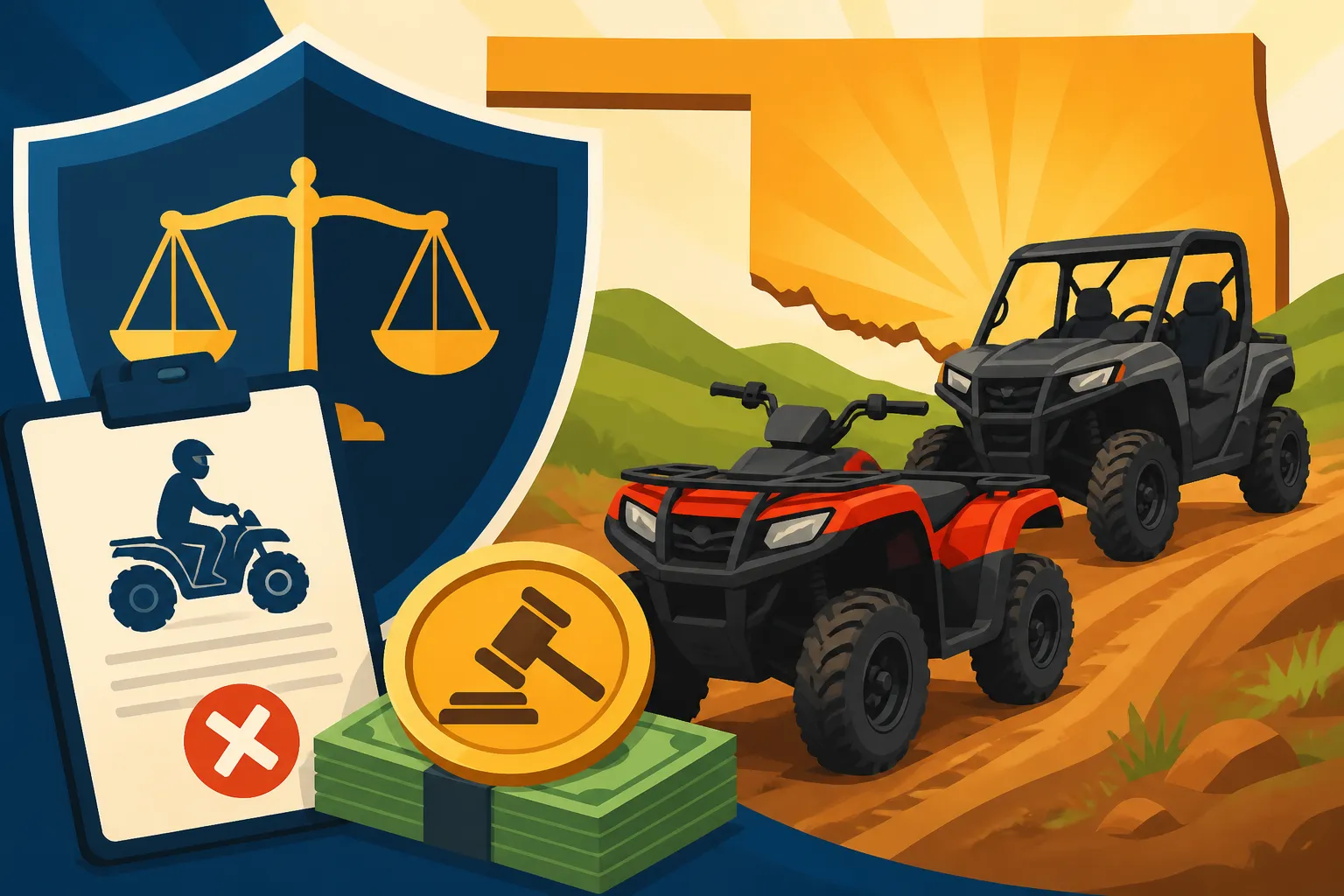
Oklahoma law sets a specific maximum for the fine associated with many non-moving violations involving off-road machines on public roads. For a vast majority of these infractions, the actual monetary fine itself is capped at just $25. This isn't a rumor; it's codified in state statute. This cap applies to situations like riding on an unauthorized county road, making an improper highway crossing, or failing to wear a helmet if you're under 18. The intention behind [Oklahoma Penalties Capped at $25] is likely to provide a deterrent without imposing an overly burdensome financial penalty for what are often considered lesser infractions, particularly in rural settings.
It's crucial to understand what this $25 covers: it's strictly the fine amount. It doesn't include other potential costs, which we'll discuss shortly. So, while the ticket might read a $25 fine, don't expect to walk away paying only that amount. The $25 is the punitive portion directly related to the violation itself.
Why the Cap Exists (and Its Limitations)
The legislative intent behind the $25 fine cap likely stems from a recognition that off-road machines are often used in rural areas where access to public roads might be the only way to get from one private property to another, or to conduct farming and ranching activities. Lawmakers probably aimed to create a penalty that was noticeable but not crippling for activities that, while technically illegal, might not carry the same level of danger as, say, reckless driving in a car. It acknowledges that many riders might simply be ignorant of the specific rules rather than intentionally malicious.
However, it's vital to recognize the limitations of this cap. It's not a green light to disregard the rules. It means the fine portion of the penalty is small, but it doesn't diminish the illegality of the act or the potential for other, more significant consequences. Think of it this way: getting a ticket for riding your quad on a closed county road will result in a $25 fine, plus other costs. It's a slap on the wrist, but it's still a slap. It registers as a violation and serves as a formal warning.
What the $25 Actually Covers
As we've touched upon, the $25 fine cap is precisely that: a cap on the fine amount. When you receive a citation, there are typically several components to the total sum you're expected to pay. The $25 is the penalty for the specific offense. However, attached to almost every citation are court costs and administrative fees. These are not part of the fine; they are charges levied by the court system for processing your ticket, maintaining records, and funding various legal services.
For example, you might get a ticket with a $25 fine, but then find that [Oklahoma Court Costs for a Citation] add another $50, $75, or even more, depending on the county and the specific court. So, your total out-of-pocket expense could easily be $75, $100, or higher, even for a "minor" $25 fine. This is why it's a common misunderstanding; riders hear "Oh, it's only a $25 ticket," but then they're shocked when the total bill is much larger. Always assume that the total amount you'll owe will be more than just the listed fine.
When the $25 Fine Cap Doesn't Apply
While the $25 fine cap is a notable feature of Oklahoma law for many ATV/UTV violations, there are critical situations where it simply doesn't apply. Understanding these exceptions is crucial to truly grasp the potential financial and legal risks.
Street-Legal UTV Violations
One of the most significant carve-outs from the $25 cap applies to street-legal UTVs. Because these machines have been specifically modified, registered, and plated for road use under [Oklahoma Street-Legal UTV Statute], they are treated much more like conventional motor vehicles. If you're driving a street-legal UTV with [Oklahoma Annual Plates for Street UTVs] and commit a traffic infraction—such as speeding, running a stop sign, or driving without proper insurance—you're looking at standard traffic fines, not the $25 cap. These fines can be significantly higher, often ranging into the hundreds of dollars, plus court costs, and could impact your driving record and insurance rates, just like a car violation.
This distinction highlights the two different worlds of UTV operation in Oklahoma. A recreational UTV used off-road primarily for trails and occasional farm work, if caught on a road illegally, might fall under the $25 cap for that specific offense. But a UTV that has been formally converted and registered for street use takes on the full responsibilities and penalties associated with on-road vehicles.
Moving Violations or Dangerous Driving
The $25 fine cap is intended for relatively minor, non-hazardous infractions related to the unauthorized presence of an off-road machine on a road. It absolutely does not apply to serious moving violations or dangerous driving offenses. If your ATV or UTV operation involves reckless driving, excessive speed that endangers others, fleeing an officer, or most critically, driving under the influence (DUI), you are facing penalties far beyond a mere $25 fine.
A [Oklahoma DUI Law and Off-Road Machines] violation, for instance, carries severe consequences, including hefty fines (often thousands of dollars), potential jail time, license suspension, mandatory substance abuse treatment, and impoundment of your machine. Similarly, if your off-road machine is involved in an accident where you are at fault due to dangerous operation, the legal and financial ramifications will be substantial, extending far beyond any fine cap. [Oklahoma Accident Reporting for an ATV Crash] may also be required, leading to further investigation and potential charges. These types of violations are taken very seriously, regardless of the vehicle type, because they directly jeopardize public safety.
Local Ordinances and State Parks
While state law sets the $25 fine cap for many road-use violations, it's important to remember that cities, counties, and state parks can have their own sets of rules and penalties. Some [Oklahoma Municipal Ordinances That Open Streets] may also contain specific prohibitions or conditions that, if violated, could carry a different fine structure not bound by the state's $25 cap. A municipality might, for example, have an ordinance against excessive noise from off-road vehicles that carries a higher fine.
State parks and wildlife management areas (WMAs) are another significant area of exception. Places like Little Sahara State Park or Robbers Cave OHV Area operate under their own specific regulations. Violations within these areas—such as riding outside designated trails, failing to have a whip flag, or riding without a permit—are subject to fines set by the Oklahoma Parks and Recreation Department or the Oklahoma Department of Wildlife Conservation. These fines can, and often do, exceed $25. [Oklahoma Park Rangers as Enforcers] have the authority to write citations for these violations, and they enforce park-specific rules rigorously. So, don't assume the $25 cap applies when you're on a designated trail system or in a state park; always check the rules for that specific location.
Who Enforces ATV/UTV Road Rules and Fines?
Understanding who has the authority to issue a citation is just as important as knowing the rules themselves. Several different types of law enforcement officers are empowered to enforce ATV and UTV regulations in Oklahoma, depending on the location and nature of the violation.
State Highway Patrol and County Deputies
These are the primary enforcers you're likely to encounter on state highways and county roads. Oklahoma Highway Patrol (OHP) troopers have jurisdiction on all state and interstate highways, and they are well-versed in the regulations concerning off-road vehicles. If you're operating your ATV or UTV illegally on a state highway, an OHP trooper can certainly pull you over and issue a citation.
Similarly, county sheriff's deputies are the main law enforcement presence on county roads throughout Oklahoma. They enforce state laws and any specific county ordinances that might be in place regarding ATV and UTV use. If your county commissioners haven't opened a particular road to off-road machines, or if you're making an improper highway crossing, a county deputy is fully authorized to issue a ticket. Picture a deputy on patrol in rural Osage County, spotting a quad speeding down a section line road that's closed to ATVs. They have every right and duty to intervene.
Municipal Police and Park Rangers
Within city limits, municipal police officers enforce local ordinances as well as relevant state laws. If a city has passed specific rules regarding ATV and UTV use on its streets – either opening them or restricting them – the city police will be the ones enforcing those rules. For instance, if you're riding your UTV on a city street where there's no ordinance permitting it, a local police officer can issue a citation.
Outside of city streets, [Oklahoma Park Rangers as Enforcers] play a vital role in enforcing regulations within state parks, recreation areas, and designated OHV parks like Little Sahara or Robbers Cave. These rangers are commissioned law enforcement officers with full authority to issue citations for violations of park rules, which, as mentioned, often carry fines distinct from the general $25 state cap. They are trained specifically in park regulations and prioritize the safety and preservation of these recreational lands.
Game Wardens and Timber Company Personnel
Oklahoma Game Wardens, operating under the Oklahoma Department of Wildlife Conservation, have broad law enforcement authority, especially within wildlife management areas (WMAs), game reserves, and other public lands managed by the state. While their primary focus is on hunting, fishing, and wildlife laws, they can and do enforce vehicle regulations, including those pertaining to ATVs and UTVs, particularly if the machines are used in a manner that disrupts wildlife, damages habitat, or violates WMA-specific rules. [Oklahoma Game Wardens Check on Public Land] for all sorts of infractions, including unauthorized vehicle use. [Oklahoma WMA Access for a Quad] can be restricted, and wardens will enforce those limits.
Furthermore, on privately owned timber company lands that are open for public access (often under specific permit agreements, such as Honobia Creek or Three Rivers WMAs), there might be security personnel or designated enforcement officers from the timber company itself. While these individuals may not have full law enforcement powers to issue state citations, they can certainly enforce company rules, leading to trespass warnings, revocation of access permits, or contacting local law enforcement to issue citations. They are essentially stewards of the land, ensuring that public access doesn't lead to abuse or damage.
Beyond the Fine: Other Potential Repercussions
While the $25 fine cap for many ATV/UTV violations in Oklahoma might seem minimal, it's crucial to understand that the fine itself is often just one piece of the financial and legal puzzle. Other costs and consequences can quickly add up, making a seemingly minor infraction much more significant.
Court Costs and Administrative Fees
As we touched on earlier, the $25 fine is almost never the total amount you'll pay. Every citation goes through a judicial process, and with that process come mandatory [Oklahoma Court Costs for a Citation] and various administrative fees. These are charges for the court's time, paperwork, and services, and they are added on top of the actual fine. The exact amount of these costs can vary significantly depending on the county and the specific court (e.g., municipal court vs. district court), but they can easily push your total bill into the $75 to $150 range, or even higher, for what started as a $25 fine.
Consider a scenario where you're cited for riding your quad on a non-approved county road. The fine is $25. But when you go to pay at the court clerk's office, you might find an additional $80 in court costs and surcharges. Suddenly, your "cheap" $25 ticket has become a $105 bill. These costs are non-negotiable and are part of the legal system's operation, so always factor them in when assessing the true expense of a citation.
Impoundment and Towing
In more serious cases, or sometimes even for repeat offenses, an officer has the authority to impound your ATV or UTV. [When an Officer Can Impound Your Machine] typically happens if you're operating it without proper registration (if required), if it's involved in a serious accident, if you're arrested for DUI, or if you're simply creating a significant public nuisance or safety hazard. The costs associated with impoundment can be staggering and will quickly overshadow any fine.
First, there's the towing fee, which can be hundreds of dollars, especially if your machine needs to be recovered from a ditch or a difficult location. Then, there are daily storage fees at the impound lot, which can accrue rapidly, sometimes $25-$50 or more per day. Before you can even think about paying your fine, you'll need to pay the towing and storage fees to get your machine back. This can quickly turn a $25 fine into a $500 to $1,000 headache, depending on how long your machine sits in impound. The financial strain and inconvenience of retrieving an impounded machine are powerful deterrents.
Safety Courses and Insurance Impact
While Oklahoma currently [Oklahoma Has No Mandatory Safety Course] for general ATV/UTV registration, a judge might, in some cases, order you to complete a safety course as part of your penalty, especially for younger riders or if safety was a significant factor in the violation. While the course itself might not be expensive, it requires your time and effort.
Furthermore, any citation, even one with a low fine, technically creates a record. While a minor ATV violation might not directly impact your car insurance rates, if you have a separate insurance policy for your off-road machine (which is a good idea for liability and comprehensive coverage, even if not legally required for trail use), repeated citations could potentially lead to higher premiums or even non-renewal. Insurers assess risk, and a pattern of violations, regardless of the fine amount, indicates a higher-risk rider. Even if your machine is uninsured, a pattern of law-breaking activity isn't something you want on your record if you're ever involved in a more serious incident.
How to Avoid ATV/UTV Road Violations in Oklahoma
Preventing violations is always better than dealing with the consequences. By being proactive and responsible, you can significantly reduce your chances of receiving a citation and experiencing the associated headaches.
Know Your Local Laws and Ordinances
The single most effective way to avoid violations is to be thoroughly informed about where you can and cannot legally ride. This means going beyond just state law. You need to investigate what specific resolutions your county commissioners have passed (or haven't passed) regarding opening county roads to ATVs and UTVs. Similarly, if you plan to ride within or near a town, you must check for [Oklahoma Ordinance Lookups Before You Ride] to see if they have specific rules that permit or prohibit off-road machine use on their streets.
Don't rely on assumptions or what "everyone else does." Take the time to visit your county clerk's office, check county government websites, or call local law enforcement agencies. These resources can provide definitive answers about local regulations. Remember, what's legal in one part of Oklahoma might be strictly forbidden just a few miles down the road. This diligence can save you a lot of trouble.
Prepare Your Machine Appropriately
If you intend to utilize the legal exceptions for road use, such as crossing a highway or riding on an opened county road, ensure your machine is equipped for maximum visibility and safety. While a standard off-road machine doesn't require all the bells and whistles of a street-legal UTV, good lighting, a clear horn, and even side mirrors can make a huge difference in an officer's perception of your intent and safety awareness.
Companies like SuperATV offer a wide range of accessories, including universal turn signal kits, LED light bars, side mirrors, and horns, that can significantly enhance your machine's visibility and audibility. Adding these components isn't just about avoiding a ticket; it's about making yourself safer on any shared roadway. While these upgrades won't make your non-street-legal machine fully road-legal, they demonstrate a commitment to safety and can be invaluable when exercising those limited road-use privileges, such as when crossing a road or traveling on an open county path where a specific ordinance doesn't demand full street-legal equipment.
Prioritize Safety and Responsible Riding
Beyond legal compliance, a fundamental aspect of avoiding violations is simply being a responsible and considerate rider. This means always prioritizing safety, both for yourself and for others. Wear appropriate safety gear, and if you or any passengers are under 18, helmets are non-negotiable due to [Oklahoma Helmet Law for Riders Under 18]. Always ride sober; alcohol and off-road machines are a dangerous combination. Adhere to posted speed limits, even on dirt roads, and be courteous to other road users, whether they are in vehicles, on bicycles, or walking.
Even on roads where ATVs are permitted, driving recklessly or creating excessive noise can draw negative attention and lead to complaints, which in turn can lead to increased law enforcement presence and citations. For example, if you're riding on an open county road for farm work, slow down when passing houses or other vehicles. Respect private property by staying off land you don't have permission to be on. A positive public image for off-road enthusiasts starts with individual riders acting responsibly and demonstrating respect for the law and their community.
What to Do If You Receive an ATV/UTV Citation
Despite your best efforts to ride responsibly and stay informed, sometimes things happen, and you might find yourself with an ATV or UTV citation. Knowing how to react and what your options are can make a significant difference in the outcome.
Understand the Citation
The first and most important step is to read the citation carefully. Don't just glance at the fine amount. Look for the specific violation code or description, the date and time of the alleged offense, the name of the issuing officer, the court where you are to appear or send payment, and the deadline for responding. Understanding exactly what you're accused of and the necessary next steps is crucial.
If any part of the citation is unclear, or if you believe there's an error, make a note of it immediately. Gather any relevant information yourself, such as the exact location, time, and any photos or witnesses that might support your account. The more detail you have, the better prepared you'll be, whether you decide to pay the fine or contest it.
Your Options: Pay or Appear in Court
Once you've understood the citation, you generally have two main options:
-
Pay the fine and costs: For many minor violations, especially those with the $25 fine cap, simply paying the fine and associated court costs is the most straightforward path. This resolves the matter without requiring a court appearance. Instructions on how and where to pay are usually provided directly on the citation. [Where and How to Pay an ATV Fine] will be clearly laid out, whether it's by mail, online, or in person at the court clerk's office. By paying, you are essentially admitting guilt to the violation.
-
Appear in court to contest it: If you believe you were wrongly cited, or if there are extenuating circumstances you wish to present, you have the right to appear in court and plead not guilty. This means you will have the opportunity to present your side of the story to a judge. [How to Fight an ATV Citation in Court] can involve demonstrating that you were within legal boundaries, that the officer made a factual error, or that the law was misinterpreted. If you choose this route, be prepared to present your case clearly and concisely, potentially with evidence or witnesses. Keep in mind that contesting a ticket means spending time in court, and if you lose, you will still be responsible for the fine and court costs, potentially with additional administrative fees.
Seek Legal Advice (If Necessary)
For most standard ATV/UTV road-use violations that fall under the $25 fine cap, retaining an attorney might not be financially practical or necessary. The costs of legal representation could far exceed the fine and court costs. However, there are definitely situations where seeking legal advice is a wise decision.
If you are facing serious charges, such as DUI, reckless endangerment, or if your machine has been impounded and you're struggling to get it back, consulting with a qualified attorney is highly recommended. An attorney can help you navigate the complexities of the legal system, understand your rights, and potentially negotiate a better outcome or represent you effectively in court. This is especially true if the violation has implications beyond a simple fine, such as potential impacts on your driver's license or personal record. Don't hesitate to consult with legal counsel if the stakes are high.
| Type of Violation (Common) | Typical Fine Cap (Oklahoma State Law) | Potential Additional Costs (Typical) | Notes |
|---|---|---|---|
| Riding on non-approved county road | $25 | Court costs, administrative fees | Applies to most general off-road machine road violations not involving dangerous driving. |
| Improper highway crossing | $25 | Court costs, administrative fees | Must be daylight, 35 mph or less posted, 90-degree angle crossing. |
| Underage rider (no helmet, etc.) | $25 | Court costs, administrative fees | Helmet law is mandatory for all riders under 18 on public lands and roads. |
| Street-Legal UTV moving violation | Standard traffic fine (e.g., $100-$300+) | Court costs, insurance impact, points on license | For UTVs properly registered and plated for street use. Treated like a car. |
| DUI/Reckless Operation | Significant fines ($500-$2,000+), potential jail time | Court costs, legal fees, license suspension, impoundment | No cap; these are serious criminal offenses with severe penalties. |
| State Park/WMA Rule Violation | Varies by park/WMA ($50-$250+) | Park fees, permit revocation, potential impoundment | Fines often set by the specific park or wildlife agency, not the general state cap. |
Disclaimer
This article is for general informational purposes only and does not constitute professional advice. Laws, prices and regulations vary by location and change over time. Consult a qualified professional for guidance on your specific situation.