Farm-Only Use and the Instrument of Husbandry Rule
Riding an ATV or UTV is a way of life for many Oklahomans, especially for those of us out on the farm or ranch. There's nothing quite like the convenience of a side-by-side to haul feed, check fences, or simply get across a sprawling property. However, a common headache arises when that convenience meets public roads. Many riders assume their farm machine gets a free pass to drive on public roads because it's "just for farm work," only to find themselves pulled over and facing questions about registration and road legality. This guide aims to clear up the confusion surrounding Oklahoma's "instrument of husbandry" rule and how it truly applies to your ATV or UTV used exclusively for agricultural purposes, helping you understand where you can and cannot ride legally.
Understanding the "Instrument of Husbandry" Exemption
The phrase "instrument of husbandry" might sound a bit old-fashioned, but it's a critical legal term in Oklahoma that directly impacts how your ATV or UTV can be used on public roads, specifically for farming and ranching operations. It's not a free pass for joyrides, but rather a narrow exemption designed to allow farmers and ranchers to conduct necessary work efficiently.
Defining the Term
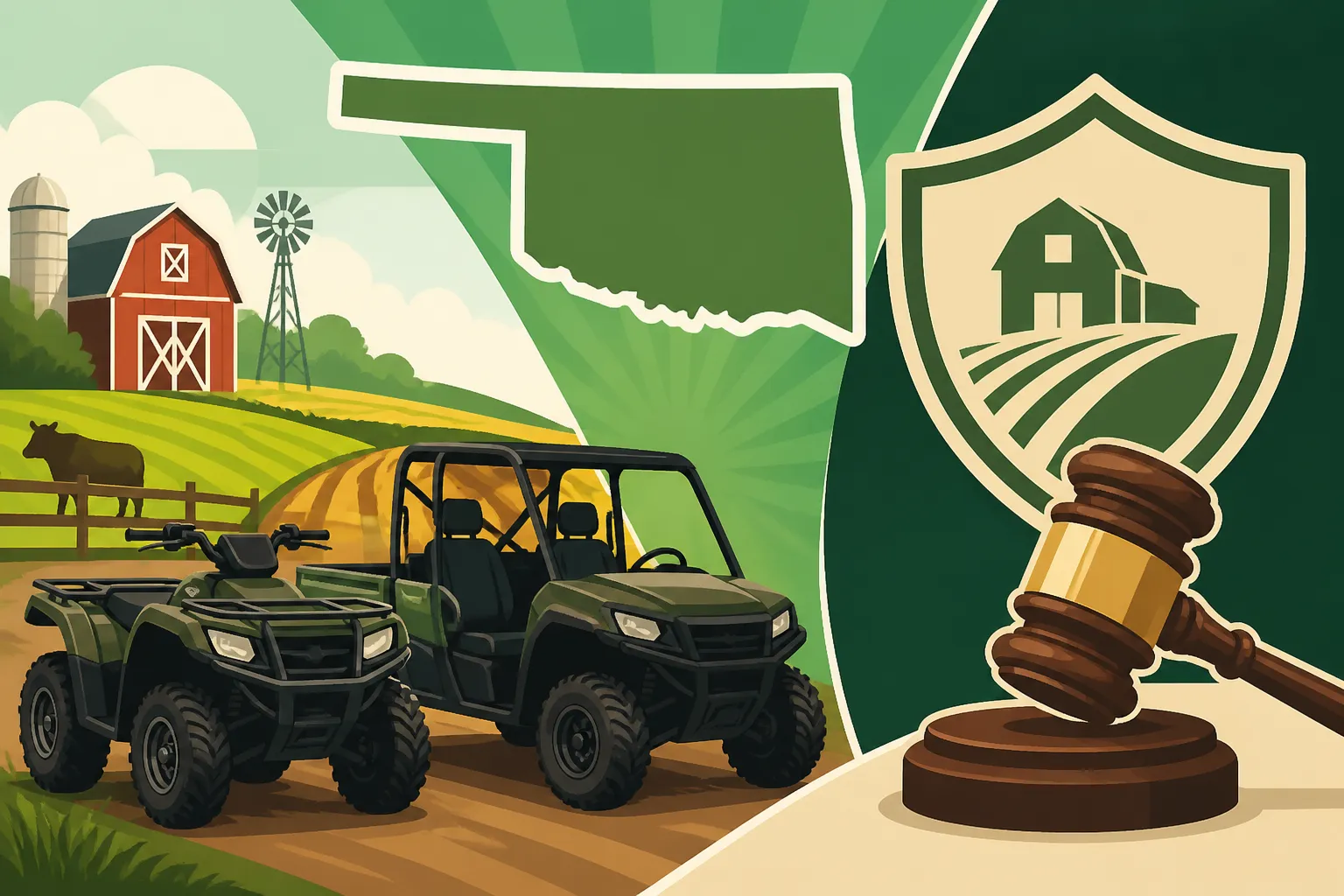
At its core, an "instrument of husbandry" refers to a vehicle or implement that is primarily designed and used for agricultural purposes. Think tractors, combines, hay balers, and—critically for our discussion—ATVs and UTVs that are exclusively dedicated to farm tasks. The key here is "primarily designed and used for agricultural purposes." This isn't about the type of machine so much as its intended and actual use. If your UTV spends its days hauling feed, checking cattle, or spraying fields, it's likely to fall under this definition. If it's used for weekend trail rides with the kids, even if you also have a few chickens, it probably won't.
The statute makes a clear distinction: these machines aren't considered "motor vehicles" in the same way your pickup truck or family sedan is when they are actively engaged in agricultural work. This exemption is all about enabling the flow of commerce and the efficiency of farm operations, recognizing that these machines are tools of the trade, not primarily modes of transportation for the general public. It's a pragmatic approach to rural life, acknowledging the unique needs of the agricultural community.
The Historical Context in Oklahoma Law
Oklahoma's legal framework for "instruments of husbandry" has evolved over time, reflecting the changing landscape of agriculture and the types of machinery used. Historically, this exemption was primarily applied to large farm equipment, like tractors pulling plows or cultivators. As ATVs and UTVs became more robust and integral to modern farm management, the state laws adapted to include these versatile machines within the definition. This evolution wasn't without its growing pains; there was a period of uncertainty as law enforcement and tag agencies grappled with how to categorize these smaller, faster, and more widespread off-road vehicles.
The intent behind these laws has always been to support the agricultural industry by removing unnecessary bureaucratic hurdles for equipment essential to daily farm operations. However, this support is balanced with public safety concerns, especially when farm machinery shares roads with other vehicles. It's not just about what the machine is, but what it does and where it does it. Understanding this historical perspective helps to clarify why the rules are structured the way they are—to facilitate farm work while maintaining a degree of order and safety on public byways.
Key Exemptions Provided
So, what exactly does being classified as an "instrument of husbandry" exempt your ATV or UTV from? Primarily, it exempts you from the standard registration and titling requirements that apply to regular motor vehicles when operating briefly on public roads for farm purposes. This means that if your side-by-side is genuinely used exclusively for agriculture, you generally won't need to get a standard Oklahoma registration or title for it if its only road use is incidental to farm work. This can be a huge relief, saving you the [Oklahoma ATV Registration Cost] and the hassle of annual renewals.
However, it's crucial to understand the limitations. This exemption does not make your farm machine street-legal in the broader sense. It doesn't mean you can drive it to the grocery store or take it on a leisurely drive down the highway. The exemption specifically applies to using the machine for legitimate farm tasks, such as moving from one field to another, taking feed across a county road to another pasture, or performing maintenance on a fence line that borders a public road. It's about necessity, not convenience or recreation. For example, if you're a rancher needing to get from one part of your property to another that's separated by a county road, you might briefly use that road. This is the kind of use the "instrument of husbandry" rule is designed to cover, allowing you to seamlessly continue your work without needing a separate road plate.
What Qualifies as "Farm-Only Use" in Oklahoma?
This is where many riders can get tripped up, and it's essential to be crystal clear. The definition of "farm-only use" isn't just about owning land; it's about the primary function of the machine itself. The law isn't looking for a loophole for recreational riding; it's looking to support bona fide agricultural operations.
Beyond the Barn: Examples of Agricultural Tasks
"Farm-only use" extends far beyond simply being stored in a barn. It encompasses a wide array of activities that are integral to farming, ranching, and other legitimate agricultural endeavors. This could include:
- Hauling feed, hay, or water: Moving supplies from a storage shed to livestock in a pasture, even if that pasture is across a county road.
- Checking fences or irrigation lines: Traversing your property, which might involve brief trips on section lines or county roads to access different sections of your land.
- Spraying or fertilizing crops: Transporting equipment and chemicals to various fields.
- Moving livestock: Herding animals or carrying supplies for animal husbandry.
- Maintaining farm equipment: Transporting tools or parts needed for repairs in the field.
- Harvesting small crops: Using the UTV bed to collect produce or move it to a processing area.
These are all examples of legitimate agricultural tasks where an ATV or UTV acts as an essential tool. The key takeaway is that the machine is directly contributing to the productivity and management of an active farm or ranch operation. It's not about what could be done with the machine, but what it is regularly used for.
The "Primary Purpose" Test
Oklahoma law often employs a "primary purpose" test when determining if a machine qualifies for certain exemptions. For the "instrument of husbandry" rule, this means that the ATV or UTV's overriding and most frequent use must be for agricultural purposes. If you use your UTV for farm work Monday through Friday, but then take it on dedicated recreational trail rides every weekend at a place like Little Sahara State Park, it would be difficult to argue that its primary purpose is solely agricultural.
Consider this hypothetical: you live on 40 acres and raise a few cattle. Your side-by-side is invaluable for checking on them, repairing fences, and occasionally towing a small trailer of firewood for your own use. However, your teenage kids also use it to visit friends on neighboring properties and run errands into the nearest small town. In this scenario, the machine's primary purpose might be blurred, and an officer could argue it's not exclusively for husbandry. It's a gray area that emphasizes the importance of truly limiting the machine's use to agricultural tasks to maintain its exempt status. Many agricultural riders even modify their machines with SuperATV accessories like cargo racks or heavier duty suspension purely for farm utility, further reinforcing their primary purpose.
Machines Kept Primarily on Private Land
Another strong indicator of "farm-only use" is where the machine primarily resides and operates. An ATV or UTV that qualifies as an "instrument of husbandry" should spend the vast majority of its operational life on private property, specifically the farm or ranch land. Its presence on public roads should be infrequent, brief, and directly linked to moving between parts of the agricultural operation.
If your machine is frequently seen driving down public roads for non-agricultural reasons—such as commuting, visiting neighbors, or running into town for groceries—then it raises red flags. The exemption isn't meant to allow an unregistered, untaxed vehicle to function as a general-purpose commuter. The expectation is that the machine is a workhorse, tethered to the property and only venturing onto public thoroughfares when absolutely necessary to continue its agricultural duties. This is a practical distinction that helps law enforcement determine the true intent behind the machine's operation.
Navigating Public Roads: Limitations and Crossings
Even when your ATV or UTV legitimately qualifies as an instrument of husbandry, its use on public roads is highly restricted. This isn't a license to roam; it's a constrained permission to cross or briefly travel for specific agricultural purposes. Breaking these rules is where farm riders often encounter problems.
Brief Crossings vs. Extended Travel
The operative word here is "brief." An "instrument of husbandry" is generally allowed to make brief crossings of public roads, like a county road or a section line, to get from one field or pasture to another. This might involve driving a few hundred feet, or perhaps even a quarter-mile, to reach another part of your property. The key is that the road use is incidental and directly connected to continuing farm work. For example, a farmer might need to cross a paved county road to reach a hay field on the other side. This is typically allowed under the exemption.
However, the exemption does not permit extended travel on public roads. You cannot drive your UTV five miles down a highway to pick up a part, even if that part is for farm equipment. This is where the distinction between a "brief crossing" and "extended travel" becomes critical. The moment your travel becomes more than an incidental crossing necessary for farm work, you risk losing the "instrument of husbandry" exemption and could be cited for operating an unregistered, untitled, or unplated vehicle on a public roadway. It's a fine line, and discretion is often left to the enforcing officer, so it's always best to err on the side of caution. Remember, the intent is work, not travel.
Daylight and Speed Restrictions
When an ATV or UTV is being operated as an "instrument of husbandry" on public roads, even for brief crossings, there are strict rules regarding when and how it can be done. Primarily, such operations are restricted to daylight hours. This is a common-sense safety measure; these machines are not typically equipped with the extensive lighting systems required for safe nighttime operation on public roads, nor are they as visible as other vehicles. [Oklahoma Highway Crossings in Daylight] is a specific rule often applied here.
Furthermore, speed is a significant factor. While the law doesn't always specify an exact MPH, the expectation is that these machines will be operated at a speed consistent with slow-moving farm equipment. This means a pace that does not impede traffic significantly or create a hazard. You're expected to yield to other vehicles and ensure your operation doesn't put anyone at risk. Trying to zip across a road at full throttle in your utility UTV, even if it's fitted with some performance parts from SuperATV for enhanced field work, would likely be seen as a violation of the spirit of the law and potentially the letter of it as well. The idea is to be as safe and unobtrusive as possible when sharing the road. [Oklahoma Crossing Rules at 35 mph] is a good guideline for what types of roads might be permissible for crossing.
County and Municipal Road Exceptions
While the general rule is strict, local jurisdictions in Oklahoma have some leeway. County commissioners, for example, have the authority to open certain county roads to ATV and UTV traffic. This means that in some rural areas, a county might specifically designate certain roads where ATVs and UTVs, including those used for farm purposes, can operate more freely than state highways. However, these are specific local ordinances and do not override the state's "instrument of husbandry" rule. You'd still need to check if your county has such a designation and understand its limitations. [Oklahoma County Commissioners and ATV Roads] details this power.
Similarly, some municipalities might have ordinances that allow ATVs or UTVs on certain city streets. These are typically for specific purposes or in smaller, more rural towns. It's crucial not to assume. Just because you see someone else doing it doesn't mean it's legal or that the "instrument of husbandry" rule applies. Before you take your farm machine onto any public road, whether it's a county road or a town street, always verify the local rules. The burden is on the operator to know and obey the law. [Oklahoma Municipal Ordinances That Open Streets] is a good resource for understanding this.
Distinguishing from Street-Legal UTV Registration
This is perhaps the most critical distinction to grasp. The "instrument of husbandry" exemption is not the same as making your UTV street-legal. These are two entirely separate legal pathways with different requirements, purposes, and implications. Confusing them can lead to significant legal trouble.
Why the "Instrument of Husbandry" Isn't a Road Plate
The core difference is simple: an "instrument of husbandry" is about incidental and limited road use for agricultural work, while a street-legal UTV is designed for general road use, albeit with specific restrictions. If your UTV is an instrument of husbandry, it does not get a standard Oklahoma license plate, nor does it require a regular registration decal. The law makes a specific allowance for its work-related crossings.
A street-legal UTV, on the other hand, does require specific registration through a tag agency, receives a special annual road plate, and must meet a host of equipment requirements to be deemed safe for general road use. [Oklahoma Road Plates for a Street-Legal UTV] are distinct from the general ATV/UTV registration decals. The "instrument of husbandry" rule does not grant you the same privileges or impose the same responsibilities as obtaining a street-legal registration. It's a specific exemption, not a transformation of your machine's legal status for public road use.
Equipment Differences and Requirements
The divergence in purpose also means a major difference in required equipment. An ATV or UTV used purely as an "instrument of husbandry" has no specific state-mandated equipment beyond basic safe operating condition for brief road crossings. You wouldn't typically see turn signals, DOT-approved tires, or extensive reflective marking on such a machine, though for safety on roads, adding some of these voluntarily is always a good idea.
A street-legal UTV, however, must meet a comprehensive list of equipment standards to be issued a road plate. This typically includes:
- Headlights, tail lights, and brake lights
- Turn signals (front and rear)
- Horn
- Rearview mirrors (one on each side)
- DOT-approved tires
- Windshield (often with a wiper)
- Seatbelts for all occupants
- Properly functioning exhaust system with a spark arrester
These are not suggestions; they are mandates for any UTV seeking street-legal status. Many riders turn to aftermarket companies like SuperATV to find the necessary components to convert their UTVs to meet these specific road-legal requirements. If you intend to drive your UTV regularly on public roads, even county roads, you need to invest in these modifications and register it as street-legal. [Oklahoma Equipment Required for Street UTVs] goes into more detail on this.
Cost and Renewal Differences
The financial implications are also vastly different. If your machine truly falls under the "instrument of husbandry" exemption, you avoid the initial [Oklahoma ATV Registration Cost] and the [Oklahoma Excise Tax at Titling] that would typically be applied if you were registering it for recreational or street-legal use. Since it doesn't receive a standard registration, there are no renewal fees either. This is where the cost savings for genuine farm machines really come into play.
For a street-legal UTV, however, you're looking at an initial titling fee, an excise tax based on the purchase price, and an annual renewal fee for the road plate. While the specific figures can change, these are recurring costs. So, while the "instrument of husbandry" rule provides a cost-effective way for farmers to use their machines for essential tasks, it doesn't give you a free pass to drive your UTV like a car. The costs reflect the privileges—or lack thereof—associated with each classification. For instance, [Oklahoma Ag Permit Holders and Excise Tax] provides details about how some agricultural exemptions can save you money on tax at titling, which is a related but distinct benefit for farm users.
Here's a quick comparison of the two concepts:
| Feature | Instrument of Husbandry (Farm-Only Use) | Street-Legal UTV (Road Plate) |
|---|---|---|
| Primary Use | Exclusively for agricultural work on private land | General road use (within limits) |
| Road Use | Brief crossings or incidental travel between farm properties only | Regular travel on approved public roads |
| Registration | No standard registration/decal required | Requires annual registration and special road plate |
| Titling | Often titled, but no registration tied to road use | Requires titling for registration |
| Excise Tax | Generally exempt if primary purpose is agriculture | Subject to Oklahoma's 4.5% excise tax |
| Annual Renewal | No annual renewal fees | Annual renewal fees for the road plate |
| Required Equipment | No specific state-mandated road equipment for the exemption | Extensive equipment (lights, signals, mirrors, horn, DOT tires) |
| Driver's License | Not explicitly required for farm work on private land | Standard driver's license (no M endorsement needed) |
| Insurance | Not legally required for farm use (but recommended) | Liability insurance typically required for registration |
| Applicable Statute | Defined by Oklahoma Statutes related to agriculture and vehicles | Governed by [Oklahoma's Street-Legal UTV Statute] (2021 law) |
Potential Pitfalls and Best Practices for Farm Riders
Navigating the complexities of ATV and UTV use on and off public roads in Oklahoma requires more than just a passing understanding of the rules. It demands a proactive approach to ensure you're always on the right side of the law, especially when relying on the "instrument of husbandry" exemption.
Misinterpreting "Farm Use"
One of the biggest traps riders fall into is a broad interpretation of "farm use." Just because you live in a rural area or have a few acres doesn't automatically mean your ATV or UTV is always an "instrument of husbandry." The key, as we've discussed, is exclusive and primary use for legitimate agricultural tasks. If your machine regularly pulls double duty as a recreational vehicle for trail rides, hunting trips, or running personal errands, then it's highly unlikely to qualify for the exemption.
Consider a scenario where you use your UTV to check on your small herd of goats, but you also take it to the neighbor's house for a social visit a couple of times a week. That social visit, while seemingly innocent, blurs the line of "exclusive agricultural use." An officer who observes this could rightfully question your machine's exempt status. It's vital to be honest with yourself about how the machine is truly being used. If there's any significant non-agricultural use, you should seriously consider getting it properly registered or keeping it strictly on private land.
Documentation and Proof of Use
While there isn't a specific "instrument of husbandry" permit you can apply for, having some documentation can certainly help your case if you're ever stopped while crossing a road. This could include:
- Proof of property ownership or lease: Documents showing you own or operate the farm/ranch.
- Agricultural tax exemptions or permits: Any documentation that identifies you as a legitimate agricultural producer.
- Bills of sale for feed, livestock, or farm equipment: These can help demonstrate ongoing farm operations.
- A written statement: A simple, signed document stating the machine's primary and exclusive use for agricultural purposes on your property.
While none of these are guarantees, they can collectively paint a clear picture for a law enforcement officer that your use of the machine is indeed for husbandry. It shows you've thought about the issue and are acting in good faith. You're trying to prove you're not just using "farm use" as an excuse, but that it's your genuine practice.
Staying Informed About Local Ordinances
Even with the state's "instrument of husbandry" rule, local jurisdictions—counties and municipalities—can have their own specific ordinances that further define or restrict ATV/UTV use on roads. What's perfectly acceptable in one rural county might be a no-go zone in an adjacent one. For instance, while state law allows certain highway crossings, a county might explicitly prohibit ATVs/UTVs on specific county roads, even for farm use, or impose additional safety requirements.
It is absolutely your responsibility as the operator to know the specific rules of the road wherever you're riding. A quick call to your county commissioner's office or the local sheriff's department can often clarify local regulations. Don't rely on hearsay or what your neighbor does. Laws can change, and interpretations can vary. Staying proactive and informed is the best defense against an unexpected citation. The information in [Oklahoma Farm Use on County Roads] is a great starting point, but always double-check with local authorities for the most current and specific rules in your area.
By understanding the nuanced "instrument of husbandry" rule, limiting your road use to strictly agricultural tasks, and staying informed, you can continue to enjoy the immense utility of your ATV or UTV on your Oklahoma farm or ranch without running afoul of the law.
Disclaimer
This article is for general informational purposes only and does not constitute professional advice. Laws, prices and regulations vary by location and change over time. Consult a qualified professional for guidance on your specific situation.