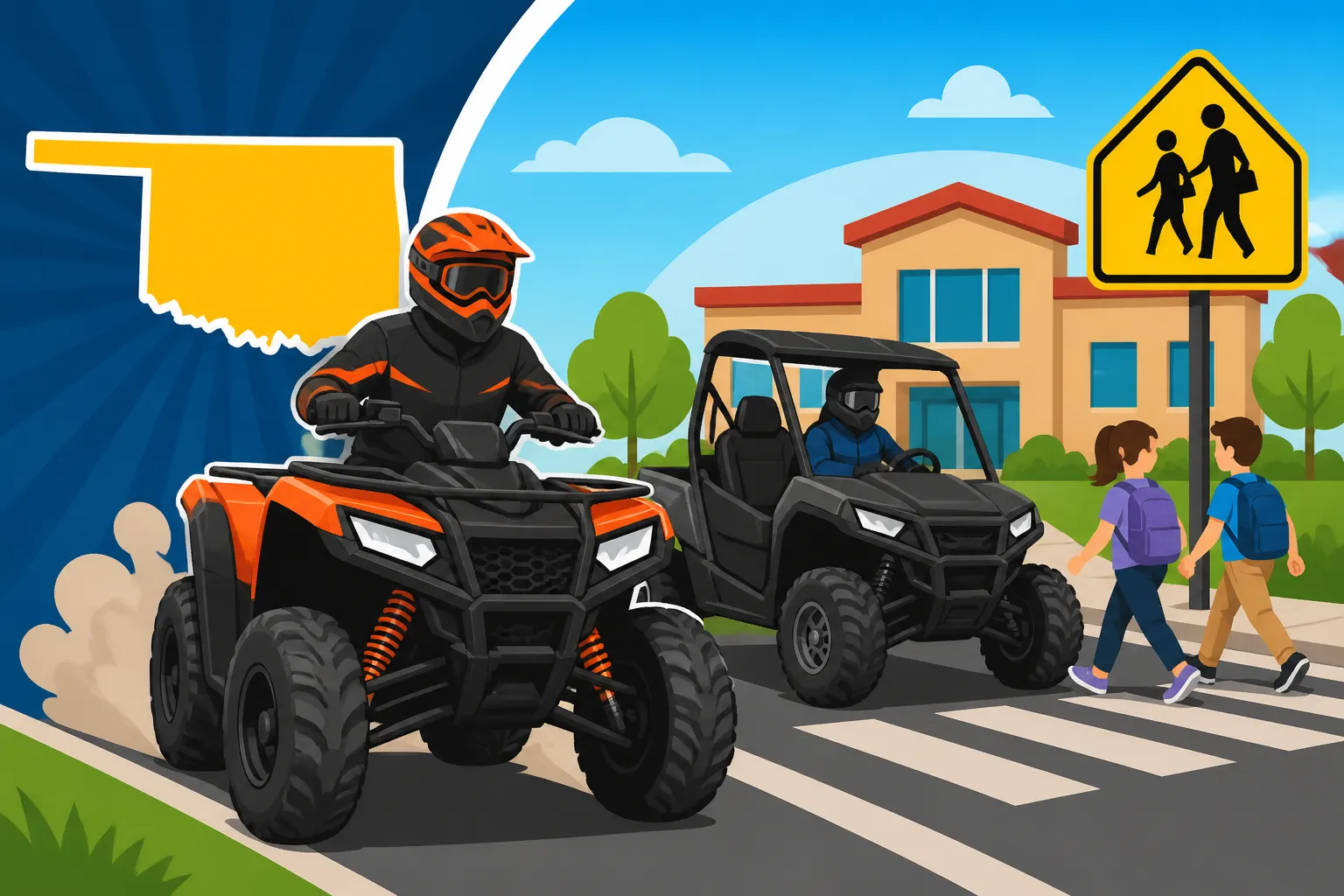
Oklahoma Rules for Riding Near a School
Riding your ATV or UTV in Oklahoma is all about freedom and enjoying the open air, but when those trails or rural roads start leading you closer to populated areas, especially near schools, things get a little tricky. It's easy to assume that because you're on a county road, all rules are the same, but the reality is that school zones bring a whole new layer of considerations, from safety to local ordinances. This guide is here to help you understand exactly what you need to know to ride responsibly and legally when a school is nearby.
The Basics: When ATVs and UTVs Can (and Can't) Be on Oklahoma Roads
Let's be real, Oklahoma's laws about ATVs and UTVs on public roads can feel like a tangled mess. One minute you're zipping along a dirt path, the next you're wondering if that paved county road is fair game. The truth is, the default position for most off-road vehicles in Oklahoma is that they are not designed or legally permitted for general public road use. However, there are significant exceptions, especially for UTVs that meet specific "street-legal" requirements. Understanding this fundamental distinction is your first step to riding responsibly, especially near places with high pedestrian traffic like schools.
Understanding the "Street-Legal" Distinction
For many years, the idea of a "street-legal" ATV or UTV in Oklahoma was pretty much a pipe dream for most riders. Our machines were meant for the trails, the farm, or the hunting lease. But then, things started to shift, and now, certain UTVs can indeed be made street-legal. This isn't just about throwing a license plate on your side-by-side; it's about meeting a specific set of equipment requirements that transform an off-road machine into something that can share the asphalt with cars and trucks. We're talking about things like proper headlamps and tail lamps, brake lights, turn signals, mirrors, and even a horn. If your UTV meets all these requirements, it can be registered with a special road plate, distinguishing it from purely off-road machines. Without this designation and the appropriate equipment, your UTV (and certainly your ATV) is generally restricted from public roads. If you're wondering what it takes, you'll want to dive into [Oklahoma Street-Legal UTV Requirements].
General Restrictions on Off-Road Vehicles
Even with the option for street-legal UTVs, it's crucial to remember that ATVs (quads) generally do not have a path to become street-legal in Oklahoma. They are, by design and law, off-road vehicles. This means that if you're on a traditional ATV, you should assume that public roads are off-limits, with very few exceptions, such as crossing a highway at a specific speed and under certain conditions. For both ATVs and non-street-legal UTVs, traveling on public roads is typically reserved for agricultural purposes, such as moving from one field to another, and even then, there are rules about speed, daylight hours, and how far you can travel. Trying to use an unregistered or non-street-legal machine on a public road, especially near a school, can quickly lead to a citation and potentially heavier fines. The simple rule is: if it's not explicitly street-legal and properly tagged, stick to private property or designated off-road trails. You might find it helpful to review [Can You Drive a UTV on the Road in Oklahoma?] for a broader understanding of these restrictions.
Specific Considerations for Riding Near Schools
When you're out riding, whether it's on a designated trail or a quiet county road, the presence of a school throws a whole new set of responsibilities into the mix. It's not just about what's legally allowed; it's about community safety, noise, and being a good neighbor. School zones are places where children, parents, and school staff are often on foot, making them high-risk areas for any vehicle, let alone an off-road machine.
Safety Zones and Increased Pedestrian Traffic
Schools, by their very nature, are magnets for pedestrian traffic. Before and after school, during lunch breaks, or for school events, sidewalks and crosswalks are bustling with activity. Children, especially, can be unpredictable; they might dart out from behind parked cars, get distracted by friends, or not pay full attention to traffic. This creates a much higher risk environment than a typical rural road. Even if your UTV is street-legal and you're technically allowed to be on that road, you need to exercise extreme caution and drastically reduce your speed. Many areas have reduced speed limits specifically for school zones, often with higher fines for violations. Being aware of the time of day and anticipating children in the area is paramount. A responsible rider understands that even a legally compliant action can be dangerous if not executed with the utmost care in these sensitive zones. Understanding general road rules, like those discussed in [Oklahoma Rules for Riding a County Road], is a starting point, but schools require an extra layer of vigilance.
Noise Ordinances and Community Concerns
Let's face it, ATVs and UTVs aren't always the quietest machines. The rumble of an exhaust or the whine of an engine can be part of the thrill when you're out in the wilderness, but in a residential area, especially near a school, that same noise can be a major disturbance. Many communities have noise ordinances designed to keep peace and quiet, and these are often more strictly enforced around schools and neighborhoods. Blasting through a school zone, even at a safe speed, with a loud exhaust could easily draw unwanted attention from residents, school staff, or law enforcement. This isn't just about getting a ticket for a noise violation; it's about being respectful of the community. People often have strong feelings about off-road vehicles in their neighborhoods, and riding noisily near a school can quickly turn public opinion against riders, potentially leading to stricter local bans or increased enforcement. It's a perception issue as much as a legal one.
Equipping Your Machine for Road Use and Visibility
If you plan to use your UTV on public roads at all, even for short stretches near a school, proper equipment isn't just a suggestion—it's a legal requirement and a critical safety measure. This isn't about making your machine look cool; it's about making it visible and controllable enough to share the road safely with other vehicles and pedestrians.
Essential Street-Legal Gear
To make your UTV street-legal in Oklahoma, there's a specific list of equipment you absolutely must have. This includes proper headlights, taillights, brake lights, and turn signals for both the front and rear. You'll also need at least one rearview mirror (though many riders opt for two for better visibility) and a horn. Think about it: these are the basic safety features that cars and trucks have, and they're essential for communicating your intentions to other drivers and warning pedestrians. Imagine trying to make a turn without a signal, or backing up without a clear view behind you—it's a recipe for disaster. Many manufacturers and aftermarket companies, like SuperATV, offer complete street-legal kits that include all the necessary components, making the conversion process much simpler. For more details on what's required, check out [Oklahoma Equipment Required for Street UTVs].
Here's a quick reference for key street-legal equipment:
| Equipment Type | Requirement | Purpose |
|---|---|---|
| Headlights | Required (white, forward-facing) | Illuminates the road ahead, makes machine visible to oncoming traffic |
| Taillights | Required (red, rear-facing) | Makes machine visible from behind |
| Brake Lights | Required (red, illuminates when brakes applied) | Signals braking to following traffic |
| Turn Signals | Required (front and rear, amber or white/red) | Communicates turning or lane change intentions |
| Rearview Mirror | Required (at least one, driver's side or center) | Allows driver to see traffic behind and to the sides |
| Horn | Required (audible from 200 feet) | Warns pedestrians or other vehicles of presence or danger |
| Windshield | Required for UTVs that will exceed 25 mph on roads (safety glass) | Protects occupants from debris and elements |
| Seatbelts/Restraints | Required (for all occupants, properly used) | Keeps occupants secure in case of sudden stops or collisions |
Enhancing Visibility for Shared Roads
Beyond the legally required equipment, there are smart choices you can make to enhance your visibility even further, especially in areas like school zones where awareness is key. Brightly colored machines or adding reflective tape can make a big difference, particularly during dawn, dusk, or overcast conditions. Auxiliary lighting, beyond your standard headlights, can also help you stand out. Consider LED light bars or additional marker lights. While not always legally mandated for street-legal status, these additions significantly increase your presence on the road. Remember, the smaller profile of an ATV or UTV compared to a car means you're inherently less visible, so anything you can do to make yourself more noticeable is a win for safety. Products like robust mirrors from SuperATV can also vastly improve your situational awareness, allowing you to see children or cars approaching from various angles. Always ask yourself: "Can other drivers and pedestrians clearly see me coming?"
Navigating Local Ordinances and School Zones
Oklahoma's state laws provide a framework for ATV and UTV use, but when it comes to riding on specific roads, particularly within city or town limits, local ordinances often take precedence. This can be a real headache for riders, as rules can change from one municipality to the next, sometimes just a few miles down the road.
How Cities and Counties Regulate ATV/UTV Use
While the state has general rules for street-legal UTVs and off-road vehicles, many cities and counties have their own specific ordinances that either open or close certain roads to ATVs and UTVs, regardless of their street-legal status. Some towns might allow street-legal UTVs on all city streets with a speed limit below a certain threshold, while others might ban them entirely from all public roads, or only permit them for specific purposes like parades or municipal work. School zones within these municipalities often come with additional restrictions, such as stricter enforcement of speed limits, noise ordinances, or even outright prohibitions on off-road vehicles during school hours. It's a complex patchwork, and what's okay in one town might get you a ticket in another. The best advice is to never assume. If you're looking for more general info on this, check out [Oklahoma Municipal Ordinances That Open Streets].
When In Doubt, Check With Local Authorities
Because local rules vary so much, the absolute best course of action before riding your ATV or UTV anywhere near a school, or even on public roads within a town, is to check directly with the local city hall or police department. A quick phone call or a visit to their website can save you a lot of grief, time, and money in potential fines. Don't rely on what you heard from a buddy or what applied in the next county over. Laws can change, and enforcement can vary. It's also wise to pay attention to signage. School zones are almost always clearly marked with signs indicating reduced speed limits, increased fines, and sometimes specific hours of operation for these restrictions. Ignorance of local law is never a valid defense, and the last thing any rider wants is to receive a [Oklahoma Ticket Costs for Road Riding] near a school. Being proactive and informed is the mark of a responsible rider and will help ensure your time on your ATV or UTV remains enjoyable and hassle-free.
Disclaimer
This article is for general informational purposes only and does not constitute professional advice. Laws, prices and regulations vary by location and change over time. Consult a qualified professional for guidance on your specific situation.