Oklahoma Daylight Crossing Rules
It can feel incredibly frustrating trying to navigate the complex world of Oklahoma's off-road vehicle laws, especially when you just want to get your quad or side-by-side from one riding spot to another without breaking any rules. The question of whether you can even cross a public road, let alone when you can do it, often leaves riders scratching their heads and fearing a run-in with law enforcement. This guide is here to untangle the specifics of Oklahoma's daylight crossing rules, so you can ride with confidence and keep your machine legal.
Understanding Oklahoma's Off-Road Vehicle Statutes
Oklahoma, like many states, has a distinct set of rules governing how off-road vehicles like ATVs (All-Terrain Vehicles) and UTVs (Utility Terrain Vehicles, often called side-by-sides) interact with public roads. It's not as simple as "you can't ever be on a road," nor is it a free-for-all. The state aims to balance the recreational and utility needs of riders with public safety on paved and unpaved roads shared with other vehicles. Understanding these foundational statutes is key to interpreting the more specific rules about crossing.
The General Prohibition on Road Use
At its core, Oklahoma law generally prohibits the operation of off-road vehicles on public streets and highways. This is the starting point for all other discussions. Your ATV or UTV isn't designed, equipped, or insured for typical road use, unlike cars, trucks, or motorcycles. The tires are often aggressive for traction in dirt and mud, not smooth pavement. The suspension is built for bumps, not high-speed cornering. This general prohibition means you can't just hop on a highway and cruise down to the gas station or a buddy's house. It's a common misconception that if a road is rarely traveled, it's fair game. That's simply not true under state law.
This prohibition extends to almost all public roadways, from busy interstates down to sparsely traveled county roads. The reasoning is primarily safety-focused: off-road vehicles handle differently, are less visible to other motorists, and lack many of the safety features found on street-legal vehicles. This is why you'll see specific exceptions carved out rather than a blanket permission. Riders often lament this, feeling their machines are perfectly capable of handling a short stretch of road, but the law looks at the broader safety implications for all road users.
The Importance of Statutory Exceptions
While the general rule is "no road use," there are crucial exceptions that allow ATVs and UTVs to legally interact with public thoroughfares. These exceptions are not loopholes; they are specifically written into law to accommodate necessary actions, such as moving from one section of private land to another, engaging in agricultural work, or, pertinent to this article, crossing a road. It’s these exceptions that provide the framework for when and how you can legally operate your machine near or on a public road.
These exceptions are often very precise, outlining conditions like time of day, speed limits, specific types of roads, and even the purpose of the travel. For instance, an ATV used as an "instrument of husbandry" on a farm might have different allowances than a recreational UTV heading to a trail. [Oklahoma's Instrument of Husbandry Exception] is a perfect example of a specific carve-out designed for agricultural operations. Riders often get into trouble when they assume an exception applies broadly when it's actually quite narrow. Always check the specific wording of the statute or local ordinance before assuming your activity is covered.
Differentiating ATVs and Street-Legal UTVs
It's vital to understand that the rules for a standard ATV or UTV are different from those for a street-legal UTV. Oklahoma has a specific classification and registration process for UTVs that meet certain equipment requirements, allowing them to be legally driven on many public roads. This is a game-changer for UTV owners, but it does not apply to ATVs, nor does it mean all UTVs are street-legal. Your typical quad or side-by-side bought for trail riding is not street-legal by default.
A street-legal UTV goes through a distinct registration process and receives a regular license plate, just like a car. [Oklahoma Street-Legal UTV Requirements] are extensive, including things like turn signals, mirrors, horns, and proper lighting. If your machine doesn't have a regular license plate issued after meeting these requirements, it's considered an off-road vehicle subject to the general prohibitions and exceptions we're discussing. Confusing the two can lead to significant fines and legal issues, as the expectations for a street-legal UTV are much higher than for a standard off-road machine only allowed to cross a road.
Deciphering the "Daylight Only" Crossing Rule
One of the most critical and often misunderstood aspects of Oklahoma's off-road vehicle laws regarding road interaction is the "daylight only" provision for crossings. This isn't just a suggestion; it's a hard and fast rule designed to enhance safety for everyone on the road. Ignoring it can put you and others at serious risk and will definitely attract the attention of law enforcement.
What "Daylight Only" Truly Means for Riders
When the law states "daylight only," it means exactly that: you can only cross a public road during the hours of natural light. This isn't about when you personally feel it's bright enough, or when the streetlights come on. It refers to the period between official sunrise and official sunset. You can’t legally cross a highway an hour before sunrise, even if the sky is getting light, nor can you cross an hour after sunset, even if there’s still a glow in the west. This strict definition removes ambiguity, ensuring that crossings occur when visibility is at its peak.
For riders, this means checking the local sunrise and sunset times, especially if you're out riding at dawn or dusk. It's easy to lose track of time when you're having fun on the trails or wrapping up farm work. Imagine you're out near the Three Rivers Wildlife Management Area, enjoying a late afternoon ride, and you need to cross a county road to get back to your truck. If you misjudge the sunset, even by a few minutes, you're in violation. This rule is absolute, regardless of whether your machine has working headlights.
Why This Rule Exists: Safety First
The "daylight only" rule is fundamentally about safety, both for the off-road vehicle operator and for other motorists. ATVs and UTVs, especially standard ones without all the street-legal modifications, are significantly less visible than typical cars or trucks. They are smaller, often lack bright reflective surfaces, and may not have robust lighting systems designed for road use. At night, or even in twilight conditions, they can be incredibly difficult for drivers of larger vehicles to spot, especially on rural roads with limited street lighting.
Consider a scenario where a pickup truck is traveling at 55 mph down a county road at dusk. An ATV, even with its headlights on, can blend into the background, making it hard for the truck driver to judge its speed or distance before a crossing. [Oklahoma Highway Crossings in Daylight] specifically addresses this danger. The risk of a collision increases exponentially in low-light conditions. By restricting crossings to daylight hours, the state significantly reduces the chance of accidents that could result in serious injury or even fatalities for everyone involved.
Practical Application: When Does Daylight Begin and End?
So, how do you practically apply the "daylight only" rule? It's not about guessing. "Daylight" is generally defined as the period from 30 minutes before sunrise to 30 minutes after sunset. However, for maximum safety and legal compliance, it's best to stick to the actual sunrise and sunset times. You can easily find these times for your specific location using a quick search on your phone or by checking a local weather app.
For example, if you're riding near Little Sahara State Park, and sunset is officially at 7:30 PM, you absolutely must complete any road crossings before that time. Planning your route and timing your return to avoid being near a road intersection after sunset is crucial. This might mean leaving the dunes a little earlier than you'd like, or finding an alternative path that avoids public road crossings altogether if you plan to ride late. It's a simple check that can prevent a lot of headaches, tickets, or worse.
Specifics of Approved Highway Crossings
Just being in daylight isn't the only requirement for legally crossing a public road in Oklahoma. There are other very specific conditions that must be met to ensure the crossing is done as safely and efficiently as possible. These details are often overlooked, but they are just as important as the time of day.
Speed Limits and Crossing Restrictions
When you are permitted to cross a public road, it's not a green light to zoom across. Oklahoma law often stipulates that such crossings must be done at an angle of approximately 90 degrees to the roadway and as quickly and safely as possible. More importantly, there are often speed restrictions on the road you are crossing. The general rule allows crossings on roads with a posted speed limit of 35 miles per hour or less. [Oklahoma Crossing Rules at 35 mph] is a critical point to remember. This means you cannot cross state highways or federal routes that typically have higher speed limits, even if it's daylight and you're in a hurry.
This restriction is another layer of safety. On roads with lower speed limits, other vehicles have more time to react to an off-road vehicle crossing. Crossing a 55 mph highway is incredibly dangerous, as a vehicle traveling at that speed covers a great deal of distance very quickly, leaving little margin for error. If your riding area requires you to cross a road with a speed limit higher than 35 mph, you'll need to find an alternative route, trailer your machine, or simply avoid that area altogether. Trying to "make a dash for it" across a fast road is not only illegal but extremely hazardous.
Railway Crossings: A Unique Consideration
While highway crossings have their own set of rules, railway crossings introduce an entirely different layer of safety and legality. For most off-road vehicles, crossing railway tracks is generally prohibited unless it's at a designated public railroad crossing. Even then, the same "daylight only" rule applies. [Oklahoma Railway Crossings in Daylight] are permitted, but caution is paramount. Railway tracks are private property for the most part, and trespassing on them, even to cross, can lead to serious legal consequences and extreme danger.
Furthermore, railroad crossings themselves present unique hazards for ATVs and UTVs. The tracks can be uneven, the gravel loose, and the space between the rails and pavement can catch tires, leading to a loss of control. Always approach any railway crossing with extreme caution, look both ways (even if crossing is permitted), and cross perpendicular to the tracks to minimize the risk of getting a tire stuck. Never assume that because you can cross a road, you can cross adjacent railway tracks.
What Happens If You Cross After Dark?
If you decide to cross a public road after legal daylight hours, you are breaking the law. The consequences can range from a citation and fine to a more severe penalty if an accident occurs. A state trooper or county deputy catching you crossing a road after sunset won't simply give you a warning about your headlights. They will likely issue a ticket for illegal operation of an off-road vehicle on a public roadway. [Oklahoma Penalties Capped at $25] for ATV violations might seem small, but the court costs and potential insurance ramifications can add up.
Beyond the legal trouble, the biggest risk is an accident. Imagine crossing a dark, unlit county road at night. Even with your machine's lights on, your profile is small, and your visibility to other drivers is significantly reduced. If another vehicle, traveling at speed, doesn't see you, the results could be catastrophic. It's simply not worth the risk to save a few minutes or to push the limits of riding into the twilight hours when an approved crossing is necessary. Always err on the side of caution and safety.
Equipment Requirements for Crossing Roads
While the "daylight only" rule addresses when you can cross, there are also considerations for what your machine needs to have, even for a brief crossing. These aren't necessarily full street-legal requirements, but rather basic safety measures to ensure your machine is as visible as possible during its short stint on a public right-of-way.
Visibility Essentials for Safe Crossing
Even though you're crossing in daylight, making your machine as visible as possible is paramount. This means having properly functioning headlights and taillights, even if it's broad daylight. While they might not be crucial for your visibility of the road ahead during the day, they significantly increase your visibility to others. A bright headlight and a red taillight can catch the eye of an approaching motorist much more effectively than an unlit machine.
Consider adding reflective tape or brightly colored accents to your ATV or UTV, especially if your machine is a darker color. Think about the high-visibility vests utility workers wear – that same principle applies to your off-road machine when it interacts with public roads. Some riders even add a bright flag, like those required at Little Sahara, even for simple road crossings elsewhere, just to be extra cautious. While not legally mandated for a simple crossing, these additions are smart safety choices. You can find robust lighting upgrades and reflective kits from brands like SuperATV that could enhance your machine's visibility.
Lighting Beyond Crossings: The Bigger Picture
It’s important to clarify that simply having working headlights and taillights on your ATV or UTV does not make it legal to ride on roads at night, or even after sunset. The "daylight only" rule still applies to crossings. The lights are there to augment visibility during the permitted daylight crossing, not to enable nighttime road use.
If you have a street-legal UTV, then your lighting requirements are much more extensive, including [Oklahoma Turn Signals and Mirrors], and often more powerful headlights and DOT-approved tires. But for a standard ATV or off-road UTV, even the best aftermarket lights won't grant you permission to operate on a public road outside of the specific, limited, and daylight-only crossing exception. Knowing the difference here can save you a lot of trouble.
Helmets and Passenger Rules During Crossings
Safety equipment for riders also comes into play when crossing roads. In Oklahoma, [Oklahoma Helmet Law for Riders Under 18] is clear: anyone under the age of 18 operating or riding as a passenger on an ATV or UTV on public lands, or in this case, crossing a public roadway, must wear a helmet that meets federal safety standards. Even if you're crossing a quiet county road, this rule applies.
For adult riders (18 and over), while a helmet isn't legally mandated for off-road use, it is always a wise choice, especially when interacting with public roads. The risk of serious head injury in a collision is very real. As for passengers, your machine must be designed to carry more than one person, and the passenger must be seated properly. [Oklahoma Passenger Rules on a Quad] are strict: quads are generally designed for one rider, and carrying a passenger can dangerously shift the machine's balance, making it even riskier during a road crossing. Side-by-sides, designed with multiple seats and seatbelts, are generally safer for carrying passengers, but all occupants should still be properly secured.
Distinguishing Crossing from Riding on a Road
This is where many riders get confused and can inadvertently break the law. There's a critical difference in Oklahoma statutes between crossing a road and riding on a road. One is generally allowed under specific conditions; the other is largely prohibited. Understanding this distinction is vital to staying legal.
The Fine Line Between Passing Through and Traveling On
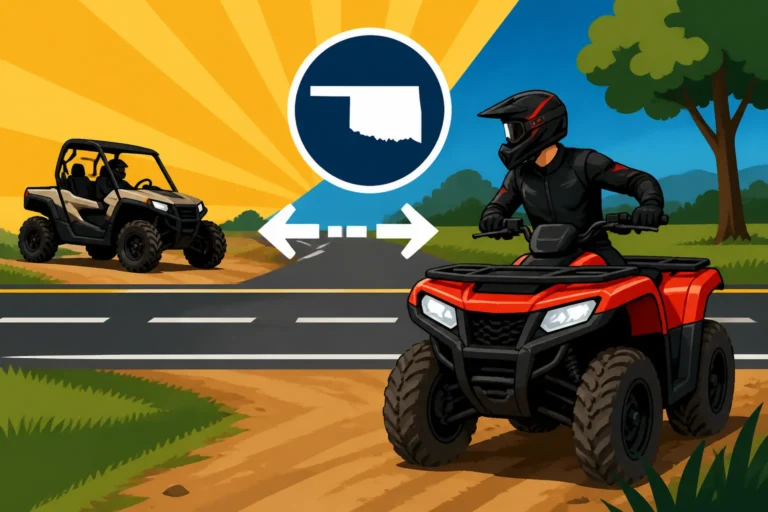
Crossing a road means you are moving from one side of a road to the other, perpendicularly, and as directly as possible, with the clear intention of continuing your journey off-road immediately upon reaching the other side. It is a brief, transient action. Traveling on a road, however, means operating your ATV or UTV parallel to the roadway, even for a short distance, with the intent of using the road as a path for travel. This is generally prohibited for standard off-road vehicles.
Think of it this way: if you're on a trail and a county road intersects it, you can cross the road to pick up the trail on the other side. That's a crossing. But if you get to the road and then turn left or right and ride along it for a quarter mile to get to the next section of trail, that's traveling on the road, and it's illegal for a non-street-legal machine. This is a crucial distinction that law enforcement understands well. Even if it's only a hundred feet, riding down the shoulder is usually not considered a "crossing."
Instruments of Husbandry and Farm Use Exemptions
There's a significant exception to the "no riding on roads" rule for vehicles used as "instruments of husbandry" or for legitimate agricultural purposes. If you're a farmer or rancher using your ATV or UTV for work, such as checking fences, herding cattle, or transporting feed across properties, you might have more leeway to operate on certain public roads, like county roads, for limited distances. [Oklahoma Farm Use on County Roads] provides some details on this.
However, this exemption is not a blanket permission slip. It applies specifically to machines actively being used for farming or ranching operations, typically on roads adjacent to or connecting agricultural properties. It does not extend to recreational riding, even if you own a farm. You can't claim "farm use" if you're just out joyriding your UTV. It's also important to remember that even with this exemption, safety and visibility rules still apply, and you should use extreme caution when sharing roads with other vehicles.
Local Ordinances and Open Roads
Another layer of complexity comes from local ordinances. While state law sets the general rules, individual counties or municipalities in Oklahoma have the authority to pass their own ordinances that can open certain roads or streets to ATV and UTV use, or restrict them further. [Oklahoma County Commissioners and ATV Roads] highlights this local control. This means that what's legal in one county or town might not be in another.
Before planning a ride that involves any road use or crossing, especially if you intend to travel any distance on a road, it's highly advisable to check with the local county sheriff's office or city hall for any specific ordinances. Some towns, particularly those near popular riding areas, might have designated routes or specific times when off-road vehicles are allowed on certain streets to access services or trails. Relying solely on state law without checking local rules can lead to an unexpected ticket.
Consequences of Violating Crossing Rules
Nobody wants a ticket or, worse, an accident. Understanding the potential consequences of violating Oklahoma's ATV and UTV road crossing rules can serve as a strong motivator to always follow the law and prioritize safety.
Penalties and Fines for Non-Compliance
If you're caught violating the daylight crossing rules, or any other rule related to off-road vehicle operation on public roads, you can expect a citation. As mentioned, [Oklahoma's Fine Cap for ATV Violations] is often $25, but this doesn't include court costs, which can easily double or triple the amount you pay out of pocket. A $25 fine can quickly become a $100+ bill. More importantly, getting a ticket goes on your record, and repeated violations could lead to more serious repercussions.
Beyond the initial fine, there might be other headaches. You could be delayed, your machine could potentially be impounded in extreme cases, and you might have to appear in court. It's an inconvenience and an expense that is easily avoidable by simply adhering to the rules. Law enforcement officers, including state troopers, county deputies, and even [Oklahoma Park Rangers as Enforcers] if you're near a state park, are well aware of these regulations and will enforce them to ensure public safety.
Potential for Accidents and Liability
The most severe consequence, by far, is the potential for an accident. Operating an off-road vehicle illegally on a public road, especially at night or on a high-speed highway, dramatically increases the risk of a collision with another vehicle. In such an event, the personal injuries could be devastating, not just for you but for anyone else involved.
Furthermore, if you are found to be operating your ATV or UTV illegally when an accident occurs, your liability could be substantial. Your standard off-road vehicle insurance might not cover incidents that happen during illegal road use, leaving you personally responsible for damages, medical bills, and legal fees. This financial burden can be astronomical. It's a sobering thought, but one that underscores the absolute necessity of respecting the "daylight only" and other crossing regulations.
What to Do If You Get Pulled Over
If, despite your best efforts, you find yourself pulled over by law enforcement while crossing a road or for any other road-related ATV/UTV infraction, remain calm and cooperative. Turn off your engine, remove your helmet (if you're wearing one), and keep your hands visible. Present your identification, and if asked, your [Oklahoma ATV Registration You Pay Once] and proof of ownership.
Explain your situation calmly and truthfully. While cooperation doesn't guarantee you won't get a ticket, it can often lead to a more favorable outcome than being argumentative or resistant. Remember, officers are primarily concerned with safety. Understanding the rules and making an effort to follow them, even if you made an honest mistake, can sometimes influence their decision.
Navigating Different Types of Roads
Oklahoma is a diverse state with many types of roads, from busy urban arteries to dusty, unnamed section lines. The rules for ATV and UTV interaction can vary slightly depending on the specific type of road you encounter.
County Roads and Section Lines
County roads and section lines are often the most common types of public roadways off-road riders encounter. These are typically unpaved or lightly paved roads that traverse rural areas, connecting farms, ranches, and remote properties. Many off-road trails and riding areas are accessed via these roads. For these types of roads, the "daylight only" crossing rule, along with the 35 mph speed limit restriction, generally applies.
However, it's also on these county roads that you might find local ordinances allowing for limited ATV/UTV travel, particularly if local county commissioners have voted to open specific stretches. It's a patchwork, so don't assume. Always check with the county sheriff's office for the specific area you plan to ride. Even if a road looks like a private drive, if it's maintained by the county, it's likely a public road subject to these rules. Being aware of the local rules on these less-trafficked roads is especially important, as they often form the backbone of access for many riding areas.
Municipal Streets and Designated Routes
City and town streets fall under municipal jurisdiction, meaning city councils can pass ordinances that differ from county or state laws regarding off-road vehicles. Generally, ATVs and UTVs are prohibited from municipal streets. However, in certain towns, especially those that cater to off-road enthusiasts (like Waynoka near Little Sahara), you might find specific ordinances that allow street-legal UTVs or even standard off-road vehicles on certain designated routes during specific hours to access gas stations, restaurants, or nearby trails.
These municipal ordinances are usually very specific, outlining which streets, what times, and what types of vehicles are allowed. You won't find this level of detail in state law, so a quick call or visit to the city clerk's office can save you a lot of trouble. Never assume that because a town is "off-road friendly" that all its streets are open to your quad or side-by-side. Always look for signage or verify the rules beforehand.
Private Roads and Easements
Private roads, such as those on private property, within a private ranch, or leading to an oil and gas lease, are generally not subject to the same public road crossing rules. However, this comes with a crucial caveat: you must have explicit permission from the landowner to be on that private road. [Getting Written Permission Before Riding Private Land] is always the best practice. Without permission, you are trespassing, regardless of whether you're riding or crossing.
Easements, which grant a right to use another's land for a specific purpose (like access to a public utility or landlocked property), can be tricky. While you might have a legal right to cross an easement, it doesn't automatically mean you can operate an off-road vehicle on it, especially if the easement is over private land. When in doubt about private roads or easements, always secure permission or seek legal clarification. Even on private land, common-sense safety and courtesy are paramount, particularly if other users share the easement.
Planning Your Ride with Crossing Rules in Mind
Successful and legal off-road riding in Oklahoma isn't just about hitting the trails; it's about smart planning that includes how you'll interact with public roads. A little forethought can make a huge difference in avoiding issues.
Pre-Ride Checks and Route Planning
Before you even load up your machine, take a few minutes to plan your route. Identify any public roads you'll need to cross. Note their speed limits. If any are above 35 mph, you know you'll need an alternative plan, like trailering your machine over that section. Factor in sunrise and sunset times for your riding day. If you plan a long day, consider where you might be at dusk and adjust your return path accordingly to avoid late crossings.
A good route plan also includes checking for local ordinances. A quick online search for "ATV UTV ordinances [county name]" or "[city name]" can often reveal pertinent information. Consider equipping your machine with enhanced visibility items, such as a brighter whip flag or additional reflective markers. SuperATV offers a range of accessories, including mirrors and light bars, that can boost your machine's visibility, making those daylight crossings even safer. These pre-ride checks are not just about legality; they're about ensuring a safe and stress-free adventure.
Emergency Preparedness for Road Intersections
Even with the best planning, emergencies can happen. What if your machine breaks down right before or after a road crossing? What if you get lost and end up on a road you didn't intend to cross? Being prepared for these scenarios is part of responsible riding. Always carry a basic tool kit, a fully charged cell phone (though service can be spotty in rural Oklahoma), and let someone know your planned route and expected return time.
If your machine breaks down near a road, get it off the roadway and out of the right-of-way immediately, even if it means pushing it into a ditch or onto private property (if safe and you have permission). Make it as visible as possible. If you must summon help, be prepared to describe your exact location accurately. Emergency services might not be as familiar with rural trail names, so referencing nearby road names or cross streets is helpful.
Staying Informed About Rule Changes
Laws and regulations, even those concerning off-road vehicles, are not static. They can change over time. [A Rule Amended in 2023] or a new bill introduced in the legislature could alter what's currently legal. County commissioners might vote to open new roads or close existing ones. What was allowed last year might not be this year.
It's a good practice for serious riders to periodically check the Oklahoma Statutes (Title 47, specifically) or consult with your local tag agency or sheriff's office for updates. Following reputable Oklahoma ATV/UTV riding groups or forums can also help you stay abreast of changes. Being informed means you can adapt your riding habits and continue to enjoy Oklahoma's vast outdoor spaces legally and safely for years to come.
Here's a quick summary table of key daylight crossing rules:
| Rule Aspect | Standard ATV/UTV (Non-Street Legal) | Street-Legal UTV (With Plate) | Notes |
|---|---|---|---|
| Time of Day | Daylight only (Sunrise to Sunset) | Generally anytime (with proper lighting) | Crucial for non-street legal machines. Strict adherence to official sunrise/sunset times is essential. Street-legal UTVs must meet specific lighting requirements for night operation. |
| Road Speed Limit | 35 mph or less | No specific limit (operates like a car) | Limits where non-street legal machines can cross. Street-legal UTVs still have speed restrictions (e.g., usually prohibited on interstates and US highways even if local roads are open). |
| Crossing Angle | Approximately 90 degrees | Not specified (operates like a car) | For non-street legal machines, cross directly and quickly. Street-legal UTVs merge and drive as any other vehicle. |
| Purpose | To access another off-road area | General transport | Non-street legal machines cannot "travel on" the road. Street-legal UTVs can use roads for general travel where allowed by local ordinances and state statutes. |
| Required Equipment | Headlights/Taillights (functional) | Full street-legal equipment | Non-street legal machines need basic functional lights. Street-legal UTVs require DOT tires, turn signals, horn, mirrors, seatbelts, etc., and must be titled and registered with a plate. |
| Helmets (Under 18) | Required | Required (same as ATV) | Applies to both ATV/UTV types. |
| Local Ordinances | Can open specific roads | Can open specific roads | Check with county/city for specific rules. Local ordinances often dictate where ATVs/UTVs can operate beyond state law. |
| Railway Crossings | Designated public crossings only | Designated public crossings only | Both must use designated public crossings; extreme caution advised. |
Disclaimer
This article is for general informational purposes only and does not constitute professional advice. Laws, prices and regulations vary by location and change over time. Consult a qualified professional for guidance on your specific situation.