Late Registration Costs a Dollar for Every Day
It's incredibly frustrating, isn't it, when you finally get around to taking care of your ATV or UTV registration in Oklahoma, only to realize you've missed the deadline and now face extra fees? That sinking feeling when you know it's going to cost you more than it should is something many of us have experienced. This guide is here to walk you through exactly how late registration penalties work in Oklahoma, how quickly those costs add up, and, most importantly, how you can avoid them in the future.
Understanding Oklahoma's 30-Day Registration Deadline
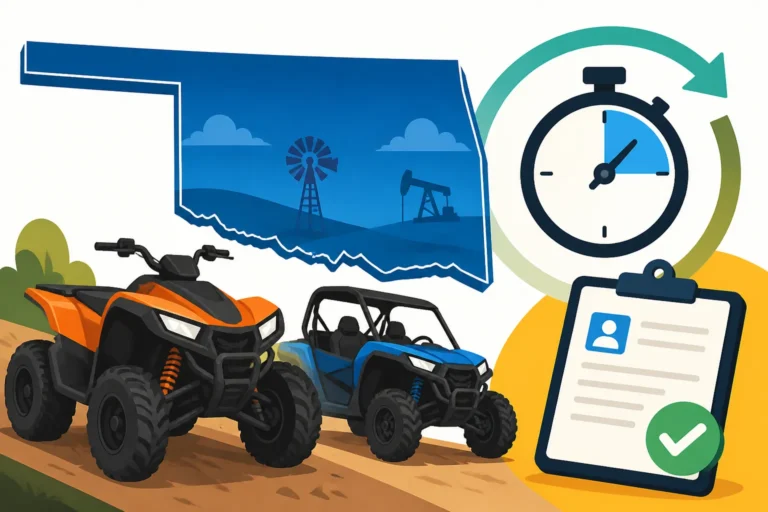
First things first, let's clear up what triggers those late fees. In Oklahoma, the moment you purchase an ATV or UTV, you're on the clock. You have a very specific window of 30 days from the date of purchase to get your machine registered with the state. This deadline applies whether you bought it new from a dealership, used from a private seller, or even if you're a new resident bringing your machine into Oklahoma. It's a hard and fast rule, and missing it is what sets the daily penalty in motion.
This 30-day window isn't just about getting your decal; it's also about getting your title processed. Both tasks are typically handled at the same time through a local tag agency. Many riders get caught off guard because they assume the title is the main priority and the registration is secondary, or they simply forget about the deadline amidst the excitement of a new machine. It’s easy to do, especially if you’re focusing on getting the machine ready for the trails or ranch work. Remember, the clock starts ticking the day you take possession, not when you first plan to ride. For more details on this crucial period, check out [Oklahoma's 30-Day Registration Deadline].
The Crucial Deadline: When the Clock Starts Ticking
The 30-day period begins on the date of purchase or the date you establish residency in Oklahoma if you're bringing a machine from out of state. It's marked clearly on your bill of sale or dealer invoice. This isn't a suggestion; it's a legal requirement. When you visit a tag agency, they'll look at that date immediately to determine if you're within the window. If you're past it, that's when the late fees come into play, and there's no way around them once the deadline has passed.
Imagine you bought a shiny new side-by-side on June 1st. You have until June 30th to get it titled and registered. If you show up at the tag agency on July 1st, you've officially missed the deadline, and the late penalty will begin to accrue from that first day past the due date. This applies even if you had a busy month or simply didn't realize the clock was ticking so fast. It's vital to mark that date on your calendar as soon as you make the purchase.
Why Oklahoma Sends No Renewal Notice
Here's another common trap: unlike cars and trucks, Oklahoma does not send out renewal notices for ATVs and UTVs. This can be a huge surprise to new owners, or even seasoned riders who are used to getting a postcard in the mail reminding them to renew their car's tag. The reason is simple: [Oklahoma Registration Never Renews]. You pay for your ATV or UTV registration once, and it's good for the life of the machine in your ownership. So, while you won't get a renewal notice for your quad, you also won't have to worry about paying for a new decal every year, which is a nice perk once you get past that initial registration hurdle.
This lack of a renewal notice means there's no annual trigger to remind you about any initial registration you might have missed. If you fail to register within those first 30 days, the late penalty just keeps adding up in the background until you finally go to a tag agency. It's easy to forget about it entirely, especially if you buy a machine in the off-season and don't plan on riding for a while. Without that annual reminder, it's all on you to remember that initial 30-day window for your new purchase. For more on what that one-time fee covers, see [What Oklahoma's $11 Registration Fee Actually Covers].
The "Dollar a Day" Breakdown: How Late Fees Add Up
So, you missed the 30-day deadline. What now? Oklahoma's late registration penalty is straightforward, yet it can be a painful surprise if you don't know about it. The penalty is exactly one dollar ($1) for every day that your ATV or UTV remains unregistered past that initial 30-day window. It sounds like a small amount, but as anyone who has seen late fees pile up knows, a dollar a day can become a significant sum surprisingly quickly. This daily charge adds up every single day, including weekends and holidays, until you finally complete the registration process.
This daily accumulation means that even a short delay can start costing you real money. Two weeks late? That's an extra $14. A month late? Another $30 on top of the initial registration fee. It's not a punitive fee meant to break the bank, but rather an incentive to get things done within the legal timeframe. While it might seem a bit harsh that there's no grace period, the state wants to ensure all off-road vehicles are properly documented and on file, especially since they're not subject to annual renewals.
Calculating Your Daily Accumulation
Let’s break down how this dollar-a-day calculation actually works. Once your 30-day window closes, each subsequent calendar day incurs that $1 penalty. It's a simple multiplication: the number of days you're late multiplied by $1. So, if you were 45 days late, your penalty would be $45. If you were 90 days late, it would be $90. There's no complex formula, no percentages, just a straightforward daily charge.
This is why it's so important to address registration sooner rather than later. Every day you put it off, you're essentially adding another dollar to your bill. It’s not like some other fees that might only kick in after a full month or have tiers. This one is continuous. The tag agency clerk will count the exact number of days from the expiration of your 30-day window to the day you walk through their door, and that's the figure they'll present to you.
Hypothetical Scenarios for Late Fees
Let's look at a few common scenarios to make this perfectly clear.
- Scenario 1: Just a Little Late. You bought your quad on March 1st. Your 30-day deadline is March 30th. You finally make it to the tag agency on April 10th. That means you are 11 days late (April 1st through April 10th). Your late fee would be $11. Not too bad, but still an unnecessary expense.
- Scenario 2: A Couple of Months Late. Same purchase date of March 1st, deadline March 30th. You don't get around to registering until June 15th. That's 15 days in April, 31 days in May, and 15 days in June, totaling 61 days late. Your penalty would be $61. This is where it really starts to feel like a pinch, especially when you consider the base registration fee is only $11.
- Scenario 3: Really, Really Late. You bought a used side-by-side in November and planned to work on it over the winter, forgetting all about registration until the spring. If your 30-day deadline was December 1st, and you show up on April 1st, you're 121 days late (30 days in Dec, 31 in Jan, 28-29 in Feb, 31 in March, 1 in April). That would be a $121 penalty, except for the cap we'll discuss next.
As you can see, these daily charges accumulate quickly, turning a small oversight into a noticeable cost. It's why the advice is always to handle it as soon as possible after purchase. For more on how the daily fee accrues, see [How the Daily Late Fee Adds Up].
The Penalty Cap: When the Fees Stop Climbing
While the dollar-a-day penalty can definitely add up, there's a bit of good news: Oklahoma has a maximum cap on how much you'll pay in late registration fees for your ATV or UTV. This cap is set at $100. This means that no matter how long you've delayed, you won't pay more than $100 in penalties. So, if you're 121 days late, you won't pay $121; you'll pay $100. This cap provides a ceiling on potential costs, offering some relief for those who might have forgotten about their registration for an extended period.
This cap is a crucial detail that many riders don't realize. It protects owners from truly exorbitant fees that could pile up if the machine remained unregistered for years. While no one wants to pay $100 extra, it's certainly better than facing hundreds, or even thousands, of dollars in penalties. It’s important to remember, though, that this cap only applies to the late penalty itself, not to any other fees that might be involved in the titling and registration process, such as excise tax or the base registration fee.
Oklahoma Late Penalties Capped at $100
Let's reiterate: the maximum late penalty you will ever pay for a single ATV or UTV registration in Oklahoma is $100. Once your daily accumulation reaches this point, it stops. So, whether you are 100 days late, 200 days late, or even a year late, your penalty amount will not exceed $100. This policy is clearly defined in Oklahoma law and is applied uniformly across all tag agencies in the state.
This cap means that if you realize you're significantly past due, you don't need to panic about an endlessly growing bill. The $100 figure serves as a definitive limit. While it still stings to pay it, at least you know the damage is contained. It's a pragmatic approach to ensure people eventually get their machines registered without being completely discouraged by an overwhelming fee. For more context on why these penalties stop climbing, take a look at [Why Late Penalties Stop Climbing at $100].
Why the Cap Offers Some Relief
The $100 cap, while still a cost, offers significant relief compared to states where late fees can continue indefinitely or accrue at much higher rates. It removes the paralyzing fear of an astronomical bill for a long-forgotten registration. Knowing there's a ceiling can motivate someone who is very late to finally get their paperwork in order, rather than just putting it off forever out of dread.
Imagine someone inherited an ATV, and it sat for years before they decided to use it. In some states, they might face hundreds or even thousands of dollars in back fees and penalties. In Oklahoma, that person would only pay the $100 late penalty, plus the standard $11 registration fee and any applicable excise tax. It makes the task of bringing an older, unregistered machine into compliance much more manageable. This cap helps ensure that an honest mistake or oversight doesn't lead to an unfairly burdensome financial penalty.
Avoiding Late Fees: Best Practices for ATV/UTV Owners
Nobody wants to pay extra money just because they missed a deadline. The good news is that avoiding late registration fees for your ATV or UTV in Oklahoma is entirely within your control. It comes down to being proactive and organized, especially since the state doesn't send out renewal notices. A little bit of planning upfront can save you that frustrating dollar-a-day penalty and keep more money in your pocket for gas or new accessories.
Establishing a routine for new purchases and keeping all your important documents in one place are key strategies. It’s not just about avoiding penalties; it’s about making the entire ownership experience smoother and less stressful. Think of it as part of the initial setup process for your new machine, just as important as reading the owner's manual or doing the first oil change.
Setting Your Own Reminders
Since Oklahoma won't remind you, it's up to you to set your own reminders immediately after purchasing an ATV or UTV. As soon as you sign that bill of sale or dealer invoice, pull out your phone and set a calendar alert for 28 days out. This gives you a two-day buffer before the actual 30-day deadline, allowing you some wiggle room in case life gets busy. You can also put a sticky note on your fridge, write it on your physical calendar, or even ask a family member to remind you.
Another great idea is to create a simple checklist for any new vehicle purchase. Item number one: "Register ATV/UTV by [Date]." This makes it a tangible task you can tick off. Don’t rely on memory, especially if you have a lot going on. A proactive reminder system is your best defense against those creeping daily fees. It's a small habit that can save you $100 and a headache at the tag agency.
Organizing Your Paperwork
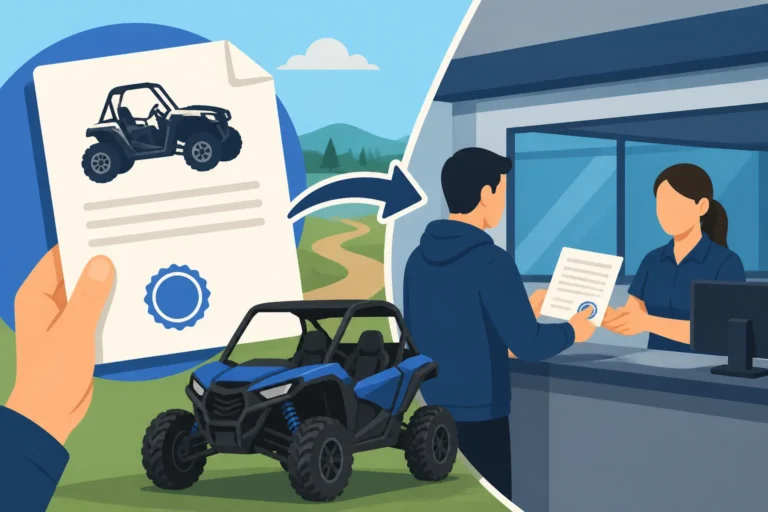
Having all your essential documents in order is critical for a smooth registration process and for avoiding any delays that could push you past the 30-day mark. This means keeping your bill of sale, original title (if it's a used machine from out of state), or Manufacturer's Statement of Origin (MSO) for a new machine, and proof of your Oklahoma residency all together. If you're buying from a dealer, they'll usually provide you with a packet of paperwork; keep it safe.
For private sales, ensure you get a thorough bill of sale that includes the purchase date, price, buyer and seller names, and VIN. You can find reliable templates for this online, perhaps even from a service like LawDepot, which offers customizable legal documents. Having a clear, professional bill of sale prevents any disputes about the purchase date, which is crucial for the 30-day calculation. Don't show up at the tag agency missing a vital piece of paper, only to be sent home and accrue more late fees! For specifics on what paperwork to bring, check out [Oklahoma Dealer Invoices at Titling] and [Oklahoma Bills of Sale for Older Machines].
Understanding the Titling vs. Registration Timeline
It’s common for people to confuse titling and registration, or to assume they're the exact same thing. While they often happen concurrently at the same tag agency visit, they are distinct processes with different purposes. Understanding this distinction is key to navigating the requirements for your ATV or UTV in Oklahoma and ensuring you don't accidentally overlook a step that could lead to late penalties. Both are mandatory for most off-road machines in the state.
The state wants to track ownership (titling) and collect the one-time registration fee (registration). Neglecting either part of this equation can cause headaches down the road. It’s also important to note that the registration isn't just a piece of paper; it comes with a physical decal that must be displayed on the machine.
Titling as the First Step
Titling essentially establishes legal ownership of your ATV or UTV. When you buy a machine, whether new or used, the first major step is to transfer or obtain a title in your name. This involves presenting the MSO (for new machines) or the previous owner's signed-over title (for used machines) to the tag agency. You'll also typically pay the state's excise tax at this point, which is 4.5% of the purchase price, unless an exemption applies (like for farm use). This title is your official proof that the machine belongs to you.
Without a proper title, you can't officially register the machine. The tag agency needs to know who the legal owner is before they can issue a registration decal. This is also where documents like a [Oklahoma Declaration of Purchase Price] come into play, especially for private sales where the purchase price might not be explicitly stated on an existing title. Don't underestimate the importance of the title; it's the foundation of your ownership.
Registration as a Concurrent Requirement
Once your title is established or being processed, you can then proceed with the registration. In Oklahoma, for ATVs and UTVs, this is a one-time, non-renewable registration that costs a mere $11. This fee covers the issuance of a front decal that must be affixed to your machine. This decal serves as your proof of registration and indicates that you've met the state's requirements. As mentioned, this is not an annual renewal like a car tag; you pay it once.
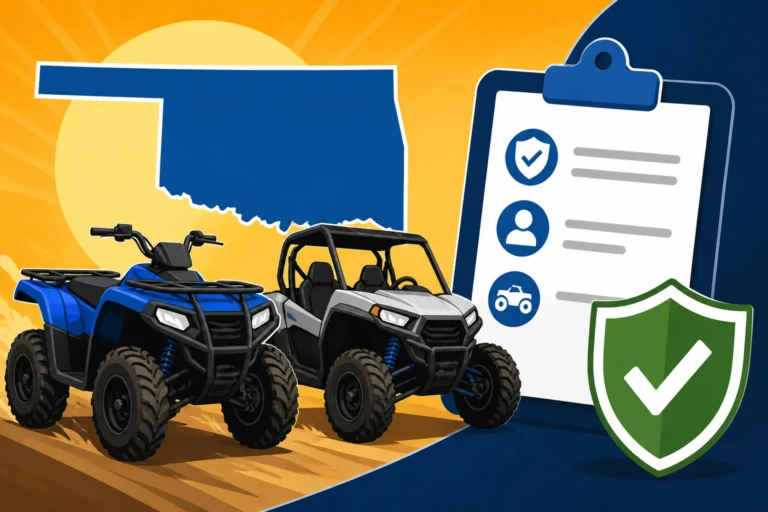
Because both titling and registration happen at the same tag agency visit, they are inextricably linked in practice. The 30-day deadline applies to getting both done. You can't just title it and put off registration, or vice versa, without incurring late penalties. The tag agency will process them together, ensuring that you walk out with both the proof of title (or application for it) and your registration decal. For a full breakdown of the application, see [Oklahoma's ATV Registration Application Explained].
What Happens If You Ride Unregistered?
So, you've missed the 30-day deadline, the late fees are accruing, and you still haven't registered your ATV or UTV. What are the potential repercussions if you decide to ride it anyway? Beyond the accumulating late fees, riding an unregistered machine can lead to additional problems, including fines and potential legal trouble. It's a risk that's simply not worth taking, especially when the initial registration cost is so low and the late penalty is capped.
Think about it: Oklahoma requires registration for a reason. It's about accountability, identifying ownership in case of theft, and ensuring that machines being operated in certain areas meet state standards. Riding an unregistered machine signals to law enforcement that you haven't complied with state law, which can quickly turn a fun outing into a stressful encounter.
Potential Fines and Citations
If you're caught riding an unregistered ATV or UTV in Oklahoma, you could face a citation from law enforcement. While the initial late fee is $1 a day, an officer could issue a separate fine for operating an unregistered vehicle. These fines are typically separate from the registration late penalties and are determined by the specific statute you've violated. The exact amount can vary depending on the jurisdiction (state, county, or municipal) and the officer's discretion, but it will certainly be more than the $11 registration fee or the $100 late penalty cap.
Getting pulled over for an unregistered machine can also lead to other complications. An officer might question why the machine isn't registered, potentially leading to further inspection of your machine's VIN or your ownership documents. It's an unnecessary hassle that can easily be avoided by simply complying with the registration requirements within the 30-day window.
Other Consequences Beyond Money
Beyond the immediate financial penalties of late fees and potential fines, there are other consequences of riding an unregistered ATV or UTV. For instance, if your machine is involved in an accident while unregistered, it could complicate insurance claims. While Oklahoma doesn't mandate insurance for off-road machines used strictly off-road, having your machine properly registered can still be a factor in how claims are handled, especially if it was involved in an incident that spilled over onto public land or roads where registration is more strictly enforced.
Furthermore, an unregistered machine could raise red flags if it's ever stolen. Without proper documentation and state records of your ownership, it can be much harder to prove the machine is yours, recover it, or even file a police report effectively. This is where a clear bill of sale (perhaps one you drafted using LawDepot) and a proper title become invaluable. It protects your investment and ensures your legal standing. For just $11, and a maximum of $100 in late fees, the peace of mind that comes with proper registration is absolutely worth it. For more on what that $11 buys you, see [What an $11 Oklahoma Decal Buys You for Life].
Here's a quick look at how those daily late fees add up:
| Days Late | Accumulation | Total Late Fee |
|---|---|---|
| 1-30 | $1 per day | $1 – $30 |
| 31-60 | $1 per day | $31 – $60 |
| 61-90 | $1 per day | $61 – $90 |
| 91-100 | $1 per day | $91 – $100 |
| 101+ | $0 per day | Capped at $100 |
This table illustrates clearly how the daily fee accrues until it hits that $100 cap. Remember, the sooner you address it, the less you'll have to pay in late penalties.
Disclaimer
This article is for general informational purposes only and does not constitute professional advice. Laws, prices and regulations vary by location and change over time. Consult a qualified professional for guidance on your specific situation.