One Permit Covering Honobia Creek and Three Rivers
A ride at Honobia Creek or Three Rivers can involve more than unloading the machine: riders need to understand which access permit applies, what land it covers and when riding is allowed. The useful shortcut is that one land-access permit can cover both areas, but it does not grant unrestricted access to every road or remove seasonal and site rules.
What the shared permit covers
Honobia Creek and Three Rivers are separate riding areas, but their land-access arrangements allow one applicable Oklahoma land-access permit to cover recreational access to both. You do not need to buy a separate permit for each area solely because you plan to ride in both. Check the permit’s current terms before setting out, since eligibility and access conditions matter as much as the permit name.
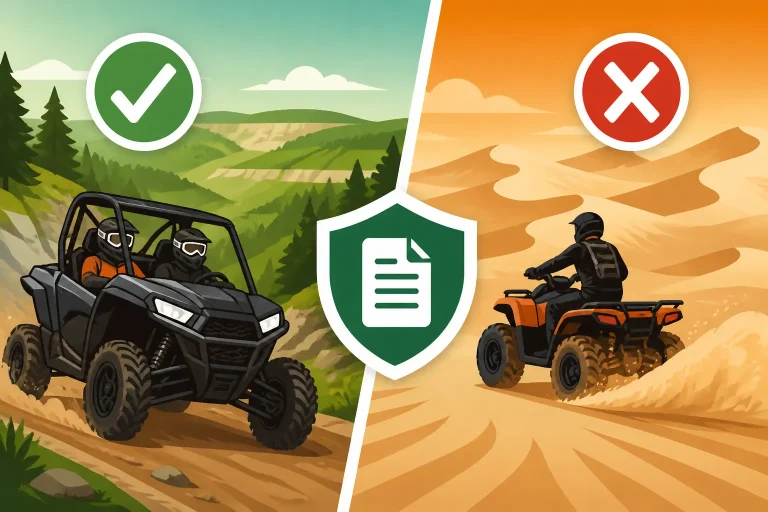
These areas are associated with timberland made available for public access. That makes them different from a private off-road park with one gate, one set of boundaries and a dedicated trail system. The permit is permission to use designated access areas under the applicable rules; it is not a blanket invitation to ride anywhere on the properties.
The permit also does not replace other requirements. For example, it does not register or title an ATV or UTV, and it does not turn an access road into a public road where ordinary road-riding rules apply. If you are unsure whether your machine needs state registration, see Oklahoma Land Access Permits Explained and Do You Need to Register an ATV in Oklahoma?. Registration, land access and permission to ride a particular route are separate questions.
| Question | Practical answer |
|---|---|
| Do Honobia Creek and Three Rivers use one shared access permit? | One applicable land-access permit can cover both areas. |
| Does the permit cover every timber road or parcel? | No. Follow the current access map, signs, closures and route rules. |
| Does it replace ATV or UTV registration? | No. Registration and land access are separate. |
| Does it automatically allow year-round riding? | No. Access can be seasonal and subject to closures. |
| Does it cover a different riding area or state park? | Not automatically. Check that location’s separate rules and fees. |
The shared permit is best understood as an access credential for the two named areas, not a general Oklahoma OHV pass. It does not automatically cover Little Sahara State Park, Robbers Cave, a private ranch park, another Wildlife Management Area or private land elsewhere. If you are planning more than one stop, check each destination separately instead of assuming the permit travels with you.
A permit is also not a substitute for asking whether a route is open. Timber roads may be closed, restricted or managed differently from one part of an area to another. A valid permit does not make a closed road available, and a gate, sign or current access notice takes precedence over an old route description.
If you are deciding between the two areas, the shared permit simplifies the access credential, but it does not mean the riding experience is identical. Read the separate area information for Oklahoma Permits for Honobia Creek and Oklahoma Permits for Three Rivers before you choose a destination.
Who needs a permit and what it does not replace
The permit question depends on why you are entering the land, who is riding and whether an exemption applies. Riders using these areas for recreation should check the current land-access requirements before arriving. Do not assume that having an ATV registration decal, a hunting license, an out-of-state permit or a pass from another park automatically satisfies the requirement.
A hunting license and a land-access permit serve different purposes. A hunting license authorizes hunting under its own conditions; a land-access permit is for the access use described in its terms. If your trip includes hunting as well as riding, confirm both sets of rules. If you are riding only, check which access credential applies to non-hunting use. Details can differ by residency and eligibility, so review Oklahoma’s Resident Land Access Permit or Oklahoma’s Nonresident Land Access Permit as appropriate.
Do not assume the permit belongs to the machine. A land-access permit is not the same thing as an ATV registration decal fixed to a vehicle. Before a group ride, confirm whether each rider needs an individual permit, who must carry proof and how the permit is checked. This matters when a family or group has multiple machines: one person’s credential should not be treated as automatically covering everyone unless the official terms clearly say so.
Some riders may qualify for an exemption based on age or another status. Exemptions can be specific, and an exemption from buying a permit does not necessarily exempt a rider from other access rules, seasonal limits or safety requirements. Confirm the current exemption before relying on it. If a child is riding with an adult, check the child’s own status rather than assuming the adult’s permit covers the entire party.
The shared permit is not:
- An ATV or UTV title, registration or road plate.
- Permission to ride on any Oklahoma public land.
- A replacement for an applicable hunting license.
- A guarantee that every road or route at either area is open.
- A waiver of posted speed, vehicle, safety or check-in requirements.
- Permission to enter land outside the designated access arrangement.
This distinction can prevent a frustrating trip. A rider may have paid for the correct permit but still arrive at a closed entrance, use a route that is not open to machines or misunderstand a seasonal restriction. Treat the permit as one part of trip preparation, alongside checking the location’s current rules and confirming that your machine is allowed.
For current permit details, use the official information for Oklahoma’s land-access program and the relevant area. If the online information does not clearly answer whether your situation qualifies, ask the responsible office or seller before departure. Keep a record of the answer and any purchase confirmation, especially if the issue involves residency, age, a hunting license or a group of riders.
Seasonal access, check-in and route limits
The shared permit does not mean that riding is open at all times. Honobia Creek and Three Rivers access is managed under seasonal and site-specific conditions. The riding window is commonly described as running from October into January, with machines required to leave the timberland after the stated closing date. Confirm the current opening and closing dates before planning around that window; access rules and notices can change.
Seasonality is more than a calendar detail. The areas are used for hunting and other land-management purposes, and a route that was open on a previous visit may be closed on the day you arrive. Weather, active work, fire risk, road conditions or other management needs may affect access. Never assume that a gate being open means every road beyond it is open to OHVs.
Before riding, check:
- The current permit terms and the dates they authorize access.
- The latest access map, including roads or areas excluded from motorized use.
- Any check-in requirement, kiosk instruction or permit display rule.
- Temporary closures, hunting activity, fire restrictions and weather notices.
- Whether the route is suitable for your machine and the conditions that day.
A check-in step is easy to overlook if you are used to riding at a private park where entry is handled at one staffed gate. For these timberland areas, follow the current instructions for the specific access program and entrance. If the instructions require check-in, do it even if you already have a permit. If you encounter a kiosk, posted notice or gate instruction that differs from what you expected, follow the current on-site direction and resolve questions before proceeding.
Stay on the routes authorized for motorized use. Timberland is working land, not a dedicated maze of unrestricted ATV trails. A visible track, old tire marks or a road shown on a general map does not prove that a route is currently open to recreational riding. Do not cut across a field, take a logging road around a barrier or follow another group onto an unmarked route.
The seasonal window also affects planning for overnight trips. Make sure your entry and exit fit within the permitted dates and any daily operating conditions. If you are camping, check the camping rules separately; a riding permit does not necessarily authorize camping wherever you stop. For more detail about the land rules, see Oklahoma Timber Land Access Rules and October to January: The Timber Land Riding Window.
A closure is not a challenge to find a workaround. It may protect habitat, accommodate land operations or manage public safety. Turning around is the right call when a road is closed or a route’s status is unclear. That is especially important in a large timberland area, where an unauthorized detour can take you far from the route you meant to follow.
How to buy, carry and verify the permit
Check the official permit information before purchasing, rather than relying on a previous season’s receipt or a friend’s description. The program’s terms explain which permit applies to you, whether a separate option exists for residents and nonresidents, which uses it covers and how long it remains valid. For current charges and purchase options, consult the official provider; fees and procedures can change.
If you are comparing options, [Oklahoma Land Access Permit Cost] explains what to check when budgeting. Do not treat a price mentioned in an old post, saved screenshot or discussion forum as current. Verify the amount and the permit period through the official source when you are ready to buy.
After purchase, keep the proof accessible. Follow the program’s instructions for showing the permit, whether that means carrying a document, keeping a digital record or presenting it at check-in. A digital copy can be convenient, but cell service may be unreliable in remote areas. Save an offline copy and consider carrying a printed backup if the rules allow it. The topic Showing a Land Access Permit on Your Phone covers practical ways to keep proof available.
For navigation, download or save the correct area map before leaving reliable service. A paper map or waterproof sleeve can help when a phone battery dies, a screen gets wet or the network drops. A basic map case sold through Amazon may be useful, but it cannot replace the official access map or current closure notices. Carry both a reliable navigation option and the area’s own route information.
A simple pre-trip file can include:
- Permit purchase confirmation and the permit terms.
- The current access map for the area you intend to ride.
- Check-in instructions and contact information for the responsible office.
- A note of the allowed season and any temporary closure notices.
- Emergency contacts and a basic plan for returning to the vehicle.
If the permit is digital, download it before you leave home. Do not rely on being able to sign in, retrieve an email or make a purchase from the trailhead. If the permit system changes or the confirmation is unclear, resolve that before towing to the area.
Pay attention to renewal and validity. A permit that covered a previous trip may no longer be valid, and a credential for one permit period may not continue automatically. Check the dates and terms shown on your confirmation. Renewing a Land Access Permit Every Year explains why riders should verify the permit period rather than assume it carries over.
A practical plan for visiting both areas
Because one permit can cover both Honobia Creek and Three Rivers, you can choose between the areas without buying a second shared-access credential just for the other location. That does not mean it is sensible to improvise the route on arrival. These are separate areas, and access details, terrain and local conditions can differ.
Use this sequence to plan:
- Choose the destination. Decide whether your group is riding Honobia Creek, Three Rivers or both during the permitted period. Check the current descriptions and map for each area.
- Confirm the credential. Verify that the permit you intend to buy applies to your residency and use. If your trip includes hunting, check hunting requirements separately.
- Check dates and closures. Confirm that the area is open for motorized access on your travel dates. Look for temporary notices close to departure.
- Review the map. Identify the designated routes and access points. Download the map and save it offline.
- Prepare the machine and group. Make sure the machine is in safe condition, all riders understand the route plan and everyone knows what proof of access to carry.
- Follow entry instructions. Complete check-in if required, observe signs and keep to authorized roads.
- Leave when required. Follow closing dates and daily limits, and do not extend a ride beyond the authorized access period.
For a trip to both areas, avoid assuming that a single day’s plan can cover them comfortably. Distances, road conditions and the time needed to load and move machines can add up. Decide whether visiting both is realistic before committing to a route, particularly if the group includes young or inexperienced riders.
Set a turnaround time and share the plan with someone who is not riding. Large, remote areas can make it difficult to regroup if machines become separated. Agree on a meeting point, keep the group together at junctions and avoid riding beyond the ability of the least experienced person. Bring water, basic tools, a first-aid kit and a way to navigate without cell service.
Respect gates and land operations. Do not block roads, enter an active work area or leave litter. If another user is working or hunting nearby, slow down, give them room and follow posted instructions. A permit provides access under conditions; it does not give riders priority over land management or other authorized uses.
If your plans change after arrival, check the access information again rather than assuming the other area has the same open routes or requirements. The shared permit removes one administrative hurdle, not the need to plan each destination. If something is unclear, contact the responsible office instead of relying on a trail rumor or an old map.
Frequently Asked Questions
Does one permit cover both Honobia Creek and Three Rivers?
One applicable Oklahoma land-access permit can cover both areas. Confirm that the permit type fits your residency and intended use, and check each area’s current access conditions.
Can I ride at either area year-round with the permit?
No. Access is subject to a seasonal riding window and possible temporary closures. Confirm the current dates and notices before traveling.
Does the land-access permit replace ATV registration?
No. Land access and machine registration are separate. Check registration requirements for your ATV or UTV independently.
Does the permit cover every road in both areas?
No. Use only routes authorized for motorized riding and follow gates, signs, maps and closure notices.
Does a hunting license automatically count as the access permit?
Do not assume so. Hunting and recreational land access have distinct requirements. Check the official terms for your specific trip.
Disclaimer
This article is for general informational purposes only and does not constitute professional advice. Laws, prices and regulations vary by location and change over time. Consult a qualified professional for guidance on your specific situation.