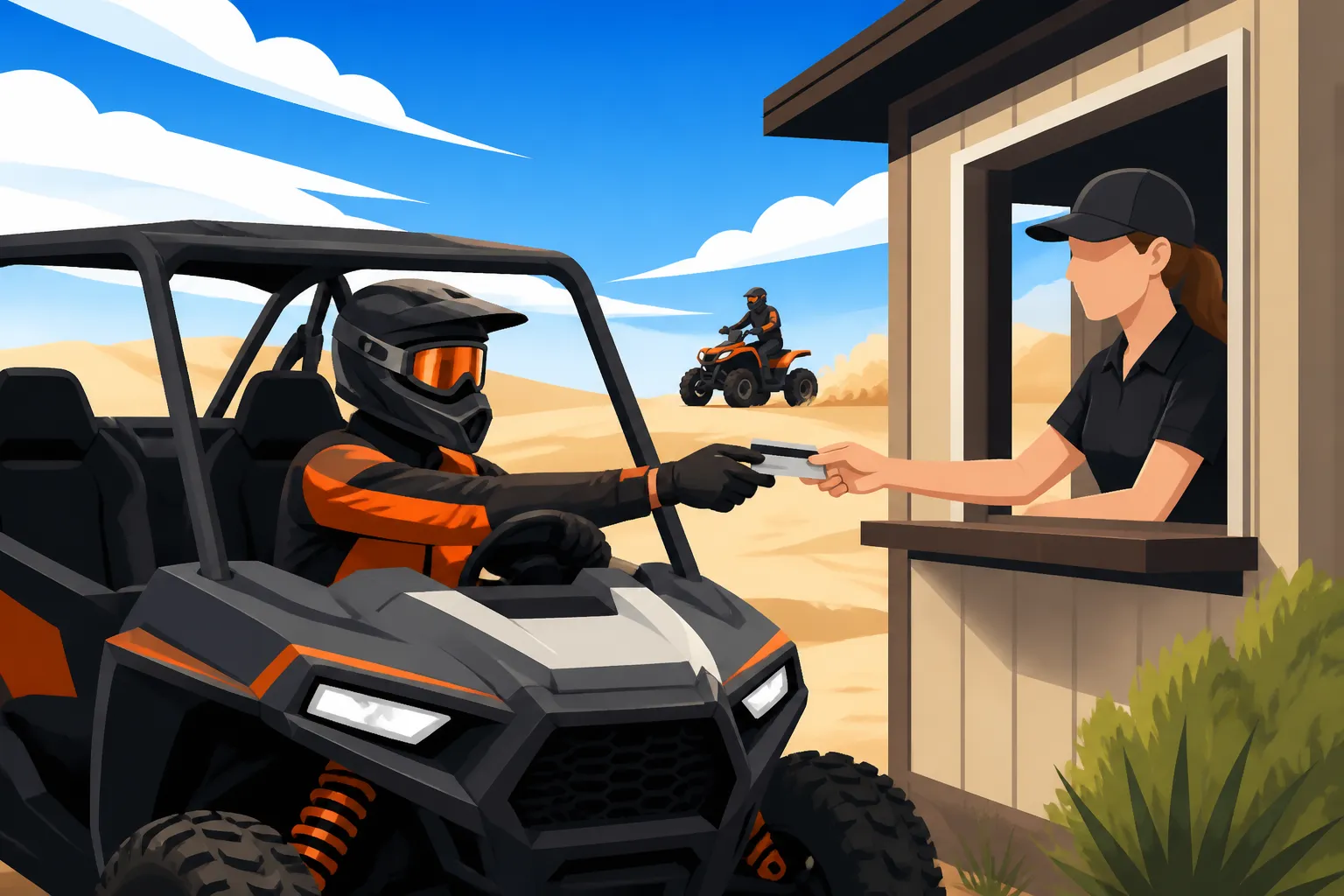
Paying at Little Sahara’s Competition Campground Kiosk
Arriving at Little Sahara State Park near Waynoka with a trailer full of machines is exciting—until you’re unsure where to pay, what the campground kiosk covers, or whether you need to stop somewhere else first. This guide explains how to approach the Competition Campground kiosk, what to check before and after paying, and how to avoid a frustrating start to your dune-riding day.
Finding the Competition Campground kiosk
Know which campground you are heading to
Little Sahara State Park has more than one campground area, so it helps to identify your destination before you turn in. The Competition Campground kiosk is a payment point associated with that campground. It is not the same location as the Buttercup Campground kiosk, which serves a different part of the park. If you are looking for that location instead, see [Where to Pay at the Buttercup Campground Kiosk].
That distinction matters when you arrive with a truck and trailer. Following signs or directions for the wrong campground can send you through an unnecessary loop, and maneuvering a long trailer around an unfamiliar campground is not the moment most people want to discover they have taken a wrong turn. If you are meeting friends, agree on one campground and one meeting point before leaving home.
When you approach the Competition Campground, follow posted signs and look for the kiosk before settling into a campsite or heading toward the riding area. Park layouts and instructions can change, so use the signs on site rather than assuming the kiosk is in the same place you remember from a previous visit. If you cannot find it, ask park staff rather than guessing about where to pay.
Treat the kiosk as a payment stop, not a substitute for park rules
A campground kiosk is a practical place to handle payment when you are using that campground, but paying there does not automatically answer every question about your visit. Before you ride, check the instructions displayed at the kiosk or elsewhere in the campground. Confirm what the payment applies to, whether it covers the people or machines in your group, and whether there are separate requirements for camping or other park services.
This is especially important if your group includes riders arriving separately. One person may reach the campground first and pay, while another arrives later with a second truck or trailer. Do not assume that one receipt or payment automatically covers everyone. Read the posted terms carefully and ask park staff if the instructions do not make the coverage clear.
For broader planning, [Little Sahara's Day Fees in Oklahoma] and [Oklahoma Little Sahara Day Fees] are useful related topics. Fees and procedures can change, so use the current information posted by the park or provided by park staff when you arrive.
Keep the campground and riding-area payment questions separate
People often use “the park fee” as if it covers every part of a visit. In reality, it is worth checking whether a payment is for a day visit, camping, or another specific use. A campsite charge and a riding-area day fee are not necessarily interchangeable. Look for wording that explains exactly what you are paying for, and keep any receipt, pass, or other proof the kiosk provides.
A quick check at the kiosk can prevent an awkward conversation later. If your plan is to camp overnight and ride during the day, confirm both parts of the visit rather than relying on what a friend remembers from last season. If you are only riding for the day, confirm how long the day payment lasts. [How Long a Little Sahara Day Fee Lasts] covers that timing question.
How to pay without slowing down your group
Read the posted instructions before starting
Before using the kiosk, pause long enough to read its signs and instructions. Check which option fits your visit, what information you need to provide, and what payment methods are accepted. Do not rely on an old photo, a social media comment, or a friend’s memory to determine the current process. The signs at the kiosk are the best guide for the transaction you are making that day.
If the kiosk has a screen, follow its prompts in order and review your selections before submitting payment. A small mistake—such as choosing the wrong visit type or entering an incorrect detail—can create more work than taking an extra moment to double-check. If a prompt is unclear, ask park staff before completing the transaction rather than guessing.
Kiosks can also be harder to use when several people crowd around them, especially if someone is trying to manage kids, gear, or a trailer at the same time. Have one person handle the payment while another keeps the group and vehicles safely out of the way. This makes the stop calmer and helps other visitors reach the kiosk too.
Save proof of payment and check what it says
After paying, keep the receipt or other proof the kiosk provides. If the process issues a printed receipt, place it somewhere it will not blow away, get soaked, or disappear under riding gear. If proof is electronic, make sure you can retrieve it later rather than assuming you will remember which screen or message contained it.
Before leaving the kiosk, check that the proof matches your visit and that you understand any instructions attached to it. If it includes a date, time, or other identifying detail, make sure it appears correct. If the machine does not produce expected proof or the transaction seems incomplete, address the problem while you are still near the kiosk or staff.
Do not leave a receipt on a dashboard where wind or a door opening could scatter it. A simple routine helps: take the receipt, photograph it for backup, and put the original in a wallet or a designated glove-box pocket. If park staff ask you to show proof, you will not have to dig through a cooler, helmet bag, and half a dozen snack wrappers.
Plan for a payment problem before you arrive
Kiosks are convenient, but a card reader or screen may not behave as expected. Bring a backup payment option if you can, and check the posted instructions for accepted methods before relying on one particular card or device. Do not assume that a kiosk accepts cash, contactless payment, or every card type unless the signs say so.
It is also sensible to avoid arriving with a nearly dead phone if your plan depends on using a digital payment method or saving electronic proof. Charge devices before the drive, and keep a charging cable available in the vehicle. If a payment issue arises, do not simply leave and assume you can settle it later. Ask park staff what to do.
For questions about park contact details and operating information, consult [Little Sahara's Office Hours and Phone Number]. Checking before you tow can save a long drive with an unanswered question waiting at the gate.
| Before you leave home | At the kiosk | Before you ride |
|---|---|---|
| Confirm which campground your group plans to use | Read the posted payment instructions | Keep your receipt or other proof accessible |
| Check park information for your visit | Select the option that matches your use | Confirm the payment covers the intended visit |
| Bring a backup payment option | Review details before submitting | Check posted riding and safety requirements |
| Charge your phone if using digital tools | Ask staff if a prompt is unclear | Keep your group together and follow park signs |
Planning your Little Sahara visit around payment
Decide whether you need a day visit or an overnight stay
Your payment questions depend partly on how long you plan to stay. A day visit, an overnight camping trip, and a longer visit may involve different arrangements. Before you head for the Competition Campground kiosk, decide whether you are paying for a day of riding, a campsite, or both. Then check the posted terms so you do not mistake one charge for another.
If you are comparing a one-day visit with repeated trips, look into the annual-pass information as well. [Little Sahara's Annual Pass in Oklahoma] and [What a Little Sahara Annual Pass Leaves Out] can help you identify questions to ask before choosing. Read the terms carefully, especially if your plans include camping or other services that may not be included in a pass.
The practical approach is to make a short checklist for your trip: campground, number of visitors, expected length of stay, riding plans, and any separate camping needs. That does not need to become a complicated spreadsheet. It just helps prevent the common “I thought that was included” confusion when the group is ready to unload.
Get organized before you reach the kiosk
Payment is only one small part of getting a group onto the dunes. Before you leave, make sure the driver knows which campground entrance to look for, everyone understands where to meet, and the trailer is packed so the first stop does not become a full unload. If friends are traveling in separate vehicles, send the campground name and a clear meeting plan rather than saying only “meet us at Little Sahara.”
A paper or digital map can be useful when cell service is inconsistent or when people arrive at different times. onX Offroad can help you review your route and keep track of your planned travel area before you leave. Download or save what you need ahead of time rather than waiting until you are parked in a low-signal spot. Keep the park’s own signs and instructions as your guide for campground access and permitted riding areas.
If you are towing from Tulsa or another distant starting point, a little planning makes arrival less hectic. [Trailering a Machine From Tulsa to Little Sahara] covers trip logistics, while [Oklahoma Trail Conditions Before You Tow] is a useful reminder to check conditions before committing to the drive. onX Offroad may also help with route planning, but it should not replace posted park directions or official access information.
Make the kiosk stop work for the whole group
When one person handles payment for a group, make sure they know who is included and what the payment covers. Share that information with the rest of the group so nobody heads off believing a separate payment is unnecessary when it is required. A quick message with a photo of the receipt or the relevant instructions can prevent confusion, particularly when vehicles arrive at different times.
For a large group, decide in advance who is responsible for payment, who will handle unloading, and where everyone will wait. Keep the area around the kiosk clear and do not block access while the group sorts out helmets, tie-downs, or snacks. Once payment is settled, move to an appropriate parking or staging spot before reorganizing the trailer.
onX Offroad can be useful for sharing a planned route or meeting area with riding companions, especially if the group is unfamiliar with the area. Use it as a planning aid, not as permission to ride wherever a map shows open ground. Park boundaries, closures, and posted restrictions take priority. For a broader introduction to riding at the park, see [Oklahoma Dune Riding Explained].
Avoiding common campground kiosk mistakes
Do not assume last visit’s process still applies
One of the easiest mistakes is arriving with a confident but outdated memory: “We paid over there last time,” or “The fee covered the whole group last year.” Even if the setup looks familiar, read the current signs and confirm the payment instructions for that visit. The kiosk location, prompts, or accepted methods may not match what you remember.
This matters particularly for families and repeat visitors. A parent may have handled the payment on a previous trip and assume the same process applies, while a teenager or friend is now arriving separately. Take a minute to explain the current plan and make sure everyone knows where proof of payment is kept.
Do not assume that a campground kiosk handles every park question. It may be the right place for a specific payment, but questions about riding requirements, camping, closures, or park access should be answered using posted information or by asking staff. If you plan to ride the dunes, review safety requirements in advance, including [Why Little Sahara Requires a 10-Foot Whip].
Do not confuse a smooth arrival with a complete ride plan
Paying at the campground kiosk is one step, not the entire preparation process. Check that your machine is ready, tie-downs are secure before the drive, helmets and safety equipment are packed, and everyone knows the group’s plan. If you are bringing new riders or children, talk through basic expectations before the machines are unloaded.
Also keep an eye on weather and conditions. Sand, wind, and changing visibility can make an otherwise simple outing feel demanding, especially for riders who have not been to Little Sahara before. Tell someone where you are going, carry water, and agree on a meeting point in case members of the group become separated.
onX Offroad can support trip planning by helping you prepare a route and mark a meeting point. Save maps and important details before you arrive, and make sure more than one person in the group knows the plan. Still, check park rules on site and follow the designated access instructions rather than relying on a map alone.
Ask a clear question if something does not add up
If you are unsure whether the kiosk payment covers your visit, say exactly what you are doing: “We are camping here and riding today,” or “We are here for a day visit with two machines.” Clear questions are easier for staff to answer than a vague “What do we owe?” If you are unsure whether a payment applies to a passenger, another vehicle, or an overnight stay, ask before leaving the kiosk.
Likewise, if the kiosk fails to complete a transaction, keep any error information and contact park staff. Do not make a second payment immediately unless the instructions or staff indicate that you should; otherwise, you could end up with a duplicate charge and a harder issue to sort out later. Keep records of what happened and follow the park’s direction.
A calm, organized stop is usually the difference between a quick start and a frustrating one. Confirm the campground, read the signs, pay for the visit that matches your plans, keep your proof, and ask when anything is unclear. Then you can focus on the reason you made the drive: enjoying your time at Little Sahara.
Disclaimer
This article is for general informational purposes only and does not constitute professional advice. Laws, prices and regulations vary by location and change over time. Consult a qualified professional for guidance on your specific situation.