Can You Drive a UTV on the Road in Oklahoma?
It's an exciting time to be an ATV and UTV enthusiast in Oklahoma, but figuring out the rules for riding on actual roads can feel like navigating a maze. Many riders, myself included, have found themselves scratching their heads, wondering if their trusty side-by-side can legally hit the blacktop for a quick run to the store or a scenic cruise down a county road. This guide is here to cut through the confusion and give you a clear, realistic breakdown of what it takes to drive your UTV on the road in Oklahoma.
The Short Answer: Yes, But With Big "Ifs"
For years, the idea of driving an off-road machine on public roads in Oklahoma was largely a non-starter, except for very specific agricultural purposes or fleeting highway crossings. This led to a lot of frustration for folks who just wanted to get from point A to point B without having to trailer their machine everywhere. The good news is that the landscape has changed! Oklahoma now has a specific classification for "street-legal UTVs," which means you absolutely can drive your UTV on some public roads, provided you jump through a few important hoops. It’s not as simple as just slapping a license plate on it, but it's far from impossible.
Oklahoma's Street-Legal UTV Statute: What Changed?
The biggest game-changer arrived with legislation passed in 2021. Before that, UTVs were largely grouped with ATVs, and neither had a clear pathway to routine road use. This new law effectively created a separate category for UTVs, acknowledging their growing popularity and versatility, and finally opening up the possibility for them to be legally operated on certain public roadways. It was a huge relief for many riders, especially those in rural areas who use their UTVs for everything from checking fences to running errands. You can read more about this legislative journey in [How Oklahoma Created a Street-Legal UTV Class]. This shift means that while your quad might still be strictly off-road, your side-by-side now has a chance to see some asphalt, given the right modifications and paperwork.
This legislative move didn't just happen overnight; it was the result of years of advocacy from riders and industry groups who saw the potential for UTVs to serve a dual purpose. The state recognized that these machines, with their increasing safety features and enclosed cabins, could function much like golf carts or other low-speed vehicles in appropriate settings. However, to ensure public safety, the law also laid out very specific requirements that UTVs must meet to earn that coveted "street-legal" designation. It’s a balance between rider freedom and public safety, aiming to integrate UTVs safely into the existing road network.
Standard ATV Registration vs. Street-Legal UTV Registration
Here's where many riders get a little tangled. Oklahoma has a standard, one-time, low-cost registration for ATVs and UTVs used off-road. This gets you a decal, usually for the front of your machine, and you never have to renew it. It's fantastic for trail riders and farmhands. However, if you want to take your UTV on the road, that basic off-road registration isn't enough. You need to apply for a distinct "street-legal UTV" registration, which comes with its own set of requirements and, notably, an annual renewal.
Think of it like this: your off-road decal is like a hunting license for your machine – it allows it to operate in specific, designated areas without bothering with road rules. The street-legal UTV registration, on the other hand, is more akin to a car's tag; it signifies that your vehicle has met the criteria to safely and legally share the road with other traffic. This means you'll be paying a yearly fee and getting a different type of decal or plate designed for road use. It's a crucial distinction that can save you a heap of trouble if a trooper pulls you over. You'll find more details on this distinction in [Oklahoma Annual Plates for Street UTVs] and [Oklahoma Yearly Decals for Street UTVs].
Who Can Drive a Street-Legal UTV in Oklahoma?
So, your UTV is street-legal – awesome! But who exactly is allowed to be behind the wheel? The rules are pretty straightforward for drivers. In Oklahoma, you must be at least 16 years old to operate a street-legal UTV on public roads. This makes sense, as it aligns with the minimum age for obtaining a driver's license for a conventional vehicle. This isn't just a suggestion; it's a legal requirement, and it's something law enforcement will definitely check if they stop you.
One piece of good news for UTV enthusiasts is that you do not need a special motorcycle endorsement on your driver's license to operate a street-legal UTV. While ATVs and some off-road motorcycles might have different rules, UTVs, in their street-legal form, are treated more like cars in this regard. This removes a significant hurdle for many potential drivers who might not want to go through the motorcycle endorsement process. So, as long as you have a valid Oklahoma driver's license and are at least 16, you're good to go on the driver qualification front. For specifics, check out [Oklahoma Drivers Must Be 16 for a Street UTV] and [Oklahoma Skips the Motorcycle Endorsement].
Essential Equipment for a Street-Legal UTV in Oklahoma
Getting your UTV registered for road use isn't just about paperwork; it's also about making sure your machine is equipped to handle the demands of public roads safely. This often means adding or upgrading several key components that might not come standard on an off-road-only model. It's about being seen, being heard, and being able to signal your intentions to other drivers, just like any other vehicle on the road.
Making Your UTV Road-Ready: Lights, Horns, and Signals
To be legally considered a street-legal UTV in Oklahoma, your machine needs to have several pieces of equipment installed and functional. This isn't optional; these are requirements for registration and continued legal operation. You'll need properly functioning headlights, taillights, and brake lights – essentially, the same lighting you’d expect on any road vehicle. Beyond that, turn signals (front and rear) are a must, allowing you to clearly indicate turns and lane changes. Side mirrors, or a rearview mirror, are also crucial for maintaining situational awareness, and a functional horn is essential for warning other drivers or pedestrians.
Many stock UTVs come with basic headlights and taillights, but adding turn signals, a horn, and proper mirrors often requires aftermarket kits. Companies like SuperATV offer a wide range of these kits, from simple universal signal kits to full plug-and-play setups specifically designed for popular UTV models. Investing in quality components here isn't just about compliance; it's about your safety and the safety of others on the road. Remember, these additions aren't just for show; they need to be fully operational and visible. You can dive deeper into these requirements with [Oklahoma Equipment Required for Street UTVs], [Oklahoma Turn Signals and Mirrors], and [Oklahoma Horns on a Street UTV].
The Importance of Insurance and Annual Renewals
Just like with any other road-going vehicle, insurance is a non-negotiable part of owning and operating a street-legal UTV in Oklahoma. When you register your UTV for road use, you will be required to show proof of liability insurance. This is a critical step, as it protects you financially in the event of an accident where you are at fault. Driving an uninsured vehicle on public roads carries significant penalties, including fines, suspension of your driving privileges, and even impoundment of your machine. It’s simply not worth the risk.
Beyond the initial registration, remember that street-legal UTV registration, unlike the one-time off-road decal, requires an annual renewal. This means every year, you'll need to ensure your insurance is current and that your registration fees are paid to keep your UTV legally on the road. Missing the renewal deadline can lead to late fees and the hassle of having to re-register. Keep track of your renewal date, just as you would for your car, to ensure continuous compliance. For more on this, consult [Oklahoma Insurance at Street Registration] and [Street UTV Decals Renew Every Single Year].
Where You Can and Cannot Ride Your Street-Legal UTV
So, your UTV is equipped, insured, and registered for the road. Fantastic! But before you head out, it's absolutely vital to understand where you can actually ride. The "street-legal" designation doesn't magically open up every single road in the state. Oklahoma has specific rules about different types of roadways, and knowing these limitations is key to avoiding fines and ensuring your safety.
Navigating Oklahoma's Roads: Restrictions and Exceptions
Here's the big one: street-legal UTVs are generally not permitted on interstate highways or U.S. highways in Oklahoma. These are typically high-speed, high-traffic roads designed for vehicles that can maintain faster speeds and have greater protective features. While it might be tempting to use them for a quick hop, doing so is illegal and incredibly dangerous for a UTV. You'll want to plan your routes to stick to other types of roads. For example, [Oklahoma Street UTVs Stay Off Interstates] covers this restriction clearly.
When it comes to county roads and city streets, things get a bit more nuanced. County commissioners have the authority to open or close specific county roads to ATV and UTV traffic. This means that what's legal in one county might not be in the next, so it's always wise to check with the local county commissioner's office or look for posted signage. Similarly, municipalities (cities and towns) can pass their own ordinances regarding UTV use within their limits. Some cities embrace UTVs on their streets, while others restrict them heavily. Always check local ordinances before riding in an unfamiliar town. These local variations can be found in more detail through resources like [Oklahoma County Commissioners and ATV Roads] and [Oklahoma Municipal Ordinances That Open Streets]. It truly pays to do your homework.
Special Cases: Farm Use and Crossing Highways
Even without full street-legal registration, there are specific circumstances where UTVs (and ATVs) have historically been allowed on public roads. One significant exception is for agricultural purposes, falling under what's known as the "instrument of husbandry" rule. If you're actively using your UTV for farm or ranch work – for example, moving between fields, checking livestock, or transporting tools directly related to agricultural operations – you might be exempt from some of the standard road rules, but only while performing those duties. This doesn't mean you can just joyride on the road with a bale of hay in the back; it's a specific exemption tied to active farming. For more on this, check out [Oklahoma's Instrument of Husbandry Exception].
Another common scenario is crossing a highway. Even if your UTV isn't street-legal, Oklahoma law generally allows you to cross a highway, provided it's done safely, during daylight hours, and at an intersection where the posted speed limit is 35 mph or less. This is for getting from one parcel of land to another, not for traveling down the highway. For street-legal UTVs, these crossing rules are still relevant, but your greater eligibility to use other roads means you might not rely on this exception as much. Understanding [Oklahoma Highway Crossings in Daylight] is crucial for all riders.
Staying Safe and Legal: Key Considerations for Riders
Beyond the equipment and the paperwork, responsible riding is paramount. Operating a UTV on public roads means sharing the space with cars, trucks, and motorcycles, all of which often travel at higher speeds and have different blind spots. Being a cautious, visible, and rule-abiding rider is not just about avoiding a ticket; it's about preventing accidents and ensuring everyone's safety.
Helmets, Passengers, and Speed Limits
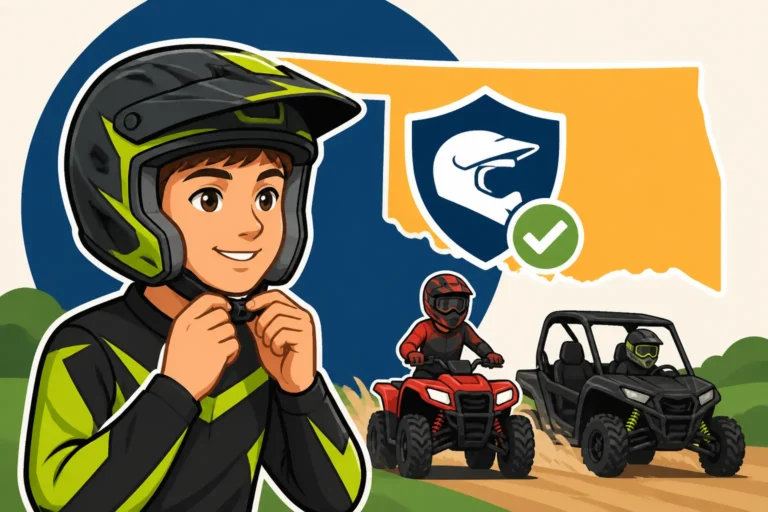
When it comes to safety gear, Oklahoma has a clear rule: all riders (drivers and passengers) under the age of 18 are required to wear a helmet when operating or riding on an ATV or UTV on public lands or roads. This applies even to street-legal UTVs. While adults are not legally mandated to wear helmets in a street-legal UTV, it’s always a good idea, especially considering the open nature of many side-by-sides. For more on this, see [Oklahoma Helmet Law for Riders Under 18].
Regarding passengers, you can generally only carry as many passengers as the UTV was designed for by the manufacturer. If your UTV has two seats, then it's a two-person machine, no matter how many friends want to squeeze in. Overloading a UTV compromises its stability and handling, making it unsafe on any terrain, let alone a public road. Additionally, stick to posted speed limits. While UTVs can be surprisingly quick, they aren't cars, and their handling characteristics at higher speeds can be different, especially on paved surfaces. Always drive defensively and be aware of your surroundings. Details on passenger rules can be found in [Oklahoma Passenger Rules on a Quad] (the principles are similar for UTVs).
Enforcement and Penalties: What Happens if You Break the Rules?
Breaking the rules for UTV operation on public roads can lead to a range of penalties. Law enforcement, including local police, county sheriffs, and Oklahoma Highway Patrol troopers, are authorized to enforce these regulations. Fines can be assessed for things like operating an uninsured machine, driving without the required equipment, or riding on prohibited roadways. While the state typically caps fines for ATV violations at a relatively low amount, such as [Oklahoma Fine Cap for ATV Violations], repeat offenses or serious infractions can lead to more significant consequences, including the impoundment of your machine or even legal action.
It's also worth noting that in certain areas, park rangers or other authorized personnel may also have the authority to issue citations, especially if you're venturing off designated paths. For example, [Oklahoma Park Rangers as Enforcers] can be a reality. The key takeaway here is to know the rules, respect them, and always carry your registration and proof of insurance when operating your street-legal UTV. Ignorance of the law is rarely an excuse, and a little preparation can save you a lot of headache and expense down the road.
Here's a quick reference for the essential equipment needed for your street-legal UTV:
| Requirement | Description | Why It's Important |
|---|---|---|
| Headlights | Two functional white lights, visible from the front. | Illumination at night, visibility to oncoming traffic. |
| Taillights | Two functional red lights, visible from the rear. | Rear visibility, especially in low light. |
| Brake Lights | Two functional red lights that illuminate when brakes are applied. | Signals braking to following vehicles. |
| Turn Signals | Functional front and rear turn signals (amber/red). | Indicates intended direction of travel. |
| Mirrors | At least one rearview mirror, typically two side mirrors are preferred. | Allows driver to see traffic to the rear and sides. |
| Horn | A functional horn capable of emitting an audible sound. | Alerts other drivers or pedestrians to your presence. |
| Insurance | Proof of liability insurance. | Legal requirement, financial protection in accidents. |
| Valid Driver's License | Driver must be 16 years old and possess a valid Oklahoma driver's license. | Legal requirement for operating on public roads. |
| Annual Registration | Valid Oklahoma street-legal UTV registration and decal/plate. | Legal right to use specified public roads. |
Disclaimer
This article is for general informational purposes only and does not constitute professional advice. Laws, prices and regulations vary by location and change over time. Consult a qualified professional for guidance on your specific situation.