A Rule Amended in 2023
Riding an ATV or UTV in Oklahoma used to feel pretty straightforward for most folks, especially with the unique one-time registration system. But then, things got a little murkier, and if you’ve been scratching your head over recent changes, you’re definitely not alone. It's frustrating when the rules of the road – or the trail – seem to shift right under your tires, especially when a key rule was amended in 2023. This guide is here to untangle the confusion, explaining what changed and what it means for you and your machine, whether you're hitting the dunes or considering a street-legal ride.
What Was Amended in 2023 Regarding Oklahoma Off-Road Machines?
Alright, let's talk about the specific rule amendment that stirred things up in 2023. While the foundational law establishing a class for street-legal UTVs in Oklahoma was actually enacted in 2021 (HB1916), the year 2023 brought significant clarifications and operational formalization, essentially amending the practical application and understanding of these rules. Prior to this, many riders weren't fully grasping the distinct difference between the traditional, one-time off-road ATV/UTV registration and the new, separate requirements for a street-legal UTV. The amendment in 2023 really solidified the procedures for this new class, particularly regarding its annual renewal and the stringent equipment requirements.
Specifically, the "amendment" in 2023 largely centered on reinforcing and streamlining the process for obtaining and maintaining a road plate for UTVs. Before this, there was still some ambiguity at the local tag agency level and among riders about what getting a "road plate" truly entailed, beyond just a one-time registration. The 2023 updates clarified that these street-legal UTVs were distinct, requiring annual renewal of their registration decal, much like a car or truck, and not just the [Oklahoma Registration Never Renews] system that applies to purely off-road machines. This brought with it clearer expectations about fees, documentation, and the yearly commitment required to keep your UTV street-legal.
This wasn't just a minor tweak; it was a significant push to ensure consistency across all tag agencies and to properly educate the riding public. It meant that if you wanted to cruise down a county road legally with your UTV, you couldn't rely on the old $11 one-time decal. Instead, you were now firmly in the territory of [Oklahoma Annual Plates for Street UTVs], complete with all the associated requirements. This also meant a clearer demarcation between the casual off-road rider and someone who intended to use their UTV for public road travel, bringing with it a whole new set of responsibilities and checks.
Differentiating Off-Road Only vs. Street-Legal UTV Registration
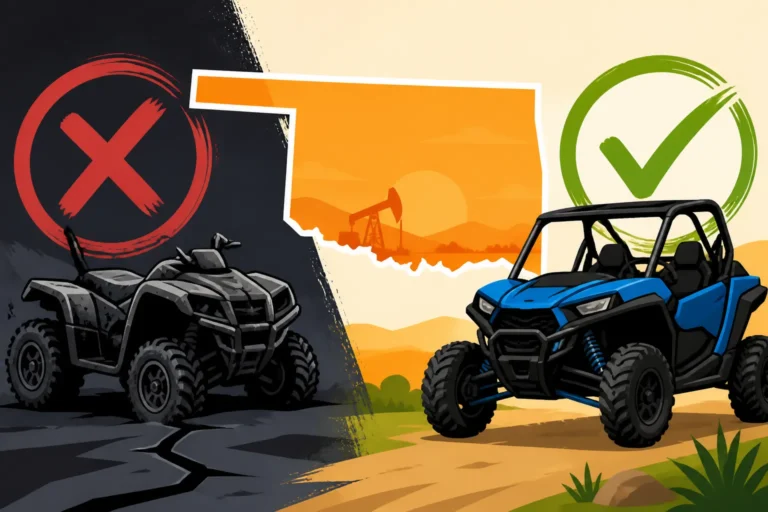
The biggest takeaway from the 2023 amendment is the crystal-clear distinction between machines intended solely for off-road use and those you want to drive on public streets. For your traditional quad or side-by-side that lives on trails, farm fields, or private land, the process remains largely unchanged. You title it, pay the [Oklahoma ATV Registration Cost] (which is a single $11 fee), get your front decal, and you're good for life, or at least for as long as you own it. There’s no yearly renewal to worry about, no constant trip to the tag agency, and no need for annual inspections or updated stickers.
However, if you're eyeing that street-legal UTV dream, the 2023 amendment really highlighted that you're entering a different ballgame. These machines need to meet specific [Oklahoma Street Legal UTV Requirements], including things like turn signals, mirrors, a horn, and proper lighting, which go way beyond what an off-road machine typically needs. More importantly, their registration is not a one-time deal. You’ll be paying for and renewing that street-legal decal every single year, just like your family car. This distinction, though introduced earlier, became much more pronounced and consistently enforced from 2023 onwards, eliminating lingering confusion about a "hybrid" registration that didn't truly exist.
The Practical Implications of the 2023 Rule Changes for Riders
So, what does this all mean for you, the rider? The implications vary depending on how you use or plan to use your ATV or UTV. For many, it's about being aware of the dual system now in place and making sure they're on the right side of the law, whether they’re sticking to the dirt or venturing onto asphalt. Ignoring these distinctions can lead to citations, fines, and a whole lot of headache, far beyond the initial registration fees.
If you’ve been riding purely off-road, perhaps on your ranch or at destinations like Little Sahara, these specific 2023 clarifications probably won't alter your routine much. Your [Oklahoma ATV Registration You Pay Once] is still valid, and you still get that single decal for the front of your machine. The main thing is to ensure you don’t mistakenly think that one-time registration makes you street-legal. It absolutely does not. The roads remain largely off-limits unless explicitly designated as open by local ordinances, or for specific agricultural purposes under the [Oklahoma's Instrument of Husbandry Exception].
How Street-Legal UTV Owners Are Now Impacted
For those who own or are considering buying a UTV with the intention of making it street-legal, the 2023 amendment brought a clearer picture of the ongoing commitment. You can't just slap on some blinkers and hope for the best; the process is now more formalized from start to finish. This includes ensuring your machine has all the [Oklahoma Equipment Required for Street UTVs], such as brake lights, headlights, turn signals, mirrors, and a horn. These aren't suggestions; they are mandates that an officer can and will check if you're pulled over on a public road.
The biggest operational shift is the annual renewal. No more "set it and forget it" for street-legal UTVs. Every year, you'll need to renew that registration and get a new decal. This means budgeting not just for the initial setup costs and higher initial registration, but for a recurring annual expense. Many riders were caught off guard by this, expecting a similar one-time fee to off-road machines. The 2023 changes really emphasized this annual requirement, making it a critical part of owning a road-worthy side-by-side. It also means you’ll be making regular trips to the tag agency or utilizing online services for these renewals.
Understanding the New Rules for Road Use
The amendment also helped solidify the rules around where you can actually ride a street-legal UTV. While you get a road plate, it doesn't grant you carte blanche to drive anywhere a car can go. [Oklahoma Street UTVs Stay Off Interstates] and [Oklahoma Street UTVs Stay Off US Highways]. Your domain is generally county roads, city streets (where local ordinances permit), and state highways with speed limits typically under 35 mph, specifically for crossing. This is a common point of confusion, and the 2023 clarification helped underscore these limitations.
It's crucial to understand your local county and city ordinances. Just because the state allows for street-legal UTVs doesn't mean every town or county has opened its roads. Many still haven't, or have very specific restrictions. Checking with your local [Oklahoma County Commissioners and ATV Roads] or municipal governing bodies is more important than ever. You don't want to get a ticket for riding legally in one jurisdiction only to find yourself in hot water a mile down the road because you crossed into an area with different rules.
Navigating the Updated Registration and Titling Landscape
Dealing with vehicle registration and titling can be a maze even in the best of times, and rule amendments certainly don't simplify things. Post-2023, for those looking to get a street-legal UTV on the road, the steps are clearer but also more demanding. It’s all about attention to detail and having the right paperwork in order.
For any machine, new or used, the first step is always getting a title. For a new machine, you'll need the [Oklahoma Requires an MSO for a New Machine] from your dealer and their [Oklahoma Dealer Invoices at Titling]. For used machines, especially older ones, you might need a [Oklahoma Bills of Sale for Older Machines] or a [Oklahoma Declaration of Purchase Price]. After the 2023 clarifications, ensure any bill of sale clearly outlines the purchase price, as this is used to calculate the [Oklahoma's 4.5 Percent Excise Tax] that applies to most UTVs unless you qualify for an [Oklahoma Agricultural Excise Tax Exemption]. Services like LawDepot can be incredibly helpful for creating legally sound bills of sale or other necessary documents that account for all required details.
Steps for Registering a Street-Legal UTV Post-2023 Amendment
If your goal is to get that street-legal plate, here's a general roadmap, keeping the 2023 clarifications in mind:
- Ensure Your UTV Meets Equipment Standards: Before you even head to the tag agency, double-check that your UTV is equipped with all the mandated items: headlights, taillights, brake lights, turn signals, mirrors (at least one on the left, but two are always better), a horn, and a windshield. These are non-negotiable for a street-legal designation.
- Gather Your Documentation: You'll need your title (or MSO for a new machine), proof of purchase (bill of sale or dealer invoice), your Oklahoma driver's license (and remember, [Oklahoma Drivers Must Be 16 for a Street UTV] and [Oklahoma Skips the Motorcycle Endorsement]), and proof of [Oklahoma Insurance at Street Registration]. For street-legal UTVs, liability insurance is a must.
- Visit a Tag Agency: Head to your local [Tag Agency or Service Oklahoma: Where to Go]. Inform them specifically that you want to register your UTV for street-legal use and obtain a road plate. Be very clear about this distinction, as it triggers a different set of forms and processes than a purely off-road registration.
- Pay Fees and Taxes: You'll pay the excise tax, the initial registration fee, and any other applicable charges. The initial registration for a street-legal UTV is generally higher than the $11 one-time fee for off-road use.
- Receive Your Plate and Decal: You'll receive a standard license plate (not just a decal) for your street-legal UTV, along with a decal to place on the plate. This plate must be displayed on the rear of your machine.
- Annual Renewal: Remember, this is the big change emphasized in 2023. Mark your calendar! Your street-legal UTV registration, and the decal on its plate, will need to be renewed annually. Don't expect a reminder in the mail like your regular car tags, as [Why Oklahoma Sends No Renewal Notice] applies to all vehicle registrations.
| Feature | Off-Road Only ATV/UTV Registration (Pre-2023 & Post-2023) | Street-Legal UTV Registration (Post-2023 Amendment) |
|---|---|---|
| Primary Use | Trails, private land, farms | Public roads (with limitations), trails |
| Registration Fee | Single $11 fee | Higher initial fee, then annual renewal fee |
| Renewal | Never renews ([Oklahoma Registration Never Renews]) | Annually ([Oklahoma Street UTV Annual Renewal]) |
| Decal/Plate | Front decal ([Oklahoma Issues a Front Decal, Not a Plate]) | Rear license plate with annual decal |
| Equipment Requirements | Basic safety (e.g., lights per manufacturer) | Extensive (e.g., turn signals, horn, mirrors) |
| Insurance Required | Not state-mandated for off-road use | Mandated liability insurance |
| Driver's License | Not required on private land, age limits vary for public trails | Driver must be 16+, valid license required |
| Road Use | Very limited, specific exceptions only | Allowed on specific roads, with major restrictions |
Using Services like LawDepot for Paperwork Accuracy
Whether you're buying or selling a used off-road machine or a street-legal UTV, having proper documentation is key. A service like LawDepot can be invaluable, especially after an amendment changes or clarifies requirements. You might need a robust bill of sale that details the machine, VIN, purchase price, and condition, which is critical for accurate [Oklahoma Excise Tax at Titling] calculations. If you're involved in a private sale, a well-drafted bill of sale helps protect both buyer and seller. LawDepot provides templates that can be customized to include all necessary information, reducing the risk of issues when you present your paperwork at the tag agency. This can save you from having to return multiple times due to incomplete or inaccurate forms, which is a common frustration for riders.
Avoiding Common Pitfalls After the 2023 Amendment
The changes, particularly the clarifications from 2023, were designed to bring more order to ATV and UTV use, but they also introduced new areas where riders can easily make mistakes. Knowing these pitfalls ahead of time can save you time, money, and potential legal trouble. The most common issues stem from not understanding the clear divide between off-road and street-legal classifications.
One major pitfall is simply assuming your off-road machine is now street-legal because you heard about the new law. The $11 [What Oklahoma's $11 Registration Fee Actually Covers] is for off-road use only and will not allow you to legally operate on public roads. Trying to do so with just that decal is a sure way to get a ticket for operating an unregistered vehicle on the highway. Always ensure your machine meets all the stringent equipment and registration requirements for a street-legal UTV before venturing onto the asphalt.
Misinterpreting Annual Renewal Requirements
Another significant mistake, especially highlighted by the 2023 operational clarifications, is forgetting or deliberately skipping the annual renewal for street-legal UTVs. Many riders, accustomed to the one-time $11 off-road decal, simply don't realize their street-legal UTV needs yearly attention. [Street UTV Decals Renew Every Single Year]. Unlike your car, you might not get a postcard reminder, so it's entirely on you to track the renewal date. Failure to renew means your UTV is no longer legally road-worthy, even if it meets all the equipment standards, and you could face penalties for expired registration.
A related pitfall is failing to ensure your machine meets current equipment standards every year. While the initial inspection might clear you, a broken turn signal or missing mirror months later could still result in a citation. Regular maintenance checks of your required street-legal equipment are paramount, not just for legality but for your own safety and the safety of others on the road.
Overlooking Local Ordinances and Restricted Roadways
Finally, a common error is not checking local ordinances. Even with a street-legal plate, you are not exempt from county and city rules. Just because you can ride on some county roads doesn't mean you can ride on all of them, or on any city street. [Oklahoma County Commissioners and ATV Roads] have the authority to open or close roads, and cities have their own specific rules. A street-legal UTV still [Oklahoma Street UTVs Stay Off Interstates] and [Oklahoma Street UTVs Stay Off US Highways] for general travel. Always verify the specific rules for the area you plan to ride in, whether through the county commissioner's office, city hall, or a simple online search for local ATV/UTV ordinances. Ignoring these can land you a ticket for violating local statutes, regardless of your state-issued road plate.
Disclaimer
This article is for general informational purposes only and does not constitute professional advice. Laws, prices and regulations vary by location and change over time. Consult a qualified professional for guidance on your specific situation.