Oklahoma Insurance at Street Registration
You've just invested in a UTV, perhaps one you're dreaming of using on Oklahoma's designated street-legal roads, and now you're faced with the bewildering process of getting it registered. One of the most common questions, and a source of real headache for many riders, is whether you need insurance to register that off-road machine for street use, and what kind of insurance that actually is. This guide will walk you through exactly what Oklahoma requires, how to meet those requirements, and what other coverage might be smart to consider for your street-legal UTV.
Understanding Oklahoma's Street-Legal UTV Class and Insurance Mandates
For years, the notion of insuring an ATV or UTV for road use in Oklahoma seemed like a distant dream, or perhaps an unnecessary complication. Most off-road machines were confined to private land, trails, or designated riding parks, where personal liability insurance might be a good idea, but certainly wasn't a state mandate for registration. However, things changed significantly when Oklahoma introduced specific legislation to create a pathway for UTVs to become street-legal. This shift brought with it new responsibilities, not least among them the requirement for proper insurance coverage.
The Legal Framework That Requires Insurance
The game-changer arrived with legislation that effectively carved out a new class of vehicle for UTVs, allowing them to operate on certain public roads. This wasn't just a simple tweak; it was a comprehensive effort to define what makes a UTV "street-legal" in the first place, covering everything from safety equipment to driver age. Crucially, as soon as a UTV is granted the privilege of operating on public roadways, it essentially steps into the same regulatory arena as any other motor vehicle. This is why, when you head to the tag agency to get your [Oklahoma Road Plates for a Street-Legal UTV], you'll be asked for proof of insurance. The state views a street-legal UTV as a vehicle that carries the same potential for accidents and liabilities as a car or truck, and therefore, it must be insured to protect other motorists and property owners. It's a fundamental aspect of road safety and financial responsibility that accompanies the freedom of street access.
This legal framework isn't unique to Oklahoma; many states that permit ATVs or UTVs on public roads have similar insurance requirements. The core idea is to ensure that if an accident occurs, there's a financial mechanism in place to cover damages and injuries. Imagine accidentally rear-ending a pickup truck at a stop sign or veering off the road and hitting someone's mailbox. Without insurance, the financial burden could be catastrophic for both you and the affected parties. The state simply wants to make sure that the financial consequences of an incident don't fall solely on innocent victims or public services. It’s about creating a level playing field of accountability for all vehicles sharing the road, whether they're conventional cars or these exciting, relatively new additions to the public thoroughfare.
Why Off-Road Machines Traditionally Didn't Need It
Before the advent of street-legal UTV classifications, ATVs and UTVs were, by definition, off-road vehicles. Their primary environments were private property, dedicated trails, or vast open lands where the general public wasn't typically at risk in the same way they are on busy streets. Because they weren't operating on public roads, the traditional motor vehicle insurance mandates simply didn't apply. You might choose to carry some form of off-road vehicle insurance, perhaps through your homeowners' policy or a specialized provider, but it was almost always optional. This type of coverage typically focused on theft, damage to your machine, or liability if someone was injured on your property while riding your machine.
The distinction between off-road use and on-road use is critical here. When a machine is strictly off-road, the risks are different, and the legal responsibilities are usually tied to property ownership or trail access rules. For instance, if you were riding on your own land and had an accident, your homeowners' policy might offer some protection. If you were at a private riding park, they likely had their own liability waivers and insurance policies in place. The state didn't intervene with mandatory insurance because the potential for interaction with the general public's vehicles and property was minimal, if not entirely absent. This made the registration process for purely off-road machines relatively simple, focusing more on basic ownership and excise tax rather than ongoing financial proof of responsibility.
What Kind of Insurance Does Oklahoma Require?
When it comes to getting your street-legal UTV registered, Oklahoma isn't asking for just any old insurance policy. It's looking for specific coverage that mirrors what's required for cars, trucks, and motorcycles operating on public roads. This primarily boils down to liability insurance, designed to protect others if you're at fault in an accident. Understanding these minimums is crucial, but it's also wise to consider what options exist beyond them for your own financial peace of mind.
Minimum Liability Coverage Expectations
Just like with any other vehicle on Oklahoma's roads, your street-legal UTV needs to meet the state's minimum liability insurance requirements. This is often expressed in a series of three numbers, such as 25/50/25. Let's break down what these figures typically mean. The first number, often $25,000, refers to the maximum amount your insurance will pay for bodily injury liability for one person injured in an accident where you are at fault. The second number, typically $50,000, is the maximum for all bodily injuries in a single accident, regardless of how many people are hurt. Finally, the third number, also often $25,000, covers property damage liability in a single accident. This means if you collide with another vehicle, a building, or a fence, your insurance will pay up to this amount for the damage you cause to their property.
It's important to understand that these are minimums. While they satisfy the legal requirement for [Oklahoma Insurance at Street Registration], they might not fully cover the actual costs of a serious accident. For example, if you cause an accident that results in severe injuries to multiple people, or if you damage a luxury car, the total costs could easily exceed these minimums. In such a scenario, you would be personally responsible for paying the difference out of pocket. This is why many riders, after understanding the implications, choose to purchase higher liability limits than the state minimums to better protect their assets and future earnings from potential lawsuits. It’s a classic case of balancing legal compliance with realistic risk management, especially when considering the significant financial exposure that even a minor accident can entail.
Understanding Your Options Beyond the Minimum
While minimum liability gets you a road plate, it leaves a lot uncovered. Savvy UTV owners often look beyond the basics to protect their investment and their finances more comprehensively. One of the first steps past liability is adding uninsured/underinsured motorist (UM/UIM) coverage. This is incredibly valuable in an accident where the other driver is at fault but either has no insurance or insufficient insurance to cover your damages and medical bills. Given the number of uninsured drivers on the roads, having UM/UIM can be a real lifesaver, ensuring you're not left to pay for someone else's mistake. It essentially acts as a safety net for your own medical costs and machine repairs when the at-fault party can't cover them.
Then there's the consideration for your own machine. Standard liability insurance does nothing to cover damage to your UTV. For that, you'll want to explore collision and comprehensive coverage. Collision insurance pays for damage to your UTV if you hit another vehicle or object, or if it rolls over. Comprehensive coverage, on the other hand, steps in for non-collision incidents like theft, vandalism, fire, natural disasters (think hail or flood damage), or even hitting an animal. These two types of coverage are crucial if you've got a significant investment in your UTV, especially if you're still making payments on it. Without them, you'd be entirely on your own for repair or replacement costs after an incident. Many riders also like to cover any customizations they've added, like a robust lift kit from SuperATV or an upgraded sound system, as these additions often exceed the factory cost the base policy covers.
The Process: Proving Insurance at the Tag Agency
Getting your street-legal UTV registered involves a few steps, and showing proof of insurance is a critical one. It's not something you can just skip or promise to get later; the tag agency will require it on the spot. Being prepared with the correct documentation can make the difference between a smooth visit and having to make another trip. This can be especially frustrating if you've already taken the time to gather all your other paperwork.
Required Documents and Verification Steps
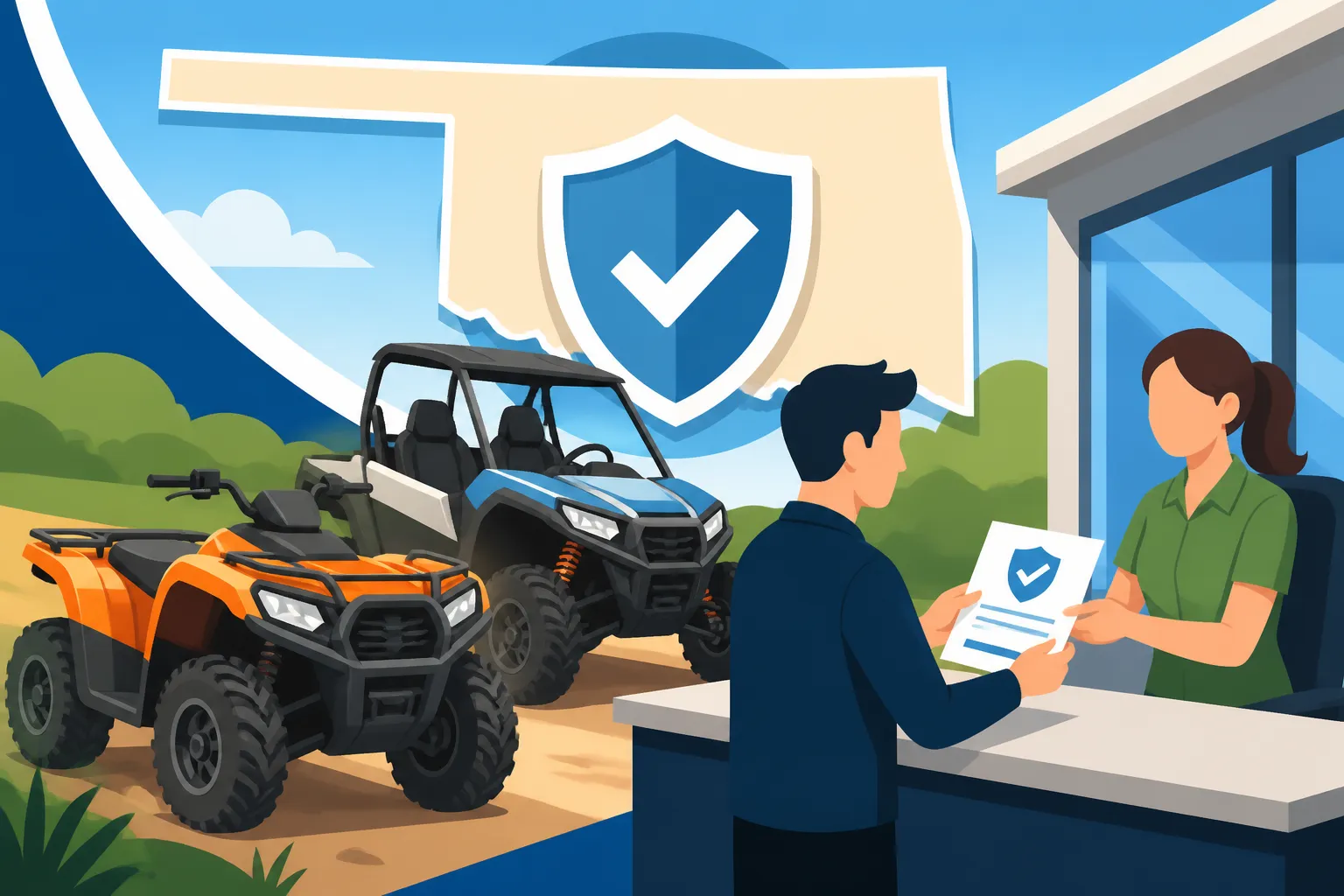
When you arrive at an Oklahoma tag agency to register your street-legal UTV, you'll need to present several key documents. Beyond your title, bill of sale, and the [Oklahoma ATV Registration Application Explained], you absolutely must have proof of current liability insurance for that specific UTV. This can typically be in the form of an insurance ID card, a copy of your policy declarations page, or a digital copy on your phone. What's crucial is that the document clearly shows the UTV's VIN (Vehicle Identification Number), the effective dates of the policy, and the coverage limits, which must meet or exceed Oklahoma's minimums. The tag agency clerk will verify this information to ensure everything is in order before proceeding with your registration.
The verification process is straightforward but firm. They aren't just glancing at a card; they're confirming that the policy is active and matches the UTV you're trying to register. If the VIN on your insurance card doesn't match the VIN on your UTV's title or MSO, or if the policy appears to be expired, they will not be able to complete the registration. This is why it's so important to double-check all the details before you even leave your driveway. Imagine the frustration of waiting in line, only to find out your insurance card has an old VIN or your policy lapsed last week. It's a common, albeit preventable, hiccup in the registration process that can cost you precious time and a second trip to the agency.
Common Pitfalls and How to Avoid Delays
One of the most frequent mistakes riders make is assuming their existing car insurance or off-road policy automatically covers their UTV for street use. This is almost never the case. A standard auto policy is designed for cars and trucks, and an off-road policy is often limited to private property or trail riding. For street-legal UTVs, you need a policy specifically tailored for a UTV operating on public roads, or one that explicitly extends coverage to that usage. Always confirm with your insurance provider that your policy covers your UTV for on-road use in Oklahoma. Another pitfall is trying to use an expired insurance card or one that belongs to a different vehicle. Always carry the most current proof for the specific UTV you are registering.
To avoid these frustrating delays, here’s a simple checklist. First, contact an insurance provider that offers specific UTV policies that include coverage for street-legal operation in Oklahoma. Second, ensure the VIN on your policy matches your UTV's VIN exactly. Third, confirm the effective dates show active coverage at the time of your visit. Finally, have a physical or easily accessible digital copy of your insurance ID card or declarations page ready when you go to the tag agency. Doing these things in advance can save you a significant amount of hassle and ensure that your visit to get your [Oklahoma Street UTV Plate Costs] and decal goes as smoothly as possible. Many local agents are quite familiar with these requirements, so don't hesitate to lean on their expertise.
Here's a quick overview of what to bring:
| Document Category | Specific Item Required | Key Detail to Check |
|---|---|---|
| Proof of Ownership | Manufacturer's Statement of Origin (MSO) or Title | VIN must match UTV, no liens unless noted |
| Proof of Purchase | Bill of Sale or Dealer Invoice | Purchase price, buyer/seller names, date |
| Application | Oklahoma ATV Registration Application | All sections accurately filled, signed |
| Proof of Insurance | Insurance ID Card or Policy Declarations | UTV VIN, active dates, Oklahoma minimum liability |
| Personal ID | Driver's License or State ID | Current, valid, matching applicant name |
Factors Influencing Your Street-Legal UTV Insurance Cost
Just like car insurance, the cost of insuring your street-legal UTV isn't a one-size-fits-all number. A variety of factors come into play, from the machine itself to your personal driving history. Understanding these can help you anticipate costs and potentially find ways to save. It's not just about the state's minimums; it's about how much risk an insurer perceives you and your machine to carry.
Machine Type, Rider History, and Usage
The type of UTV you own plays a significant role in your insurance premiums. A high-performance sport UTV, with its powerful engine and potential for higher speeds, might cost more to insure than a utilitarian work-focused UTV. The newer and more expensive your machine, the higher the replacement cost in the event of a total loss, which will be reflected in your comprehensive and collision premiums. Customizations also factor in. If you've upgraded your UTV with expensive aftermarket parts, perhaps from SuperATV, you'll want to ensure those are covered, which will typically increase your premium. Insurance companies look at the likelihood of theft, the cost of repairs, and the inherent risks associated with different types of machines.
Your personal riding history is another major component. A clean driving record, free of accidents or traffic violations, will generally qualify you for lower rates. Conversely, a history of claims, speeding tickets, or even DUI convictions (yes, [Oklahoma DUI Law and Off-Road Machines] can apply to street-legal UTVs) can significantly drive up your premiums. Insurance companies assess you as a risk: the more responsible you appear to be behind the wheel, the less of a financial gamble you are for them. Finally, how you plan to use your street-legal UTV can influence costs. If you primarily use it for occasional errands on low-traffic roads, your risk profile might be different than someone who plans to commute daily or travel on county roads where speeds might be higher. It's about how often and in what conditions your machine is exposed to potential incidents.
Discounts and Bundling Opportunities
Don't assume your first quote is your final price. There are often various discounts available that can help reduce the cost of your street-legal UTV insurance. Many insurance providers offer discounts for completing a recognized safety course, even though [Oklahoma Has No Mandatory Safety Course] for ATVs or UTVs. This demonstrates a commitment to safe riding practices, which insurers appreciate. You might also find discounts for anti-theft devices installed on your UTV, for being a member of certain associations or clubs, or for being a loyal customer for a certain period. Simply asking your agent about available discounts can uncover significant savings.
One of the most effective ways to save money is by bundling your UTV insurance with other policies you already hold, such as your auto insurance, homeowners' insurance, or even motorcycle insurance. Most major insurance carriers offer multi-policy discounts, which can lead to substantial savings across all your premiums. It streamlines your insurance needs with a single provider and reduces administrative costs for the insurer, a saving they often pass on to you. It's always worth getting a quote from your current insurance provider first, as they might offer the best bundling incentives, especially if you have a long-standing relationship with them. Always compare quotes from several providers, however, to ensure you're getting the best deal for your specific needs.
Beyond the Basics: Protecting Your Investment
While liability insurance is non-negotiable for street-legal UTVs, truly protecting your machine and your finances often means looking past the minimums. Your UTV is likely a significant investment, and leaving it vulnerable to theft, damage, or unforeseen events can be a costly mistake. Exploring comprehensive and collision coverage, along with specific add-ons for your unique machine, is a smart move for any responsible owner.
Comprehensive and Collision Coverage
We touched on this earlier, but it bears repeating: comprehensive and collision coverage are the unsung heroes of a robust UTV insurance policy. Collision coverage is what steps in if your street-legal UTV is damaged in an accident involving another vehicle or object, or if it rolls over. Imagine you're navigating a tight turn on a paved county road and misjudge it, leading to a collision with a guardrail. Your collision coverage would help pay for the repairs to your UTV, minus your deductible. Without it, you'd be looking at potentially thousands of dollars in out-of-pocket expenses to get your machine back in working order.
Comprehensive coverage, on the other hand, is your protection against almost everything else that isn't a collision. This includes scenarios like theft, vandalism (think slashed tires or graffiti), fire, natural disasters such as hailstorms or floods, and even hitting an animal while driving. For example, if your UTV is parked outside your home and a severe hailstorm rolls through, or if it's stolen from your garage overnight, comprehensive coverage would cover the repair or replacement costs. Given the value of many modern UTVs, especially those equipped with high-performance components or accessories, having both collision and comprehensive coverage provides a crucial financial safety net against a wide array of potential losses.
Add-ons for Customization and Accessories
Many UTV owners love to personalize their machines, adding everything from light bars and sound systems to winches and custom lift kits. If you're like many enthusiasts who've spent a significant amount of money upgrading your machine, perhaps with quality parts from SuperATV, you absolutely need to make sure these customizations are properly insured. A standard UTV policy might only cover the machine's factory value, leaving your expensive aftermarket additions unprotected. This is where specific add-on coverages for accessories and custom parts become essential.
Most insurance companies offer endorsements or separate policies that allow you to declare the value of your added equipment. This ensures that in the event of damage or theft, you'll be reimbursed for the actual cost of your customized machine, not just its stock value. Think about the peace of mind knowing that your high-end sound system, your powerful winch, or those new, wider tires are fully covered. Discussing these specific additions with your insurance agent is vital. They can help you accurately assess the value of your modifications and ensure your policy reflects your full investment, preventing a potentially unpleasant surprise if you ever need to file a claim. Don't let your passion for customization turn into a financial vulnerability; ensure every dollar you've invested is accounted for in your coverage.
Navigating the Market: Finding the Right Policy
Finding the right insurance for your street-legal UTV doesn't have to be a daunting task. While it's tempting to grab the first quote, taking a little time to compare options and understand the nuances can save you money and provide better coverage in the long run. The market is competitive, and different providers cater to different needs and risk profiles.
Comparing Quotes from Different Providers
The golden rule of insurance shopping, whether for a car, home, or street-legal UTV, is to compare quotes from multiple providers. Don't settle for the first offer you receive. Different companies have different underwriting criteria, discount structures, and risk assessments, which can lead to surprisingly varied premiums for essentially the same coverage. You might find that a company specializing in motorcycle or recreational vehicle insurance offers more competitive rates or better terms for UTVs than a general auto insurer. It's not uncommon to see hundreds of dollars in difference for comparable policies.
When comparing quotes, make sure you're looking at apples to apples. Verify that each quote includes the same liability limits, deductibles, and any additional coverages you deem necessary, such as comprehensive and collision. Pay attention to the fine print regarding custom parts and accessories, as well as any specific exclusions. Use this process to your advantage, not just to find the cheapest premium, but to identify the policy that offers the best blend of coverage, service, and cost for your specific needs. It's an investment in your UTV and your financial security, so a thorough comparison is well worth the effort.
Working with an Agent vs. Online Shopping
Deciding whether to go with an independent insurance agent or to shop online directly from a provider's website is a common dilemma. Both approaches have their merits. Working with a local or independent agent can offer a personalized experience. An agent can sit down with you, understand your specific riding habits, your UTV's customizations (like those you might have from SuperATV), and your overall financial situation. They can then shop around among multiple carriers on your behalf, often finding policies and discounts you might not uncover on your own. Agents can also be invaluable advocates if you ever need to file a claim, guiding you through the process and helping resolve any issues. For those who prefer a human touch and expert advice, an agent is often the preferred route.
On the other hand, online shopping offers convenience and speed. Many major insurance carriers allow you to get instant quotes and even purchase policies entirely online, often outside of traditional business hours. This can be ideal if you're comfortable doing your own research and know exactly what kind of coverage you need. Online platforms can be great for quickly comparing basic liability rates or if you're simply looking for the most budget-friendly option. However, the downside can be a lack of personalized advice, and it might be harder to navigate complex coverage questions or unique situations. Ultimately, the best approach depends on your personal preference for service, your comfort level with online transactions, and the complexity of your insurance needs for your street-legal UTV.
Disclaimer
This article is for general informational purposes only and does not constitute professional advice. Laws, prices and regulations vary by location and change over time. Consult a qualified professional for guidance on your specific situation.