Why a Tag Agency Asks for the Dealer Invoice
It's a familiar scenario for many Oklahoma ATV and UTV enthusiasts: you've just bought your dream machine from a dealership, filled out what feels like a mountain of paperwork, and you're ready to head to the tag agency. You expect to hand over the Manufacturer's Statement of Origin (MSO) and maybe your ID, but then the clerk asks for something else: the dealer invoice. "But why?" you might wonder. "Don't they already have everything they need?" This guide will break down exactly why that dealer invoice is so crucial for registering and titling your off-road vehicle in Oklahoma.
Understanding the Dealer Invoice Request at an Oklahoma Tag Agency
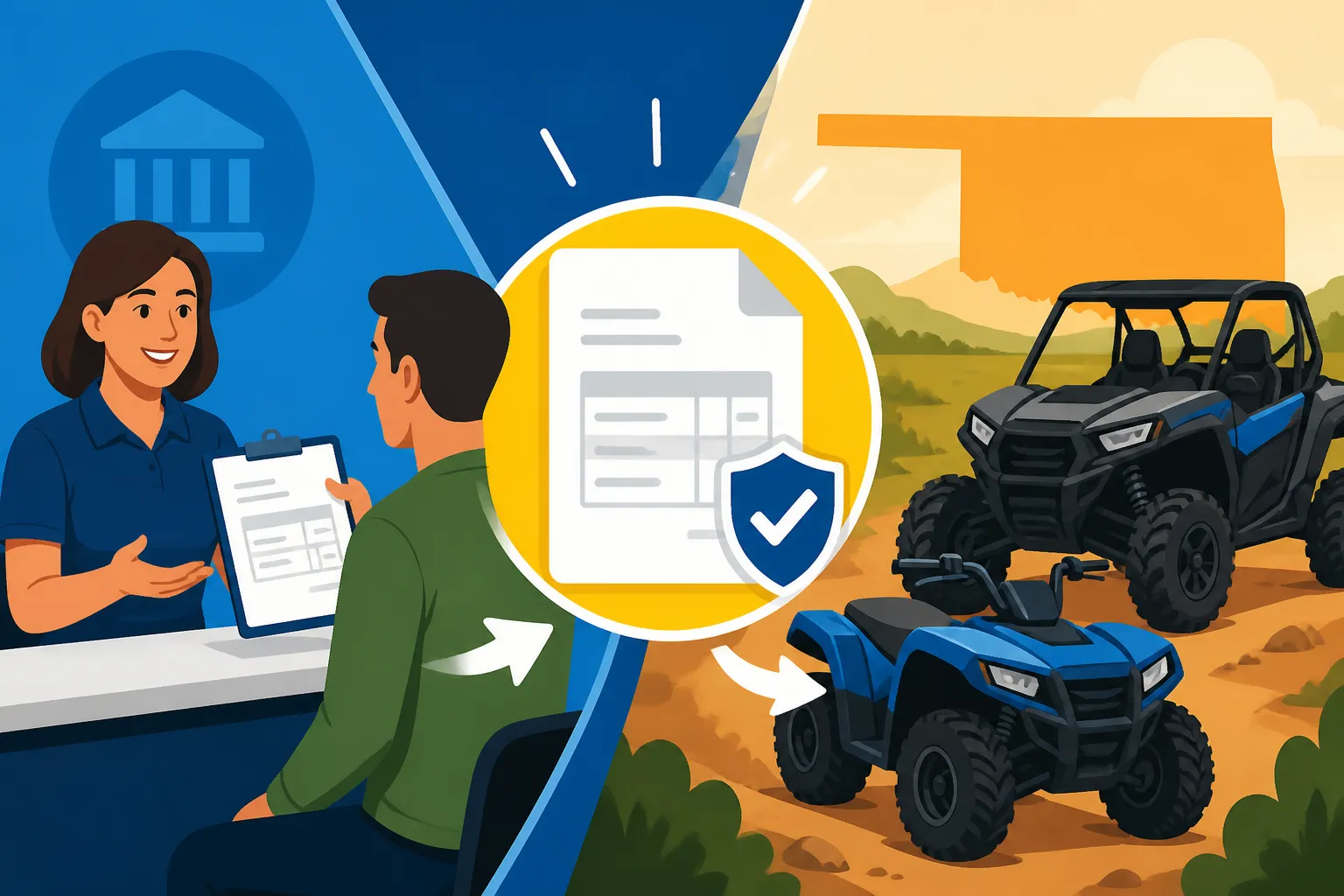
That request for the dealer invoice isn't just a bureaucratic hurdle; it's a foundational piece of the puzzle for the Oklahoma Tax Commission, which oversees the tag agencies. They're not trying to make your life harder, but they do have a job to do, and that invoice helps them do it accurately.
It's All About Establishing Value and Tax
The primary reason your local tag agency needs that dealer invoice is to establish the true purchase price of your new ATV or UTV. In Oklahoma, when you title an off-road vehicle, you'll pay a one-time excise tax. This isn't a sales tax in the traditional sense, but a separate tax collected at the time of titling. The amount of this [Oklahoma's 4.5 Percent Excise Tax] is directly calculated based on the declared purchase price of your machine. Without a detailed invoice, it would be difficult, if not impossible, for the tag agency to accurately assess this tax. They need concrete proof of what changed hands financially.
Think of it from the state's perspective: they need to ensure fairness and consistency for everyone. If one person could just declare any price without proof, it would lead to an unfair system. The invoice provides that verifiable figure, making sure you pay the correct amount, no more and no less.
Proving New Ownership and First Sale
Beyond the tax implications, the dealer invoice serves as vital documentation for proving new ownership and confirming that this is the initial retail sale of the vehicle. When you buy a brand-new ATV or UTV, the dealership provides you with a Manufacturer's Statement of Origin (MSO). This document is like the machine's birth certificate; it confirms that the vehicle meets federal safety and emission standards and lists its technical specifications. However, the MSO alone doesn't detail the financial transaction.
The dealer invoice, when presented alongside the [Bringing a Manufacturer's Statement of Origin to a Tag Agency], completes the picture. It links the specific machine (identified by its VIN on the MSO) to the buyer and the price paid. This is especially important for establishing the very first owner in the chain of title and ensures that the state records accurately reflect the vehicle's initial journey from manufacturer to consumer. For subsequent private sales, the process changes, but for a new machine, this pairing of documents is essential.
Beyond the Sticker Price: What the Invoice Details
Many people assume the "purchase price" is just the MSRP or the agreed-upon price for the machine itself. However, a comprehensive dealer invoice typically breaks down all the components that contribute to your final cost. This can include:
- Base Price: The core cost of the ATV or UTV.
- Optional Equipment/Accessories: Any upgrades, winches, light bars, or special tires you added at the time of purchase.
- Freight/Destination Charges: The cost to get the machine from the factory to the dealership.
- Setup/Preparation Fees: What the dealer charges to uncrate, assemble, fill fluids, and perform a pre-delivery inspection.
- Documentary Fees (Doc Fees): Administrative fees charged by the dealer for processing paperwork.
Each of these line items can contribute to the total "purchase price" that the excise tax is calculated on. The tag agency needs to see this detail to understand the full scope of the transaction and apply the 4.5% excise tax correctly. Sometimes, what you thought was a simple sticker price actually includes a variety of charges that impact your total tax bill.
The Financial Side: How the Invoice Impacts Your Wallet
Let's be frank: nobody enjoys paying taxes or fees, but understanding why you're paying them can at least demystify the process. The dealer invoice is the key to that understanding, especially when it comes to the financial obligations associated with titling your new off-road machine in Oklahoma.
Calculating Oklahoma's Excise Tax Accurately
As we touched on, Oklahoma levies a 4.5% excise tax on the purchase price of your ATV or UTV when you title it. This is not the same as the sales tax you pay on other goods, which was actually eliminated for vehicles in 2021. Instead, it's a one-time fee collected by the state at the tag agency. The dealer invoice is the authoritative document for this calculation. Let's say your total purchase price, including freight and setup, is $12,000. Your excise tax would be 4.5% of that amount. Without the invoice clearly itemizing these costs, the tag agency would have to guess or rely on less reliable information, which could lead to errors and potential issues down the road. This direct link between the invoice and your tax bill is why it's so vital. Your [Oklahoma Excise Tax at Titling] is a significant part of your initial outlay, and the invoice ensures its correct assessment.
Dealer Fees and Why They Matter for the Invoice
You might notice various fees itemized on your dealer invoice, such as "freight," "setup," or "documentary fees" (often called "doc fees"). These fees are charged by the dealership for services related to getting your machine ready and handling the transaction. While they can sometimes feel like an added sting, they are generally considered part of the overall cost of the vehicle for excise tax purposes.
- Freight Charges: This covers the cost of shipping the ATV or UTV from the manufacturer to the dealer.
- Setup Fees: This compensates the dealer for uncrating, assembling, and performing pre-delivery inspections to ensure the machine is ready to ride safely.
- Doc Fees: These cover the administrative costs associated with preparing all the sales and title paperwork. [Oklahoma Dealer Documentary Fees] typically fall within a certain range, and you'll see them clearly listed on your invoice.
The tag agency needs to see these fees on the invoice because, in most cases, they're factored into the total purchase price that the 4.5% excise tax is applied to. So, while you might negotiate the price of the machine, these fees often become part of the final taxable amount. Understanding this helps you budget for the full "out-the-door" price, including the [Oklahoma Dealer Freight Charges] and setup costs.
When a Trade-In Changes the Invoice Calculation
What if you're trading in your old ATV or UTV towards the purchase of a new one? This is where the dealer invoice becomes even more important for clarity. In Oklahoma, the excise tax is applied to the net purchase price after a trade-in, assuming the trade-in is also a vehicle that was subject to excise tax when it was acquired.
Your dealer invoice should clearly show the agreed-upon price of the new machine, the trade-in allowance for your old machine, and the resulting net amount. This net figure is what the 4.5% excise tax will be calculated on. So, if your new side-by-side is $15,000 and you trade in an old quad for $3,000, the excise tax would be on $12,000. If the dealer invoice doesn't explicitly show this breakdown, the tag agency may have questions, and you might have to pay excise tax on the full new machine price before getting a potential refund later. Always check how your [Does a Trade-In Reduce Oklahoma's Excise Tax?] is reflected on the dealer's final invoice.
What If You Don't Have a Dealer Invoice? Private Sales and Older Machines
Not every ATV or UTV purchase involves a shiny new machine from a dealership. Many riders find their perfect quad or side-by-side through a private sale or inherit a trusty old workhorse that's been around for decades. In these situations, a dealer invoice simply won't exist, and the tag agency has a different set of documents they'll ask for.
The Declaration of Purchase Price for Private Sales
If you've bought a used ATV or UTV from a private seller, you won't have a dealer invoice or an MSO. Instead, the critical documents for titling and registration will be a bill of sale and a form called the Declaration of Vehicle Purchase Price. The bill of sale acts as your proof of ownership, detailing the buyer, seller, VIN, and most importantly, the agreed-upon purchase price.
The Declaration of Vehicle Purchase Price form, which you'll fill out at the tag agency, is where you formally state the amount you paid for the machine. This is the figure that the excise tax will be calculated on. It's crucial that the price declared on this form matches what's on your [Writing a Bill of Sale That Lists the Price] to avoid any inconsistencies or delays. For many private sales, especially those without a notary, this form becomes the state's official record of the transaction value. When you're ready to declare that price, the tag agency will assist you with [When You File a Declaration of Vehicle Purchase Price]. Many riders find it helpful to use online resources, like those available from LawDepot, to ensure their bill of sale includes all the necessary details and is legally sound for presenting at the tag agency. LawDepot can provide customizable templates that make this process straightforward.
Older Machines and Affidavit of Ownership
What if your machine is truly ancient, perhaps a vintage quad from the 1980s that's been passed down through the family, and there's no bill of sale or any other paperwork to be found? This is a situation that comes up more often than you might think, especially with off-road machines that weren't always strictly titled in the past.
In these cases, you definitely won't have a dealer invoice. The tag agency will have specific procedures for establishing ownership and value. This often involves an affidavit of ownership, where you swear under oath that you are the rightful owner and explain how you acquired the machine. They might also use industry guides (like NADA) to determine a fair market value for the excise tax calculation. While it might seem daunting, it's a path many owners of [Oklahoma Machines With No Paperwork] have navigated. It simply requires a different approach than bringing in a new dealer invoice, and the tag agency staff are usually well-versed in these scenarios. Remember, for these situations, a well-prepared affidavit, perhaps even using a template from a service like LawDepot, can greatly assist in proving your claim and moving the titling process forward.
Common Questions and Getting It Right the First Time
Navigating the world of ATV and UTV registration and titling can sometimes feel like a maze, especially with all the required paperwork. Getting it right the first time saves you trips back to the tag agency and avoids unnecessary frustration. Let's tackle some common questions related to the dealer invoice.
What If My Invoice Has Errors?
It happens. Dealerships are busy places, and sometimes errors can sneak onto an invoice. Maybe the VIN is incorrect, an accessory wasn't listed, or a fee was miscalculated. If you notice any discrepancies on your dealer invoice, it is absolutely critical that you address them before you leave the dealership. Trying to correct an invoice after you've left, or worse, after you've presented it to the tag agency, can be a major headache.
The tag agency relies solely on the document you provide. If there's an error, they'll process it as-is, and you might end up paying incorrect taxes or having issues with your title later on. Take a moment to thoroughly review every line item on that invoice before you sign and take possession of your new machine. It’s far easier for the dealer to make a correction on the spot than to get an amended document later.
What to Bring Besides the Invoice
While the dealer invoice is a cornerstone document for a new purchase, it's not the only thing you'll need. To ensure a smooth, one-trip visit to the tag agency for your new ATV or UTV, make sure you have the following essentials in hand:
- Manufacturer's Statement of Origin (MSO): This is the "birth certificate" for your new machine.
- Your Valid Driver's License or State ID: For identification purposes.
- Proof of Oklahoma Residency: Such as a utility bill or lease agreement if your ID doesn't show your current Oklahoma address.
- Payment for Fees and Taxes: This will include the excise tax, the one-time [Oklahoma ATV Registration Cost], and any other titling fees.
- Proof of Insurance (if applicable): While not typically required for initial off-road registration, if you plan to get a road plate for a street-legal UTV, you'll need insurance.
Having all these documents organized and ready will streamline your visit and ensure you walk out with your new title and decal. You can also review [Oklahoma ATV Title Requirements] or [Oklahoma's ATV Registration Application Explained] for a complete checklist.
Why Some Fees Seem Confusing
It's completely understandable to feel a bit confused or overwhelmed by the various fees and charges that appear on a dealer invoice and at the tag agency. It can sometimes feel like you're being nickel-and-dimed. The key distinction to remember is that the tag agency's role is primarily to collect state-mandated taxes (like excise tax) and registration fees. They don't set the dealer's freight, setup, or doc fees.
The dealer invoice simply provides the official record of all the money that changed hands in the transaction, and the state uses that total figure to calculate the excise tax. So, while you might find some dealer fees frustrating, the tag agency is simply applying the state's rules to the documented purchase price. If you have questions about specific dealer fees, those are best directed to the dealership itself before you finalize your purchase. The tag agency clerks are there to process your paperwork according to the law, which is why having a clear and accurate dealer invoice is so important for them.
Here's a quick comparison of documents needed:
| Scenario | Key Document for Value & Ownership | Other Required Documents |
|---|---|---|
| New Machine from Dealer | Dealer Invoice | Manufacturer's Statement of Origin (MSO), ID, Proof of Address |
| Used Machine (Private) | Bill of Sale & Declaration of Purchase Price | ID, Proof of Address, Current Title (if available) |
| Very Old Machine (No Paperwork) | Affidavit of Ownership | ID, Proof of Address, State-approved Value Assessment |
Disclaimer
This article is for general informational purposes only and does not constitute professional advice. Laws, prices and regulations vary by location and change over time. Consult a qualified professional for guidance on your specific situation.