What Oklahoma’s Registration Application Asks For
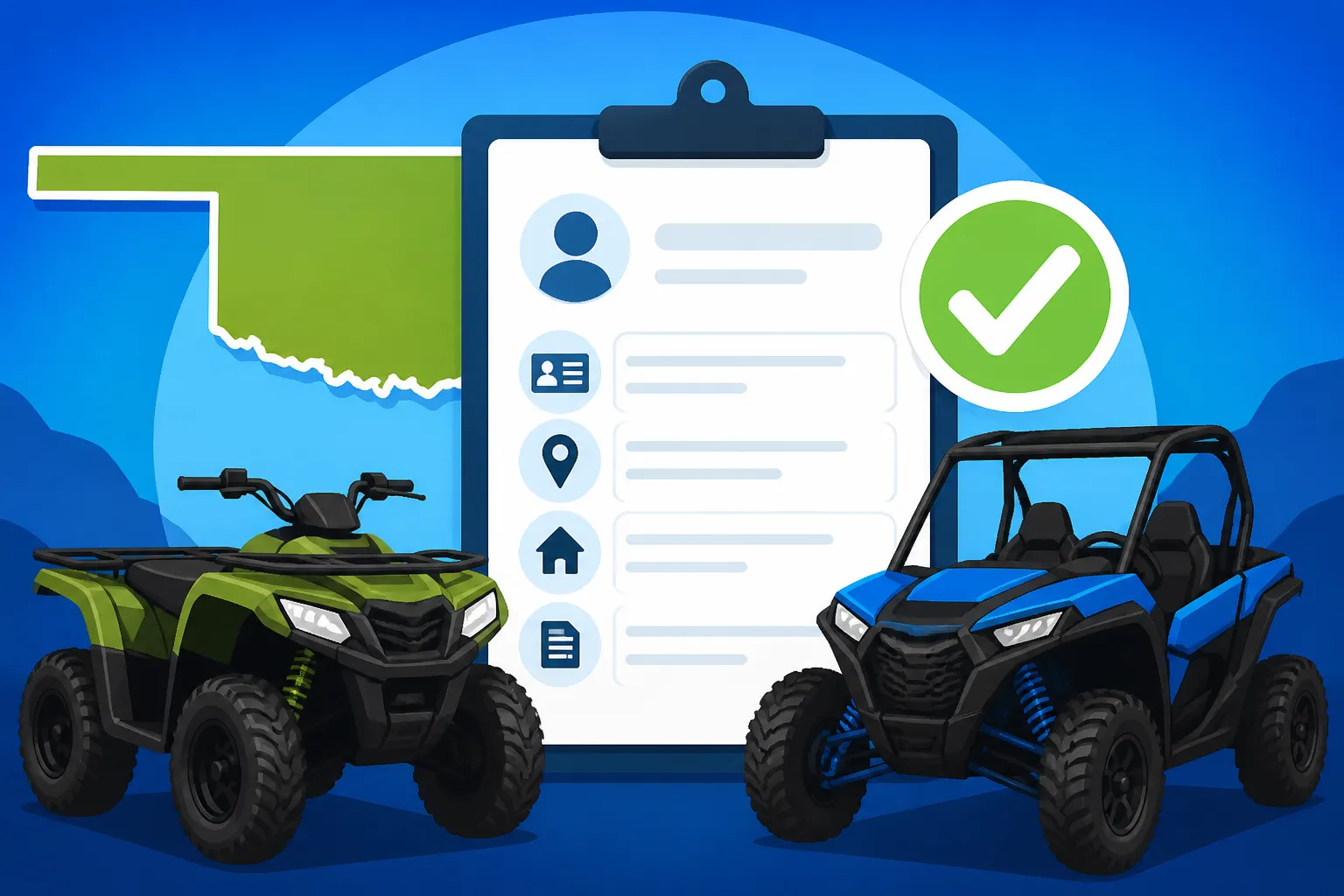
Let's be real: trying to figure out what forms to fill out and what information you need to bring when registering your ATV or UTV in Oklahoma can feel like solving a puzzle with half the pieces missing. You just want to hit the trails or get some work done on the farm, not spend hours deciphering government paperwork. This guide is here to demystify the Oklahoma ATV registration application, breaking down every section so you know exactly what to expect and how to complete it without a hitch.
Why the Registration Application Matters So Much
The registration application for your off-road machine in Oklahoma isn't just another piece of bureaucratic paperwork; it's the cornerstone of your legal ownership and ability to ride. Many riders underestimate its importance, thinking it's just a formality, but getting it right from the start can save you a world of trouble later on.
More Than Just a Form: It's the Foundation
The application isn't just a piece of paper you quickly fill out; it's the official record that establishes your ownership and right to operate your ATV or UTV in Oklahoma. Think of it as the foundational document for everything else that follows – your title, your registration decal, and even how potential future transactions are handled. When you walk into an Oklahoma tag agency, this application is what the clerk will use to input all of your machine's critical data into the state system. Every single field, from your name to the vehicle identification number (VIN) and the declared purchase price, builds the official profile of your off-road machine within the state's records.
Without a correctly completed application, the entire process grinds to a halt. Imagine showing up, waiting in line, and then being told you're missing a crucial piece of information that you could have easily provided if you'd known about it beforehand. This isn't just an inconvenience; it can mean an extra trip to the tag agency, or even worse, delaying your ability to ride legally. It sets the stage for accurate record-keeping, ensuring that your machine is correctly identified and that you're paying the appropriate taxes and fees, like the initial [Oklahoma's 4.5 Percent Excise Tax].
Avoiding Future Headaches: Getting It Right the First Time
Taking the time to fill out the application accurately and completely from the start can save you a world of trouble down the line. Incorrect information, like a transposed VIN digit or a misspelled name, can lead to discrepancies that pop up unexpectedly in the future. For example, if you decide to sell your machine, a mismatch between your title and the registration application could raise red flags for the buyer or complicate the transfer process at the tag agency. It's much easier to double-check everything now than to go through the bureaucratic hoops of correcting an error months or years later.
Beyond simple mistakes, the application also dictates how the state tracks your machine for things like late fees or even potential impoundment if it's ever involved in an incident. An incomplete application might mean you don't receive important notices, or that your ownership isn't clearly established in state records, which could make reclaiming a stolen machine more difficult. Think of this initial diligence as an investment in peace of mind, ensuring that your off-road adventures are always on the right side of the law. You want your [Oklahoma ATV Registration You Pay Once] to be smooth, not stressful.
Section by Section: Owner Information
The first major segment of the Oklahoma ATV/UTV registration application focuses on establishing who you are as the owner. This section is all about your identity and your connection to the state, ensuring that the machine is legally linked to a responsible party.
Your Personal Details: Accuracy is Key
The initial part of the application will ask for your full legal name, current physical address (remember, no P.O. boxes for registration, as the state needs a verifiable location!), and your mailing address if it differs from your physical address. You'll also need to provide your Oklahoma driver's license number or state identification card number, along with your date of birth and contact information like a phone number and email address. While these details seem straightforward, accuracy is paramount.
Any deviation, even a minor one like using an initial instead of your full middle name, could lead to delays. Imagine you've just moved to Oklahoma and you're eager to get your new side-by-side registered. If the address on your driver's license doesn't match your current residence, you'll need to be prepared to offer additional proof of your new Oklahoma residency, such as a utility bill, rental agreement, or a bank statement. The tag agency needs to verify that the person registering the machine is indeed an Oklahoma resident and who they claim to be. This is especially true for new arrivals trying to navigate [Oklahoma Registration for a New Resident].
Multiple Owners and Business Registrations
If you're purchasing an ATV or UTV with another person, perhaps a spouse, family member, or a business partner, the application will have specific sections to list multiple owners. It's critical to decide beforehand how you want the ownership structured. Commonly, this is either "and" (meaning both owners must agree and sign for any future transactions, like selling the machine) or "or" (allowing either owner to act independently). This choice has legal ramifications, so discuss it thoroughly with co-owners. Accurately completing this section ensures your [Oklahoma Registration With Two Owners] is legally sound from the start.
For those using their off-road machines primarily for commercial or agricultural purposes, such as a ranching operation, a landscaping business, or a hunting lease outfitter, you'll register the machine under the business entity's name. This requires providing the business's full legal name, its federal employer identification number (FEIN), and the physical address of the business. Additionally, you'll need to designate an individual, typically an owner, officer, or authorized agent, who has the legal authority to sign on behalf of the business. This designation ensures proper attribution of the machine to the entity that owns and operates it, crucial for both asset management and tax compliance. Having all the appropriate corporate or LLC paperwork in order is vital for [Oklahoma Titles for a Business Machine].
Section by Section: Vehicle Details
This part of the application is dedicated to the ATV or UTV itself. It's where you provide all the identifying characteristics of your machine, ensuring the state has an accurate record of the specific vehicle being registered.
Identifying Your Machine: VIN and Make/Model
The most crucial piece of information in this section is the Vehicle Identification Number (VIN). This unique 17-character code is essentially your machine's individual fingerprint, detailing its manufacturer, model year, assembly plant, and sequence number. You'll also be asked to provide the make (e.g., Yamaha, Kawasaki, Can-Am), the specific model (e.g., Grizzly, Brute Force, Defender), the actual year of manufacture, and the engine size, usually stated in cubic centimeters (CCs). Double-check the VIN you write on the application against the VIN stamped directly on your machine's frame or printed on your Manufacturer's Statement of Origin (MSO) or bill of sale. A single transposed digit can lead to an immediate rejection of your application.
Tag agency clerks are trained to verify VINs rigorously. They'll compare the VIN on your application to your supporting documents and may even ask you to verify it against a photograph of the VIN plate on the machine. This is especially true for older or unique machines where paperwork might be less standardized. Take your time entering this information, paying close attention to similar-looking characters like the letter 'O' versus the number '0', or 'I' versus '1'. It's also worth noting that [Oklahoma Has No Odometer Rule for ATVs], so you won't need to worry about reporting mileage for off-road vehicle registration.
Understanding the Cutoff Dates
Oklahoma has specific cutoff dates that are immensely important for ATV and UTV registration and titling. These dates dictate whether your machine requires a prior title and influence the type of ownership documentation you'll need. For ATVs (often referred to as quads), the critical date is July 1, 2005. If your quad was manufactured before this date, it generally has different, often less stringent, titling requirements and may not have a previous title. For UTVs (side-by-sides), the cutoff date is July 1, 2008.
The application form will implicitly or explicitly guide you based on these dates. For example, if you're registering a 2004 model quad, you might primarily need a detailed bill of sale to prove ownership. However, for a 2006 quad, you will almost certainly need an MSO or a previously issued Oklahoma title. Many riders find these cutoff dates confusing, but knowing your machine's exact year of manufacture before you start filling out the application is absolutely essential. Understanding [Oklahoma's 2005 and 2008 Cutoff Dates] is crucial for assembling the correct paperwork.
Special Designations: Agricultural or Street-Legal
The registration application may also inquire about the primary intended use of your ATV or UTV. For many Oklahoma residents, particularly those involved in farming, ranching, or other rural activities, the machine is an indispensable tool. While agricultural exemptions for registration itself largely ceased in 2008, holding an agricultural permit can still provide an exemption from paying the state's excise tax at the time of titling. The form might include a checkbox or a field to indicate if you're declaring the machine for agricultural use, which would then require you to present your agricultural exemption card or number.
Another increasingly relevant designation is for "street-legal" UTVs. If you've modified your UTV to meet the state's requirements for limited public road use and are seeking a special road plate, the application process will reflect this. This is a separate, annual registration that is distinct from the one-time off-road registration. You'll need to explicitly state your intent to register it as a street-legal UTV and be prepared to show that your machine is equipped with all the necessary safety features, such as turn signals, mirrors, a horn, and proper lighting. Familiarizing yourself with [Oklahoma's Street-Legal UTV Statute] will help ensure your machine qualifies.
Section by Section: Purchase Information
This section of the application delves into the financial specifics and method of acquisition for your ATV or UTV. It helps the state determine applicable taxes and verifies the legal transfer of ownership.
The Price You Paid: Excise Tax Implications
One of the most critical pieces of financial information you'll provide on the application is the purchase price of your ATV or UTV. This figure is directly used to calculate the 4.5% Oklahoma excise tax that you'll owe at the time of titling. It is vital to report the actual, true sale price of the machine itself, not including any trade-ins, extra accessories, or dealer-added services. A common misconception is that a trade-in reduces the taxable value; however, for ATVs and UTVs, the excise tax is based on the full value of the machine you are acquiring, not just the cash difference you paid.
If you purchased your machine from a licensed dealer, this purchase price will be clearly itemized on your dealer invoice. For private sales, the price should be explicitly stated on your bill of sale. In situations where the machine was acquired as a gift or through inheritance, you might need to complete a "Declaration of Vehicle Purchase Price" form, where you would state a nominal value or formally declare it as a gift. In some cases, a gift may be exempt from excise tax, but it's always best to confirm this specific scenario with a local tag agency. Accurate reporting here helps prevent complications with [Oklahoma Excise Tax at Titling].
Source of Acquisition: Dealer, Private, or Gift
The application will also require you to indicate how you acquired your ATV or UTV. Did you purchase it new from a licensed dealer? Did you buy it from a private individual? Was it a gift from a family member, or did you inherit it? This information is crucial because it dictates the type of supporting documentation the tag agency will expect to see to prove your ownership. For instance, a brand-new machine purchased from a dealer will necessitate a Manufacturer's Statement of Origin (MSO) and a detailed dealer invoice. A used machine acquired through a private sale will typically require a properly executed bill of sale.
For older machines, especially those bought before the specific cutoff dates, where formal titles might not exist, a comprehensive bill of sale becomes the primary proof of ownership. If you've acquired a machine through less conventional means, such as a gift, inheritance, or if original paperwork is missing, you might be asked to sign a "Declaration of Purchase Price" or even an affidavit of ownership. In these private transaction scenarios, using a professional template from a service like LawDepot for your bill of sale can ensure all necessary details are captured, providing clarity for both buyer, seller, and the tag agency. This clarity is invaluable whether you're dealing with [Oklahoma Titles After a Private Sale] or [Oklahoma Titles for an Inherited Machine].
Understanding Supporting Documents
While the registration application itself is crucial, it's just one piece of the puzzle. You'll need to bring several other key documents to the tag agency to successfully register and title your ATV or UTV. These documents serve to prove ownership, verify your identity, and confirm your residency.
Proof of Ownership: MSOs, Bills of Sale, and Declarations
The most critical supporting documents are those that establish your legal ownership of the ATV or UTV. For new machines, this is the Manufacturer's Statement of Origin (MSO), which functions as the vehicle's initial certificate of title, along with the dealer's invoice detailing the purchase. When dealing with used machines, the requirements vary based on the machine's age and history. If the machine was previously titled in Oklahoma, you'll need the original title, properly signed over to you by the previous owner.
For older ATVs, especially those manufactured before the July 2005 cutoff, a complete and detailed bill of sale might be sufficient proof of ownership, as Oklahoma often [Oklahoma Skips Chain of Title for Old Machines] for these older models. In situations where original paperwork is lost, or if the machine was inherited or gifted, you might be asked to complete a Declaration of Vehicle Purchase Price or an affidavit of ownership. These situations can sometimes be complex, so it's always a good idea to contact your local tag agency beforehand if you anticipate any issues with ownership documentation. Services like LawDepot can assist in generating legally sound bills of sale or affidavits to help you cover all your bases.
Identification and Residency Proof
To finalize your ATV or UTV registration, you'll need to present valid identification and, in some cases, proof of your current Oklahoma residency. Your valid, unexpired Oklahoma driver's license or state identification card is typically sufficient for identification. However, if you are a new resident, or if the address on your ID does not precisely match the physical address you've provided on the registration application, the tag agency will require additional documentation to confirm your residency.
Acceptable forms of additional residency proof can include a recent utility bill (such as electric, water, gas, or trash), a current rental agreement or lease, a mortgage statement, or a recent bank statement. The key is that these documents must clearly display your name and the current physical address that you are listing on your registration application. This step ensures that the state can accurately link your machine to a legitimate Oklahoma resident. Having all these documents readily available can significantly reduce [Oklahoma Registration Processing Time].
Here's a handy table summarizing common ownership documents:
| Acquisition Method | Machine Year/Type | Primary Ownership Document | Supporting Document(s) Often Needed | Notes |
|---|---|---|---|---|
| New from Dealer | Any ATV/UTV | Manufacturer's Statement of Origin (MSO) | Dealer Invoice | MSO is the 'birth certificate.' Invoice shows purchase price. |
| Used Private Sale | ATV (pre-July 2005) | Bill of Sale | Declaration of Purchase Price (if needed) | Often no prior title. Bill of sale must be detailed, like one from LawDepot. |
| Used Private Sale | ATV (post-July 2005) / UTV | Signed-over Oklahoma Title | Bill of Sale | Title must be properly signed and notarized if required. Bill of sale confirms transaction details. |
| Used Private Sale | Out-of-State Purchase | Prior State's Title | Bill of Sale | Ensure the out-of-state title is properly signed off. [Oklahoma Tax on an Out-of-State Purchase] applies. |
| Gift / Inheritance | Any ATV/UTV | Bill of Sale (nominal value) | Declaration of Purchase Price | A specific declaration form might be needed to declare a gift, possibly avoiding excise tax. [Oklahoma Titles for an Inherited Machine] has more details. |
| Auction Purchase | Any ATV/UTV | Auction Sales Document | Bill of Sale, possible Affidavit | Specific documentation from the auction house is required, potentially an affidavit if no title exists. Paperwork for a Quad Bought at Auction is specific. |
Common Pitfalls and How to Avoid Them
Even with all the right information, small errors can lead to big headaches when registering your ATV or UTV. Being aware of common mistakes can help you navigate the process smoothly and efficiently.
Missing Information and Typos
The most frequent reason for an application rejection or delay is surprisingly simple: missing information or typographical errors. It could be an overlooked blank field, an incomplete address, or a single digit transcribed incorrectly in the VIN. These seemingly minor errors can bring your entire registration process to an immediate halt. Tag agency clerks are trained to be extremely meticulous because their primary role is to ensure that the state's records are perfectly accurate. If they find any discrepancy, they are required to send you away to correct the error before they can proceed.
Before you even consider heading to the tag agency, dedicate a few minutes to meticulously review every single line item on your completed application. Compare the VIN on your form against the VIN on your Manufacturer's Statement of Origin (MSO), bill of sale, or directly from the machine's frame. Double-check your driver's license number, date of birth, and current address. This extra step, while seemingly tedious, can save you hours of frustration, potentially multiple trips to the tag agency, and the disappointment of not being able to ride. Your ultimate goal is to complete your [Oklahoma Registration Before Your First Ride] without a hitch.
Expired Paperwork and Incomplete Signatures
Another common issue that often stalls the registration process is presenting paperwork that is either expired or lacks essential signatures. For example, if you're using a bill of sale as proof of ownership, ensure that both the buyer (you) and the seller have properly signed and dated the document. If the transaction involves an older document, confirm that it clearly and accurately reflects the current transfer of ownership. When submitting an MSO or a previously issued title, verify that the seller has completed all necessary sections for transferring ownership, including their signature in the designated space. Some title transfers may even require a notary's signature, depending on the circumstances.
Always make sure your personal identification, such as your driver's license or state ID, is current and unexpired. An expired ID will not be accepted by the tag agency. Furthermore, if your ATV or UTV is being registered with multiple owners, ensure that every individual who is required to sign has done so. For business registrations, the authorized signatory must sign, and occasionally a corporate seal may also be required. Utilizing a reputable template from a service like LawDepot for your bill of sale can be incredibly helpful, as these templates are designed to include all the necessary fields and signature lines, significantly reducing the chances of an incomplete document. Being thoroughly prepared ensures you avoid common missteps, safeguarding you from [Five Registration Mistakes That Cost Riders Money].
Disclaimer
This article is for general informational purposes only and does not constitute professional advice. Laws, prices and regulations vary by location and change over time. Consult a qualified professional for guidance on your specific situation.