Oklahoma Registration When the Serial Is Gone
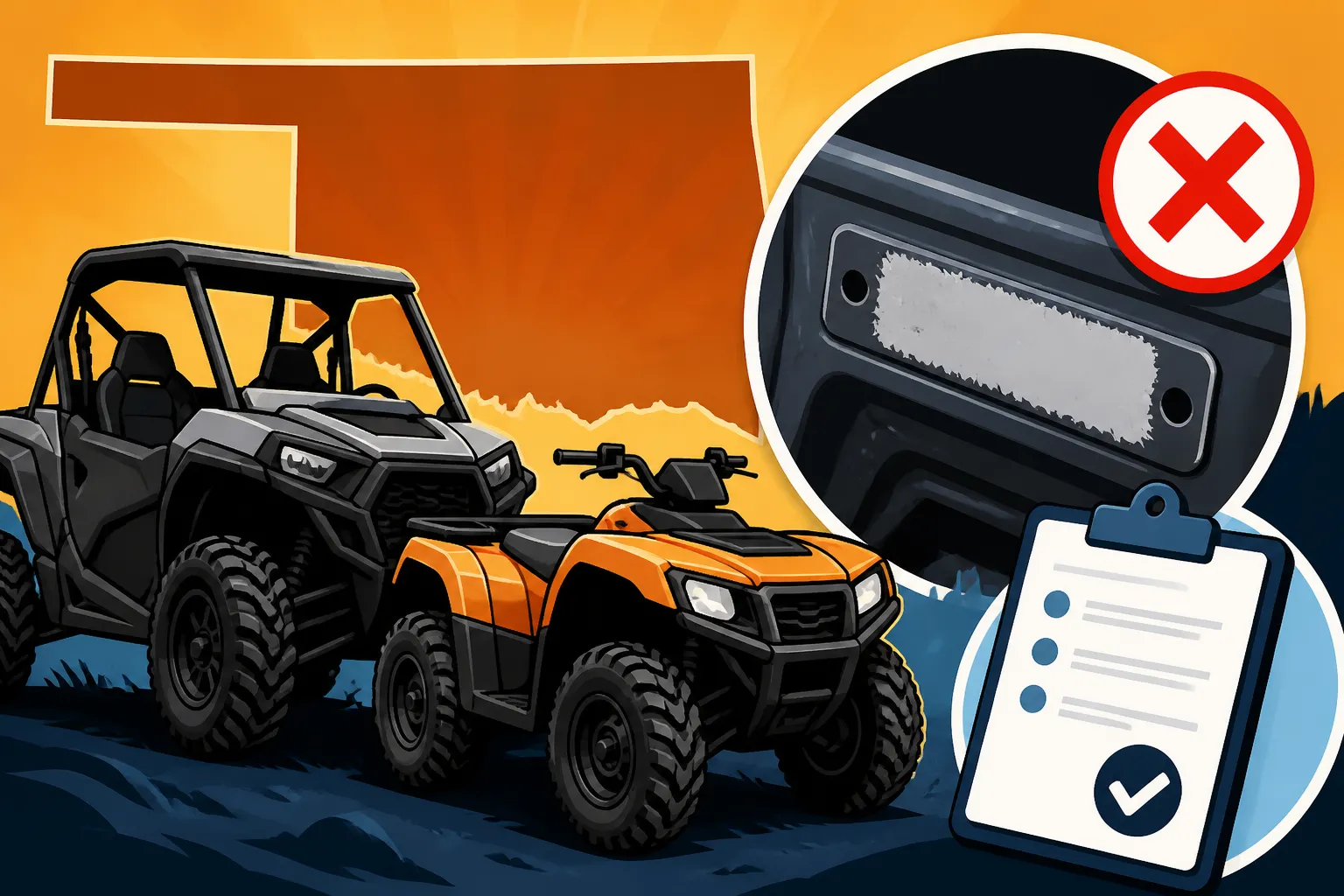
Many riders in Oklahoma find themselves in a tough spot when they've got a quad or a side-by-side they love, but somewhere along the line, the all-important serial number – that Vehicle Identification Number (VIN) – has gone missing, been scratched off, or is just plain unreadable. This isn't just a minor annoyance; it can throw a massive wrench into getting your machine legally titled and registered in the Sooner State. This guide is here to walk you through the frustrating reality of dealing with a lost or compromised VIN and what steps you can realistically take to navigate the Oklahoma titling and registration process.
The Headache of a Missing or Unreadable Serial Number
Imagine you've just bought what seems like a great deal on a used ATV. You're ready to hit the trails, maybe at Little Sahara or Robbers Cave, but when you go to register it, the tag agency clerk looks at you with that familiar "this is going to be a problem" expression. The serial number, your machine's unique identifier, is either completely gone, ground off, or so rusted and faded it's impossible to read. This isn't just about an obscure detail; it's about proving ownership, ensuring the machine isn't stolen, and meeting a fundamental legal requirement in Oklahoma.
Why the VIN is Your Machine's Identity Card
Every vehicle, including your ATV or UTV, gets a unique serial number at the factory – think of it as its DNA. This string of characters encodes information like the manufacturer, model year, and production sequence. For the state of Oklahoma, this VIN is the absolute bedrock of vehicle identification. It's how your machine is distinguished from every other one on the planet. Without it, verifying who legally owns the machine, or even if the machine itself is legitimate, becomes incredibly difficult. It's the primary piece of information a tag agency clerk will look for when you bring in your [Oklahoma's ATV Registration Application Explained] or any other paperwork.
The absence of a clear VIN raises immediate red flags, and for good reason. Stolen vehicles often have their VINs tampered with or removed to obscure their origins. While your situation might be completely innocent – perhaps years of outdoor storage rusted it away, or an accident obscured it – the authorities have to treat any missing VIN with suspicion. This means your journey to legal registration will be scrutinized more intensely, and you'll likely face additional hurdles that perfectly legitimate owners with clear VINs never encounter. It's a frustrating situation when you know your intentions are good, but the physical evidence on your machine tells a different story.
The Impact on Ownership and Resale Value
Beyond the immediate challenge of registration, a missing or unreadable VIN profoundly impacts your ability to prove legal ownership. Without this unique identifier tied to a title, your "ownership" is essentially based on a handshake and a bill of sale, which might not hold up under legal scrutiny, especially if the machine's history is ever questioned. If you ever want to sell that machine down the road, potential buyers will be understandably wary. How can they be sure they're not buying a stolen item? How can they even register it themselves? A missing VIN drastically reduces the resale value and shrinks your pool of potential buyers to those willing to take on significant risk and legal headaches.
Imagine trying to explain to a potential buyer that you just can't get it titled because the VIN is gone. Even if you've been riding it on private land for years, the moment you want to make it legitimate or pass it on, you hit this brick wall. Most reputable buyers, and certainly any dealer considering a trade-in, will outright refuse a machine without a clear, verifiable VIN. This means that a machine that might otherwise be valuable can become almost worthless on the open market, confined to private property use indefinitely. It’s a bitter pill to swallow for what might otherwise be a perfectly good, functional ATV or UTV.
Oklahoma's Stance on Missing VINs for ATVs and UTVs
Oklahoma takes the integrity of vehicle identification very seriously, and rightfully so. The state's system for [Oklahoma Titles ATVs and UTVs], while simpler than for cars in some aspects, still hinges on that critical serial number. If your machine doesn't have a visible, legible VIN, you're going to face an uphill battle at the tag agency. Unlike some other states that might have more robust procedures for assigning new VINs to previously untitled machines in specific situations, Oklahoma's system is built on the premise that the factory VIN will always be present and readable.
Why the VIN is Non-Negotiable for Titling
For any ATV or UTV that requires titling in Oklahoma – which includes virtually all of them, especially those manufactured after specific cutoff dates like [Oklahoma ATV Cutoff of July 2005] and [Oklahoma UTV Cutoff of July 2008] – the VIN is the cornerstone of the entire process. Without it, the tag agency simply cannot process your application for a title. The VIN is how they check against stolen vehicle databases, how they track previous owners (if a title history exists), and how they properly categorize the machine for state records. It's a fundamental data point that their system demands.
This isn't just about bureaucracy; it's about preventing fraud and protecting legitimate owners. The state's systems are designed to ensure that every titled machine has a clear, unambiguous identity. When that identity is compromised, the system, by design, halts. A tag agency clerk isn't just being difficult when they tell you they can't proceed; they're following strict state regulations. They don't have the authority to issue a title or registration decal to a machine with an unidentifiable serial number because doing so would open the door to all sorts of illicit activities and undermine the very purpose of vehicle titling.
What a Tag Agency Will Look For
When you visit an Oklahoma tag agency, the clerk will request specific documentation, including your proof of ownership (like a [Oklahoma Declaration of Purchase Price], a [Oklahoma Dealer Invoices at Titling], or [Oklahoma Bills of Sale for Older Machines]) and the machine's VIN. If the VIN is obscured, they're not going to take your word for what it "used to be" or what you "think it says." They need to physically verify it. This might involve an inspection, though Oklahoma generally [Oklahoma Has No Out-of-State VIN Inspection] requirements for ATVs, implying an expectation that the VIN is readily available on machines purchased within the state.
If the VIN is truly unreadable, the tag agency will likely inform you that they cannot proceed. They may advise you to contact law enforcement or, in rare cases, suggest applying for a "Special Assigned VIN" through the Department of Public Safety (DPS) or another state agency. However, for ATVs and UTVs, this process is far more common for kit cars or custom builds that never had a factory VIN, not for machines where the original VIN has been lost or removed. It's crucial to understand that getting a "new" VIN assigned to a machine that should have had one is an exceptionally challenging process, often requiring extensive documentation, law enforcement verification, and proof that the machine wasn't stolen.
Steps to Take When Your Machine's VIN is Compromised
Finding yourself with an ATV or UTV that has a missing or unreadable serial number can feel like a dead end, but there are some logical, albeit challenging, steps you can take. Your primary goal will be to either recover the original VIN or, failing that, gather enough evidence to convince the authorities that your machine is legitimate and deserves an identity. This process requires patience, meticulous record-keeping, and a willingness to navigate various state agencies.
Contacting Law Enforcement
The first and most crucial step when dealing with a compromised VIN is to contact your local law enforcement agency – the sheriff's office in a rural area, or city police in a municipality. Explain your situation: you have a machine, you believe it's legitimately yours, but the VIN is unreadable or gone. They will likely want to inspect the machine themselves. Their primary concern will be to ascertain if the machine is stolen or if the VIN was deliberately tampered with for illegal purposes. Be prepared for a thorough examination.
A police officer might be able to use specialized techniques to reveal a partially obscured VIN, or they might have access to resources that can help trace the machine's history if other identifiers (like engine serial numbers, if present and distinct) are available. If they determine the machine is not stolen and the VIN was genuinely lost due to age, wear, or an accident, they might provide you with a written statement or a report. This document, affirming that the machine isn't stolen and has been inspected, will be invaluable for any further steps you take. It's the first hurdle you absolutely must clear to move forward.
Searching for Hidden or Secondary VINs
Manufacturers often place VINs in multiple locations on a vehicle. While the primary VIN plate is usually easy to find (often on the frame, near the handlebars, or on the passenger side of a UTV), there might be secondary or "secret" VINs stamped elsewhere on the frame, engine block, or other major components. These are often less exposed to the elements and might still be legible even if the primary VIN is not. Do a thorough search, using a wire brush (carefully!) or even a flashlight and magnifying glass, across the entire frame. Consult online forums for your specific make and model; other owners might know common secondary VIN locations.
Even if you find a secondary VIN, it's critical that it matches any documentation you have, such as your [Oklahoma Bills of Sale for Older Machines] or any previous title paperwork (if you have it). If you find a matching VIN, take clear photographs from multiple angles. This can be the breakthrough you need. Presenting a clear, readable VIN, even if it's from a less obvious location, might be enough for the tag agency to proceed with your titling process. Remember, the goal is to provide any legible, verifiable serial number that can be traced back to the manufacturer and, ideally, to your proof of ownership. If you're dealing with an older machine, you might need tips for [Reading the VIN Plate on a Pre-2005 Machine].
Crafting a Robust Bill of Sale or Declaration
If you purchased the machine from a private seller, having a detailed bill of sale is always crucial, but it becomes absolutely essential when the VIN is compromised. This document should include the full names and addresses of both buyer and seller, the date of sale, the purchase price, and a detailed description of the machine, including make, model, year, and any identifiable numbers (even if the main VIN is gone, note any engine numbers or partial frame numbers). You can find templates for these documents through services like LawDepot, which help ensure all necessary fields are included.
If you don't have a perfectly clear VIN to put on the bill of sale, the seller should still include a statement affirming that they sold the machine to you with the VIN in its current, unreadable state, and that they guarantee they are the rightful owner. If you're filling out an [Oklahoma Declaration of Purchase Price], you'll still need to provide as much identifying information as possible, explaining in the notes section the issue with the VIN. While a bill of sale or declaration can't replace a VIN, it serves as vital evidence of a legitimate transaction, especially when supported by a law enforcement report confirming the machine isn't stolen. It provides a paper trail that, while incomplete regarding the VIN, can corroborate your story of ownership. Always make sure to get all paperwork in order, especially when buying used, as [Oklahoma Skips Chain of Title for Old Machines] for some ATVs, placing more weight on the bill of sale. For a private sale, this is key for [Oklahoma Titles After a Private Sale].
When All Else Fails: The Limits of the System
Unfortunately, for ATVs and UTVs in Oklahoma, if you cannot recover a legible VIN and law enforcement cannot verify its legitimacy, you may find yourself in a situation where the machine cannot be legally titled or registered. Unlike passenger vehicles, which sometimes have avenues for "bonded titles" or specialized VIN assignment for unique circumstances, these options are rarely applicable or available for off-road vehicles with genuinely lost or removed factory VINs. The state's priority is to prevent stolen vehicles from being legitimized.
This means that machines in this category often become limited to use on private property only, where no state registration is required. While this isn't ideal, it's often the reality for owners facing this specific challenge. Before giving up entirely, however, make one last attempt: visit a different tag agency. Sometimes, the interpretation of rules can vary slightly, or a different clerk might have more experience with unusual cases. Always bring all your documentation: law enforcement reports, bills of sale (perhaps a template from LawDepot), photographs, and any other shred of evidence you have.
Here's a quick look at the typical documentation requirements, and how a missing VIN complicates things:
| Document Type | With Clear VIN | With Missing/Unreadable VIN |
|---|---|---|
| Proof of Ownership | MSO (New), Bill of Sale (Used), Title (Transfer) | Bill of Sale (from LawDepot), Declaration of Purchase Price |
| VIN Verification | Visual inspection by tag agency clerk | Law enforcement inspection and report (critical) |
| Previous Title (if applicable) | Required for transfer | Not possible if no VIN, reliance on bill of sale |
| Application Form | [What Oklahoma's Registration Application Asks For] | Standard form, with explanation/notes on VIN |
| Excise Tax Payment | Based on purchase price and VIN | Based on purchase price, but VIN still needed for system |
| Registration Decal Issuance | Issued once title and tax are cleared | Highly unlikely without a verifiable VIN and title |
This table really highlights how central the VIN is. If you're buying a used machine, especially an older one where rust and wear are common, it's absolutely vital to [Photographing the VIN Before You Hand Over the Machine] and ensure it's clear and verifiable before money changes hands. It's a simple step that can save you countless headaches down the road. You can also [Checking Whether a Used ATV Was Reported Stolen] using the VIN to protect yourself.
Ultimately, while Oklahoma tries to make registration straightforward, the system relies heavily on that unique serial number. If it's gone, your options become significantly limited, often to the point where the machine can only be used on private land. It's a harsh reality, but an important one for all ATV and UTV owners in the state to understand.
Disclaimer
This article is for general informational purposes only and does not constitute professional advice. Laws, prices and regulations vary by location and change over time. Consult a qualified professional for guidance on your specific situation.