No Exemption for a Visitor
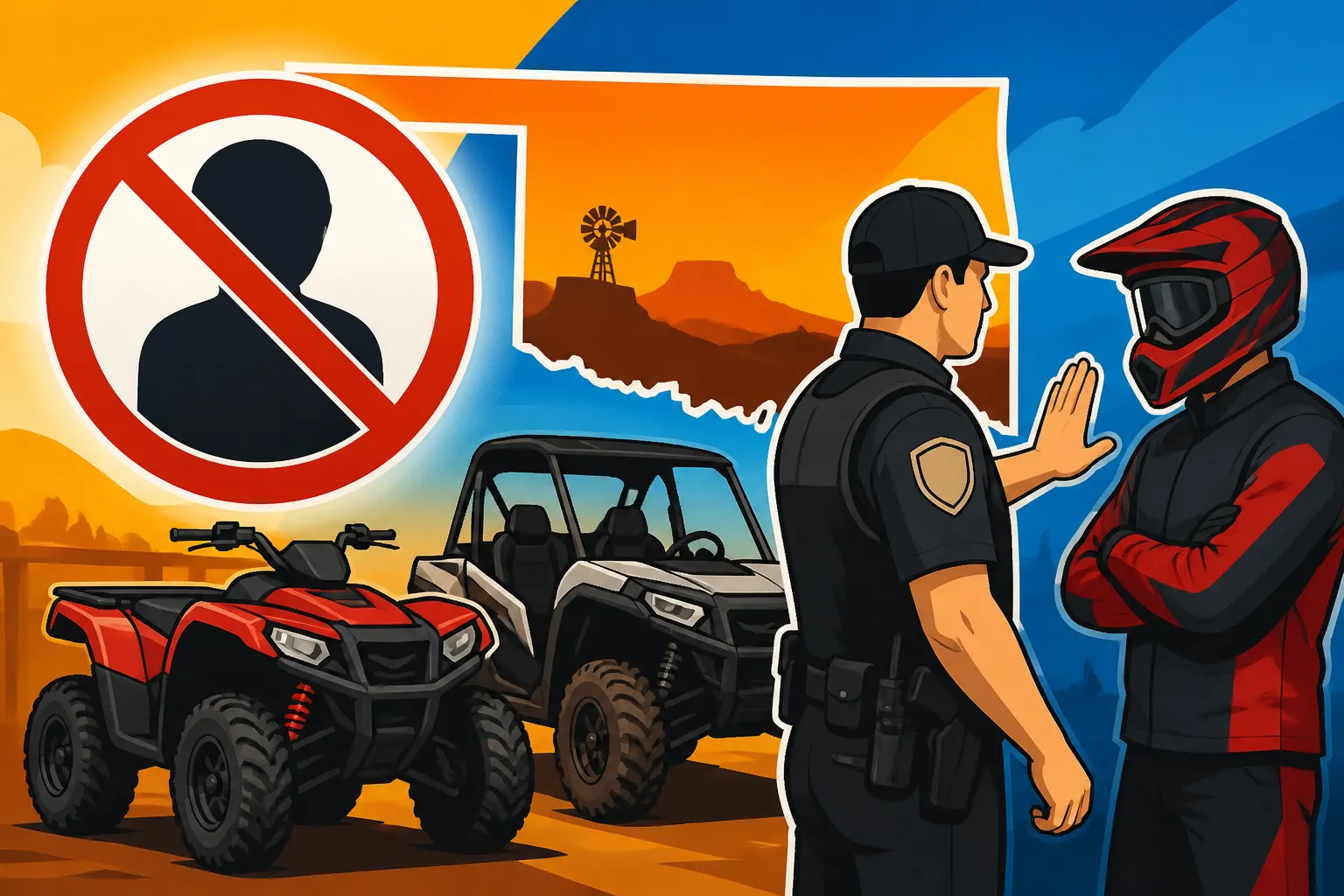
Visitors riding an ATV or UTV in Oklahoma may assume their home-state registration or age exemption carries over. It may not. The key distinction is where you ride: certain public lands require a separate land access permit, and nonresidents generally cannot use resident age exemptions to avoid that permit.
What “no exemption for a visitor” means
Oklahoma’s land access permit rules apply to particular lands, including Honobia Creek and Three Rivers Wildlife Management Areas. The permit is separate from your ATV registration, any decal from your home state, and fees charged by a riding park.
Some Oklahoma residents qualify for an age-based exemption from the land access permit requirement. That resident exemption does not automatically extend to visitors. A nonresident should not assume that being under 18 or 64 and older removes the permit requirement when riding on land covered by the program.
This does not mean every visitor needs a land access permit everywhere in Oklahoma. It means you need to check the requirements for the specific property you plan to ride. A state wildlife area, a private off-road park, a state park, and a public road can each have different rules and charges.
| Where you plan to ride | What to check |
|---|---|
| Honobia Creek or Three Rivers | Whether you need a land access permit, plus current access and riding rules |
| A different wildlife management area | Whether motorized riding is allowed there and whether a permit applies |
| A private riding park | The park’s entry fees, waivers, age rules, and machine requirements |
| A state park or dune area | That site’s vehicle access rules, fees, and safety requirements |
| A road or street | Whether local and state rules allow the machine on that route |
A permit is not a blanket pass to ride any public land. It also does not replace compliance with property-specific rules, seasonal closures, designated-route limits, or other access conditions. Before traveling, check the current permit details and land rules with the official source. For a closer look at the difference between resident and visitor requirements, see Oklahoma Resident vs Nonresident Permits and Oklahoma’s Nonresident Land Access Permit.
Why your home-state status may not help
Visitors often mix together three separate questions: whether the machine is registered, whether the rider needs a land access permit, and whether the particular site allows that machine. A document that answers one question does not necessarily answer the others.
Registration is not the land access permit
A current registration or decal from another state may help show that your machine is registered there. It does not, by itself, prove that you have paid for access to Oklahoma land covered by a separate permit program.
Likewise, an Oklahoma land access permit is not a replacement for registration where registration is required. Keep the paperwork for each requirement separate, and confirm what you need for the land you will visit. The rules for an out-of-state decal are a different topic from the age-based permit exemption; see Does Oklahoma Recognize Another State’s ATV Decal?.
An age exemption may be resident-specific
A visitor may be accustomed to a home state’s age-based exception, or may see Oklahoma residents riding without a permit and assume the same rule applies to everyone. That can lead to an avoidable problem at a check-in point or during an enforcement contact.
For covered land, treat a visitor’s age as separate from a resident’s exemption. If you are not an Oklahoma resident, confirm whether a permit is required for your planned ride, even if you are under 18 or 64 and older. Don’t rely on another rider’s status or an old trip’s paperwork; residency, land access, and permit rules may differ.
A permit does not open every property
Paying for a land access permit does not give you permission to ride on private property, enter a closed wildlife area, or leave designated routes where off-road travel is restricted. It also does not automatically cover entry fees at a private park or a dune area.
For example, a site may have its own day-use charge, operating hours, helmet rules, or check-in process. Confirm those requirements separately. One Permit Covering Honobia Creek and Three Rivers explains the relationship between those two areas, while Oklahoma WMA Access for a Quad can help you think through whether riding is allowed at a wildlife management area in the first place.
How visitors can check the right requirement before riding
A little preparation is easier than arriving at a gate and discovering that your permit, machine, or route does not qualify. Use this process before loading the trailer.
- Name the exact riding area. “Southeast Oklahoma” or “a wildlife area” is not specific enough. Identify the property, park, or trail system and confirm its current access status.
- Find the rules for that property. Check whether motorized riding is allowed, what routes are open, whether there are seasonal restrictions, and whether the permit program applies.
- Check the visitor rule directly. If you are not an Oklahoma resident, do not apply a resident age exemption to yourself without confirmation. Ask whether your age and residency affect the permit requirement.
- Compare permit options. If the area requires a permit, check whether an annual or short-term option is available and which locations it covers. Current availability, costs, and purchase methods can change; verify them with the official source before you leave. For a short stay, Oklahoma Three-Day Permit Rules may be useful.
- Keep proof accessible. Save the permit confirmation or carry the required proof in the way the program accepts. Also keep your registration and any property-specific pass or receipt separate.
- Recheck shortly before departure. A property can close or change access conditions because of weather, wildlife management, fire risk, or other operational needs. A permit does not guarantee that a route will be open on your travel date.
If information online is unclear, ask the land manager or permit provider a precise question: “I am a nonresident, and I plan to ride this named area on these dates. Does my age change the permit requirement, and what proof must I carry?” That is more useful than asking whether “Oklahoma requires a permit,” because the answer depends on the land and type of access.
For questions about seasonal access, Why a WMA Turns You Away in Summer is a helpful reminder that having the right paperwork does not mean a riding area is open year-round. Confirm access dates and permitted routes along with the permit itself.
What to carry and what not to assume
For a smooth visit, organize the paperwork by purpose. Have proof of any required land access permit, your machine’s registration documents, and any park or site pass you need. If the machine is registered in another state, bring the associated proof rather than assuming a decal alone answers every question.
Keep in mind that a permit requirement and an age-based exemption are only part of a safe, lawful ride. Check whether the machine type is permitted, whether you must stay on designated routes, and whether the rider must meet age or equipment rules. If you are traveling with children, verify helmet and supervision requirements for the specific location. If you are riding a UTV, check passenger and equipment rules rather than assuming ATV rules cover every situation.
A quick pre-trip checklist can prevent the most common mix-ups:
- Confirm that the property is open to the kind of machine you are bringing.
- Check whether the land access permit applies to that exact property.
- Treat resident-only age exemptions as unavailable to visitors unless the official rules say otherwise.
- Verify whether the permit covers one location or more than one.
- Check separate entry fees, waivers, operating hours, and safety requirements.
- Carry proof of permits and registration in an accepted format.
- Recheck closures and route restrictions before setting out.
The practical takeaway is simple: a visitor should not count on an Oklahoma resident’s age exemption, nor treat an out-of-state decal as a land access permit. Identify the riding area, verify its current rules, and buy the required permit before heading out.
Disclaimer
This article is for general informational purposes only and does not constitute professional advice. Laws, prices and regulations vary by location and change over time. Consult a qualified professional for guidance on your specific situation.