Oklahoma Private Park Helmet Rules
A helmet rule at an Oklahoma private riding park can be stricter than the rule you expected—or different from the one at another park. That matters when you’re bringing children, riding a side-by-side, or borrowing a machine. Here’s how to sort out what applies, choose suitable gear, and confirm the park’s requirements before you load up.
How Helmet Rules Work at Oklahoma Private Parks
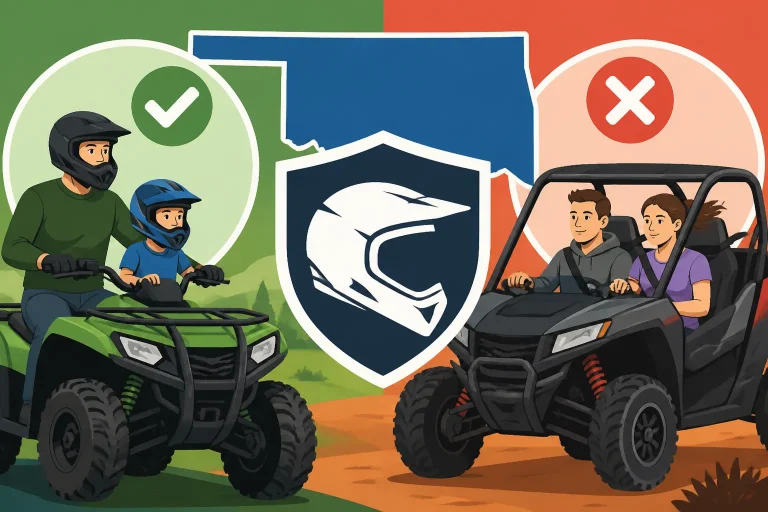
There isn’t one helmet policy that every private riding park in Oklahoma has to use. A park can set its own conditions for entry and riding, and those conditions may apply to adults and children, ATVs and UTVs, or only certain situations. One park might require helmets for everyone on every machine; another might treat an enclosed or caged side-by-side differently.
The park’s rule is separate from any state law that applies to your ride. Oklahoma requires helmets for riders under eighteen in the situations covered by state law, but don’t assume that riding on private property automatically removes every legal requirement. The details can depend on where and how the machine is being operated. For an overview of the age-related rule, see Oklahoma Helmet Rules Bind Under 18.
A private park can also adopt a policy that goes beyond the state minimum. For example, it may require a helmet for an adult riding a quad even if the adult would not be covered by the same age-based state requirement. It may set rules for passengers, rental machines, or particular trails. A signed waiver does not necessarily mean that you can ignore a posted helmet rule or a law that applies to your ride.
| Riding situation | What to check |
|---|---|
| Adult on an ATV | Whether the park requires helmets for all riders, including adults |
| Rider under eighteen | The park’s age rule and the state requirement that applies to the ride |
| Passenger on an ATV | Whether passengers are allowed and what protective gear the park requires |
| Driver or passenger in a UTV | Whether a helmet is required with a roll cage, doors, or other occupant protection |
| Rental machine | Whether the park supplies helmets, sets a specific style, or requires your own |
| Group with children | Minimum ages, supervision rules, and helmet requirements for both riders and passengers |
These are common questions to settle before arrival, not a substitute for the park’s current instructions. A rule posted at the gate or supplied by park staff may be more specific than a general description online. If a park’s information is unclear, ask for its helmet policy directly and explain the age of each rider, the type of machine, and whether anyone will ride as a passenger.
It also helps to check the park’s broader requirements at the same time. Helmet rules may sit alongside age limits, passenger restrictions, safety waivers, and supervision requirements. The policies can vary between private parks, so don’t assume that approval at one location carries over to another. See Oklahoma Private Park Waivers and Rules and Oklahoma Private Park Minimum Ages when you’re planning a visit with a child.
Which Helmet to Bring
If a park requires a helmet, the next question is what kind it accepts. Some parks may only say “helmet,” while others may specify a full-face design, a safety certification, or additional eye protection. Ask for the exact standard rather than guessing from the helmet’s appearance or price.
For a road-approved motorcycle helmet, a DOT mark is associated with the federal safety standard FMVSS 218. A label or seller’s claim is not a reason to skip the park’s instructions: the park could ask for a particular style or apply a stricter rule. See Which Federal Safety Standard a Helmet Must Meet for more on what that standard means. Avoid assuming that a bicycle helmet, novelty helmet, or soft cap will meet an off-road park’s requirements.
Fit matters just as much as the label. A helmet that shifts, lifts, or blocks vision can be a poor choice even if it appears to meet a standard. Before the ride, check that:
- The helmet fits snugly without creating painful pressure points.
- The chin strap fastens securely and stays fastened when you move your head.
- The helmet does not slide forward or backward when secured.
- The rider can see clearly in every direction needed for the trail.
- The helmet is in good condition, with no cracks, damaged straps, or other obvious defects.
- Goggles or other eye protection fit comfortably with the helmet, if the park requires them.
A helmet that worked for one rider may not fit another person, particularly a child. Don’t choose a larger helmet for a young rider to “grow into” if it moves around when fastened. If you’re shopping through a marketplace such as Amazon, check the product details and labeling carefully, then confirm the helmet fits the individual rider and meets the park’s stated requirements. A marketplace listing alone does not establish that the park will accept a specific helmet.
A full-face helmet may offer more face coverage than an open-face design, but the park’s policy is the deciding factor for entry. Likewise, goggles, gloves, and other protective gear may be sensible for the conditions without being mandatory under the park’s helmet rule. Keep the distinction clear: recommended equipment is not automatically required equipment, and required equipment may differ from one location to another.
Don’t assume a UTV cage replaces a helmet
A UTV’s roll cage, doors, nets, and seat belts are important parts of occupant protection, but they do not automatically mean a park will waive its helmet rule. Some parks may require helmets in UTVs; others may have a different policy for machines with occupant restraints or protective structures. The answer depends on the park’s written rules and, where relevant, the applicable law.
If you plan to carry a child in a UTV, ask about the helmet rule and passenger requirements together. Confirm that the child is permitted to ride in that machine, that the seat and restraint are appropriate, and that the helmet fits with the vehicle’s headrest or other equipment. Don’t rely on a general “UTVs are caged” assumption.
Questions to Ask Before You Arrive
A quick call or message to the park can prevent a denied entry or a last-minute scramble for gear. Give the staff enough detail to answer your actual situation: the ages of your riders, whether they’ll operate or ride as passengers, and whether you’re bringing ATVs, UTVs, or both.
Ask these questions:
- Who must wear a helmet? Find out whether the rule covers every rider, only minors, passengers, or people on particular machines.
- Does the rule change for a UTV? Ask whether helmets are required inside a caged machine and whether seat belts, doors, or nets affect the policy.
- What helmet style is accepted? Check whether a full-face helmet or a particular safety standard is required.
- Is eye protection required too? Ask whether goggles or a face shield are part of the rule, and whether tinted lenses are allowed in the conditions you expect.
- Are helmets available to borrow or rent? If so, confirm availability and sizing rather than assuming the park will have one that fits.
- Are there separate rules for children and passengers? Helmet compliance does not necessarily mean a child is permitted to ride on a particular machine.
- Where can I see the current rule? Ask whether the park has written rules online, at registration, or at the entrance.
For a visit with minors, check age and supervision policies as well. A park might require an adult to supervise a young rider, limit which machines a child can operate, or prohibit a child from riding as a passenger in certain circumstances. Those rules aren’t interchangeable with the helmet policy. Oklahoma Supervision at a Private Park and Passenger Rules Inside a Private Riding Park cover related questions to resolve before the trip.
If a staff member gives you an answer by phone, note the date and the name of the person who provided it, then check the posted rules when you arrive. Policies can change, and a verbal answer may not cover every rider or machine in your group. If written park rules and an informal answer seem inconsistent, ask staff to clarify before unloading.
A Simple Plan for a Group Ride
Helmet planning gets more complicated when several people are sharing machines or when riders have different ages and experience levels. The simplest approach is to make a gear list for each person rather than counting helmets by vehicle.
Before leaving home:
- Write down each rider’s age and whether that person will drive or ride as a passenger.
- Confirm the park’s policy for each machine type you plan to use.
- Match each person with a helmet that fits and complies with the park’s stated requirements.
- Pack any required goggles or other protective gear.
- Check age, supervision, and passenger rules separately.
- Keep the park’s written instructions accessible during check-in.
If someone will use a rental, ask whether the park provides the helmet or expects the rider to bring one. Even where helmets are available, there may be limited sizes or styles. Bringing a properly fitting helmet can avoid relying on uncertain availability, but only if the park accepts that helmet.
For children, make sure the equipment is sized for the child, not simply available in the vehicle. Also confirm that the child is allowed to ride in the intended seat or operate the intended machine. A helmet cannot make an otherwise prohibited passenger arrangement acceptable. When a child will ride with an adult, check both the park’s passenger rules and any state rules that apply. Oklahoma Private Park Minimum Ages can help with the age-policy side of planning.
For mixed groups, don’t use the least strict rule as your group’s rule. If one park says adults need helmets and another does not, follow the policy of the park you’re visiting. If the group is unsure what counts as acceptable protective equipment, contact the park before departure rather than waiting until check-in. Questions to Ask the Park Office Before You Go offers additional questions worth settling ahead of time.
The practical rule is straightforward: confirm the current park policy, follow any state requirement that applies, and bring a correctly fitting helmet that meets the park’s stated standard. That approach leaves less room for confusion at the entrance and helps keep the focus on the ride.
Disclaimer
This article is for general informational purposes only and does not constitute professional advice. Laws, prices and regulations vary by location and change over time. Consult a qualified professional for guidance on your specific situation.