Only Licensed Deer Hunters May Ride Timber Land
Riding an ATV on Oklahoma timber land is not the same as heading to a public trail: access can depend on the season, your deer-hunting license, a land-access permit, and where the landowner allows machines to go. This guide explains the rules for participating timber-land areas, what to check before unloading, and how to avoid a frustrating turn-around at the gate.
Who can ride Oklahoma timber land
A deer license is part of the access rule
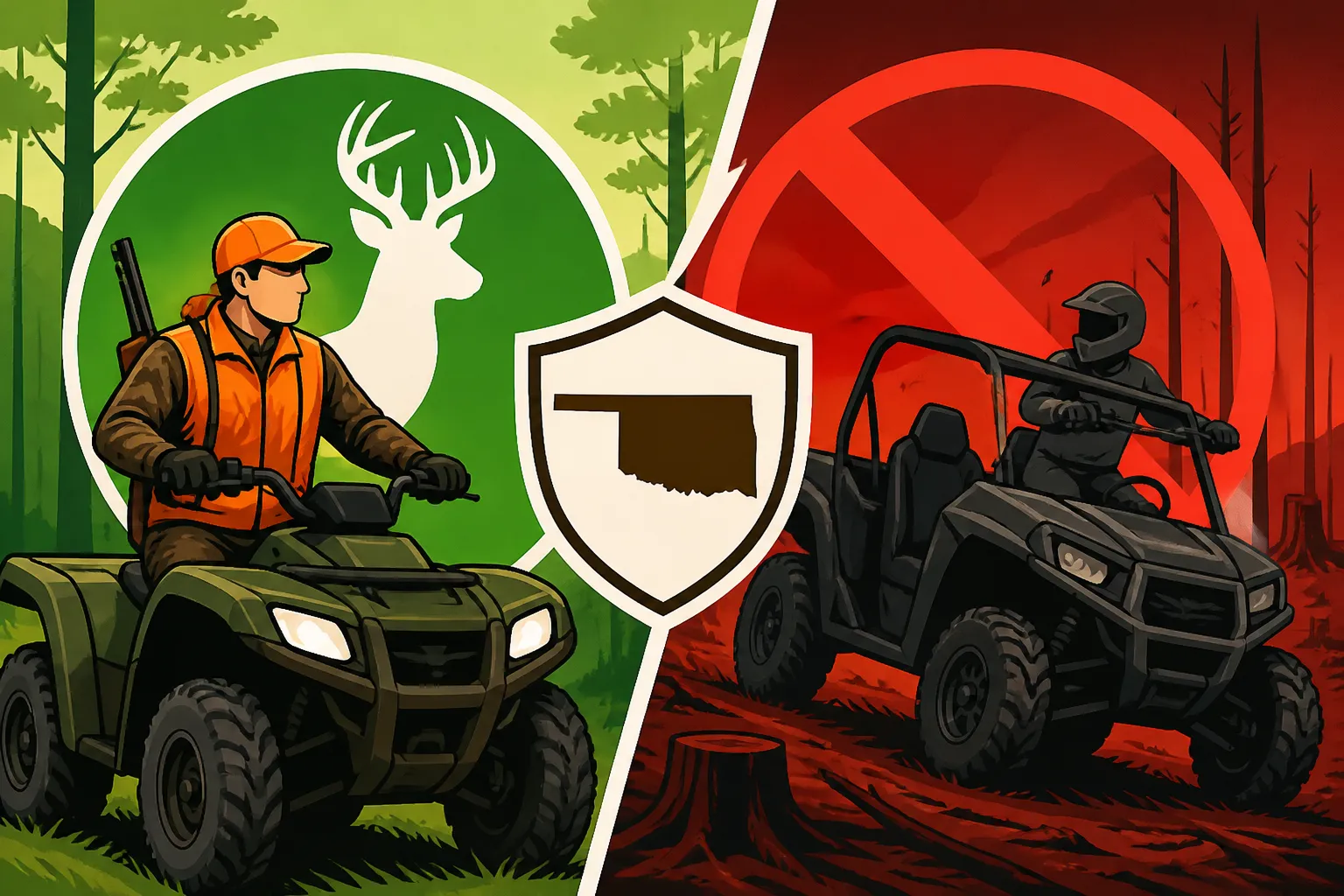
Some timber company lands in southeastern Oklahoma are open to outdoor recreation through public access arrangements. That does not make them unrestricted riding areas. On participating timber land, ATV access is generally limited to licensed deer hunters during the designated riding period. A general hunting interest, an ATV registration decal, or permission to ride somewhere else does not automatically meet that requirement.
Before you go, make sure your deer license is valid for the time and activity you have planned. Hunting licenses and deer licenses are not interchangeable phrases in everyday conversation, so check that your license actually covers deer hunting. If you are riding with a group, do not assume the licensed rider’s status covers everyone else. Each rider should confirm the applicable access and licensing rules for themselves.
This distinction catches people out. A family might plan a fall weekend around riding, only to discover that one person has a deer license and the others do not. Another rider might hold a license but plan to visit outside the authorized period. Check both eligibility and dates before committing to the drive. For more on the land-specific requirements, see [Only Licensed Deer Hunters May Ride Timber Land] and [Oklahoma Timber Land Access Rules].
The riding window is seasonal
Timber-land riding is seasonal, not year-round. The access window is commonly described as running from October into January, and machines must be off the land after the designated end date. The exact dates and conditions can depend on the property’s access rules, so confirm them before you travel rather than relying on a friend’s recollection from a previous season.
The seasonal restriction matters even if the weather is perfect and the road looks open. A gate left unlocked is not proof that motorized access is allowed that day. Hunting activity, land-management needs, road conditions, or posted notices can also affect where you may go. Read the current property rules and any signs at the entrance.
The rule is especially important for riders who keep a machine at a cabin or hunting camp. A familiar route can feel like it is still available after the season closes, but that is not a safe assumption. Check the dates each time you plan a trip, especially around the January cutoff. The seasonal details are covered further in [October to January: The Timber Land Riding Window] and [Riding Only From October to January].
The land is not one large open trail system
“Timber land” can refer to substantial areas of privately owned forest made available under specific access arrangements. It does not mean every road, cut-through, or patch of woods in southeastern Oklahoma is open to riding. Access rules apply to the participating property, and boundaries can be easy to misread when roads, timber blocks, and neighboring parcels meet.
Honobia Creek and Three Rivers are two names riders may encounter when researching timber-land access. Their scale can make a map look inviting, but size does not equal unrestricted travel. Each property has its own access details, permit requirements, and restrictions. Check the rules for the exact area you intend to enter, not just a general description of nearby land.
An off-road mapping app such as onX Offroad can help you plan and understand your route, but a map is a planning aid, not permission to cross a boundary. Compare your route with official access information and on-the-ground signs. If you cannot tell whether a road is within the authorized area, do not ride it until you have confirmed.
Permits, licenses, and what to check before leaving
A hunting license and an access permit serve different purposes
A deer license addresses whether you are eligible to hunt deer. A land-access permit addresses access to certain lands. They are separate requirements, so having one does not necessarily mean you have the other. Before setting out, check whether the property requires a permit in addition to the applicable deer license and whether your age or residency changes the permit requirement.
The rules can vary for residents and nonresidents, and some riders may qualify for an exemption based on age. Do not assume an exemption from a land-access permit also removes the deer-license condition for riding timber land. Confirm each requirement separately. The relevant property information for two well-known areas is covered in [Oklahoma Permits for Honobia Creek] and [Oklahoma Permits for Three Rivers].
A practical way to avoid confusion is to keep a short checklist for each rider:
- Confirm the exact timber-land property and its access rules.
- Check that the riding date falls within the authorized season.
- Confirm that each rider meets the deer-license requirement.
- Check whether each rider needs a land-access permit.
- Save or carry proof of licenses and permits in the form accepted by the property.
If you are uncertain about a rule, contact the land manager or permit administrator before you leave. Sorting it out at home is far easier than trying to resolve it beside a gate with a trailer behind you.
Check the route, boundaries, and closures
Plan the ride around authorized roads, not around the broad outline of the timber property. A route that appears to connect two public roads may cross land that is closed to motor vehicles or pass through a restricted area. Use current property information, follow signs, and treat a closed gate or posted restriction as meaningful even when other vehicles have passed through.
onX Offroad can be useful for reviewing a planned route and spotting where boundaries may need a closer look. Still, digital maps can be incomplete or out of date, and a trail line is not a substitute for a posted rule. If the map, a sign, and an access document do not appear to agree, stop and verify before proceeding. Do not assume the most permissive interpretation.
It also helps to plan a conservative route with a clear turnaround point. Timber roads may be narrow, uneven, or difficult to reverse on with a trailer-sized machine. Tell someone where you expect to ride, bring a paper map or offline navigation option, and avoid depending on cell service in remote areas. For practical permit reminders, see [Showing a Land Access Permit on Your Phone].
| Before the ride | What to confirm | Why it matters |
|---|---|---|
| Rider eligibility | Whether each rider meets the deer-license requirement | One licensed person may not make an entire group eligible |
| Permit | Whether a separate land-access permit is required | A hunting license and access permit are different |
| Dates | The property’s riding window and closing date | Timber-land access is seasonal |
| Route | Roads and areas open to motorized travel | A large property is not an open trail network |
| Conditions | Closures, posted notices, and current access instructions | Entry rules can be property-specific |
| Documents | What proof to carry and how it is accepted | Saves time if eligibility is checked |
Riding rules once you are on the property
Stay on designated roads
On timber land, road access is not permission to ride wherever the ground looks passable. Riders should remain on designated roads and follow any posted restrictions. Cutting across a clearing, taking an unmarked logging track, or weaving around a muddy section can put you outside the permitted route even when you have not crossed an obvious fence.
This can be frustrating when a road is rutted or a detour looks harmless. But timber roads are part of a working landscape, and roads that seem similar may have very different access status. Do not create a shortcut around a closure. Turn around, follow an authorized route, or contact the land manager for clarification. The route restriction is explained in [Designated Roads Only on Timber Land].
Keep your speed controlled, leave room for other vehicles, and expect changing conditions. A narrow road may be shared with hunters, land managers, trucks, or other visitors. Dust can reduce visibility, while wet ground can make a firm-looking track unexpectedly slick. The posted limit and property rules take priority; timber-company roads are commonly subject to a 25 mph limit. See [25 mph on Timber Company Roads] for the specific speed rule.
Off-road travel is a narrow exception, not general permission
There may be a limited exception for going off road to retrieve a downed deer. That is not a general allowance to explore the woods, ride to a hunting spot by any route, or recover a deer with no regard to boundaries. The exception is tied to a particular purpose and distance limit, so follow the property’s wording carefully.
If you need to retrieve an animal, stay within the permitted distance from an authorized road and avoid entering a closed area or neighboring property. If the location is unclear, ask the land manager before taking the machine off the road. A useful rule of thumb is not to interpret a retrieval allowance more broadly than the written rule permits. Details are covered in [Half a Mile for a Downed Animal].
Plan ahead for the possibility that a machine cannot safely reach the recovery point. A partner on foot, a winch, or another appropriate recovery method may be safer than forcing an ATV through brush or soft ground. Protect the terrain, keep the machine under control, and do not leave a vehicle blocking a road used by others.
Camping and hunting access are not blanket privileges
Some timber-land rules allow primitive camping under specified conditions, including limits on where a camp can be set up. That does not mean you can camp anywhere that looks secluded, leave equipment on the property indefinitely, or assume a campsite is available without checking. Confirm the exact camping rules for your chosen area and keep your camp within the stated boundaries.
Likewise, having the right to ride does not automatically authorize every hunting activity, firearm practice, campfire, or overnight arrangement. Those activities may be controlled by separate land rules, hunting regulations, or seasonal restrictions. Read the full set of instructions for the property rather than treating the ATV access condition as the only rule that matters.
A simple, low-impact camp is usually the least complicated option: arrive with what you need, keep vehicles out of restricted areas, pack out all trash, and leave the site as you found it. If you are not certain whether overnight use is allowed at a particular spot, choose a designated campground or contact the property manager.
A practical plan for a timber-land riding day
Prepare for the gate before towing out
A smooth trip begins with checking the details before loading the machine. Confirm your destination, the access window, the deer-license requirement, any permit requirement, and the allowed road network. Save the relevant instructions offline so you can refer to them if reception drops. Bring identification and whatever proof of license or permit the property requires.
Inspect your machine before the trip, too. Check fuel, tires, brakes, lights, and the basic recovery gear you may need on a remote road. Bring water, a first-aid kit, and weather-appropriate clothing. Timber roads can be far from services, and a minor problem can become a long wait if no one knows where you are.
If you are traveling with a group, agree on a plan before the engines start. Decide who is leading, how often you will regroup, and what to do if someone gets separated. Riders should stay together on authorized routes rather than trying to catch up by taking an unfamiliar turn. A group’s safest route is the one everyone is allowed to use.
Use this final check before entering
When you arrive, pause at the entrance. Read posted notices, confirm that the access period is open, and look for closures or instructions that differ from what you saved at home. If the gate is closed or a sign indicates that motorized access is restricted, do not try to work around it.
Then check each rider’s documents and the planned route one last time. Make sure every rider understands the road-only rule, speed limit, and any limits on off-road travel. If a participant does not meet the access requirements, the responsible choice is to change the plan rather than assume the group will be treated as one unit.
Finally, leave the property as carefully as you found it. Stay on the permitted roads, avoid creating new tracks, carry out trash, and respect other visitors. Responsible use helps protect access arrangements that make riding possible in the first place. For broader trip planning and riding-area comparisons, see [Oklahoma ATV Trails: Where to Ride].
Disclaimer
This article is for general informational purposes only and does not constitute professional advice. Laws, prices and regulations vary by location and change over time. Consult a qualified professional for guidance on your specific situation.