Oklahoma Riding Areas That Take Reservations
Trying to reserve an Oklahoma riding weekend can get confusing fast: one place may reserve campsites but not trail access, while another may require you to arrange a visit directly. This guide explains what to confirm, how public and private riding areas differ, and how to plan lodging, trailers, groups, and backup options before you tow.
What a reservation usually covers
A campsite reservation is not always a riding reservation
The first question to ask is what, exactly, you are booking. At a state park or public recreation area, you may be able to reserve a campsite while riding access follows separate rules. A confirmed site does not necessarily guarantee that a trail area is open, that your machine is permitted, or that you can ride whenever you arrive.
That distinction matters at places such as [Little Sahara State Park in Oklahoma] and [Robbers Cave OHV Area in Oklahoma]. Both are useful starting points when researching Oklahoma riding trips, but do not assume that reserving a place to stay also reserves trail access. Check the park’s current information for riding rules, operating conditions, and any entry or permit requirements, then confirm the campground arrangement separately.
The same issue comes up when a group books a cabin or a nearby campground and assumes the riding area has been taken care of. A reservation receipt might cover only the lodging. Before you pay or commit your group, ask whether the reservation includes riding access, whether riders must check in elsewhere, and whether there are separate rules for day visitors.
Private riding areas and public land work differently
Private riding parks may handle reservations, waivers, group visits, and camping through their own booking process. A private park may ask you to arrange a campsite, a group visit, or both in advance, especially when you are bringing several machines or arriving during a busy weekend. Policies vary, so contact the park directly rather than relying on an old post or a friend’s experience from a previous season.
Cross Bar Ranch near Davis is one private-area option riders may research. Read [Cross Bar Ranch in Oklahoma] for more about the riding area, then ask the park what needs to be booked and what can be handled at arrival. Confirm details like check-in, overnight parking, campsite availability, machine rules, and whether each rider must complete a waiver before getting on the trails.
Public hunting and wildlife areas are a different category. Areas such as Honobia Creek and Three Rivers have access and use rules that can depend on permits, season, and designated routes. They are not interchangeable with a private park’s reservation system. Review [Oklahoma Land Access Permits Explained] and confirm the specific area’s rules before planning around it. If your trip depends on a particular date or access window, verify that access is allowed for the intended activity.
| Riding-area situation | What you may be able to reserve | What to confirm separately |
|---|---|---|
| State park with an OHV area | Campsite or other lodging | Whether riding access is open, permitted, and included |
| Private riding park | Camping, group arrangements, or other services | Reservation requirements, waivers, machine rules, and check-in |
| Wildlife or public land area | Sometimes nearby lodging, rather than trail access | Permits, seasonal access, designated routes, and activity restrictions |
| Campground near a riding area | A place to stay | Distance to the trails, machine parking, and whether access is available to non-campers |
How to find a riding area that fits your trip
Start with the kind of riding weekend you want
Before searching for a place that takes reservations, decide what the reservation needs to solve. A family bringing a youth quad may need a campground with simple access, clear age rules, and nearby facilities. A group towing several side-by-sides may care more about trailer parking, machine-friendly roads, and room to stage before riding. Riders looking for a full weekend on varied terrain may prioritize trail access and a place to camp close by.
Use [Oklahoma ATV Trails: Where to Ride] as a starting point for comparing areas, then narrow the list by the machines in your group and the trip logistics. A place that sounds ideal for a quad might not allow side-by-sides on every route. A campground that looks close on a map may still involve a drive to the riding entrance. Ask about the details that affect your own group instead of relying on a general description of the area.
If your group is new to riding together, build in time for check-in, unloading, and a rules briefing. Ten riders arriving at different times can turn a smooth morning into a parking-lot puzzle. A simple plan—one meeting point, one person responsible for the reservation, and a shared arrival window—can make the first hour much less stressful. For more preparation ideas, see [Oklahoma Group Ride Planning].
Check maps, access, and trail conditions before you commit
A map can help you understand the area, but it cannot confirm that a road or trail is currently open. Use a mapping tool such as onX Offroad to explore the general layout and plan how you will get to the riding area. Then compare your route with official park information and contact the operator if any access detail is unclear. A line on a map should not be treated as permission to ride.
This is especially important when a route crosses land with different owners or management rules. Confirm where the public riding area begins, where you are allowed to unload, and whether the route you have in mind is open to your type of machine. If mobile coverage may be limited, prepare your route before leaving town and save useful map information for offline use. onX Offroad can help with trip planning, but the park or land manager is the authority on closures and access rules.
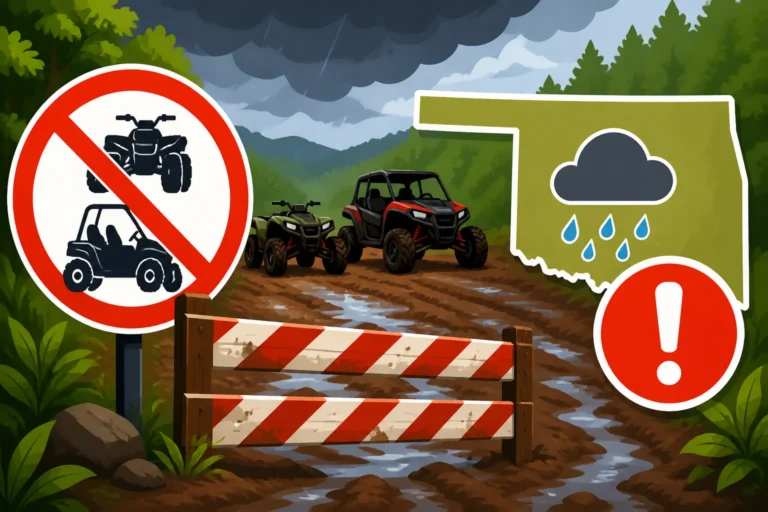
Weather deserves its own check. Rain can change trail conditions, affect access roads, or make a route unsuitable for towing and riding. Ask the park whether recent weather has affected the trails, and review [Oklahoma Trail Closures After Rain] and [Oklahoma Trail Conditions Before You Tow] while planning. If the answer is uncertain, have a backup riding area or a flexible arrival plan rather than treating a campsite booking as proof that the trails will be rideable.
What to ask before you book
Confirm the reservation, check-in, and machine rules
When you contact a park or campground, ask direct questions and write down the answers. “Can I reserve?” is too broad; it may lead to a yes that applies only to camping. Be specific about the date, number of people, number and type of machines, trailer size, and whether you need overnight parking.
A useful call or email can cover:
- What does the reservation include: a campsite, a group visit, riding access, or more than one of these?
- Does each rider or vehicle need a separate booking, permit, waiver, or check-in?
- Are quads, dirt bikes, and side-by-sides all allowed on the routes you plan to use?
- What are the arrival and check-in procedures, including after-hours arrangements?
- Can you park a truck and trailer near the campsite or staging area?
- Are there rules for passengers, children, pets, fires, quiet hours, or generators?
- What happens if weather closes or limits the riding area?
Rules that sound minor can affect the whole trip. A campground may have a quiet-hour policy that changes when you can unload or run a generator. A park may require each rider to complete a waiver, so arriving just before sunset with a large group can create a bottleneck. Ask whether paperwork can be completed ahead of time and what everyone must bring.
Also verify how far the campsite is from the trailhead and whether you can ride between the two. A nearby campground is not necessarily connected to the riding area by a legal route. If you expect to drive machines to the trailhead, ask about trailer parking and unloading. Related planning topics include [Oklahoma Trailheads With Trailer Parking] and [Oklahoma OHV Camping With Trail Access].
Keep written details and make a backup plan
After receiving confirmation, keep the reservation details where the group can find them. Save the confirmation email, note the contact number, and share the arrival plan with everyone traveling separately. If you use onX Offroad to plan the approach, send the group a clear meeting location and save a second route in case the first road is closed or unsuitable for a trailer.
Make a short pre-departure checklist: reservation confirmation, required permits or waivers, machine ownership documents if needed, helmets and riding gear, tie-downs, fuel, and a way to navigate if phone service drops. Ask the park whether any particular documentation is required; do not assume the same checklist applies everywhere. For campground-focused details, [Oklahoma Riding Areas With RV Hookups] and [Oklahoma Riding Areas With Showers] can help you compare amenities when those matter to your group.
A backup plan does not need to be elaborate. It might mean choosing a second campground, shifting the riding day, or agreeing that the group will wait for a closure update before unloading. This is particularly helpful when a long tow is involved. Nobody wants to discover at the gate that the campsite is fine but the riding area is unavailable, or that a machine in the convoy is not allowed on the planned route.
A practical booking workflow for Oklahoma riders
Work through the details in the right order
Start by choosing the riding area based on terrain, machine access, and travel distance. Then identify whether the area is private, state-managed, or part of a public-land system. That classification gives you a clue about who handles bookings and which rules you need to check, but it does not replace confirmation from the operator or land manager.
Next, decide whether you need a campsite, nearby lodging, or only day access. Contact the riding area and ask what its reservation covers. If lodging is handled by a separate campground, call that provider too. This two-call approach can feel tedious, but it prevents a common problem: having a bed booked while the riding plan remains unresolved.
After confirming the dates, check trail access, vehicle eligibility, permits, and weather-related policies. If you are comparing several destinations, use [Oklahoma Riding Areas With RV Hookups] or [Oklahoma Riding Areas With Showers] to focus on practical amenities, and use onX Offroad to understand the general route and travel layout. Keep the park’s own instructions as the final word for gates, closures, check-in, and permitted riding areas.
Use a simple decision check before you commit
Before finalizing the trip, make sure each of these answers is clear:
- You know whether you are reserving lodging, riding access, or both.
- The park or land manager has confirmed that your machine type is allowed.
- Your group understands the check-in, waiver, and permit process.
- Your truck, trailer, and machines can be parked and unloaded as planned.
- You know what weather or closure changes could affect the trip.
- Everyone has the correct arrival details and a backup plan.
If one answer is missing, pause and ask. It is much easier to resolve a question at home than after hours on the road with a loaded trailer. For broader destination comparisons, [Oklahoma Riding Areas With Cell Service] can help you think through communication needs, while [Oklahoma Trail Etiquette Locals Expect] is useful for preparing everyone to share the area responsibly.
Reservations can make an Oklahoma riding weekend more predictable, but only when you know what the booking actually covers. Treat camping, riding access, permits, and trail conditions as separate items until the park confirms otherwise. A few specific questions before departure can save your group a long drive, an awkward check-in, and the frustration of arriving ready to ride without a workable plan.
Disclaimer
This article is for general informational purposes only and does not constitute professional advice. Laws, prices and regulations vary by location and change over time. Consult a qualified professional for guidance on your specific situation.