Oklahoma Riding Near Davis
Davis is a handy base for an Oklahoma off-road weekend, but finding a place where you can legally ride is not as simple as spotting a dirt road on a map. This guide explains how to plan around Cross Bar Ranch, choose a suitable ride, check access and trail conditions, and avoid confusing nearby public land with an authorized OHV area.
Where to ride near Davis
Cross Bar Ranch is the main nearby OHV option
For riders looking around Davis, Cross Bar Ranch is the area to investigate first. It is a private off-highway vehicle park in the Arbuckle region, with riding terrain for off-road machines. Its location makes it a natural starting point for an ATV or UTV trip based in Davis, whether you are coming for a day ride or building a longer weekend around the trails.
Private parks are different from public forest roads or trails. Access depends on the property’s rules and operating arrangements, so don’t assume you can arrive and ride just because the land appears open. Check the park’s current instructions before leaving home, including which vehicle types are welcome, what the check-in process involves, and whether you need to complete paperwork before riding. The overview in [Cross Bar Ranch in Oklahoma] is a useful starting point for understanding the area.
It also helps to think of the park as a place with its own riding conditions, rather than a single route that suits every machine. A novice on a small quad may want to stick to easier terrain, while an experienced driver in a side-by-side may be looking for a more demanding outing. Ask about trail difficulty, closures, and any restrictions that could affect your machine or group. If you’re bringing a UTV, see [Oklahoma Trails That Allow Side-by-Sides] for broader context on checking vehicle access before a trip.
Nearby scenery is not automatically riding access
Davis sits near well-known natural attractions, including Turner Falls and the Arbuckle Mountains. That makes the area appealing for a mixed weekend of sightseeing and trail riding, but scenic proximity does not mean an ATV or UTV can be ridden anywhere nearby. Roads, recreation areas, private ranches, and OHV parks each have different access rules.
A common planning mistake is to look at a map, see a trail-like line, and assume it is open to motorized use. It may be a hiking route, a private road, a utility access route, or a road with restrictions. Even a wide, unpaved road can be off-limits to recreational riding. Get permission where land is private and verify the rules for public land before unloading. [Oklahoma ATV Trails: Where to Ride] offers a wider view of the state’s riding options, while [Oklahoma Landowner Permission Rules] is worth reviewing if your route might cross private property.
Keep your sightseeing and riding plans separate in your notes. For example, you might reserve one part of the day for a park visit and another for an authorized OHV area. That simple distinction prevents the frustrating situation of arriving with a trailer, gear, and eager riders only to discover that the nearby place you had in mind does not allow recreational machines.
Choose a ride that suits your group
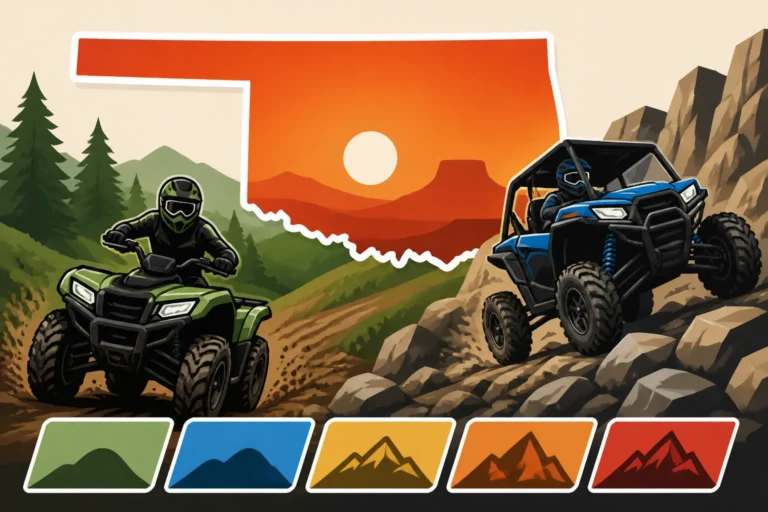
Match terrain to rider experience and machine
A good day near Davis is not necessarily the one with the most aggressive terrain. It is the one where riders can enjoy themselves without being pushed into obstacles they are not ready to manage. Before setting out, talk honestly about experience levels, confidence, and how comfortable each person is with hills, loose ground, rocks, mud, or narrow passages. A mixed group should plan around its least experienced rider, not the most confident one.
Machine type matters, too. A youth quad, a full-size ATV, and a wide side-by-side do not move through every trail the same way. Width, turning space, ground clearance, tires, and the driver’s ability to control the machine all affect what is practical. A route that feels easy in a narrow quad may be awkward in a larger UTV, especially where the trail tightens or the ground is uneven. Ask the park which areas are appropriate for your vehicle rather than relying on a general trail description.
If you’re riding with children or newer drivers, build in time for short breaks and an easy return route. It is far better to finish with energy left than to turn a fun day into a long, stressful push back to the staging area. Review [Oklahoma Trail Difficulty Ratings] when comparing routes, and make sure every rider understands that turning around is a sensible option, not a failure.
Use a map as a planning tool, not permission
A digital map can help you get oriented, but it cannot grant access or guarantee that a route is open. Apps such as onX Offroad can help riders review mapped roads and trails, plan a route, and keep track of where they are. Still, map information should be treated as one part of the preparation. Confirm access with the property or relevant land manager, and follow signs and posted restrictions when you arrive.
This distinction matters around Davis because a planned drive may pass near multiple types of land. A route that looks continuous on a screen might cross a boundary, reach a closed gate, or switch from an authorized riding area to a road where off-road use is not allowed. Before the trip, review the route in onX Offroad and identify the property boundary, designated staging or parking areas, and a clear way back. Then compare that plan with the park’s own instructions.
Download or save your route information before heading out, especially if you expect weak cell service. A phone can lose signal, run low on battery, or become difficult to read in bright sun. Carry a backup power source and keep the group together at forks and intersections. A map is most useful when everyone knows how to use it and the route has been checked against current access rules.
| Planning question | What to confirm before you go | Why it matters |
|---|---|---|
| Is the riding area open? | Current operating status and check-in instructions | Access can depend on park rules and conditions |
| Is your machine allowed? | Vehicle types, size restrictions, and any machine-specific rules | A route suitable for a quad may not work for a wider UTV |
| Is the route appropriate? | Difficulty, terrain, and available turnarounds | Helps keep mixed-experience groups safe and comfortable |
| Can you camp nearby? | Whether camping is offered and what arrangements are required | Camping access is separate from riding access |
| Are conditions suitable? | Recent rain, closures, and surface conditions | Mud and damaged trails can make a planned ride unsafe |
| Can you navigate offline? | Downloaded map, charged phone, and backup power | Cell service and battery life are not guaranteed |
Prepare for the day before you leave Davis
Check access, paperwork, and park rules
Confirm the basics before you load the trailer: the park is accepting riders, your vehicle is permitted, the group understands the check-in requirements, and you know where to go on arrival. Private riding areas commonly have rules about waivers, passengers, speed, noise, alcohol, pets, camping, and where machines may be operated. Do not rely on an old social post or a friend’s memory for those details. Review the current park information and ask directly if any part of the plan is unclear.
If anyone in the group is a minor, check the rules that apply to young riders and make sure the right adult is available to handle any required forms. Each rider should know which machine they will use and whether passengers are allowed on it. A machine should not carry a passenger unless it is designed for one, and children should not be put on a vehicle simply because a seat is available. [Cross Bar Ranch Makes Everyone Sign a Waiver] can help you anticipate one part of the private-park process.
Make the trip easier by preparing paperwork and contact details at home. Save the park’s directions, note the check-in location, and keep your emergency contact information accessible. If your group plans to ride in more than one area, verify whether each location has separate admission or access requirements. A pass or permit for one place should never be assumed to cover another.
Pack for changing Oklahoma conditions
Even a short ride can become tiring when heat, dust, wind, or changing weather enters the picture. Carry more drinking water than you expect to need, and make sure each rider has appropriate clothing, eye protection, gloves, and a helmet that fits. For UTV passengers, confirm how to use the vehicle’s restraints and keep arms and legs inside the cab. A dusty trail can reduce visibility quickly, so leave enough space between machines to avoid riding in the cloud from the vehicle ahead.
Bring a basic tool kit suited to your machines, a tire repair solution, a first-aid kit, and a way to contact help. The exact kit depends on your vehicle and route, but it is useful to think through simple problems before they happen: a loose connection, a low tire, an overheated machine, or a rider who needs to stop. Tell someone who is not riding where you are going and when you expect to be back.
Weather can affect both trail conditions and the comfort of your group. After rain, clay and uneven ground may become slick; dry conditions can mean more dust. Check the forecast and ask about the surface before towing from home. [Oklahoma Trail Conditions Before You Tow] and [Oklahoma Trail Closures After Rain] are useful reminders that a route can change significantly with the weather. If conditions look poor, changing the plan may save a long, disappointing drive.
Make camping and logistics part of the plan
Confirm camping rather than assuming it is included
Some riders want to turn a trip near Davis into a full weekend, but camping availability and riding access are separate questions. Confirm whether camping is offered at the place you plan to ride, what type of campsite is available, whether advance arrangements are needed, and what facilities you can expect. If you plan to stay elsewhere, check the drive time between your lodging and the riding area so you do not underestimate how much of the day will go to hauling and setup.
A family with a camper, for example, may want convenient access to restrooms and a simple place to park, while a group arriving in trucks may be comfortable with a more basic setup. Neither preference is inherently better; the important thing is knowing what the site actually provides. Don’t assume that a day-use riding fee includes an overnight stay, or that a campground nearby is part of the same property.
If camping is a priority, look at [Oklahoma Trails With Camping] while comparing destinations. For Cross Bar Ranch, check its current camping information directly and build your arrival time around check-in requirements, unloading, and any setup rules. The related guide [What a Day at Cross Bar Ranch Includes] can help you think through the pieces of a riding visit beyond time spent on the trails.
Plan towing, fuel, and arrival time
The ride begins before the first trail. Check the tow vehicle, trailer lights, tie-downs, tires, and hitch before leaving. Secure each machine so it cannot shift during the drive, and make sure ramps and loose gear are stowed safely. If you are traveling through Davis or stopping for supplies, account for the extra time needed to park a trailer and move a group through a busy stop.
Fuel planning deserves attention, too. Start with enough fuel for the drive and the ride, and learn whether fuel is available near the park or whether you should arrive with what you need. Do not count on finding a convenient station immediately before riding. Carry fuel only in appropriate containers and follow the park’s rules for storing or handling it.
Arrive with enough daylight and time to check in without rushing. Rushing leads to missed instructions, forgotten gear, and a group that sets off before everyone understands the route. Decide where you will regroup if someone falls behind, and agree on a simple rule for intersections: stop, wait, and make sure the last rider is accounted for before continuing. If you are coordinating a larger outing, [Oklahoma Group Ride Planning] can help you organize communication and pacing.
Ride responsibly and leave room for a safer return
Follow boundaries and respect other visitors
At an OHV area, stay on routes that are designated for your machine and follow signs even when a side track looks tempting. Shortcuts can damage vegetation, widen trails, and put riders into places that are difficult to exit. Give other groups room, slow down near staging or camping areas, and avoid kicking up dust around people who are setting up or walking.
Keep noise and speed under control, especially near other visitors and at camp. A throttle that feels manageable in an empty stretch can create a hazard around a blind corner or a group with children. Use extra caution when visibility is reduced by dust, trees, or uneven terrain. If you meet another machine on a narrow section, slow down early and follow the park’s passing expectations rather than trying to squeeze through.
Respecting boundaries also means treating the surrounding landscape as something other than a playground. Don’t ride across private property without permission, leave trash behind, or assume a closed gate is an invitation to find another way in. Good behavior helps preserve access for the next group. [Oklahoma Trail Etiquette Locals Expect] covers habits that make a ride more considerate for everyone.
Know when to turn back
The smartest choice on a trail is sometimes to turn around. A machine that begins to struggle, a rider who is getting tired, worsening weather, or a route that looks more difficult than expected are all good reasons to change plans. It can be tempting to push onward because the group has already come a long way, but fatigue and poor judgment tend to compound each other. Keep enough time and energy for a calm return.
Agree on a group pace before the ride begins. The fastest rider should not disappear around every bend, and the least experienced rider should not feel pressured to keep up. Use regrouping points and make sure no one is left behind. If a machine develops a problem, stop in a safe place and let the group know rather than trying to continue until the issue becomes worse.
Before leaving the riding area, account for every person and machine, check that you have your keys and gear, and follow any check-out or departure instructions. A few minutes of final organization can prevent a lost item, an overlooked passenger, or a problem discovered only after you are back on the road. For a broader view of destinations around the state, [Oklahoma Trails Within Two Hours of Tulsa] and [Oklahoma Trails Near Lawton] can help you compare future trips with your Davis-area plans.
Disclaimer
This article is for general informational purposes only and does not constitute professional advice. Laws, prices and regulations vary by location and change over time. Consult a qualified professional for guidance on your specific situation.