Gates and Cattle Guards on an Oil Lease Road
Riding an ATV or UTV in Oklahoma offers incredible freedom, but when you venture onto the vast network of oil lease roads, you quickly discover a whole new set of rules and challenges. Dealing with mysterious gates that seem to appear out of nowhere, or the bone-jarring rattle of a cattle guard, can be confusing and even intimidating. This guide is all about helping you understand these unique obstacles, ride respectfully, and ensure your adventures on Oklahoma's oil lease roads are both safe and responsible.
Understanding Oklahoma's Oil Lease Roads and Your Riding Rights
Oklahoma is a land rich in natural resources, and its landscape is crisscrossed with countless roads designed to access oil and gas operations. For ATV and UTV riders, these can look like an open invitation to explore. However, unlike public roads or designated trails, oil lease roads come with their own set of unspoken — and sometimes explicitly stated — rules that every rider needs to understand to avoid problems.
The Legal Landscape of Access
Many riders assume that if a gate is open or there's no "No Trespassing" sign, the road is fair game. This assumption can lead to a lot of trouble. Oil lease roads are, by and large, private property, even if they aren't always clearly marked. They exist to serve the needs of oil and gas companies and the landowners who lease their property for energy extraction. The core issue here is that permission is almost always required, even if it feels like a vast, empty expanse. Without explicit permission, you could easily be trespassing, which is a big deal in Oklahoma. The frustration of not knowing who owns what, or who to even ask for permission, is a common one among riders. You might just see a pump jack and a dusty track, not a clear boundary line.
It's tempting to think that because these roads look like public access points, they are. But the truth is, the land beneath those roads, and the roads themselves, are often owned by private individuals or entities. Even if a particular section of land has been in your family for generations, if an oil company has a lease on it, their roads are for their operations first. This means your "right to ride" isn't inherent. Understanding this fundamental difference is crucial before you ever put a wheel on one of these paths.
Seeking Permission: Your First Step
Given that oil lease roads are predominantly private, your very first step before planning any ride on them should be to seek permission. But who do you even call? This is where the real-world challenge kicks in. Often, you won't see a clear sign with a phone number. A good starting point is to identify the landowner or the oil and gas operator working on that specific lease. This might involve a bit of detective work, perhaps looking up property records at the county clerk's office or checking with the Oklahoma Corporation Commission for lease operator information. It sounds like a lot of work, and it can be, but it's far better than facing a confrontation or a citation for trespassing.
When you do manage to make contact, be clear about your intentions. Explain that you want to ride your ATV or UTV and ask for specific access permissions. Written permission, even a simple email, is always best. This way, if you encounter an employee of the oil company, a ranch hand, or a game warden, you have something tangible to show them. Remember, just because you got verbal permission once doesn't mean it applies indefinitely or to every part of the lease. Conditions can change, ownership can shift, and rules can be updated. For specific details on where and how land access permits apply to other types of private land, you might want to read [Oklahoma Land Access Permits Explained].
Common Courtesy and Respect
Beyond the legalities, there's the equally important aspect of common courtesy and respect. When you ride on an oil lease road, you are a guest on someone else's land and in their working environment. This means adhering to a higher standard of behavior than you might on a dedicated public trail. Your presence can impact the landowner's agricultural operations, disrupt wildlife, and potentially interfere with the energy company's work. It's not just about avoiding a ticket; it's about being a good steward and ensuring that riders continue to be welcome in these areas.
Always think about the "why" behind any rules or expectations. If a road is wet and muddy, creating deep ruts can damage the road for the heavy equipment that needs to use it daily. Speeding near livestock or residences can scare animals and alarm residents. Leaving trash or cutting fences is an absolute no-go. These actions not only reflect poorly on you but on the entire ATV/UTV riding community. By showing respect for the land, its owners, and the operations, you help maintain a positive relationship that benefits everyone. For more general guidance on responsible riding, check out [Oklahoma Trail Etiquette Locals Expect].
Navigating Gates on Oil Lease Roads
Gates are an almost universal feature of oil lease roads, and for good reason. They serve multiple purposes, from containing livestock to securing valuable equipment and preventing unauthorized access. Understanding their function and how to properly interact with them is key to a smooth ride.
The Different Types of Gates You'll Encounter
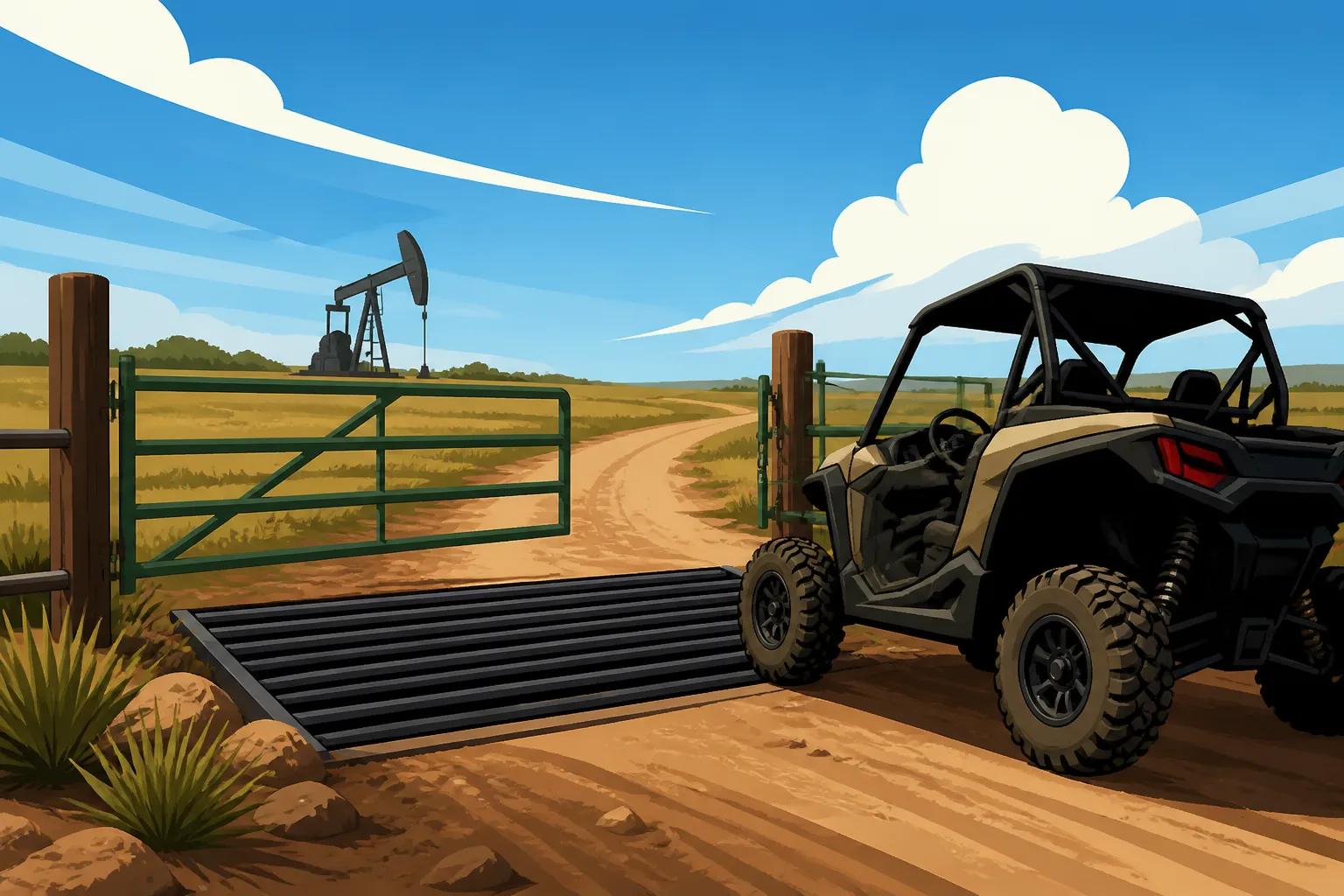
You'll quickly discover that not all gates are created equal. On Oklahoma's oil lease roads, you might come across a simple chain-and-hook gate that’s easy to open and close. Then there are the more robust pipe gates, sometimes with a heavy spring or hinge system, requiring a bit more muscle to maneuver. Some gates might have combination locks, requiring a specific code that you hopefully obtained with your permission. And, of course, there are the traditional wooden or wire cattle gates designed specifically to keep livestock penned in. The frustration of finding a locked gate when you thought you had access is totally valid – it can instantly derail your ride.
Each type of gate has its own quirks. The simple ones can be quick, but if they're flimsy, they might not secure properly if you're not careful. The heavier pipe gates often have a specific way they need to swing or latch. Combination locks require you to not only know the code but also remember to scramble it after closing. Understanding these variations helps you anticipate what to expect and how to handle them efficiently. Always be observant when you approach a gate; look for clues on how it's meant to be secured.
The Golden Rule: Leave Gates As You Found Them
This rule cannot be stressed enough: if a gate was closed when you arrived, close it behind you. If it was open, leave it open (though this is less common on active oil leases for security reasons). This "leave it as you found it" principle is paramount for several reasons. Most importantly, it's about livestock. Leaving a closed gate open, even for a few minutes, can result in cattle, horses, or other animals escaping, leading to significant trouble and financial loss for the landowner or rancher. This kind of mistake can swiftly lead to your access being revoked, not just for you, but for all recreational riders.
Beyond livestock, gates often serve as a security measure for the oil and gas infrastructure. Leaving a locked gate open, or failing to re-secure it, could expose the company's equipment to theft or vandalism. Imagine riding with a group, and someone in the back forgets to close a gate. That single oversight can ruin relationships and trust that took years to build. Always double-check, and make it a group responsibility if you're riding with others. This simple act of diligence goes a long way in showing respect and ensuring continued access to these unique riding areas.
Dealing with Locked Gates
It's inevitable: at some point, you'll encounter a locked gate on an oil lease road that you intended to ride. If you have prior permission but weren't given a key or combination, your options are limited. First and foremost, never, ever try to force a gate open, cut a lock, or try to find a workaround that damages property. This is a sure way to incur legal penalties and permanently lose any chance of future access. Your machine might be tough, especially if you’ve outfitted it with SuperATV heavy-duty bumpers or guards, but those won't protect you from a trespassing charge.
If you have permission but no access, your best course of action is to contact the person who granted you permission. Perhaps there's an alternative route, or they can provide the necessary access code. If you don't have permission for that specific lease, a locked gate is a clear signal to turn back. Respect the boundary. It's far better to adjust your route and explore elsewhere than to risk confrontation, fines, or damage to your machine or someone else's property. Remember, [Oklahoma Trespass Law for Riders] has real teeth, and ignoring a locked gate is an open invitation for trouble.
Conquering Cattle Guards on Oil Lease Roads
Cattle guards are an ingenious solution to a common problem on rural and lease roads: how to prevent livestock from crossing a boundary without needing to open and close a physical gate every time a vehicle passes. For ATV and UTV riders, they represent a unique terrain feature that requires a specific approach.
What Are Cattle Guards and Why Are They There?
Essentially, a cattle guard is a series of parallel metal pipes or concrete beams laid over a shallow pit in the road. The spacing and design are meant to be uncomfortable and disorienting for animals, making them reluctant to walk across. For us riders, they prevent us from having to constantly stop, open, drive through, and close gates, which is a real time-saver. However, they also present a riding challenge. The uneven surface can be jarring, and if not crossed correctly, there's a potential for damage to your machine or even a loss of control. It's totally frustrating when you're cruising along and suddenly hit one of these without enough warning, giving your suspension a real workout!
Their primary purpose is to maintain property lines and keep cattle contained within pastures, often where different landowners' properties meet or where lease roads intersect grazing land. Understanding this purpose helps reinforce the need to respect them. They are not designed to be jump ramps or speed bumps; they are functional barriers for livestock management. So, while they save you the hassle of a gate, they demand your respect and caution as a rider.
Safe Crossing Techniques for ATVs and UTVs
Crossing a cattle guard safely is all about technique, not speed. Your goal should be a slow, steady, and straight approach. First, reduce your speed significantly before you reach the guard. You want to maintain enough momentum to smoothly roll over, but not so much that you're bouncing or jostling violently. Point your machine directly at the center of the guard, aiming for a straight line across. Avoid any sudden turns or swerving while on the guard, as this increases the risk of a tire slipping between the rails or catching an edge.
The impact can be mitigated by good suspension and tires. While your factory setup might handle it, many riders upgrade their suspension for a smoother ride on rough terrain, and quality tires provide better grip and stability. Companies like SuperATV offer robust suspension kits and tires designed for challenging off-road conditions, which can definitely make a difference when you're crossing these frequently. Riding over cattle guards incorrectly can lead to bent rims, damaged tires, or even stress cracks in your frame or suspension components over time. For more information on protecting your machine, consider reading [Skid Plates for Rocky San Bois Trails].
When to Be Extra Cautious
Certain conditions call for extra caution when traversing cattle guards. Wet conditions, mud, ice, or snow can make the metal rails incredibly slick. What might be a routine crossing in dry weather can become a hazardous sliding situation when wet. Always reduce your speed even further in adverse weather and check the condition of the guard before committing to crossing. Look for any loose gravel or mud that has accumulated on or around the guard, as this can also compromise traction.
Another factor to consider is the condition of the cattle guard itself. Some older or less maintained guards might have bent or broken rails, creating uneven gaps or sharp edges. If a guard looks to be in disrepair, it’s often safer to find an alternative route or proceed with extreme caution, almost at a crawl. Good lighting, especially if riding near dusk or dawn, also helps you spot these conditions well in advance. Having SuperATV lighting accessories can improve your visibility not only for yourself but also for others on these roads.
Respecting the Environment and Infrastructure
Riding on oil lease roads means you’re often sharing space with vital infrastructure and the natural environment. Your actions have consequences, and riding respectfully is essential for everyone involved.
Minimizing Your Impact
Every time you ride off the established path, you create a new one. On oil lease roads, this can lead to accelerated erosion, especially on hillsides or near water crossings. Creating deep ruts, particularly in wet conditions, damages the road for others and can take a long time to heal naturally. Sticking to designated trails and existing two-tracks is not just good etiquette; it's environmental stewardship. The Oklahoma red clay can turn incredibly slick and soupy after rain, so riding when it's muddy can cause significant damage. You can learn more about how to handle these conditions by reading [Oklahoma Trail Riding After Heavy Rain].
Think about the long-term health of the land. Avoid spraying mud and debris onto vegetation or into water sources. Pack out everything you pack in, and leave no trace of your visit. This minimization of your environmental footprint ensures that these areas remain viable for both energy operations and, potentially, for future recreational use. Your goal should be to pass through without anyone even knowing you were there, except for the faint track of your tires on the established path.
Protecting Oilfield Equipment
Oil and gas leases are active industrial sites, and the equipment found there is critical, often expensive, and sometimes dangerous. Wellheads, storage tanks, pipelines, and various machinery are all part of the daily operation. It's imperative that riders give these installations a wide berth. Driving too close not only risks damaging the equipment but also exposes you to potential hazards like spills, leaks, or even explosions. There's also the risk of interfering with ongoing work.
Remember that these roads are primarily for the heavy trucks and specialized vehicles that service these sites. They operate on schedules and have specific access needs. Always be aware of your surroundings, look for signs of active work, and yield to any official vehicles. If you happen to get stuck, having a reliable winch, like those offered by SuperATV, can be a lifesaver for self-recovery without having to resort to risky maneuvers that could damage nearby infrastructure.
Sharing the Road Safely
You're rarely alone on an oil lease road. You’ll encounter oilfield trucks, maintenance crews, other landowners, hunters, and occasionally, other riders. Safety dictates that you always be prepared to share the road. This means slowing down, moving to the side, and giving heavy vehicles ample room to pass. Dust can be a major issue, especially in dry Oklahoma summers, reducing visibility significantly. [Why Dust Hangs Over a Section Road in Summer] explains this phenomenon well. Be prepared to stop or pull over if you encounter oncoming traffic in a dust cloud.
Yielding the right of way isn't just polite; it's a safety measure. These roads are not race tracks. The people working on them are focused on their jobs, and they might not expect recreational riders. Make eye contact if possible, and signal your intentions clearly. Riding defensively ensures a safe experience for everyone, helping to maintain goodwill and prevent accidents in areas that can often be remote and far from immediate assistance.
Here’s a quick overview of etiquette for navigating oil lease roads:
| Feature | Action | Rationale |
|---|---|---|
| Gates (Closed) | Open, pass through, close, and re-secure. | Prevents livestock escape, maintains security, respects property rules. |
| Gates (Locked) | Do NOT force or cut. Seek alternative route or contact person with permission. | Avoids trespassing, property damage, legal issues. |
| Cattle Guards | Approach slowly, ride straight across, maintain steady speed. | Prevents tire slippage, machine damage, loss of control. Improves ride comfort. |
| Permission | Always seek written permission from landowner/operator. | Avoids trespassing charges, ensures a right to be there. |
| Environment | Stay on marked trails, pack out trash, avoid creating new ruts. | Minimizes erosion, protects land, shows respect. |
| Equipment | Maintain safe distance from all oilfield infrastructure. | Prevents accidents, property damage, and ensures operational safety. |
| Other Vehicles | Yield to oilfield trucks and other official vehicles. Reduce speed for dust. | Ensures safety for everyone, minimizes interference with work. |
Disclaimer
This article is for general informational purposes only and does not constitute professional advice. Laws, prices and regulations vary by location and change over time. Consult a qualified professional for guidance on your specific situation.